
That "future potential": how many years from now are we talking about?
We break down the vague phrase "future potential" into concrete criteria for judgment: how many years from now, what is expected to increase, and whether you can keep up your repayments even if it does not come true.

BENERU writes for readers who live in Japan. Taxes, loans and the other rules described here are those of Japan, and they assume a resident of Japan.
This page is a translation of the Japanese original. If the two differ, the Japanese original prevails.
Good day.
When talking about properties, there is a phrase that comes up at a fairly early stage.
This area has future potential.
It is a convenient phrase. It is hard to argue against, and to deny it you would need to know the future.
But let me ask just one thing.
That future: how many years from now is it?
2 years from now and 30 years from now mean different things, even under the same "future potential."
If it is about 2 years from now, that is a schedule that is almost settled. The start of construction on a redevelopment, the opening of a new station, the completion of a large facility. You can check it in documents, and while it may be delayed, you more or less know whether it will happen.
If it is about 30 years from now, that is speculation. How the population will move, where industries will shift to, whether people will even commute in the same way. No one knows.
Because these 2 are called by the same phrase, the discussion gets blurry.
And the term of the loan on the money you are borrowing is usually closer to the latter.
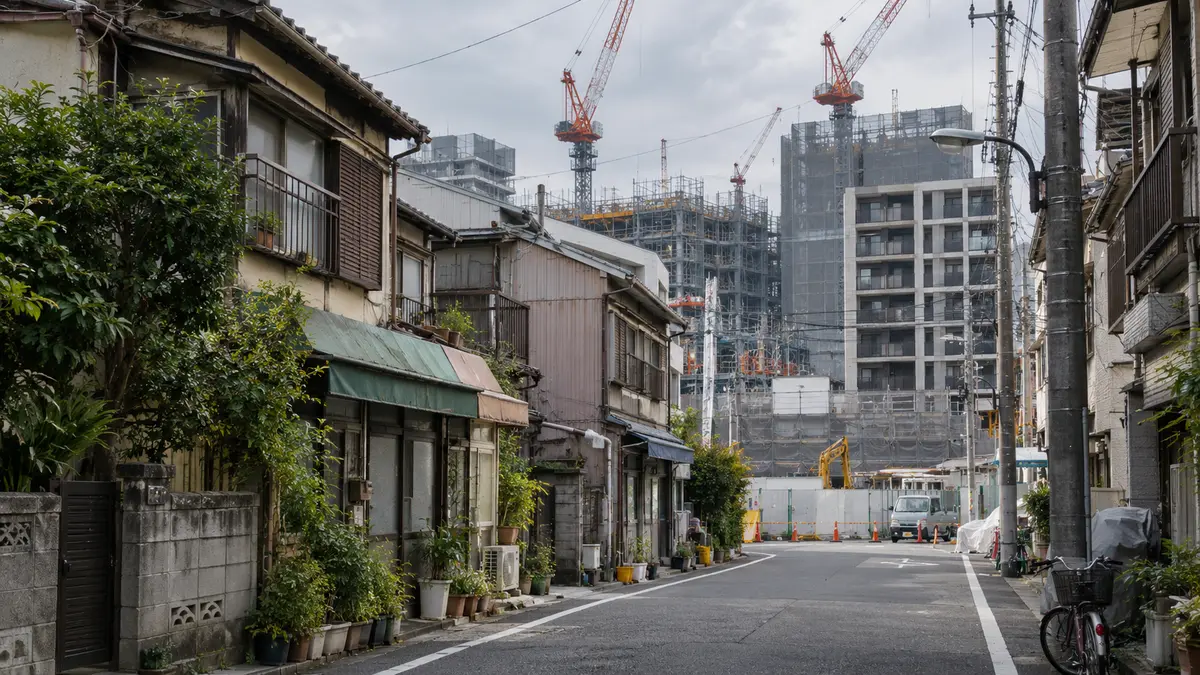
What has to increase for it to be future potential?
There is one more thing I want to check.
When someone says there is future potential, what is expected to increase?
Will people increase? Will incomes increase? Will buildings increase? Will transportation become more convenient?
These are separate matters.
Even if the population increases, if the increase is single students, the upper limit of rent does not move much. If buildings increase, that also works in the direction of lowering rents. When transportation becomes more convenient, the commuting area widens, and competition increases too.
Whether it affects your own property changes depending on what increases. The phrase "future potential" alone does not tell you which one is being talked about.

Still, it is not something you can predict
Having written this much, you may well be thinking this.
No one can know such things.
That is right. I do not know either.
So I think there is no need to predict it.
What you should look at is what happens if it turns out wrong.
If the redevelopment you expected is postponed. If the population does not grow as much as you thought. If rent stays flat at the current level.
If you can keep up your repayments in that case, future potential is not the center of the decision. It is an upside factor.
Conversely, if the plan only works if the future potential comes true, then you are not buying future potential; you are betting on it.
I am not saying betting is bad. But I think it is better to know for yourself which one you are doing.
3 checks are enough. When is that future? What is expected to increase? Can you hold out if it does not increase?
If the third is filled in, it does not matter if the first and second turn out wrong.
The other day, I went into a coffee shop on the outskirts of Shinagawa. It opened in the Showa era, the chairs sink, and the menu is still handwritten.

About 10 years ago, this area was said to be "about to transform." It actually did transform. Many new shops moved in, and then about half of them were replaced.
What remains are the ones nobody talked about in terms of future potential.
That said, it is probably not a story about old shops being strong either. The reason that shop remained is probably that it was able to keep paying the rent, and probably nothing more than that.