
Settlement day is also the day of adjustments
On the day you pay the balance, 7 things move almost at once. The adjustments for fixed asset tax, rent and security deposits are not a matter of splitting the bill. We organize the basis on which registration costs are calculated, and which costs do not appear on that day.

BENERU writes for readers who live in Japan. Taxes, loans and the other rules described here are those of Japan, and they assume a resident of Japan.
This page is a translation of the Japanese original. If the two differ, the Japanese original prevails.
Good day. I'm Nel Shikina.
The 4th signing: settlement (closing).
Many people think of this day as "the day you pay the price," but in reality 7 things move almost at the same time.
What happens at the same time
| What happens | Who moves it | |
|---|---|---|
| 1 | The loan is disbursed and paid into the account | Lender |
| 2 | The balance of the price is paid to the seller | Buyer |
| 3 | Registration to cancel the seller's mortgage is applied for | Judicial scrivener (shihō shoshi) |
| 4 | Registration of the transfer of ownership is applied for | Judicial scrivener |
| 5 | Registration to create a mortgage for the buyer's loan is applied for | Judicial scrivener |
| 6 | Adjustment money for fixed asset tax and the like, rent and security deposits change hands | Seller and buyer |
| 7 | Keys, lease agreements and equipment documents are handed over | Seller |
On items 3 to 5, one point. What moves on this day is the "application" for registration. Registration is completed at a later date, and it takes some days from acceptance of the application to completion. Also, the mortgagee of the mortgage created is normally the lender that provided the financing, not the buyer.
The order matters.
In a typical simultaneous settlement, nobody hands over first.
The seller does not want to hand over ownership before receiving the price. The buyer does not want to pay the price without certainty that ownership will pass. The lender will not release the loan unless the collateral can be put in place.
To break this three-way standoff, the judicial scrivener comes in.
The judicial scrivener confirms that all the necessary documents are in place and registration can be applied for, and the money moves on that signal. The application for registration itself comes afterwards, but at the point of confirmation, the 3 parties are in a position to move at the same time.
So what happens at the settlement table is less a payment than a confirmation that everything is completed at once. If a single document is missing, everything stops.
This is why it is better to submit the documents you are asked for well before this day.
Splitting "adjustment"
Let me split the term adjustment (seisan).
It tends to be taken as splitting things half and half. In reality, the 3 items each have a different nature.
Fixed asset tax and city planning tax
This tax is levied on the owner as of January 1.
Even if the property is sold partway through the year, the taxpayer for that year remains the seller. The buyer becomes liable for the tax from the following year.
Then what is the money adjusted on settlement day?
An agreement between the parties. It is not an obligation under tax law; it is money that moves because the sale contract says "adjust on a daily pro-rata basis."
Here, there are 2 factors that change the amount.
1. The starting date. Some areas use January 1 as the starting date, and some use April 1. It is only a difference in custom; neither one is more correct than the other. But if the starting date differs, the period each side bears changes, so the amount changes.
2. Whether to adjust at all, and where it is written. Because it is an agreement, there can be transactions without it. Also, the agreement may be written not only in a clause of the sale contract but also in a separate statement of adjustments or the like.
There are 3 things to check: whether there is an agreement to adjust, what the starting date is, and which side bears the settlement day itself.
Rent
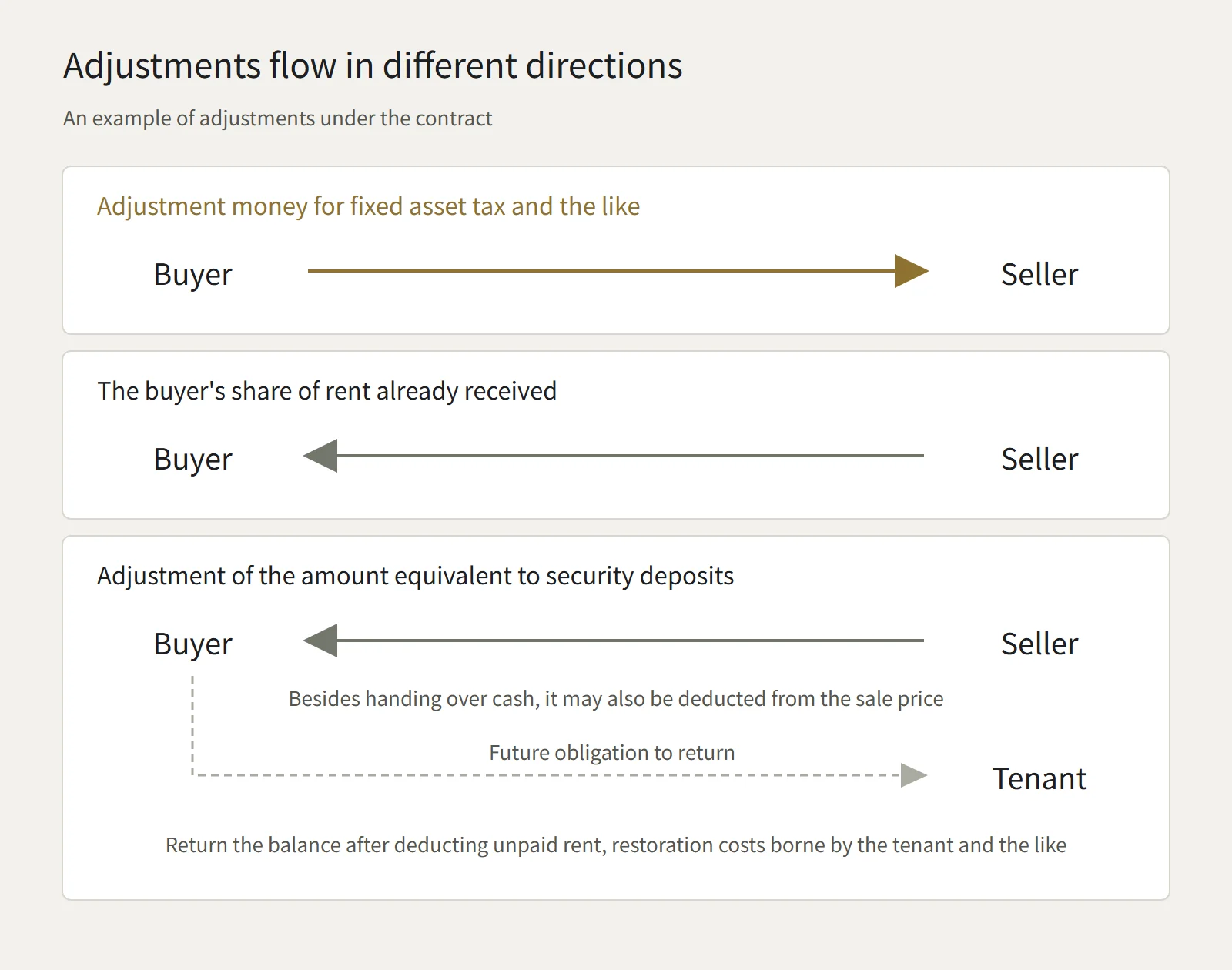
When you buy a property that is currently let, the rent for the month of settlement has in many cases already been received by the seller. This is because rent paid in advance is the usual form.
So on settlement day, the seller hands the buyer the portion for the days from the settlement date onward.
Here the direction is reversed. For fixed asset tax, money moves from buyer to seller; for rent, from seller to buyer.
If there is unpaid rent, it is handled differently.
This is easy to misunderstand. The right to claim unpaid rent that has already accrued remains, in principle, with the original landlord, that is, the seller. It does not pass to you simply because you bought the property. For the buyer to collect it, an agreement to take over that claim and a procedure to assert it against the tenant are needed. The relationship with applying it against the security deposit also comes into play.
So the starting point is not "it's undecided because the contract doesn't say," but "if it's not written, it stays with the seller in principle." For a property where arrears appear on the rent roll, decide in advance who will collect them.
Security deposits
This is the one whose nature is most different.
A security deposit (shikikin) is not the seller's income. It is money held in deposit.
It comes with an obligation to return it on move-out, after deducting costs the tenant must bear and the like. When you buy the property, you take over this obligation to return along with it.
So on settlement day, the amount held is handed from the seller to the buyer. It may also take the form of being deducted from the sale price.
One caution. What you receive is cash, but it is not a profit you have received. It is money you hold in order to return it in the future.
Of the amount paid into your account on settlement day, the portion corresponding to security deposits is not money you can use. If a 10-unit apartment building holds 2 months' rent per unit as deposits, and the rent is ¥80,000, that is ¥1.6 million. This is mixed into the incoming payment.
Registration costs are not calculated on the sale price
Registration of the transfer of ownership and registration of the creation of a mortgage are subject to registration and license tax.
The tax rates are as follows (as of November 2026).
| Registration | Tax rate |
|---|---|
| Transfer of ownership (land) | 15/1,000 * |
| Transfer of ownership (building) | 20/1,000 |
| Creation of a mortgage | 4/1,000 of the claim amount |
*The reduced rate for land applies to registrations made by March 31, 2029. The standard rate is 20/1,000.
There are 2 points to grasp here.
1. The tax base for the transfer of ownership is not the sale price. It is the value registered in the fixed asset tax ledger. This is a value set by the municipality, and it is generally lower than the sale price. For a property with no value in the ledger (such as one just newly built), it is the value determined by the registrar.
The creation of a mortgage uses a different base. Here the tax base is the claim amount, or the maximum amount for a revolving mortgage (ne-teitōken). It is not the ledger value.
2. The reduced rate for residential buildings cannot be used. There is a reduced rate of 3/1,000 for the transfer of ownership of a building, but its condition is that an individual lives there themselves after acquiring it. It does not apply to a property you let out.
Here is a fictional example. Suppose you buy an income property with a purchase price of ¥50 million with a ¥40 million loan. Suppose the values in the fixed asset tax ledger are ¥20 million for the land and ¥12 million for the building.
| Item | Calculation | Tax |
|---|---|---|
| Transfer of ownership (land) | ¥20 million × 1.5% | ¥300,000 |
| Transfer of ownership (building) | ¥12 million × 2.0% | ¥240,000 |
| Creation of a mortgage | ¥40 million × 0.4% | ¥160,000 |
| Total | ¥700,000 |
The judicial scrivener's fee is added to this. The fee can be set freely and varies with whom you engage.
When you receive an estimate of acquisition costs, check that the registration and license tax line is calculated in this way. If it shows a figure of the sale price multiplied by the tax rate, you need to ask for the basis.
There is a cost that does not appear on this day
Once settlement is over, it looks as though the payments have all gone round once.
But there is something that has not arrived yet.
Real estate acquisition tax.
It is not billed on settlement day. The registration information goes to the prefecture, and a tax notice arrives from there. The timing differs by prefecture. Some prefectures state roughly 4 to 6 months after registration for an acquisition by succession (shōkei shutoku), but that is not a set period. For a new building, it may be the following year. Please check with the prefectural tax office for the location.
The tax rate is 3% for land and housing, and 4% for buildings other than housing (until March 31, 2027). The tax base, as with registration and license tax, is the value registered in the fixed asset tax ledger. For residential land, there is a special measure setting the tax base at 1/2 of the value (until March 31, 2027, with no requirement on use). This special measure can be used for investment properties as well.
On the other hand, when you buy a used property for investment, you cannot receive the deduction that subtracts a fixed amount from the value of the housing. This deduction has the condition that the person who acquired it lives there themselves.
Please keep this distinction. What cannot be used is the deduction conditioned on owner occupancy; it is not that nothing can be used, including the special measure for land.
This is a spot with many misunderstandings. If you have heard "it's housing, so it gets a reduction," the amount on the notice will surprise you.
Please allow for it as an expense about half a year after settlement.
Once, from the opposite side
If you can choose the settlement date yourself, is the end of the month better?
It is a common question, but the amounts that move are small.
With the same starting date, and assuming the buyer bears the days from the settlement date onward, settling at the end of the month reduces the number of days the buyer bears. The days of rent you receive also decrease. Settling at the start of the month is the reverse: both what you bear and what you receive increase. The start of interest also shifts by a few days.
Both are small figures relative to the purchase price. Their effects on income and expenses run in opposite directions, but they are not necessarily the same amount.
What matters more is whether the final loan review will make it in time.
If you pull the settlement date too far forward, the date arrives before approval comes. Then you have to ask the seller for a postponement, and your position weakens. As I wrote in an earlier article, sellers are often moving with a settlement date in mind.
One more thing: at the end of the month, judicial scriveners and lenders are busy. If there is a problem with the documents, there is less room to adjust.
So the order of priority is this.
1. Set a date with room to spare after approval comes.
2. Avoid the end of the month if you can.
3. Think about daily pro-rata gains and losses last.
Going after tens of thousands of yen in daily pro-rata amounts and losing negotiating power through a postponement is not a balanced exchange.
Think back to a moving day.
You carry out your belongings, return the key, and receive the key to the new place. In that one day, where you live changes.
But your change of address is not finished on that day. The city office, the bank, insurance, deliveries. There are still places to notify. The day you receive the key is the day your life there begins, not the day the procedures end.
Settlement is much the same.
Ownership has passed. Registration has been applied for. But the work of acting as the owner begins the next day.
Next time, we look at that.