
Is it a good idea to buy an old studio in a regional city for a few million yen to live in after retirement?
Old studios in regional areas can be bought for a few million yen, but the management fee, repair reserve fund, and fixed asset tax continue as long as you own one, and real estate cannot be thrown away. Using an example with a purchase price of ¥2 million, this piece sets out the figures for renting it out and for living in it, and lists the documents to check before buying.
BENERU writes for readers who live in Japan. Taxes, loans and the other rules described here are those of Japan, and they assume a resident of Japan.
This page is a translation of the Japanese original. If the two differ, the Japanese original prevails.
I answered a question like this on a Q&A site.
I've heard that once you get old, landlords stop renting to you because of risks like dying alone. After turning 60, would it be a good idea to buy an old studio condominium unit in a regional city for ¥1 million to ¥3 million? Are there any pitfalls?
This may be a rather excellent question, so I thought I would write down the things that tend to become pitfalls.
It is good for exactly those people who plan to buy a studio or 1LDK in a regional area in old age because it is cheap, and make it their final home, to know this.
"Real estate cannot be thrown away."
This is a blind spot for many people.
I think, from the preconception that of course nobody would ever throw it away, they don't even have the idea.
Money that goes out just from owning it
Just owning real estate incurs a tax called fixed asset tax. The tax itself is not a big amount, but when you think of it as a retirement expense, it slowly wears on you.
A condominium has fixed monthly expenses called the management fee and the repair reserve fund. The repair reserve fund in particular tends to get more expensive the older the building gets.
Even for a studio condominium unit, it would not be strange for it to cost ¥10,000 or more. Combined with the management fee, this too becomes an expense that slowly hurts over the year.
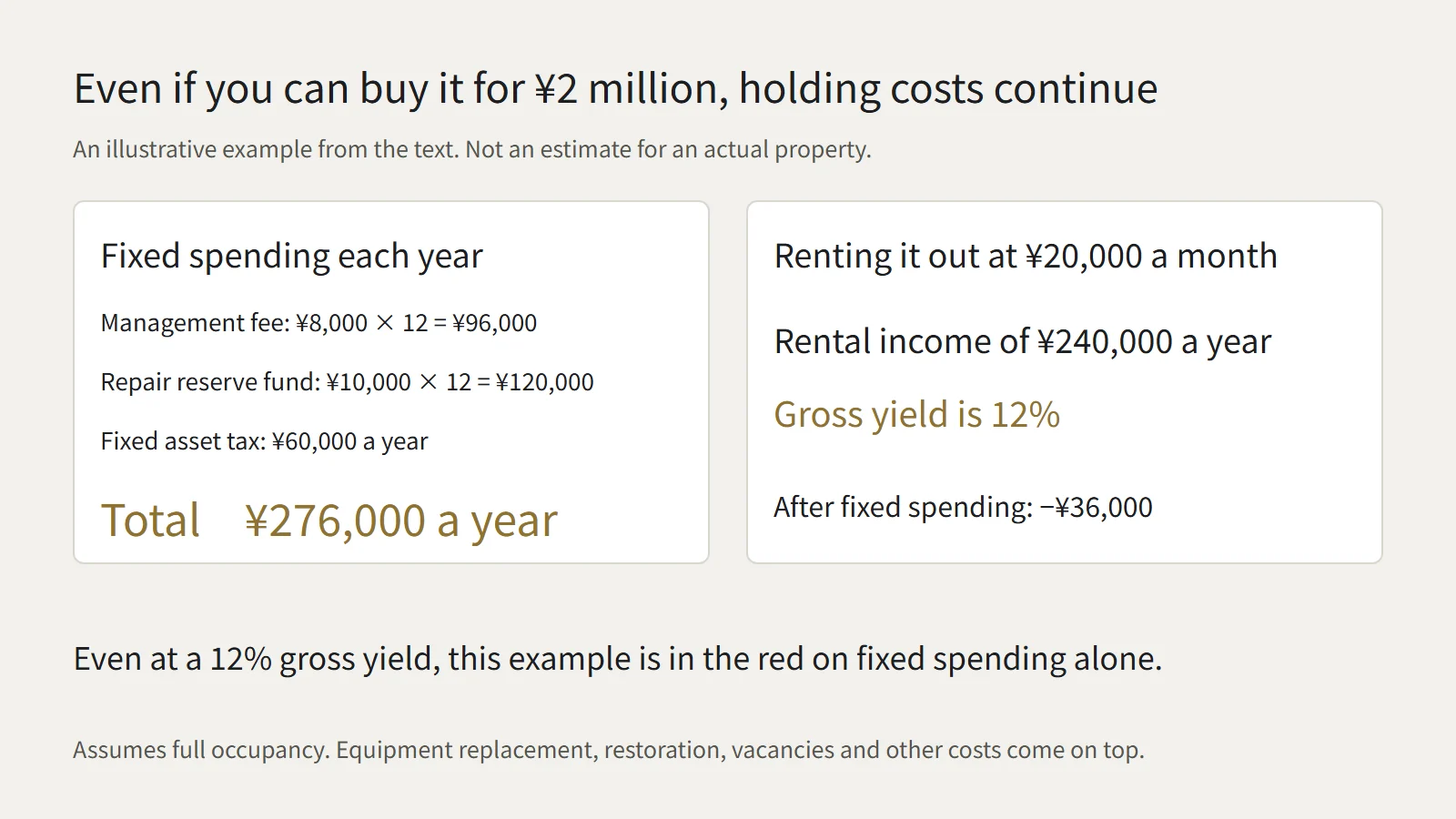
With a management fee of ¥8,000 a month, a repair reserve fund of ¥10,000, and fixed asset tax of ¥60,000 a year, the total comes to ¥276,000 in expenses a year.
And this cannot be thrown away. Even if you come to hate living there, no matter what happens, the tax burden and expenses continue.
A system for having the state take over inherited land (the system for vesting inherited land in the national treasury) began in 2023, but land with a building on it is not covered. A condominium unit cannot be let go under this system.
"Just sell it" does not work
Then the answer would be to sell it.
But who would buy it?
A condominium you yourself bought at a throwaway price. Would there be a buyer if it is likewise nearly free?
There might be, or there might not.
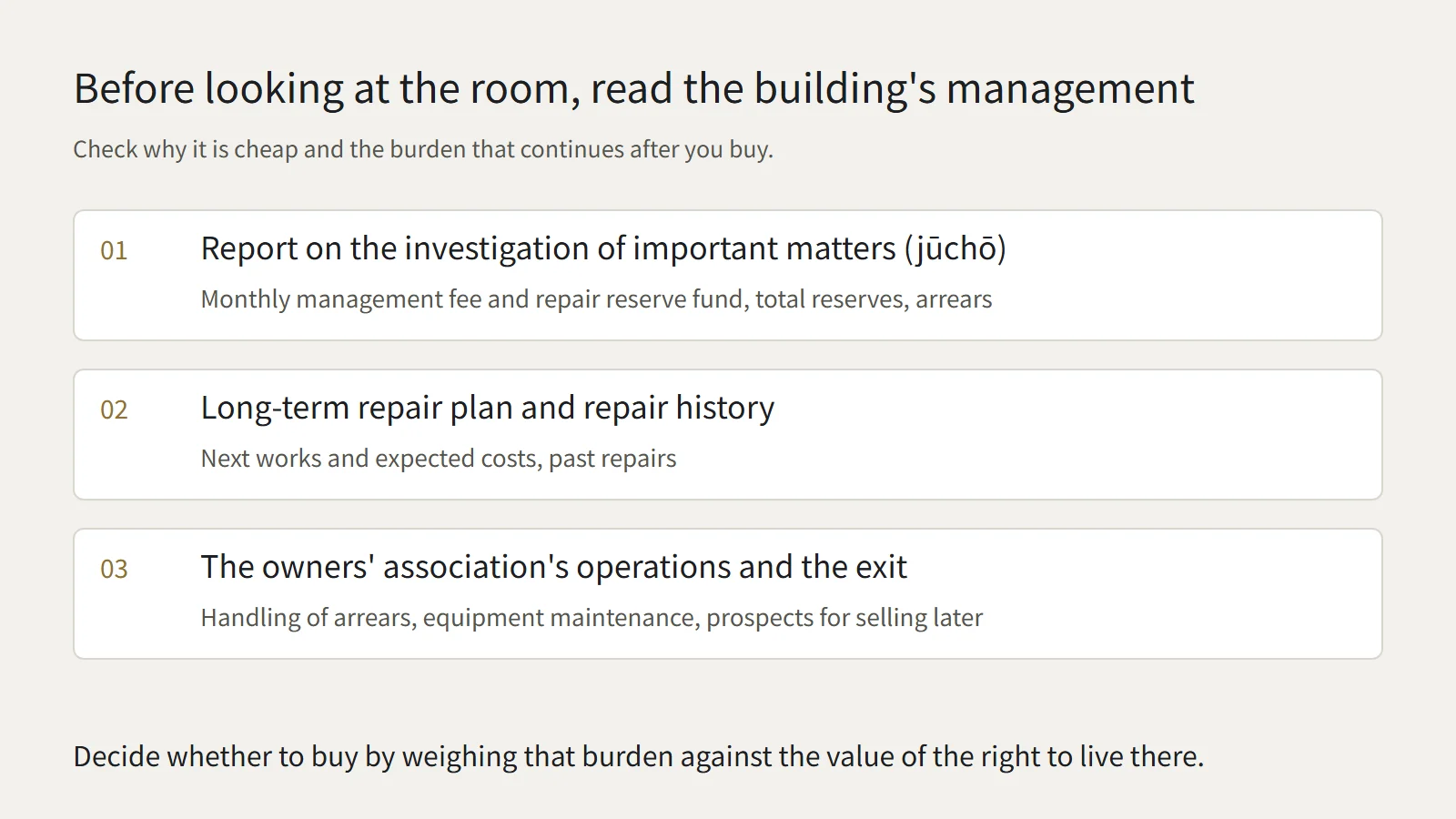
When buying a condominium unit, you need to check a document from the management company called the report on the investigation of important matters. There is a similar document called the statement of important matters, but this is different. This document, commonly called "jūchō," lists the repair reserve fund currently accumulated, the recent repair history, whether there are owners in arrears, and so on.
In older condominiums, owners in arrears on the management fee and repair reserve fund increase, and some condominiums appear where management has deteriorated.
When the rental business stops adding up, for example through falling income due to aging in the case of owners who live there, or through falling rents in the case of owners who hold it as an income property, unpaid management fees and repair reserve funds start to occur.
A board with sound management will run things while sending demands to those in arrears and, in some cases, even filing small claims suits, but once the board itself loses its strength, things are left unchecked.
Among old condominiums, not a few end up in this state.
Now, would anyone buy a condominium whose management is not functioning properly? Nobody buys a condominium with failed management that you can tell at a glance just by looking at the jūchō.
No. Well, maybe there are, since people keep buying them because they are cheap.
The end of a condominium is a game of Old Maid.
However high the yield looks, no one with knowledge buys it.
When people hear of an old condominium for ¥2 to ¥3 million, some may jump at it, thinking how cheap it is that you can buy a home for about the cost of a car, but you should think that it is being sold because it is only worth that amount, and in reality it is not even worth that.
What happens if you rent it out
Let's think of it as an income property and consider the yield. I think knowing this kind of thing is truly meaningful.
Say it is a studio condominium unit with rent of ¥20,000, on sale for ¥2 million.
Rental income of ¥240,000 a year gives a gross yield of 12%. ¥20,000 × 12 months ÷ ¥2 million = 12%
Not bad. In fact, outstandingly good.
It is a high-yield investment property.
However, as mentioned, there are expenses.
Against income of ¥240,000 a year, expenses are ¥276,000.
This is a loss. The net yield is negative. Nobody would buy a property like this.
What happens if you live in it
Then should you live in it?
The rent needed to live in this room for 10 years is ¥2.4 million.
In contrast, if you buy, you pay ¥2 million at purchase and after that just pay ¥276,000 every year.
Hm? That is ¥2.76 million over 10 years, costing ¥4.76 million in total. And that is without even considering acquisition costs at purchase or the brokerage commission.
Then what about living there for 20 years? Renting, it comes to ¥4.8 million. The rent may change, but even if you live there the whole time, this is the price. With renewal fees and other charges it might be a bit higher.
And buying? It comes to ¥7.52 million.
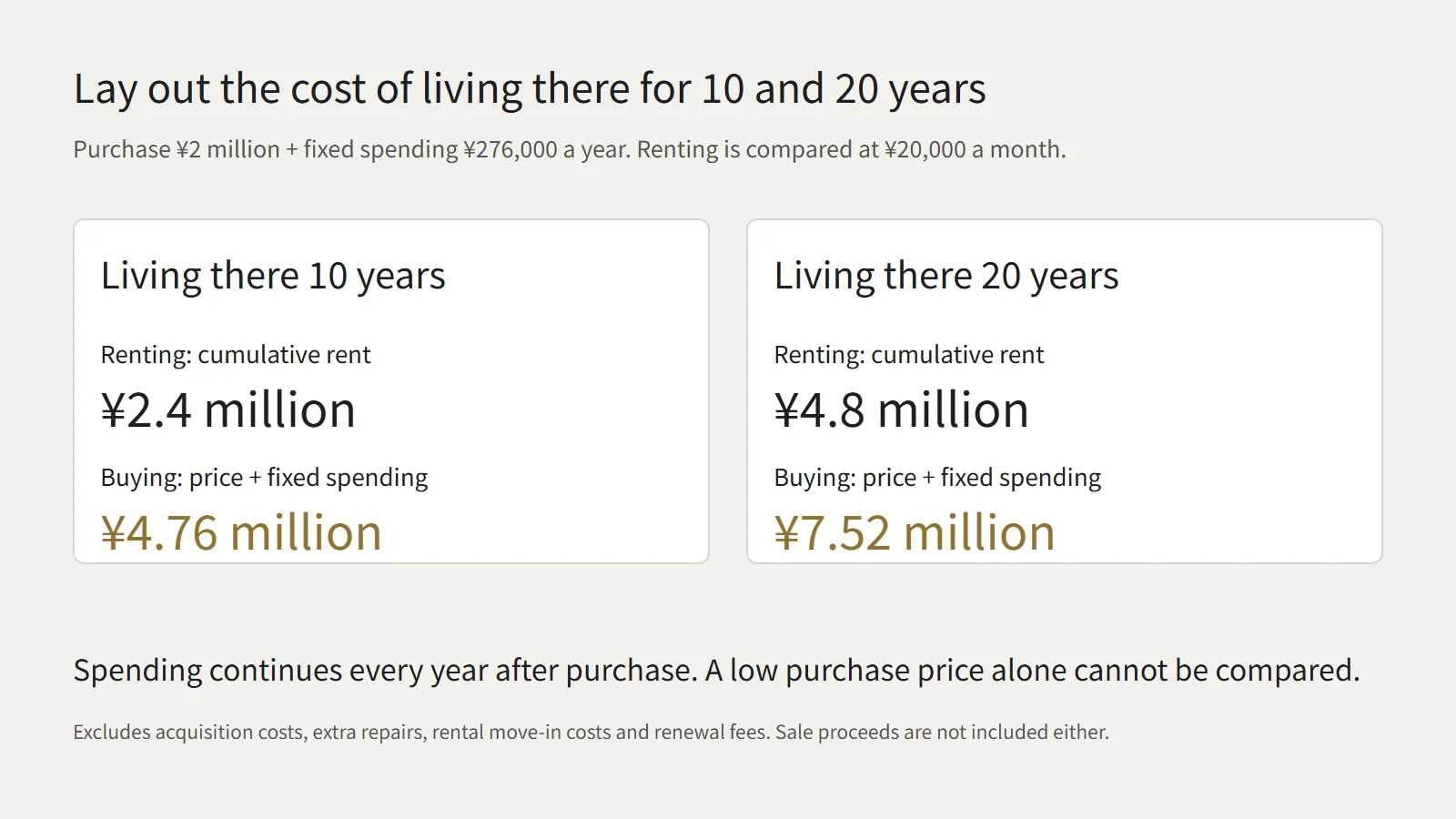
Hmm? Even though you bought it, it never becomes more advantageous than renting.
Of course. The management fee is higher than the rent, so naturally it turns out this way.
On top of that, being the owner means you also bear the repair costs.
Expenses will go out even further.
Is a property with rent of ¥20,000 unusual?
Oh? Then how much would be fine?
Could you manage with a room that gets about ¥40,000?
No, it's impossible. ¥480,000 - ¥276,000 = about ¥200,000, so it certainly looks like a profit.
However, cleaning costs at move-in and move-out, equipment costs, and advertising costs for tenant placement will leave almost nothing.
That is why nobody buys.
The end of an aging condominium in a regional area is a game of Old Maid. Once maintenance of the water tank and upkeep of the elevator can no longer be done, real danger finally appears. If you still say you can live there, it may be worth considering.
There are cases like the Kowloon Walled City, after all.
You must buy with a good understanding that there is little merit in deliberately buying a property that cannot even gather the cost of demolition.
Not "don't do it"
So. Am I saying don't do it?
No.
I think buying is fine if you do so with that in mind.
It is a fact that it becomes harder to sign a lease once you have no job, and it is the buyer who finds value in the right of ownership.
But there are pitfalls, and you should learn about them in advance. Surely the seller won't tell you.