
You think you are buying a room. You are buying voting rights.
We sort out what you can decide for yourself as the owner of a condominium unit, and what you leave to the owners' association. We show the numbers for a year with a tenant move-out, and the documents to check before you buy.
BENERU writes for readers who live in Japan. Taxes, loans and the other rules described here are those of Japan, and they assume a resident of Japan.
This page is a translation of the Japanese original. If the two differ, the Japanese original prevails.
Good day. I'm Nel Shikina.
Last time, I said that the word "safe" has four different meanings, and that each one comes with a price.
From this episode on, we get specific.
When you buy a condominium unit, what are you actually buying?
"One room in a condominium" is not an answer. Let us look at what is written in the property register, exactly as it appears.
The register lists 4 things
When you buy 1 condominium unit, this is what you get.
1. Ownership of the exclusive area
This is your unit. But its boundary sits further inside than you might think.
It extends only to the interior finishes of the ceiling, floor and walls. The concrete structure itself is a common area. With the front door, the lock and the paint on the inside are part of the exclusive area, but the door itself is common. The balcony is also a common area; the unit owner only has the right to use it.
Your freedom to renovate covers only this interior.
2. Site use rights (a share)
This is the land. But it is not your own plot of land. It is a share.
The following is a fictional example for illustration.
In a condominium whose exclusive areas total 2,000㎡, if your unit is 25㎡, your share is 1.25%. If the site is 500㎡, that is equivalent to 6.25㎡. If the land is worth ¥1 million per ㎡, that is ¥6.25 million.
Of a unit bought for ¥30 million, the land is ¥6.25 million. The remaining ¥23.75 million is the building.
The building loses value over time. The land does not. The longer you hold, the more this ratio matters.
3. A co-ownership share of the common areas
Corridors, stairs, elevators, exterior walls, the roof, the main water supply and drainage pipes. You own 1.25% of each of these.
4. Voting rights in the owners' association
And this is the main subject of this episode.
You "own" it, but you cannot decide
The word "own" usually carries the meaning "I can decide for myself."
With sectional ownership, that meaning drops away.
Even for things that affect your own unit, there are matters you cannot decide alone.
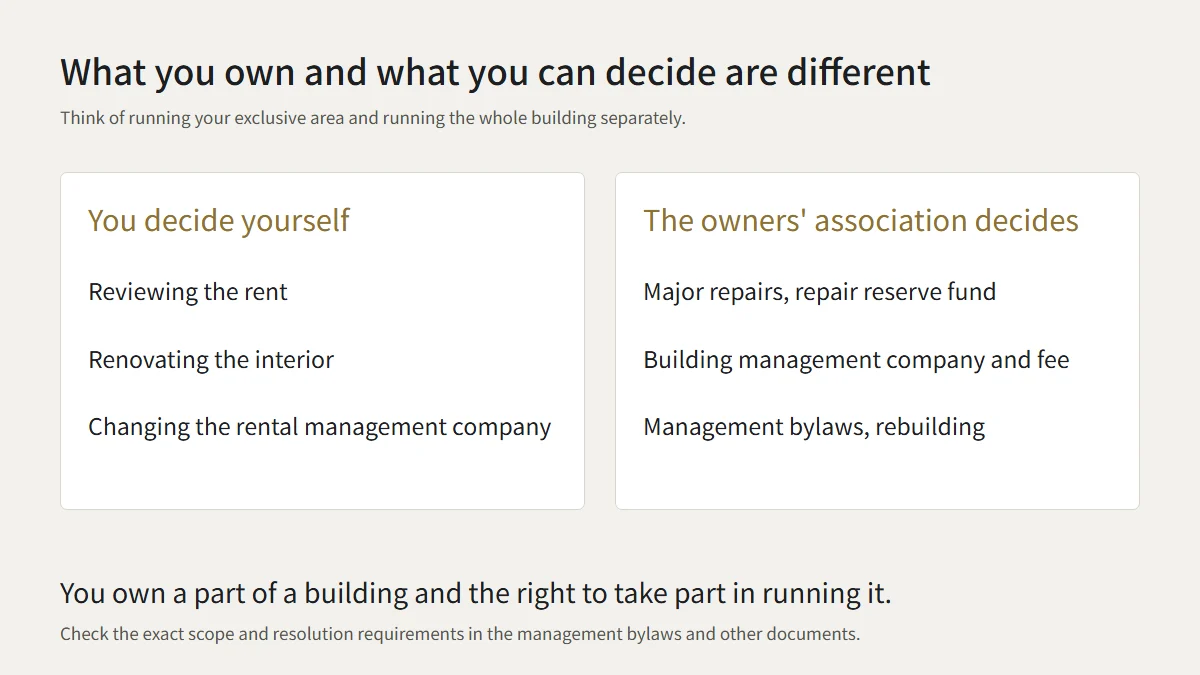
- When to carry out major repairs, and for how much
- Whether to raise the repair reserve fund
- Whether to change the property management company, or review the management fee
- Whether to amend the management bylaws
- Whether to rebuild the building
All of these are resolved at the general meeting. And your voting rights are 1.25%.
Last time, I talked about how "if you put work in, the return goes up." Changing the property management company to cut costs, for instance.
With a condominium unit, your hand does not reach that far. It reaches only the inside of the exclusive area. Reviewing the rent, renovating the interior, changing the rental management company. Up to this point, you can decide for yourself. The operating costs of the building itself are out of your hands.
Rebuilding, in principle, requires the approval of at least 4/5 of the unit owners and at least 4/5 of the voting rights (Article 62 of the Act on Building Unit Ownership, etc.). That is 80%. An amendment that took effect in April 2026 eased this to at least 3/4 of each for buildings with certain grounds, such as insufficient earthquake resistance, but even so, that is 75%. The older the building, the more the owners differ in both their means and their views.
So what you are buying with a condominium unit is not so much the room itself as a part of a building, and the right to take a small part in running it.
That one line is the reason behind everything that follows.
There is a cost that is already set to rise
Let us go back to Property A from last time.
Central Tokyo, 5 minutes' walk from the station, 8 years old. Purchase price ¥30 million, acquisition costs ¥2 million, total investment ¥32 million. Rent assuming full occupancy is ¥100,000 a month, ¥1.2 million a year. We set operating expenses at ¥200,000 a year.
That ¥200,000 is made up of the management fee, the repair reserve fund, the rental management fee, and fixed asset tax and city planning tax.
Of these, there is one that you already know will go up at the time you buy.
The repair reserve fund.
Many condominiums set it low when the building is new and raise it every few years. This is called the stepped-increase method. The monthly amount at the time you buy assumes it will rise from there.
Suppose ¥5,000 a month becomes ¥12,000 a month in the 12th year.
That is an increase of ¥84,000 a year. Expenses go from ¥200,000 to ¥284,000.
If the rent stays the same, that amount disappears straight out of your income.
This adds one task.
Before you buy, look at the long-term repair plan and the total amount in the repair reserve fund.
Look at 3 things.
- When the next major repairs are, and what total cost is expected
- Whether the current reserve total is enough for that expected cost
- How much is in arrears
If it is not enough, the result will be a future increase or a one-off levy. Either way, the person who bought pays.
These figures appear in the "survey report on important matters" issued by the property management company. Also read the general meeting minutes for the last 2 to 3 terms. You may find a record that a proposal to raise the fund was put forward and voted down. The fact that it was voted down means it was postponed.
For vacancy, there is no such thing as an occupancy rate
There is one more property specific to condominium units.
There is only 1 unit.
Last time, I assumed 95% occupancy. Averaged over the year, that is how it works out. In reality, though, in any given month the unit is either occupied or it is not. A state of "95%" does not exist in any month.
Let us calculate the year in which a tenant moves out, as it is.
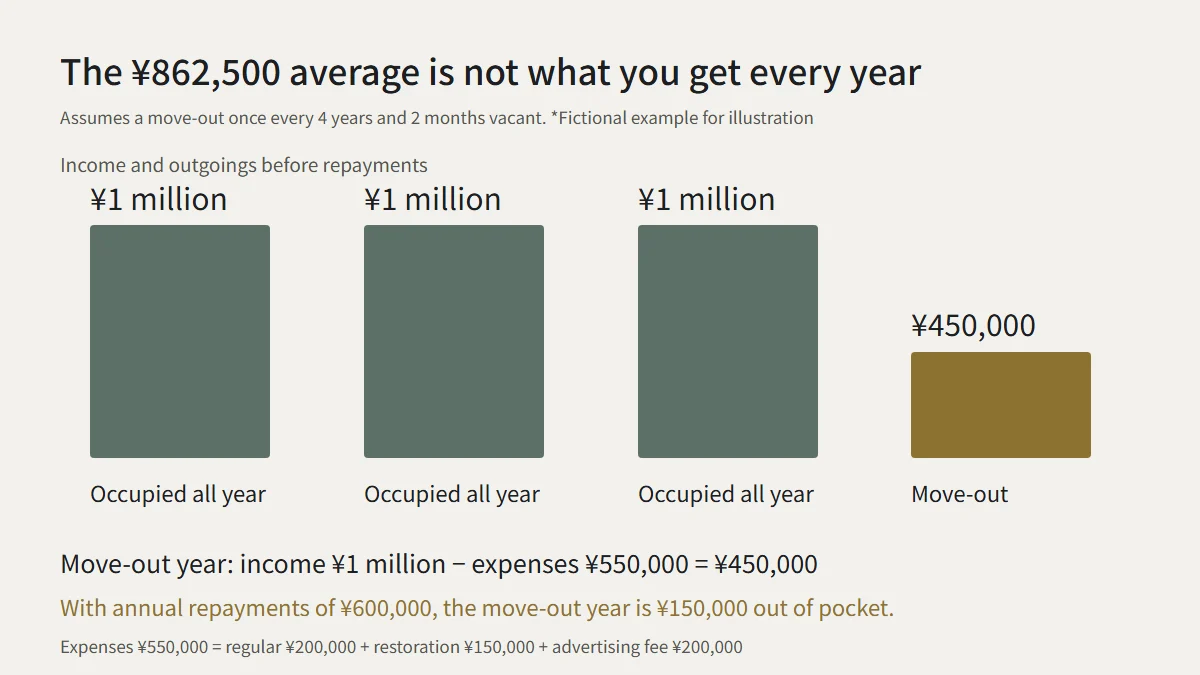
Assume a tenant moves out once every 4 years, and it takes 2 months to find the next tenant.
A year with continuous occupancy
- Income ¥1.2 million − expenses ¥200,000 = ¥1 million
A year with a move-out
- Income ¥1.2 million × 10 months / 12 months = ¥1 million
- Expenses ¥200,000 + restoration ¥150,000 + advertising fee (2 months' rent) ¥200,000 = ¥550,000
- ¥1 million − ¥550,000 = ¥450,000
Averaged over 4 years, that is ¥862,500 a year.
Last time, I put it at ¥940,000. That was 2.94% of the total investment, but once you include the cost of a move-out it becomes 2.70%.
So my earlier number was too optimistic. I had not put restoration and advertising fees into the annual figures. The very thing I described as "easy to forget to subtract" in Episode 8 of Series 1, I forgot to subtract myself.
But what I want you to look at here is not the difference of 0.24 percentage points.
It is that only in the year with a move-out, your cash left over drops from ¥1 million to ¥450,000. Less than half.
Even if the average is ¥860,000, what actually happens is three years at ¥1 million and one year at ¥450,000. Whether you can withstand that "¥450,000 year" is the line that decides whether you can hold a condominium unit.
The out-of-pocket limit we worked out in Episode 3 of Series 1 comes into play here.
Note that loan repayments are not included here. If you have borrowing, the repayment is subtracted from the ¥450,000. If annual repayment is ¥600,000, that year you are ¥150,000 out of pocket.
Seen from the other side, the same things are advantages
Having read this far, condominium units may look unfavorable.
So let us look at it from the other side as well.
The properties I just listed look like this when turned over.
You cannot decide → you do not have to decide
Cleaning of common areas, fire safety inspections, elevator maintenance: the owners' association handles all of it. You do not need to find contractors, get quotes, or be there in person. Being hands-off is a clear advantage of condominium units.
The amount is small → the entry point is low
At ¥30 million, you have a wide range of options for combining own funds and financing. Compared with a whole building, it is a realistic price range for a first property.
Sold unit by unit → you can sell in parts
If you own 3 units, you can sell just 1. When you need cash, you can carve out only part of your assets. A whole building cannot be split. If you sell, you sell all of it.
A wide range of buyers → easier to sell
Buyers of condominium units are not only investors. People who will live there buy them too. Because the pool of buyers is deep, you are more likely to be able to sell when you want to. Of the four kinds of safety from last time, this is the third.
Condominium units are priced high (yields are low) because a price is attached to this third kind, and to the first (the price is less likely to fall).
To put it as I did last time: it is not a loss because it is cheap, and it is not fine because it is expensive. What you are buying is different.
Documents to read before you buy
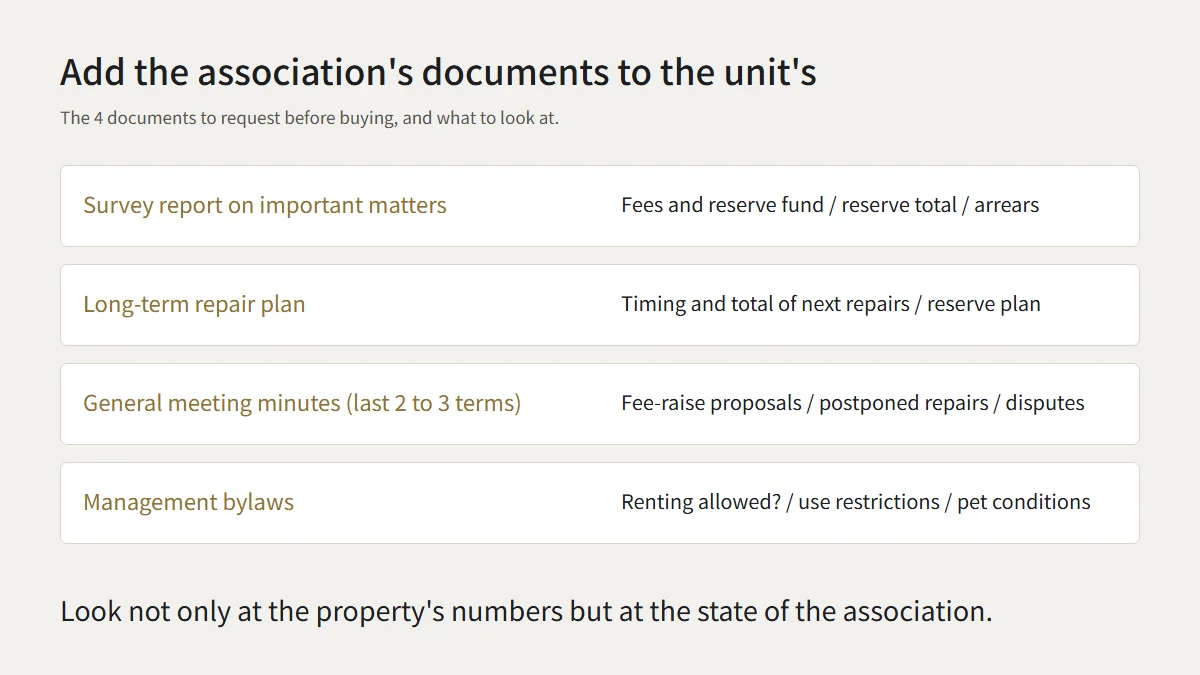
Here is this episode's task list. In addition to the property brochure, request 4 documents.
| Document | What to look at |
|---|---|
| Survey report on important matters | Monthly management fee and repair reserve fund, reserve total, amount in arrears |
| Long-term repair plan | Timing and expected total cost of the next major repairs, reserve plan |
| General meeting minutes (last 2 to 3 terms) | Proposals to raise fees, postponed repairs, any disputes |
| Management bylaws | Whether renting out is allowed, use restrictions, conditions such as pets |
Of these, the amount in arrears is easy to overlook.
A condominium with a lot of arrears does not have enough funds for repairs. And unit owners who are in arrears do not vote for increases. Resolutions fail, repairs are delayed, the building deteriorates, and its value falls.
This is not about the property's numbers but about the state of the association. Buying a condominium unit means joining this association with a 1.25% stake.
Next time, we look at a whole apartment building.
Everything that was "out of your hands" with a condominium unit comes back to your own judgment.
You gain freedom, but judgment is not the only thing that comes back to you.