
That explanation is not a lie
Using a fictional example of a newly built condominium unit, we sort out what is inside the explanation of about ¥10,000 a month, and what is outside it, such as fixed asset tax, vacancies, and repairs.

BENERU writes for readers who live in Japan. Taxes, loans and the other rules described here are those of Japan, and they assume a resident of Japan.
This page is a translation of the Japanese original. If the two differ, the Japanese original prevails.
Good day.
You may have heard an explanation like this.
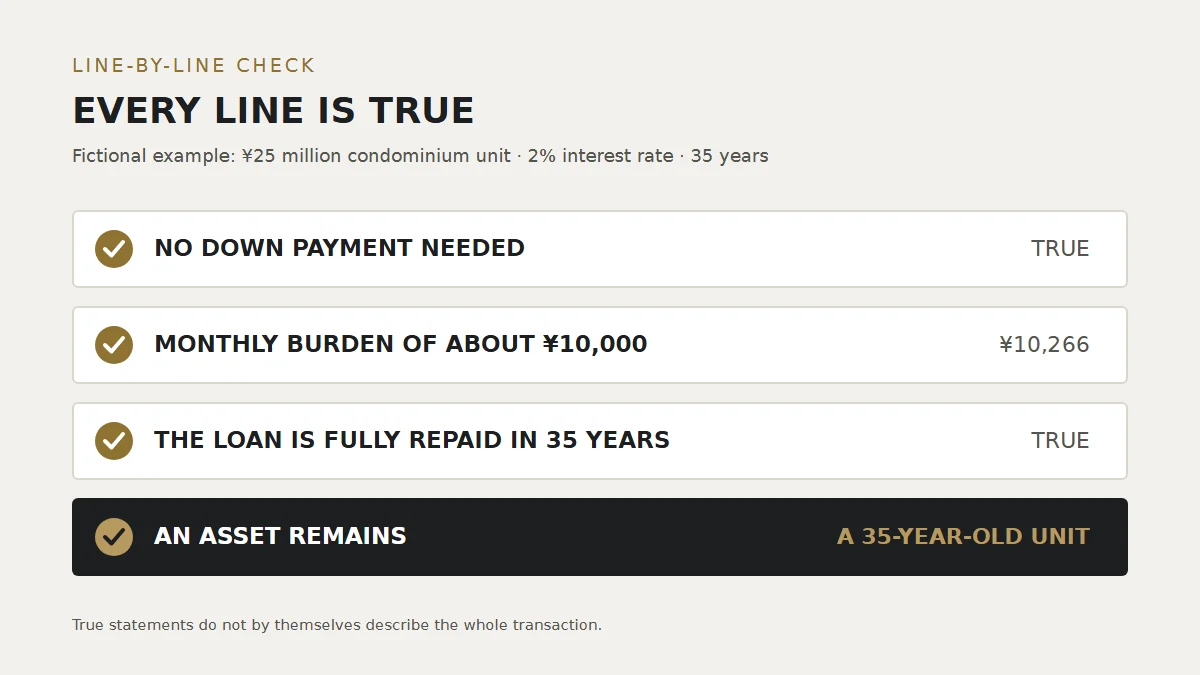
No down payment is needed. Rental income covers most of the repayment, so your monthly burden is about ¥10,000. If that continues for 35 years, the loan is fully repaid and an asset remains.
There is no lie in these sentences.
Let us go through them one line at a time.
The following is a fictional example for illustration.
A newly built condominium unit, ¥25 million. You borrow the full amount at a 2% interest rate over 35 years.
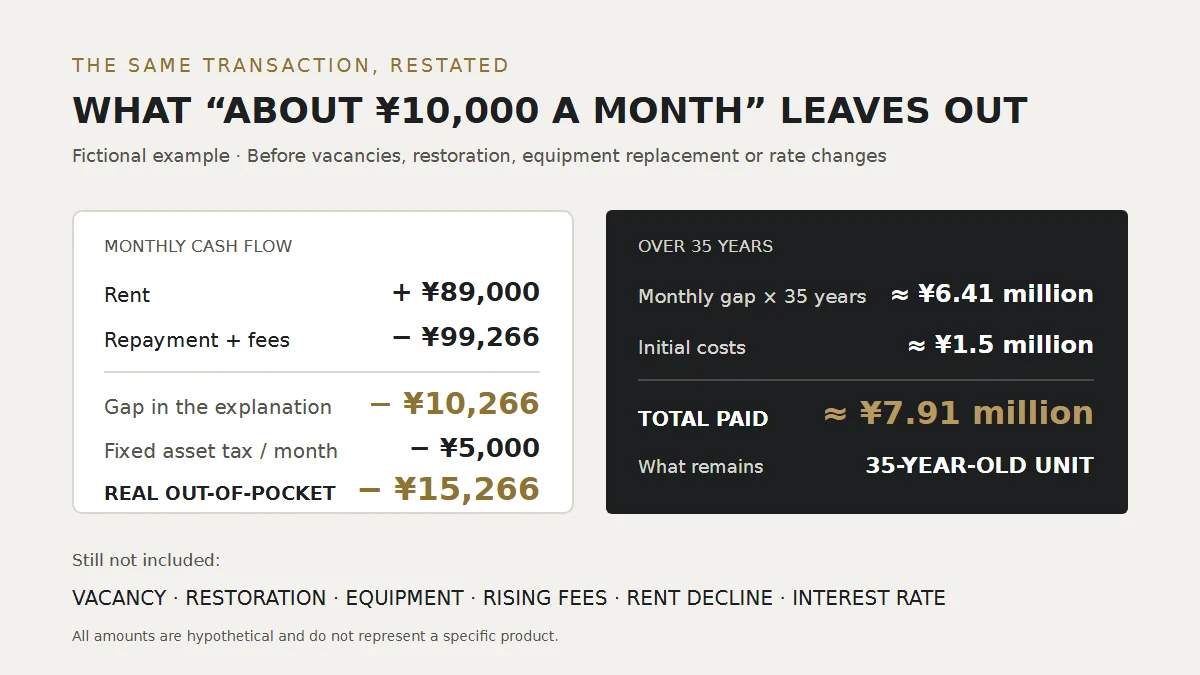
The monthly repayment is ¥82,816.
Rent is ¥89,000. From this, subtract ¥12,000 for the management fee and repair reserve fund, and ¥4,450 for the rental management fee.
What goes out totals ¥99,266. What comes in is ¥89,000.
The difference is ¥10,266.
"Your monthly burden is about ¥10,000." Correct.
"No down payment is needed." This is also true.
"If that continues for 35 years, the loan is fully repaid." As the contract says.
"An asset remains." It does. A condominium unit that is 35 years old.
It is all true.
Count not what is written, but what is not
Let me list, as they come to mind, the things not included in this calculation.
Fixed asset tax. If it is ¥60,000 a year, that is ¥5,000 a month. This alone brings the out-of-pocket amount to ¥15,266.
Vacancies. This calculation assumes the unit is never vacant once in 35 years. It is a single condominium unit, so when it is vacant, income is zero. The out-of-pocket amount that month is about ¥100,000.
Restoration and equipment replacement. Neither a water heater nor an air conditioner has probably ever lasted 35 years.
The management fee and repair reserve fund. In many condominiums, they are designed to rise in stages along the long-term repair plan. It is hard to imagine the current ¥12,000 being the same 35 years from now.
Rent. While the building is new, tenants are easy to find, and the rent may fall at the first change of tenant. How much it falls differs by property and area, but it is hard to build a plan on the assumption that it will rise.
Interest rate. If you borrowed at a variable rate, there is no promise that it stays at 2% for all 35 years.
None of this means the explanation is lying. It is just not written in those sentences.
Over 35 years, how much do you pay and what remains?
Back to the numbers.
The out-of-pocket amount including fixed asset tax is ¥15,266 a month. Over 35 years, about ¥6.41 million.
Even with no down payment, there are registration costs and loan administration fees. Assuming ¥1.5 million,
the total is about ¥7.91 million.
This is a number that does not include the vacancies, restoration, or equipment replacement I listed earlier.
And what remains after 35 years is a single condominium unit that is 35 years old.
In other words, this transaction can be restated like this.
Paying ¥7.91 million little by little each month over 35 years to obtain a single condominium unit that is 35 years old.
Whether it is a good transaction is not for me to decide.
But thinking about it after restating it in this form and thinking about it as "an asset remains for ¥10,000 a month" should lead to different decisions.
That said, is this explanation bad?
One last thing.
Is the side giving the explanation obliged to tell everything? Things set as important matters are another matter, but how many assumptions to put into a projection is a matter of that company's stance.
And a projection that includes every assumption cannot be made. Because no one knows how many months of vacancy will come after how many years.
So a projection always leaves something out. The problem is not that something is left out, but whether you can ask what was left out.
If the calculation stops when you ask, that too is material for your decision.
A route-finder app tells you the time from station to station precisely.
It even includes the walking time for transfers, and you arrive just as it says. I have never doubted it.
But it does not include the time from leaving home to passing the ticket gate, or from the station you get off at to the upper floor of the building you are going to.
The time waiting for the elevator is missing too.
The display is correct. Even so, if you leave home as it says, you will be late.