
Money does not go out only on the settlement date
From a fictional example of buying a ¥50 million property, we sort out the cash needed and when it is paid, including the down payment, settlement costs, and the real estate acquisition tax that arrives later.

BENERU writes for readers who live in Japan. Taxes, loans and the other rules described here are those of Japan, and they assume a resident of Japan.
This page is a translation of the Japanese original. If the two differ, the Japanese original prevails.
Good day.
Settlement goes smoothly, and you receive the keys.
Here it feels as if one chapter has closed. In fact, the large payments are over.
But there is something that is not over.
The following is a fictional example for illustration.
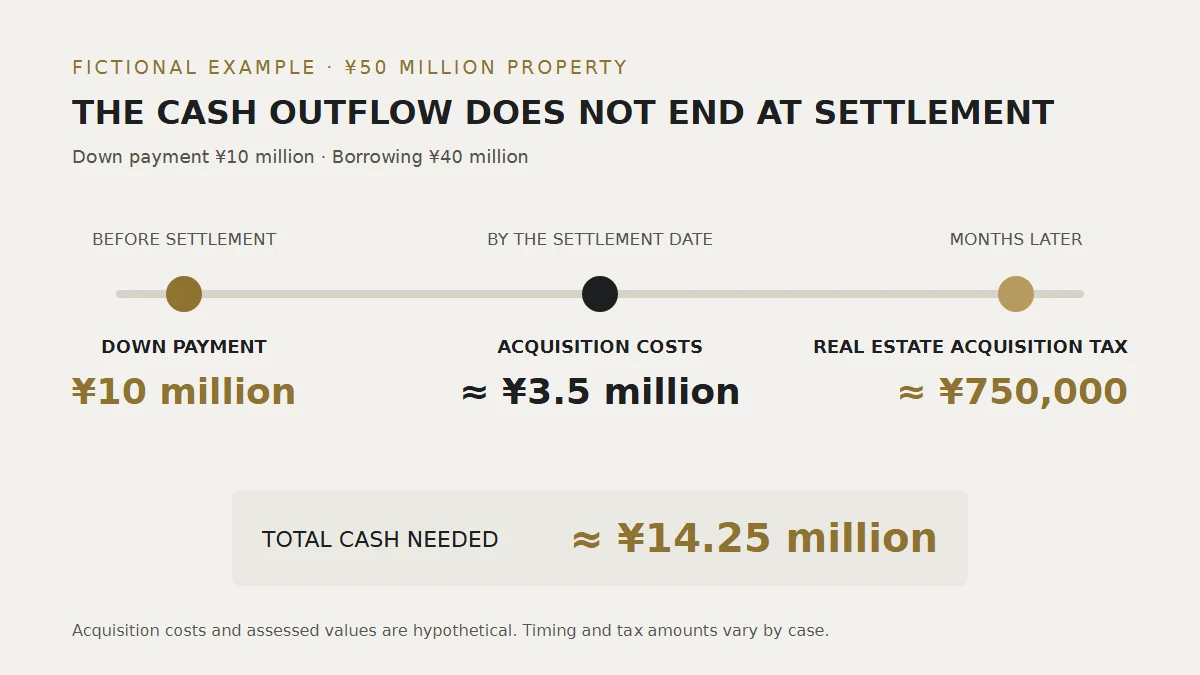
Suppose you buy a ¥50 million property with a down payment of ¥10 million and borrowing of ¥40 million.
Own funds: ¥10 million. Not a few people think this way.
Let us count, in order, what goes out by the settlement date.
- Brokerage commission: about ¥1.72 million
- Registration costs (registration and license tax and the judicial scrivener's fee): about ¥600,000
- Stamp duty: tens of thousands of yen
- Loan administration fee: about ¥880,000
- Fire insurance: about ¥200,000
- Fixed asset tax adjustment (seisan): about ¥100,000
In total, about ¥3.5 million.
Together with the ¥10 million down payment, ¥13.5 million is needed by the settlement date.
Up to here is what the brochure writes as "acquisition costs about 7%." You can know it in advance.
About half a year later, one more envelope comes
Settlement is done, rent has started coming in, and life has settled down.
Around then, an envelope arrives from the prefecture.
It is the real estate acquisition tax.
This is a tax on the fixed asset tax assessed value, and the standard rate is 4%. However, for land and housing acquired by March 31, 2027, it is reduced to 3%. For residential land, in addition, half of the assessed value can be used as the tax base.
The assessed value is not the sale price itself, and is usually lower than it. There are other deductions for buildings, but some come with conditions on floor area or use, and some cannot be used for rental properties.
Suppose the assessed values were ¥14 million for the land and ¥18 million for the building.
- Land: ¥14 million × 1/2 × 3% = ¥210,000
- Building: ¥18 million × 3% = ¥540,000
In total, about ¥750,000.
About half a year to a year after the purchase, you are billed this amount all at once.
In other words, the cash needed at the start was
¥10 million + ¥3.5 million + ¥750,000 = about ¥14.25 million
If you thought "I can buy with ¥10 million of own funds," it is more than 40% higher.
You may have thought all of it can be known in advance
That is right. An estimate can be made.
But for the real estate acquisition tax alone, the exact amount cannot be known in advance.
Because the tax base is not the sale price but the assessed value decided by the authorities. And it takes time until that assessed value is finalized and the notice is prepared.
That is why it takes half a year to a year. It comes just when you have forgotten, not out of meanness but for administrative reasons.
And this tax is a one-time tax at acquisition. It is different from fixed asset tax, which comes every year.
Because it is one-time, it is hard to put in an annual income and expense table. It appears only in the year of purchase, so it tends to slip out of standard simulations.
Own funds have 3 layers
Sorted out, it looks like this.
The first is the down payment. The part of the purchase price you do not borrow.
The second is the costs up to the settlement date. These can be counted in advance.
The third is what comes after settlement. Both the amount and the timing are decided later.
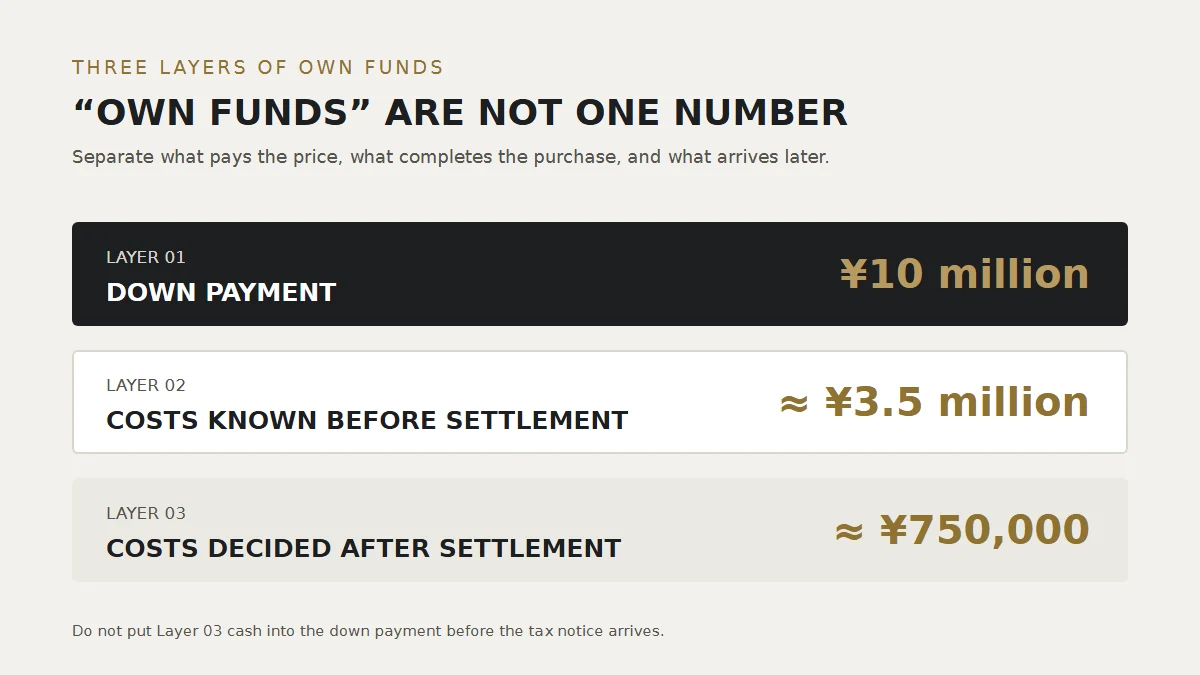
If you put everything into the down payment without keeping the third portion, you will be thin on cash when the notice arrives. Rent is coming in, but in half a year it has not built up that much.
When thinking about whether you can buy, do not draw the line at the settlement date. That alone changes the accuracy of the plan.
When you drink at a bar you don't know, the bill for the evening is settled at the register.
You leave thinking that is the end, and all that is left is to go home and sleep.
But the next morning, one more bill comes.
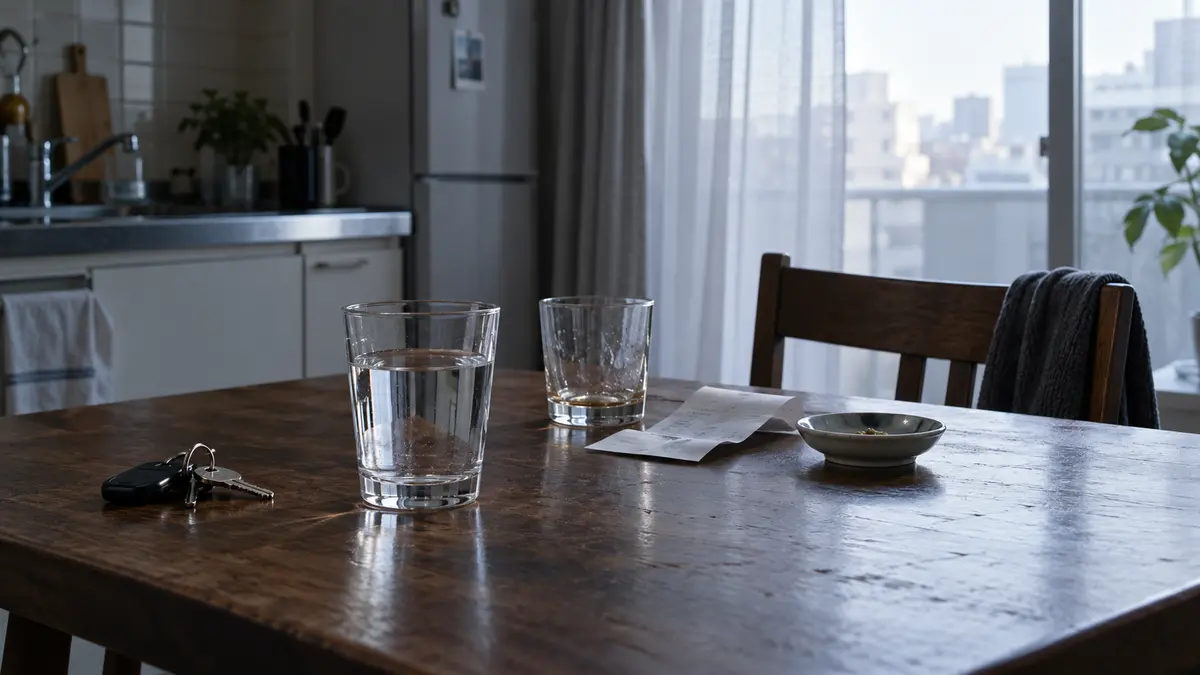 図を拡大するThis one comes from your body.
You only thought you had paid; it seems there were 2 bills.
The amount of the second is not visible while you are ordering.