
Even if you sell at the price you paid, there is tax
From a fictional example in which about ¥990,000 in tax arises even when a property bought for ¥50 million is sold for the same amount, we explain the relationship between depreciation, book value, capital gains (transfer income), and the difference in tax rates.

BENERU writes for readers who live in Japan. Taxes, loans and the other rules described here are those of Japan, and they assume a resident of Japan.
This page is a translation of the Japanese original. If the two differ, the Japanese original prevails.
Good day.
The sale contract is done, settlement is complete, the remaining loan balance is repaid, and money is left in hand.
The following year, the tax accountant (zeirishi) tells you.
The tax on capital gains is about ¥990,000.
The seller replies. I sold for the same amount I bought for. Why?
The following is a fictional example for illustration.
A property bought 10 years ago for ¥50 million was sold for ¥50 million.
It has neither gone up nor down in value. Net zero.
Even so, there is tax.
There is one reason. When calculating capital gains (transfer income), what you subtract is not the price you paid, but the amount on the books after depreciation.
Let me lay out the numbers.
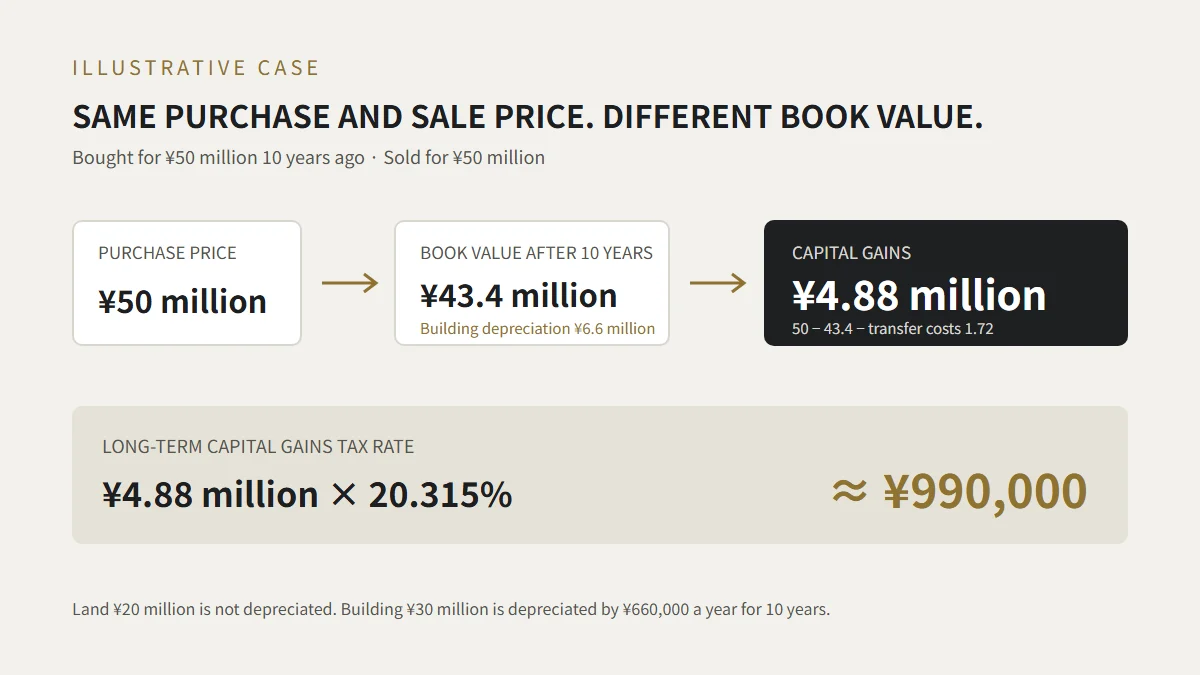
Of the ¥50 million property, suppose the building is ¥30 million and the land is ¥20 million.
For reinforced concrete construction, the building is depreciated by ¥660,000 a year. Over 10 years, ¥6.6 million.
Then the amount on the books is
- Building: ¥30 million − ¥6.6 million = ¥23.4 million
- Land: ¥20 million (not depreciated)
- Total: ¥43.4 million
From the sale price of ¥50 million, subtract this ¥43.4 million and about ¥1.72 million in transfer costs such as the brokerage commission.
Capital gains come to about ¥4.88 million.
The holding period is over 5 years, so the tax rate is 20.315%.
¥4.88 million × 20.315% = about ¥990,000
Even though the price has not risen, on the books it is treated as having risen by ¥6.6 million.
Then is depreciation a loss?
You may have thought this. If you had not depreciated, wouldn't this tax not have arisen?
That is true. But if you had not depreciated, you would not have had ¥6.6 million in expenses during the 10 years you held it either.
In other words, this is not a loss; you are only giving back what you received earlier.
Depreciation is not a mechanism that erases tax. It is a mechanism that pushes the time of payment back.
But here is where it gets a little interesting.
There are cases where it does not end with just pushing it back.
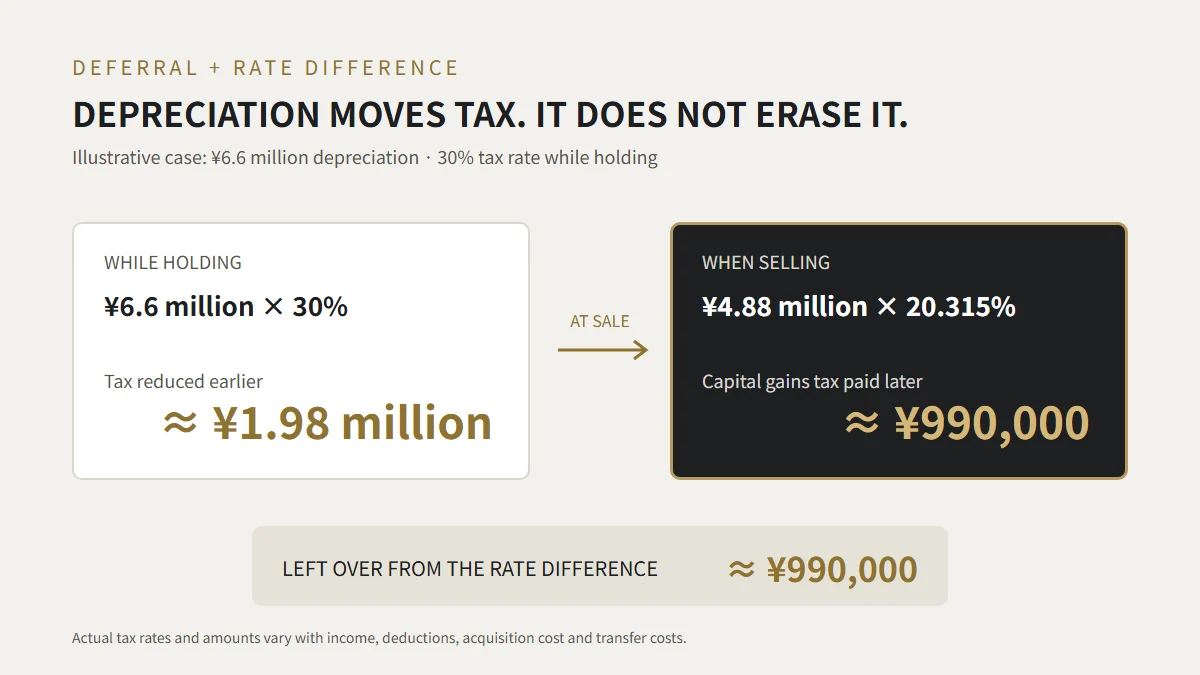
The tax saved during the holding period is calculated at the tax rate on income combined with salary and so on. The tax rate at sale, on the other hand, is separate, and fixed at 20.315% if the holding period is over 5 years.
Let us assume the tax rate during the holding period is 30%. The actual tax rate changes with other income and deductions, so this is a hypothetical number.
- Saved during the holding period: ¥6.6 million × 30% = about ¥1.98 million
- Paid at sale: about ¥990,000
On balance, about ¥990,000 remains.
This is not a bonus from deferral; it arises from the difference in tax rates. You deduct at a high rate and pay at a low rate.
Conversely, for someone whose tax rate during the holding period is low, this difference is smaller. Even with the same property and the same depreciation, how it works changes with the owner.
If you are told "it saves tax," ask whether the tax is disappearing or moving to later. It is usually the latter.
Up to the exit, it is one calculation
Thinking this way, there is not much point in separating the calculation while holding from the calculation when selling.
If you take large depreciation to thicken the cash left over each year, the capital gains at sale increase by that much.
If you hold briefly and sell, depreciation is small and capital gains are small too. But if the holding period is 5 years or less as of January 1 of the year of transfer, the tax rate is 39.63%. Close to double.
The way these 5 years are counted is a bit tricky: it is judged not by the day you sold, but by New Year's Day of the year you sold. A full 5 years may not be enough.
If you calculate only the annual cash left over when buying, and see this number for the first time when selling, every decision of the 10 years you held it gets corrected afterward.
I once helped a friend move.

My friend said there wasn't much to move. They really seemed to think so.
But when we laid out on the floor what came out of the closet, from under the bed, and from the drawers of the washstand, the room was filled.
It probably had not increased. Things that had been there all along just came out at once on that day.
While living somewhere, we probably do not know exactly what we own.