
The ledger and the bankbook say different things
The books show a loss, yet cash remains; the books show a profit, yet there is no money. We check, in an easy-to-follow way using the numbers of a fictional example, the gap that arises in real estate income and expenses.

BENERU writes for readers who live in Japan. Taxes, loans and the other rules described here are those of Japan, and they assume a resident of Japan.
This page is a translation of the Japanese original. If the two differ, the Japanese original prevails.
Good day.
When I listen to people who own real estate, there is a line that comes up at least once somewhere.
The books show a profit, but there is no money.
Or the reverse: there is a loss, but cash remains.
Both happen quite normally. It is quicker to look at the numbers, so let me line them up.
The following is a fictional example for illustration.
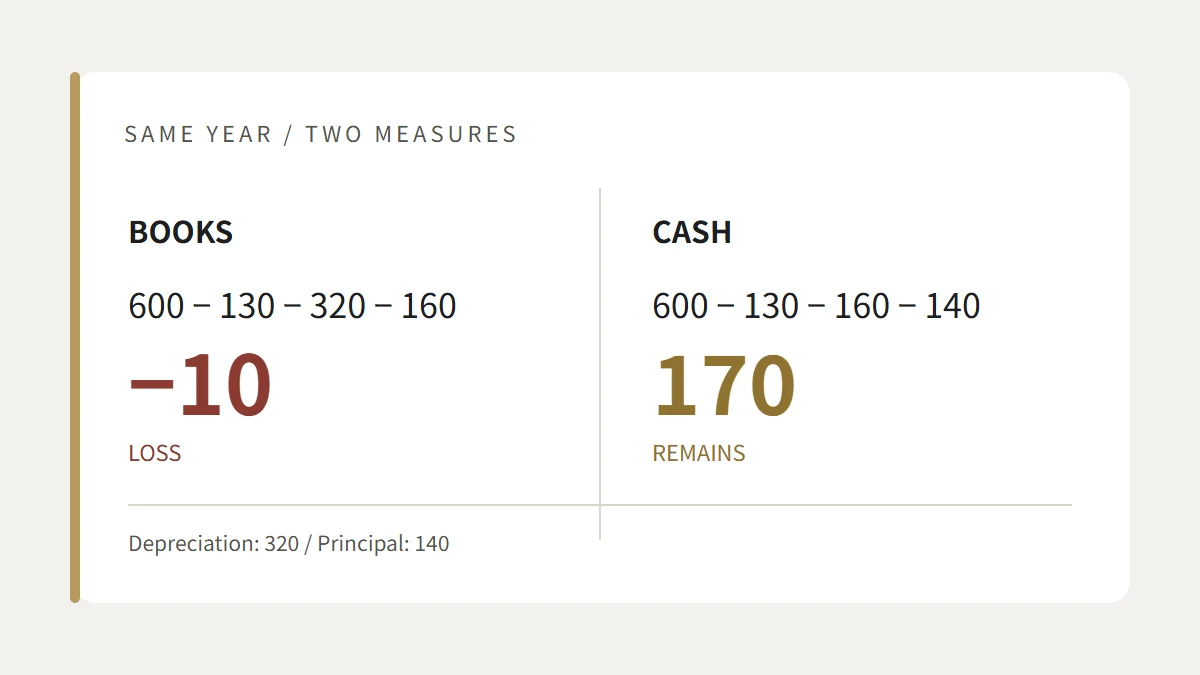
Annual rental income of ¥6 million. Expenses where money actually goes out, such as management and repairs, of ¥1.3 million. Loan repayments of ¥3 million a year, of which ¥1.6 million is interest and ¥1.4 million is principal.
So far, every one of these numbers appears in the bankbook.
There is one more number that does not appear in the bankbook. Depreciation of ¥3.2 million. It records, as an expense, the amount by which the building's value decreases year by year. Not a single yen goes out.
Now, let us calculate in 2 ways.
Profit for tax purposes
¥6 million − ¥1.3 million − ¥3.2 million (depreciation) − ¥1.6 million (interest) = −¥100,000
Cash actually left over
¥6 million − ¥1.3 million − ¥1.6 million (interest) − ¥1.4 million (principal) = ¥1.7 million
The books show a loss. The bankbook shows ¥1.7 million in the plus.
Both are correct numbers.
There are only 2 causes of the gap
Principal repayment is money going out, but it is not an expense. You are only paying back a debt; you have not suffered a loss.
Depreciation is the opposite: no money goes out, but it is an expense. You already paid when you bought it, so it is being divided up over the years and recorded.
These 2 work in opposite directions, so the books and the bankbook drift apart.
Up to this point, it is actually a welcome story. If the books show a loss, no tax is charged, and ¥1.7 million in cash remains.
The problem is that this state does not last.
Some years later, with the same rent, it becomes this
Depreciation has a time limit. It is only allocating amounts over the building's years, so when it ends, it becomes zero.
And on the repayment side, interest decreases and principal increases year by year. Even if the monthly repayment amount does not change, the allocation inside it switches over.
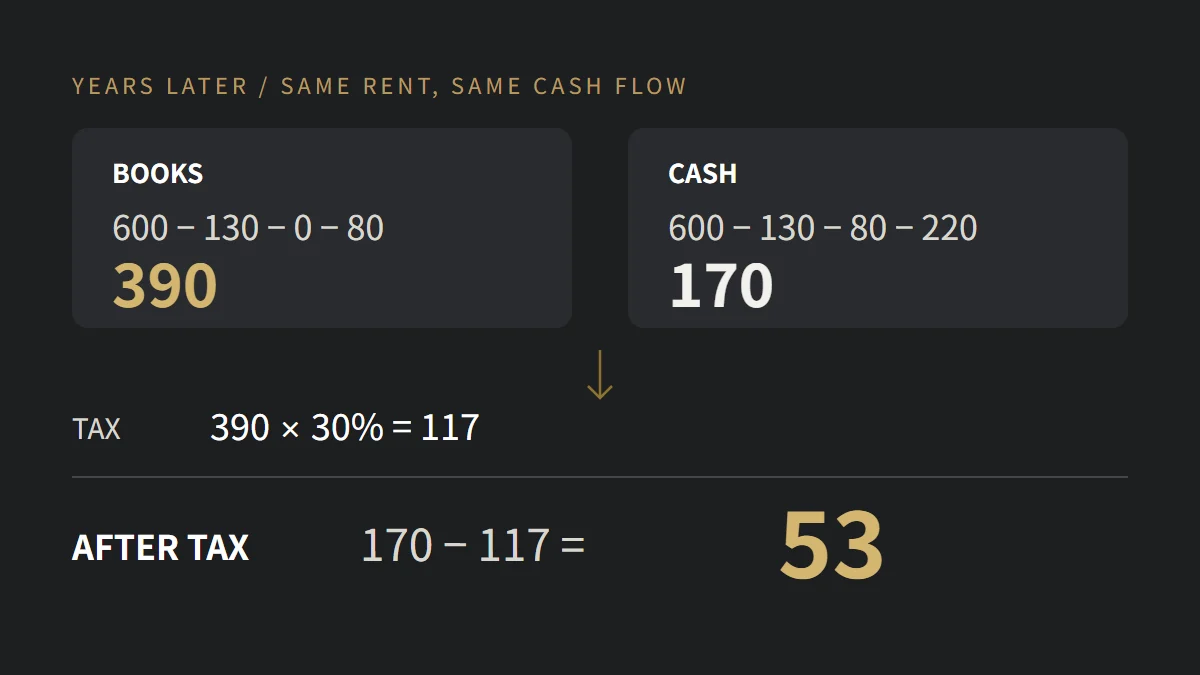
Let us calculate a year in which rent and expenses stay the same, depreciation has ended, and the split is ¥800,000 in interest and ¥2.2 million in principal.
Profit for tax purposes
¥6 million − ¥1.3 million − 0 − ¥800,000 = ¥3.9 million
Cash actually left over
¥6 million − ¥1.3 million − ¥800,000 − ¥2.2 million = ¥1.7 million
Cash is ¥1.7 million. The same as before.
But the books now show a profit of ¥3.9 million.
Let us assume this person's income tax and resident tax together come to 30%. The actual tax rate changes with other income and deductions, so this is only a hypothetical number.
¥3.9 million × 30% = ¥1.17 million
¥1.7 million − ¥1.17 million = ¥530,000
The rent has not changed. Vacancies have not increased. The cash coming in and going out is the same ¥1.7 million.
Even so, the amount left in hand falls to less than one third.
This phenomenon even has a name, but knowing the order in which it happens is more useful than memorizing the name. Depreciation ends first, and principal increases later. That is all.
Then which one should you look at?
You may have thought this. In the end, which is true, the books or the bankbook?
Both are true. But they measure different things.
The bankbook shows the money you can move this month. The books decide how much tax you pay. Both are necessary, but neither answers "did I make money?"
If you paid back ¥1.4 million of principal that year, your debt has gone down by ¥1.4 million. Even if the books show a loss, this has gone down. On the other hand, the building's value is also actually falling year by year.
Subtract liabilities from assets, and see which way it moved over a year. Whether you made money is something you see there.
The bankbook and the books are indicators that come before that.
I once stepped on the scale and saw the same number as last month, yet my belt had moved by one hole.

Probably the scale was not broken, and the belt had not stretched. Both were measuring correctly; they were just measuring different things.
Thinking about whether to believe the scale or the belt will probably not produce an answer. Recording both and lining them up a few months later is probably quicker.