
What ends at 22 years is not the building
A wooden house does not become unusable at 22 years. But the statutory useful life affects the purchase price and the exit through financing and depreciation.

BENERU writes for readers who live in Japan. Taxes, loans and the other rules described here are those of Japan, and they assume a resident of Japan.
This page is a translation of the Japanese original. If the two differ, the Japanese original prevails.
Good day.
Let me tell you something embarrassing.
Until around spring, whenever I saw the age of a wooden building, I reflexively counted toward 22 years.
If it was past 22 years, the building had no value left. That is what I thought.
I was wrong.
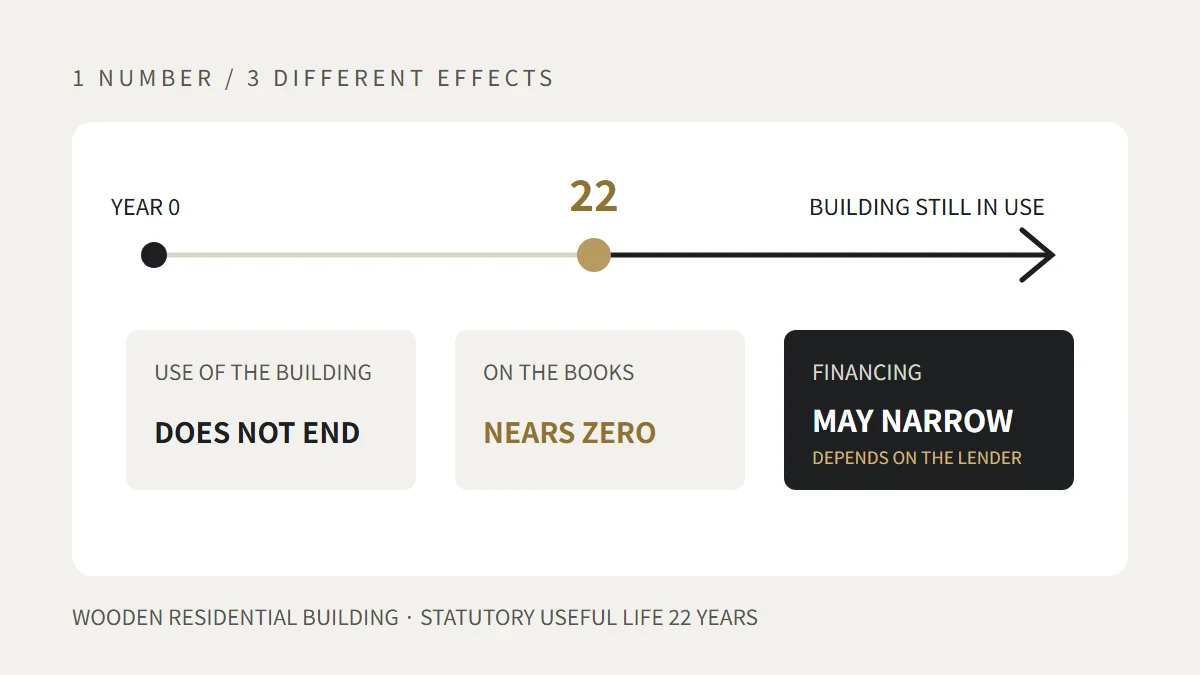
22 years is the statutory useful life.
It is set by the ministerial ordinance on the useful lives of depreciable assets, which gives 22 years for wooden residential buildings and 47 years for reinforced concrete residential buildings.
This is not a number decided by investigating how many years a building lasts.
It is a dividing line in the tax calculation: over how many years the purchase cost is split up and treated as an expense.
So for a wooden building past 22 years, only the building's value on the books approaches zero; the building does not disappear.
When you think about it, this is obvious. People live in 30-year-old wooden apartment buildings, and rent is being paid. 40-year-old detached houses are bought and sold as a matter of course.
I had taken a dividing line in tax law to be the building's lifespan. That was my mistake.
But it is not irrelevant either
It would make a neat story if I could write "so you don't need to worry about building age," but it is not that simple.
The statutory useful life does not represent the building's lifespan, yet it behaves like a lifespan.
Because lenders use it as a guide when deciding the loan term.
Some take the approach of capping the term at what remains after subtracting the years elapsed from the statutory useful life. In that case, a 20-year-old wooden building has 2 years left. At 25 years old, the calculation does not even work.
If the loan term is short, monthly repayments are heavy. If monthly repayments are heavy, fewer people can buy. If fewer people can buy, the price goes down.
The building stands as it always has, and tenants live there as usual, yet the numbers die first.
This is not about the building. It is about the buyer's financing.
The gap also has its uses
There is one more thing that arises from the same gap.
For a used property past its statutory useful life, a calculation called the simplified method allows 20% of the statutory useful life to be used as the depreciation period.
For wooden construction, 22 years × 20% = 4 years. For reinforced concrete construction, 47 years × 20% = 9 years. Fractions of less than 1 year are rounded down.
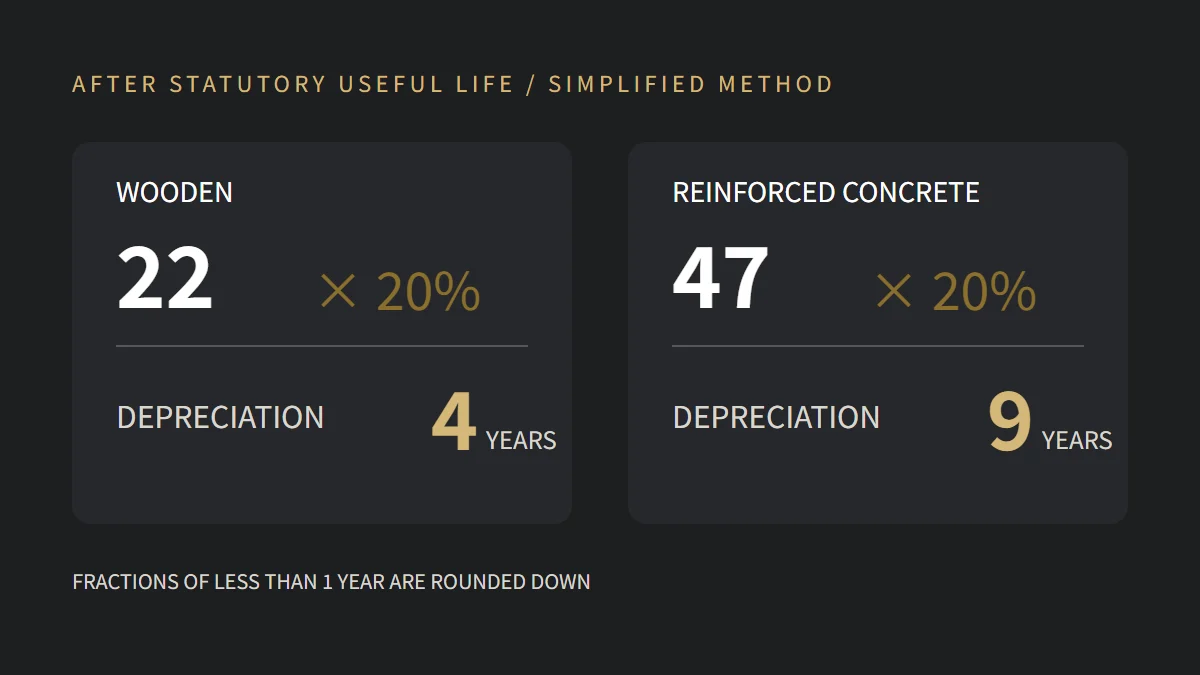
Because it is divided by a short period, depreciation per year becomes large. That means a large expense that involves no cash outflow can be recorded.
But as I wrote before, depreciation has an end. With 4-year depreciation for a wooden building, that expense disappears entirely in the 5th year.
It may feel short, but if you plan with that included, the gap is something you can use.
What to check is not you, but the next person
Sorted out this way, the question to ask when looking at building age changes.
How many more years will this building last? That is a matter of looking at the plans, the site, and the repair history.
Separately from that, you need to ask this.
When I sell, will the buyer be able to get financing?
How many years of financing were you able to get this time? In 5 years, that property will be 5 years older. At that point, how many years will the next buyer get?
If the answer is "none," that property can only be sold to people who can buy with cash. It is not that it cannot be sold; the pool of buyers changes.
If you buy cheaply knowing that, it makes sense. If you decide on yield alone without knowing it, the owner changes at the exit.
The other day, I was drinking at a place I had never been to, and the person next to me was talking about retirement.

Next month is the cutoff, apparently. They said it with an unbothered face: the work is the same as always, though.
On their 60th birthday, they surely will not suddenly become unable to do something. Their abilities should be the same as the day before.
But their title and pay will change. Because the system decides so.
Even a number that does not represent reality, once built into a system, moves reality.
It seems it was not only a story about real estate.