
Even with 8 units, it is still one bet
We sort out the operational freedom of a whole building, the burden of repairs you must set aside for yourself, the demand factors shared by all 8 units, and how the loan term affects the numbers.
BENERU writes for readers who live in Japan. Taxes, loans and the other rules described here are those of Japan, and they assume a resident of Japan.
This page is a translation of the Japanese original. If the two differ, the Japanese original prevails.
Good day. I'm Nel Shikina.
Last time, I said that what you buy with a condominium unit is not the room itself, but a part of a building and the right to take a small part in running it.
The timing of major repairs, the amount of the management fee, the choice of property management company: none of these are yours to decide. Your voting rights were 1.25%.
This time, it is a whole apartment building.
There, all of that is turned upside down.
The register lists only 2 things
When you buy a whole apartment building, 2 things are registered.
The land (all of it) and the building (all of it).
Not a share. Not co-ownership.
In practical terms, this means the following.
- When to repaint the exterior walls → you decide
- Which property management company to use → you decide
- How much to charge in rent → you decide
- Tenant conditions (pets, foreign nationals, corporate leases) → you decide
- Whether to rebuild, or clear the land and sell → you decide
There is no general meeting. There is no share of voting rights. There is no one to vote against you.
Last time, I wrote that "if you put work in, the return goes up, but with a condominium unit your hand does not reach that far."
With a whole building, it does.
You can bring expenses down yourself
Let us go back to the property used in Series 1.
The following is a fictional example for illustration.
- A wooden apartment building with 8 units
- Purchase price ¥50 million / acquisition costs ¥3.5 million (total investment ¥53.5 million)
- Rent assuming full occupancy ¥4 million a year (about ¥42,000 a month per unit)
- Operating expenses ¥800,000 a year
- Borrowing ¥40 million, interest rate 3%, term 25 years (annual repayment about ¥2.276 million)
At 95% occupancy:
- ¥4 million × 95% = ¥3.8 million
- Expenses ¥800,000
- Repayment ¥2.276 million
- Cash left in hand: ¥724,000 a year
Now let us look inside the ¥800,000 of expenses. The rental management fee, fixed asset tax and city planning tax, electricity and cleaning for common areas, fire insurance, and the annual average of restoration and advertising fees.
Of these, the rental management fee is typically around 5% of rent. 5% of ¥4 million is ¥200,000.
If you switch to a company that does the job for 3%, it becomes ¥120,000. A difference of ¥80,000 a year.
You cannot do this with a condominium unit. You cannot replace the property management company chosen by the owners' association for your own convenience. You can replace the rental management company, but the building's management fee itself is out of your hands.
With a whole building, both are your own decision.
The same goes for setting rent. If the building next door is full at ¥45,000, you can raise the rent at your next round of tenant recruitment. If it does not fill at the higher rent, you lower it. You can experiment.
Freedom means having the chance to try many times.
But there is no one setting money aside for you
For the same reason, something else comes back to you.
Last time, I talked about how the repair reserve fund for a condominium unit keeps rising. The example was ¥5,000 a month becoming ¥12,000 a month in the 12th year.
That is a system that makes you save, whether you like it or not.
A whole building has no such system.
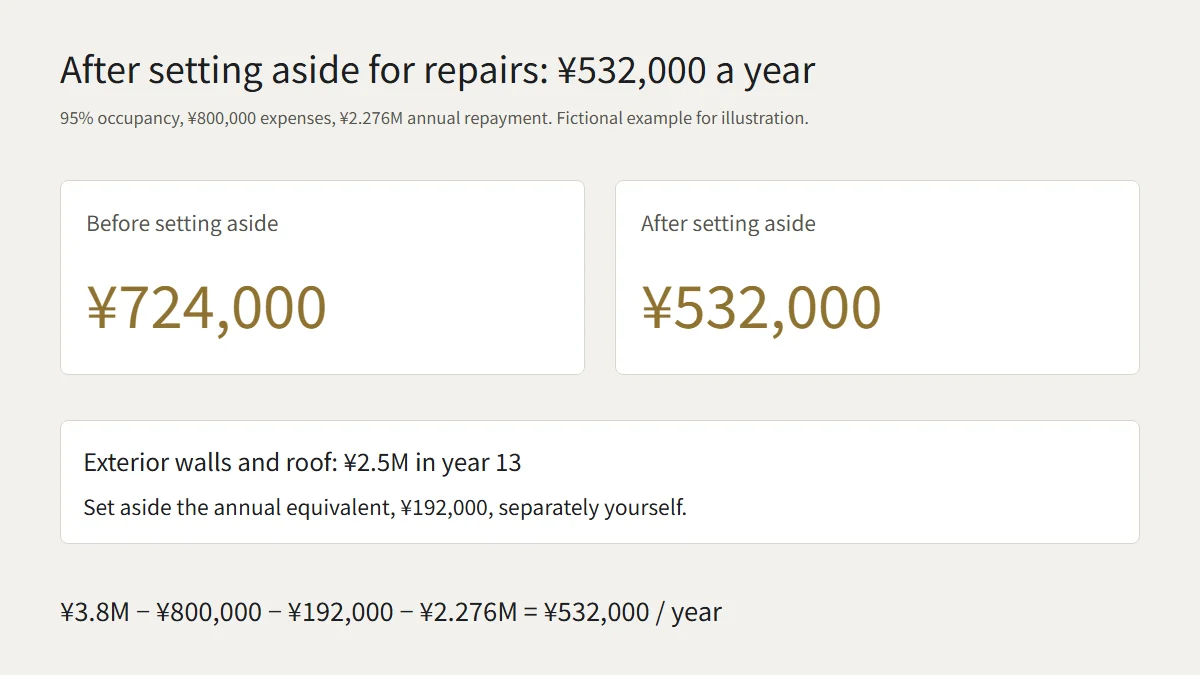
Suppose repainting the exterior walls and roof costs ¥2.5 million in the 13th year. On an annual basis, that is ¥192,000.
No one sends you a bill. No notice arrives. Unless you put ¥192,000 a year into a separate account yourself, you will have to pay ¥2.5 million in cash in the 13th year.
If you include this in expenses:
- ¥3.8 million − ¥800,000 − ¥192,000 − ¥2.276 million = ¥532,000 a year
¥724,000 has become ¥532,000.
It has not actually gone down. It is simply that something that should have been set aside all along was not written into the annual figures.
Last time, the condominium unit's numbers had this reserve included in expenses from the start, because it is compulsory. The whole building's numbers do not. Only you can put it in.
With a condominium unit, you are made to pay. With a whole building, you can forget.
The difference is not the total amount you pay, but whether you can forget it.
Breaking down "diversification"
This is the advantage of a whole building that is mentioned most often.
A condominium unit has only 1 room, so if it is vacant, income drops to zero. A whole building has 8 units, so if 1 is vacant, 7 units' worth remains. That is why it is stable.
The first half is correct. Let us actually calculate it.
| Status | Occupancy | Rental income | NOI | After repayment |
|---|---|---|---|---|
| Fully occupied | 100% | ¥4 million | ¥3.2 million | ¥924,000 |
| 1 unit vacant | 87.5% | ¥3.5 million | ¥2.7 million | ¥424,000 |
| 2 units vacant | 75.0% | ¥3 million | ¥2.2 million | −¥76,000 |
| 3 units vacant | 62.5% | ¥2.5 million | ¥1.7 million | −¥576,000 |
With a condominium unit, income is zero as soon as the one room is vacant, so the whole building certainly falls more gently.
But here, let us stop at the word "diversification" for a moment.
Diversification means holding several things that move independently. When one goes down, the other has not, so the whole is protected. That is the definition of diversification.
So, do these 8 units move independently?
They are in the same building. The same distance from the same station. Same age, same layout, same rent band.
When a new apartment building goes up nearby, it does not happen that only 1 of the 8 units is affected. All 8 face the same competitor.
When a factory near the station closes, it does not happen that half of the 8 units come through unscathed either.
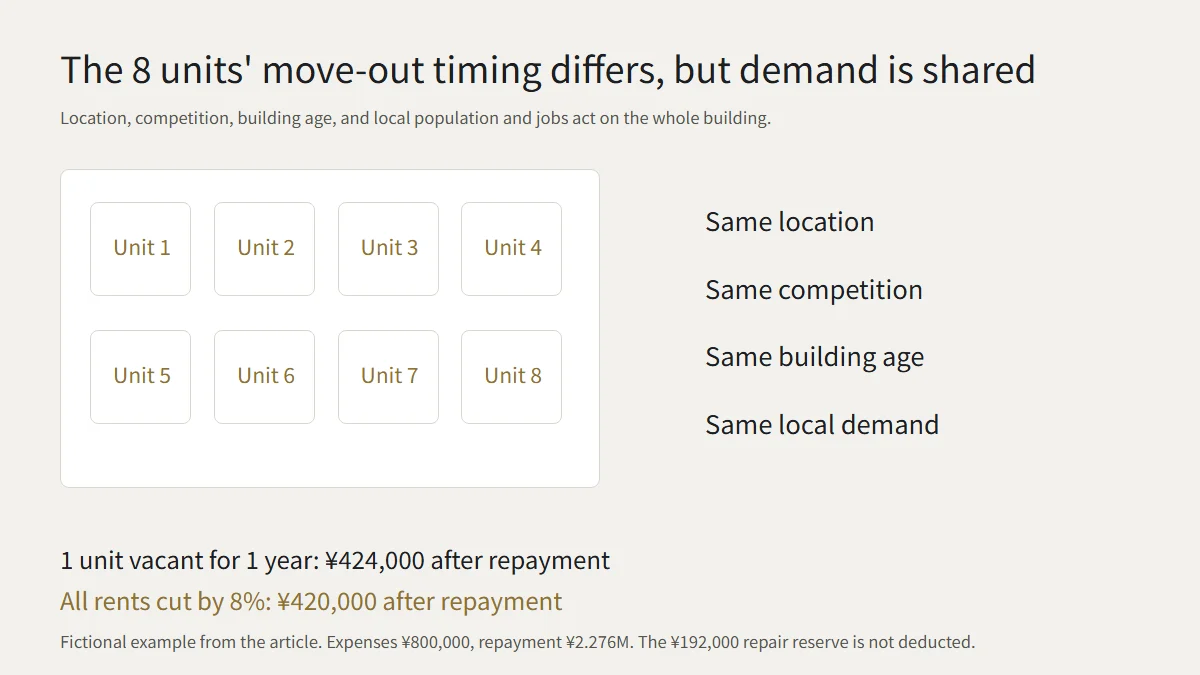
What is diversified is the timing of move-outs. Not demand.
The 8 units are not 8 bets. They are one bet cut into 8 pieces.
Let us look at the numbers. Suppose a competitor appears nearby and, to keep the units filled, you lower all rents by 8%. No one moves out. Occupancy stays at 95%.
- ¥4 million × 92% × 95% = ¥3.496 million
- Expenses ¥800,000, repayment ¥2.276 million
- ¥420,000 a year
The case above, where 1 unit was vacant for 1 full year, was ¥424,000.
Almost the same.
And there is a decisive difference between the two.
1 vacant unit returns to normal once it is filled. A drop in rent does not come back. Each time a lease is renewed, the lower level becomes the baseline.
What really matters with a whole building is not vacancy in individual units. It is the factors that act on all 8 units at once.
Location. Competition. Building age. The local population and employment.
If you think "it has 8 units, so it is stable" without looking at these, you have the order backwards.
Lenders look at it completely differently
There is one more point where things change a great deal from a condominium unit.
What the lender looks at.
There is land
A whole building comes with all of its land. Because the cost-approach value can be worked out from road-rating land values (rosenka) and the fixed asset tax assessment, it can be valued as collateral. This is a clear strength of a whole building. With the land share of a condominium unit, this kind of valuation is hard to obtain.
The useful life is short
On the other hand, the statutory useful life of a wooden building is 22 years. For steel frame, it is 19 to 34 years depending on the thickness of the steel, and for reinforced concrete, 47 years.
Many lenders set the loan term using the remaining useful life as a guide. For a 15-year-old wooden building, 7 years remain. In practice, of course, each lender judges differently, and some will lend beyond 22 years, but the structure in which building age feeds directly into the loan term does not change.
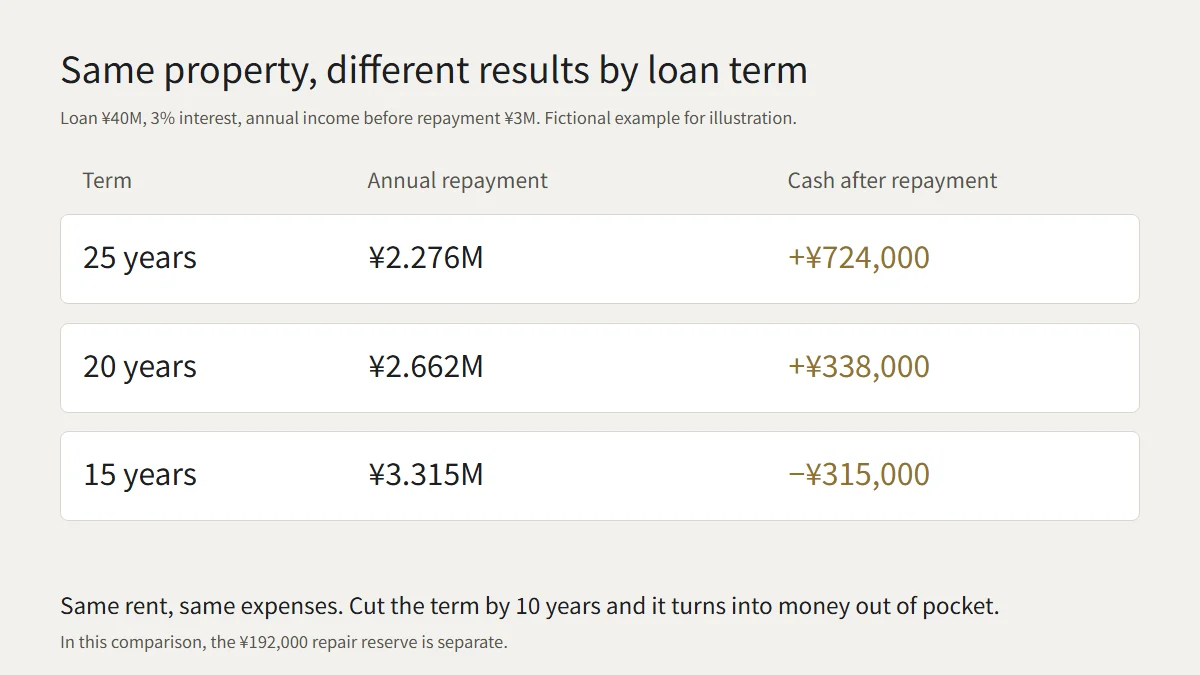
What happens when the term changes? Same ¥40 million, same 3% interest rate; we change only the term.
| Loan term | Annual repayment | Cash left after repayment (NOI ¥3 million) |
|---|---|---|
| 25 years | ¥2.276 million | ¥724,000 |
| 20 years | ¥2.662 million | ¥338,000 |
| 15 years | ¥3.315 million | −¥315,000 |
The property is exactly the same. Rent and expenses are the same.
Just by shortening the term by 10 years, an investment that leaves ¥720,000 a year becomes one that costs you ¥310,000 a year out of pocket.
This is why I wrote in Episode 5 of Series 1 that "the term matters more than the interest rate." With a whole building, building age feeds directly into the term, so this difference shows up head-on.
When an old wooden building is listed at a high yield, this is most of the reason the yield is high. Because a long term cannot be obtained, it only works at that yield. To put it as I did in Episode 1: yield is a payment for something.
What to look at before you buy
What you request for a whole building is different from a condominium unit.
| Document | What to look at |
|---|---|
| Rent roll | Rent, contract date and length of tenancy for each unit. If rents differ for the same layout, it may simply be that older leases are higher |
| Repair history | When, and for how much, the exterior walls, roof and plumbing were done. A property with no records has either not had the work done, or not recorded it |
| Building plans and certificate of inspection | Any history of extensions or changes of use. Without a certificate of inspection, financing can be hard to obtain |
| Official cadastral map and survey map | Whether the boundaries are fixed. If not, selling takes longer |
| Asking rents nearby | Rents currently being advertised for the same station and the same layout. If the rents in the rent roll are higher than these, they will fall with each move-out |
That last row is the most effective task in this episode.
What a rent roll shows is rent agreed in the past. Not the rent that will be agreed from now on. When you look at a fully occupied property, look less at the fact that it is full, and more at whether those rents match the level currently being advertised.
If they do not, full occupancy is a temporary state.
With this, the contents of a condominium unit and a whole building are laid out.
A condominium unit: you cannot decide, but in exchange it is hands-off and easier to sell.
A whole building: you can decide, but in exchange there are things you can forget; the 8 units are one bet; and building age feeds directly into the numbers through the loan term.
I cannot yet say which is more favorable.
Because the conditions for comparing them are not aligned. If you set side by side things with different prices, different loan amounts and different own funds, you cannot tell whether the differences come from the property or from the conditions.
Next time, we fix own funds at the same amount and put the numbers for both side by side.