
Fixing own funds at ¥13.5 million and setting 3 options side by side
With the same own funds, we compare 1 condominium unit, 2 condominium units and a whole building. We look separately at annual cash, principal repayment, and resilience to vacancy and rising interest rates.
BENERU writes for readers who live in Japan. Taxes, loans and the other rules described here are those of Japan, and they assume a resident of Japan.
This page is a translation of the Japanese original. If the two differ, the Japanese original prevails.
Good day. I'm Nel Shikina.
So far, we have laid out the contents of a condominium unit and a whole building.
Now that we are ready to compare, this time I will put the numbers side by side.
But I am setting a condition on how they are arranged. If you put things with different prices and different loan amounts next to each other, you cannot tell whether the differences come from the property or from the conditions.
I am fixing own funds at ¥13.5 million.
When the amount of cash you can put in is set, what can you put together within it? That is the order in which things happen in real life.
Three ways to put it together
All of the following are fictional examples for illustration. They are not real properties.
The properties are the ones that have appeared so far, carried over as they are.
Condominium unit A (Episodes 1 and 2) Central Tokyo, 5 minutes' walk from the station, 8 years old. Purchase price ¥30 million, acquisition costs ¥2 million. Rent assuming full occupancy ¥1.2 million a year. Operating expenses ¥200,000 a year. With a move-out once every 4 years, and the restoration cost of ¥150,000 and advertising fee of ¥200,000 at that time averaged over the years: ¥862,500 a year.
Whole building (Episode 3 and Series 1) A wooden apartment building with 8 units. Purchase price ¥50 million, acquisition costs ¥3.5 million. Rent assuming full occupancy ¥4 million a year. After 95% occupancy, operating expenses of ¥800,000 and ¥192,000 set aside for the exterior walls: ¥2.808 million a year.
As we saw in Episode 3, financing terms change with structure and building age, so I set them separately. Condominium unit A is 8-year-old reinforced concrete, so interest rate 2.0% and a 35-year term. The whole building is wooden, so interest rate 3.0% and a 25-year term.
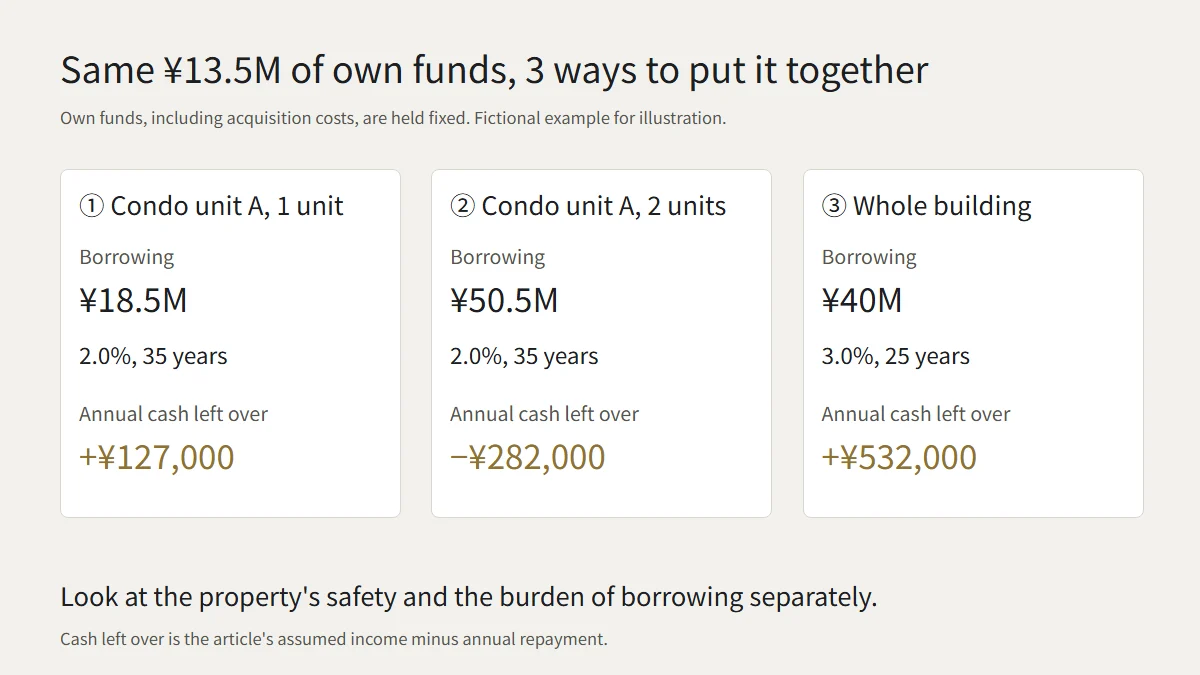
On these assumptions, I build 3 ways to use ¥13.5 million.
| ① Condo unit A, 1 unit | ② Condo unit A, 2 units | ③ Whole building | |
|---|---|---|---|
| Purchase price | ¥30 million | ¥60 million | ¥50 million |
| Acquisition costs | ¥2 million | ¥4 million | ¥3.5 million |
| Own funds | ¥13.5 million | ¥13.5 million | ¥13.5 million |
| Of which, down payment | ¥11.5 million | ¥9.5 million | ¥10 million |
| Borrowing | ¥18.5 million | ¥50.5 million | ¥40 million |
| Terms | 2.0%, 35 years | 2.0%, 35 years | 3.0%, 25 years |
| Annual repayment | ¥735,000 | ¥2,007,000 | ¥2.276 million |
| Annual NOI | ¥863,000 | ¥1.725 million | ¥2.808 million |
| Cash left over (annual) | +¥127,000 | −¥282,000 | +¥532,000 |
| Total investment / own funds | 2.37x | 4.74x | 3.96x |
It is the same ¥13.5 million.
Only ② has gone into the red.
First, why ② is in the red
With 2 condominium units, borrowing becomes ¥50.5 million. That is 2.7 times that of ①.
Income, on the other hand, only doubles. Obviously enough, this is because the down payment has been spread over 2 units, so the share that is borrowed has gone up.
Look at total investment divided by own funds. ② is 4.74x. The highest of the 3.
This is where people often get it wrong.
It is said that condominium units are safer than whole buildings. Because the amounts are small and the entry point is low.
But when you build with the same own funds, the option with better financing terms lets you borrow more. An interest rate of 2.0% with a 35-year term is something condominium unit A can obtain because it is central and fairly new. Because the terms are good, you can buy more with the same cash. As a result, leverage ends up higher than with the whole building.
You can borrow dangerously against a safe property. The reverse is also possible.
Leverage is not decided by the property. You decide it.
I am not saying ② is a bad way to put things together. As we will see later, ② has its own way of working.
What remains after 10 years
If you judge only by cash left over, you will get it wrong. This is what we covered in Episode 4 of Series 1.
The principal part of repayment leaves as cash, but it is reducing your debt.
Let us look at holding for 10 years.
| ① Condo, 1 unit | ② Condo, 2 units | ③ Whole building | |
|---|---|---|---|
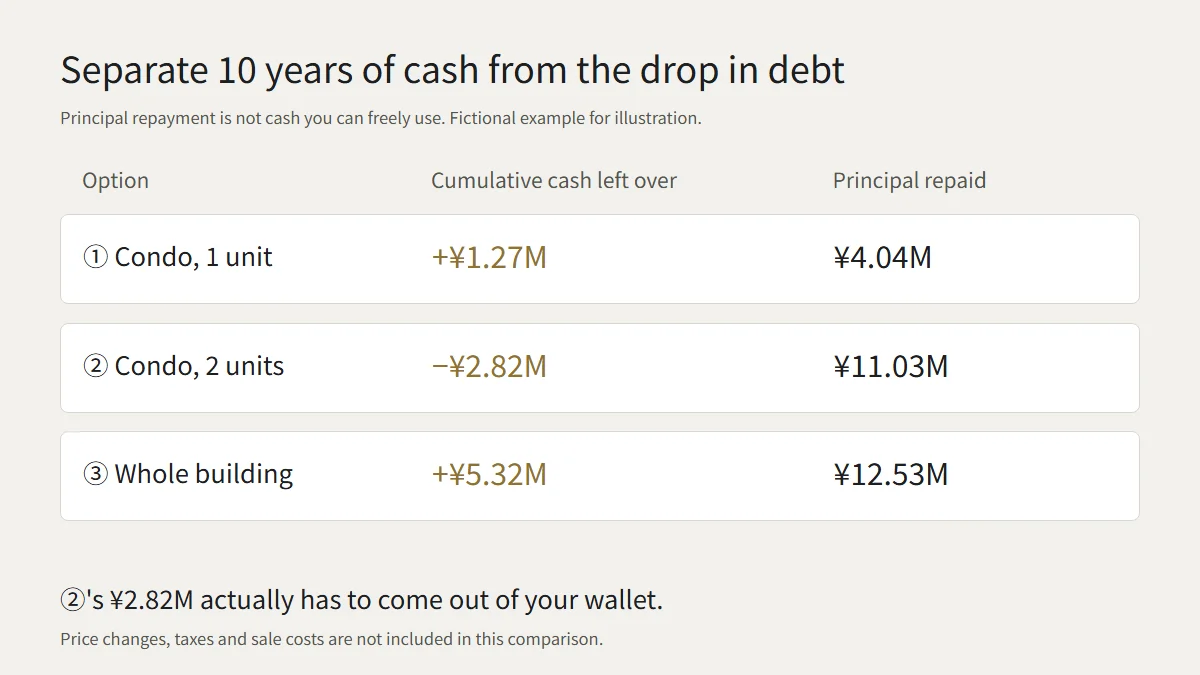
| Cumulative cash left over over 10 years | +¥1.27 million | −¥2.82 million | +¥5.32 million |
| Principal repaid over 10 years | +¥4.04 million | +¥11.03 million | +¥12.53 million |
| Total | +¥5.31 million | +¥8,210,000 | +¥17.85 million |
| Remaining loan balance after 10 years | ¥14.46 million | ¥39.47 million | ¥27.47 million |
(The sale price and taxes on a sale are not included.)
② is ¥2.82 million negative in cash, but it has reduced debt by ¥11.03 million. Net, that is a plus of ¥8,210,000.
The money that left your hands has turned into an asset.
However, that ¥2.82 million really has come out of your own wallet. Over 10 years, that is ¥280,000 a year on average. Unless it is within the out-of-pocket limit we worked out in Episode 3 of Series 1, this arrangement cannot be sustained.
Person D's line was ¥300,000 a year. That is cutting it close. If vacancies overlap even once, it goes over.
The reason ③ has the best numbers of the 3 is that the property's net yield is high. Condominium unit A has NOI of ¥862,500 on a total investment of ¥32 million: 2.70%. The whole building has ¥2.808 million on ¥53.5 million: 5.25%. Nearly double.
This difference is not "because it is a whole building." It is the difference between a fairly new unit in central Tokyo and a wooden building in a regional area. Let us check that in the next section.
Checking that it is not the property type
Here, let us test it from the other side.
I will use condominium unit B from Episode 1. Suburban, 15 minutes' walk from the station, 28 years old. Purchase price ¥15 million, acquisition costs ¥1.2 million, NOI ¥690,000.
Buy 2 of these. Purchase price ¥30 million, acquisition costs ¥2.4 million, borrowing ¥18.9 million. As 28-year-old reinforced concrete, the term is 19 years, and I assume an interest rate of 2.5%.
- Annual repayment ¥1.251 million
- NOI ¥1.38 million
- Cash left over ¥129,000 a year
Almost the same as ①. Even with condominium units, if the location and building age change, completely different numbers come out.
What is more, this arrangement borrows only ¥400,000 more than ①, yet its income is ¥517,500 higher. The reason cash left over is still the same is that a term of only 19 years can be obtained. The structure we saw in Episode 3 shows up in condominium units exactly the same way.
So what you should read from the tables so far is not "a whole building is more favorable."
What you should read is this.
What decides cash left over is not the property type, but the net yield and the loan term.
Whether it is a condominium unit or a whole building affects these two, but does not decide them.
When things break, the difference shows clearly
From here is where the difference in property type truly appears.
When 1 unit (1 room) is vacant for a year
| Cash left over (normal) | 1 unit vacant for 1 year | Drop | |
|---|---|---|---|
| ① Condo, 1 unit | +¥127,000 | −¥935,000 | ¥1.063 million |
| ② Condo, 2 units | −¥282,000 | −¥1.345 million | ¥1.063 million |
| ③ Whole building | +¥532,000 | +¥232,000 | ¥300,000 |
(Vacant for a full year. Expenses are assumed to continue during vacancy; restoration and advertising fees are not included.)
With ①, income drops to zero the moment it is vacant, and only the repayment remains.
With ③, even with 1 unit vacant, rent from 7 units still comes in, so it stays in the black.
This is what "0 or 100" and "7/8 remains," which we saw in Episodes 2 and 3, look like as numbers.
When the interest rate rises by 1 percentage point
| Current repayment | After +1 percentage point | Cash left over | |
|---|---|---|---|
| ① Condo, 1 unit | ¥735,000 | ¥854,000 | +¥8,000 |
| ② Condo, 2 units | ¥2,007,000 | ¥2.332 million | −¥607,000 |
| ③ Whole building | ¥2.276 million | ¥2.534 million | +¥274,000 |
Here it is decided not by the property, but by the loan amount.
② has ¥50.5 million of borrowing, so 1 percentage point makes it ¥325,000 a year worse. ① has ¥18.5 million, so ¥119,000.
Whether you are resilient to rising interest rates is not a matter of property type. It is a matter of how much you have borrowed.
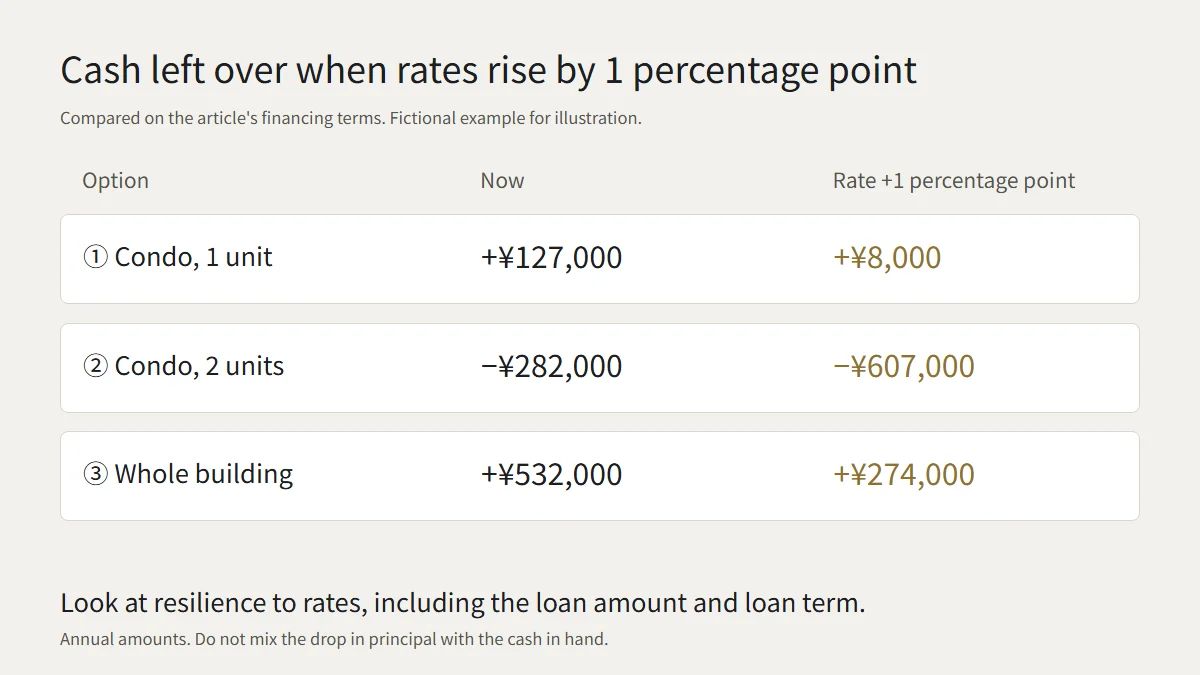
In Episode 5 of Series 1, I talked about how a 1 percentage point rise in interest rates hits in proportion to the loan amount. The same thing is happening here.
What is not in the table
Finally, here are 3 things this table does not show. They are hard to put into numbers, so they fall out of the table.
The unit in which you sell
② has 2 units. If you need cash after 10 years, you can sell just 1. With ③, if you sell, all 8 units go together.
②'s "¥280,000 a year out of pocket" also means, turned around, that "you hold it in a state where you can cut it in half at any time." Looking only at the numbers in the table, ② looks the hardest, but ② gives you the most freedom in how you stop.
Effort
With ③, you choose the property management company, decide on repairs, and set the rent. In Episode 3 I wrote that "freedom means having the chance to try many times," but trying takes time. ① and ② need almost none of this time.
For someone busy with their main job, this is a cost. It just does not show in the table; it is not zero.
Whether you can buy the next one
③ owns land, so the cost-approach value counts in the lender's assessment. ② is 2 condominium units with ¥50.5 million of borrowing.
When you think about a second property, this difference matters. But how it matters differs from lender to lender, so I cannot state it definitively here.
Setting the 3 side by side did not produce a correct answer.
What did come out is this.
- Whether cash left over is large or small is decided not by property type, but by net yield and loan term
- How it falls when things break is decided by property type
- Vulnerability to interest rates is decided by the loan amount
- Freedom when selling, and effort, do not appear in the table but are real
All four are looking at different places.
Next time, including these four, I will organize where the differences appear into 5 axes.
The aim of the next episode is to let you build the comparison table yourself.