
If you compare only what can be compared, you fail on what cannot
We organize the differences between condominium units and whole buildings along 5 axes, and show how to compare not only the numbers but also time and exit, in writing.

BENERU writes for readers who live in Japan. Taxes, loans and the other rules described here are those of Japan, and they assume a resident of Japan.
This page is a translation of the Japanese original. If the two differ, the Japanese original prevails.
Good day. I'm Nel Shikina.
Last time, I fixed own funds at ¥13.5 million and set 3 ways of putting things together side by side.
Four conclusions came out, but all four were looking at different places. Cash left over is not decided by property type. How things break is decided by type. Vulnerability to interest rates is decided by the loan amount. Freedom in selling, and effort, do not appear in the table.
They look scattered, so this time I will sort them into axes.
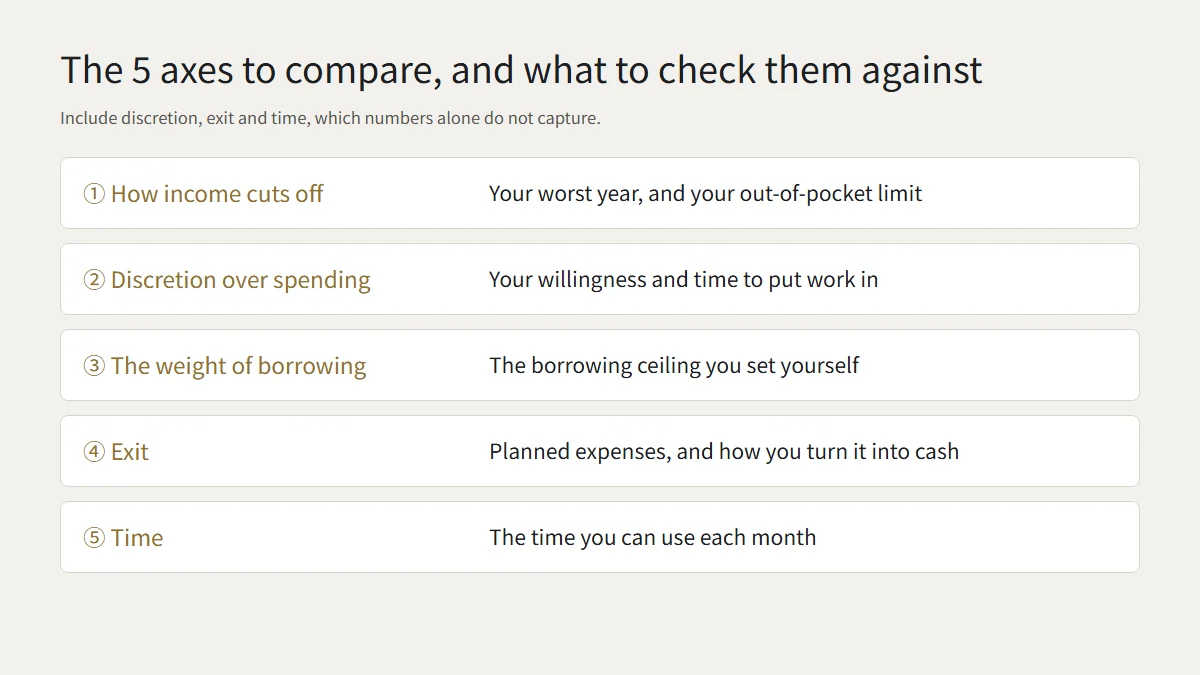
There are 5.
Axis 1: How income cuts off
What differs
A condominium unit has only 1 lease per unit. It is either occupied or not. There is nothing in between.
A whole building falls in steps of 1 unit. With 8 units, 1/8 at a time.
With last episode's numbers, it looks like this (a fictional example for illustration; vacant for 1 full year, with restoration and advertising fees not included).
| Normal year | 1 unit vacant for 1 year | |
|---|---|---|
| Condo, 1 unit | +¥127,000 | −¥935,000 |
| Whole building, 8 units | +¥532,000 | +¥232,000 |
The condominium unit tips from black into red. The whole building stays in the black.
But as we saw in Episode 3, the 8 units do not move independently. If the location or competition changes, it hits all 8 at once. The fine steps apply only to individual move-outs.
Who decides
The property type. The number of units is fixed when you buy.
Which of your own numbers to check it against
Your out-of-pocket limit (Series 1, Episode 3).
There is one thing to do. Calculate your worst 1-year result, and see whether that deficit is within your limit.
For 1 condominium unit, "vacant for 1 full year." For a whole building, assuming "30% vacancy" or so is enough.
Axis 2: Discretion over spending
What differs
With a condominium unit, the building's operating costs are out of your hands. The management fee, the repair reserve fund and the choice of property management company are all resolved at the general meeting. Voting rights follow your share, and for 1 studio unit they are in the 1% range.
With a whole building, you decide everything yourself. The property management company, the timing of repairs, the rent.
Here are 2 numbers that pair up.
- Condominium unit: if the repair reserve fund goes from ¥5,000 a month to ¥12,000 a month, ¥84,000 a year goes out. You cannot stop it.
- Whole building: if you change the rental management fee from 5% of rent to 3%, ¥80,000 a year comes back. If you do it yourself.
The amounts are almost the same. The direction, and who acts, are different.
One goes out on its own; the other is something you have to go and get. If you do not go and get it, nothing goes out, but nothing comes back either.
Who decides
The property type. But on the whole-building side, the type only gives you the "possibility"; whether you act on it is up to you.
Which of your own numbers to check it against
Your willingness and time to put work in. This cannot be made into a number. We deal with it under Axis 5.
Axis 3: The weight of borrowing
What differs
This is the only axis that has nothing to do with property type.
Recall last episode's table. The total investment for 2 condominium units was 4.74x own funds, higher than the whole building's 3.96x. The deterioration when interest rates rise by 1% was also the largest for 2 condominium units, at ¥325,000 a year.
That is not because condominium units are safe. Because the financing terms were good, you could borrow a lot, and because you borrowed a lot, you became vulnerable to interest rates. That is all.
| Borrowing | Deterioration at +1% interest | |
|---|---|---|
| Condo, 1 unit | ¥18.5 million | ¥119,000 |
| Condo, 2 units | ¥50.5 million | ¥325,000 |
| Whole building | ¥40 million | ¥257,000 |
It is neatly in order of the loan amount. The type of property does not come into it once.
Who decides
You do. Of the 5 axes, this is the only one that moves by your own judgment.
Which of your own numbers to check it against
Your borrowing ceiling (Series 1, Episode 5). The number you worked out backwards from your out-of-pocket limit applies directly.
Axis 4: Exit
What differs
It splits into 4.
| Condominium unit | Whole building | |
|---|---|---|
| Unit of sale | 1 unit at a time | All together |
| Buyers | Investors + people who will live there | Investors only |
| Buyer's financing | With reinforced concrete, the term tends to remain | With wood, it shortens with building age |
| Time it takes | Shorter | Longer |
The strength of a condominium unit is that its pool of buyers is double-layered. People who buy as an investment, and people who buy to live there. The latter do not judge by yield, so there is one more support for the price.
The buyers of a whole building are investors only. And investors judge by the interest rates and financing terms at that time. As we saw in Episode 3, wooden buildings over 22 years old struggle to get a long loan term, so buyers shift toward those who can pay in cash.
There is one more thing: the difference in the unit of sale matters.
If you hold 2 condominium units, you can sell just 1. A whole building goes as all 8 units together. The option of turning part of it into cash does not exist with a whole building.
Who decides
The property type and building age.
Which of your own numbers to check it against
Your planned expenses (Series 1, Episode 3). Education costs, replacing a car, care for a parent. If there are expenses whose timing you can roughly see, check whether the form you hold lets you turn part of it into cash at that point.
In Episode 10 of Series 1, I wrote "sell on conditions, not on a date." Whether you can set conditions at all changes here. An asset with a limited pool of buyers will not necessarily sell on your terms.
Axis 5: Time
What differs
With a condominium unit, it is about reading the general meeting materials once a year. Cleaning of common areas, fire safety inspections, elevator maintenance: the association does it.
With a whole building, you choose the property management company, get quotes, decide the timing of repairs, and set tenant conditions.
In Episode 3, I wrote that "freedom means having the chance to try many times." Turned around, if you do not try, the freedom goes unused. If you buy a whole building and leave everything to the property management company, the "¥80,000 a year you can go and get" from Axis 2 never happens. With freedom comes work.
Who decides
The property type.
Which of your own numbers to check it against
The time you can use each month. This alone cannot be converted into money.
Breaking down the act of "comparing"
So far I have set out 5 axes.
Now, can these 5 be put into one table?
They cannot.
What a comparison table can hold is only things that share a common unit on both sides. Yield is a percentage; cash left over is yen; loan balance is yen. These can be lined up.
Axis 5, "time," has no unit. Axis 4, "how easy it is to stop," has none either. Nor does Axis 2, "willingness to put work in."
So when you make a neat table to compare properties, only the things with units remain, and the things without units disappear.
What disappeared has not become zero. The format of the table simply did not accept it.
And in practice, failure usually happens on the side that disappeared.
More people struggle because "it took more work than I expected" or "I could not sell when I wanted to" than because they misjudged the yield. The former can be calculated before you buy, but the latter does not take the form of a calculation, so it is not written into the table.
A comparison table is not the decision itself, but part of the decision.
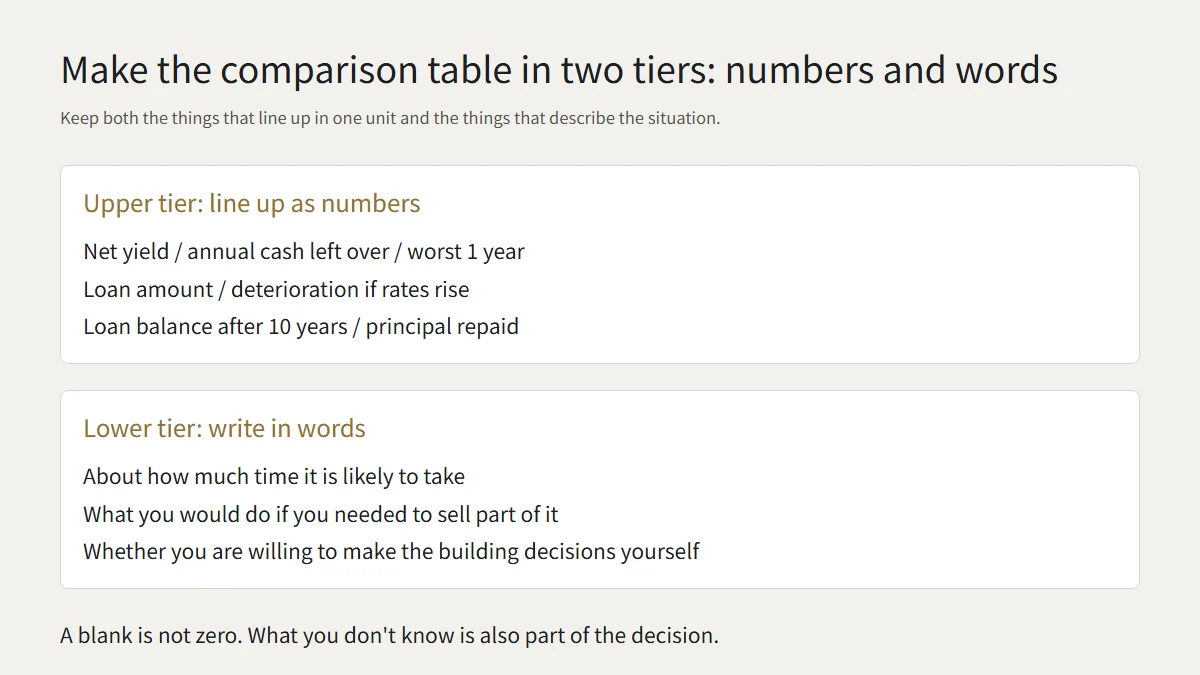
So when you make the table, make it in two tiers.
Upper tier (things that line up as numbers)
- Net yield (NOI against total investment)
- Annual cash left over
- Cash left over in the worst 1-year result
- Loan amount, and the deterioration at +1% interest
- Loan balance and principal repaid after 10 years
Lower tier (things you write in words)
- About how many hours a year it is likely to take
- What you would do if you needed to sell part of it 5 years from now
- Whether you are willing to make the building decisions (repairs, property management company, rent) yourself
It is fine if the lower tier does not get filled in. The fact that it does not fill in is itself information. As I wrote in Episode 2 of Series 1, the place where your hand stops is where you are right now.
What you see when you line up the 5
Finally, let us reorder the 5 axes by "who decides."
| Axis | Decided by |
|---|---|
| 1. How income cuts off | Property type |
| 2. Discretion over spending | Property type |
| 3. The weight of borrowing | You |
| 4. Exit | Property type |
| 5. Time | Property type |
Four to one.
This imbalance has a use.
The 4 decided by property type cannot be changed after you buy. The number of units, whether there is an association, the pool of buyers, the effort required: all are fixed at the time you buy.
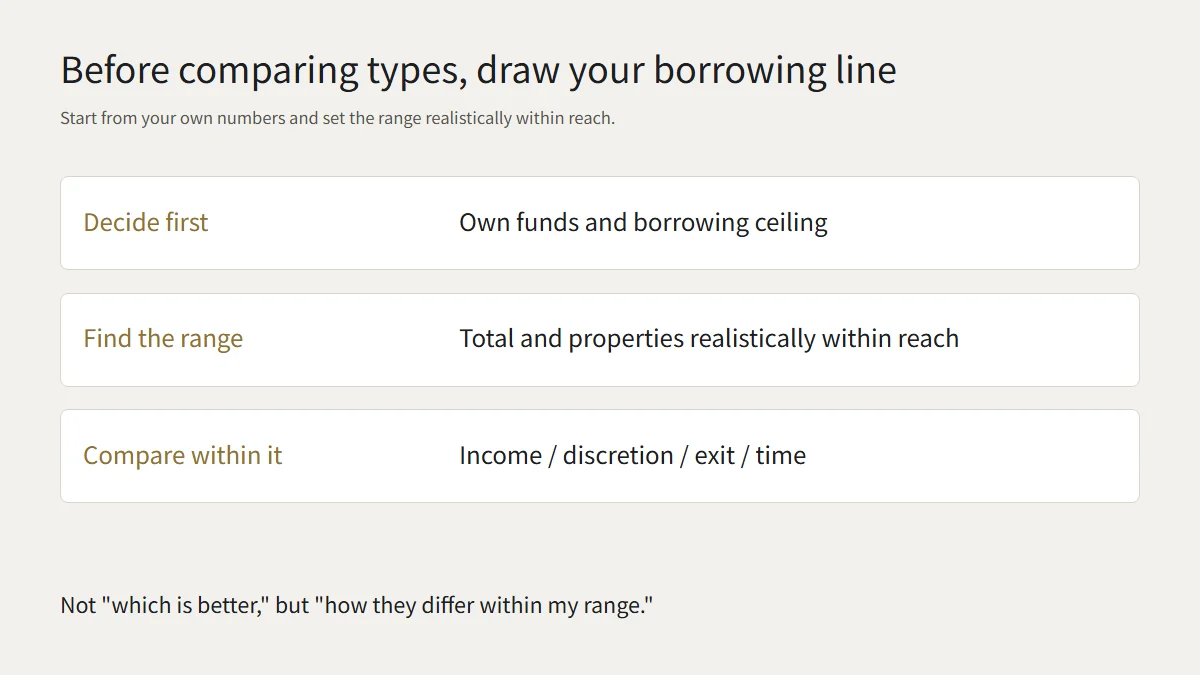
The 1 you decide yourself can be decided before you buy. And unless this one is decided first, you cannot evaluate the other 4.
Once the loan amount is decided, the total you can buy is decided. Once the total is decided, the range of properties realistically within reach is decided. Only once the range is decided does a comparison like "in that range, a condominium unit looks like this and a whole building looks like that" make sense.
What happens if you do it in the opposite order?
If you first ask "which is better, a condominium unit or a whole building," you get no answer. As we saw last time, even with the same own funds, the result reverses depending on how you put it together. Deciding the type first does not settle anything.
The order is now set.
Next time, we check this against your own numbers. The 3 we worked out in Series 1 (the cash you can move, the amount you can set aside each year, and your out-of-pocket limit) will be applied to these 5 axes.