
Would you buy it again at today's price?
Using a fictional example, we sort out what it means to keep holding a property that could sell for ¥50 million today, and the round-trip cost of about ¥7.09 million to sell and buy it back.

BENERU writes for readers who live in Japan. Taxes, loans and the other rules described here are those of Japan, and they assume a resident of Japan.
This page is a translation of the Japanese original. If the two differ, the Japanese original prevails.
Good day.
To those of you who already own a property, let me ask one thing.
Would you buy that property again, today, at its current market price?
If you thought you would not, why do you keep holding it?
It may have sounded like a mean question. But in theory, these two are the same thing.
Holding on is the same state as buying at today's price.
If you own a property that would bring ¥50 million if sold, you are continuing to keep ¥50 million in that property. You are making that choice every day.
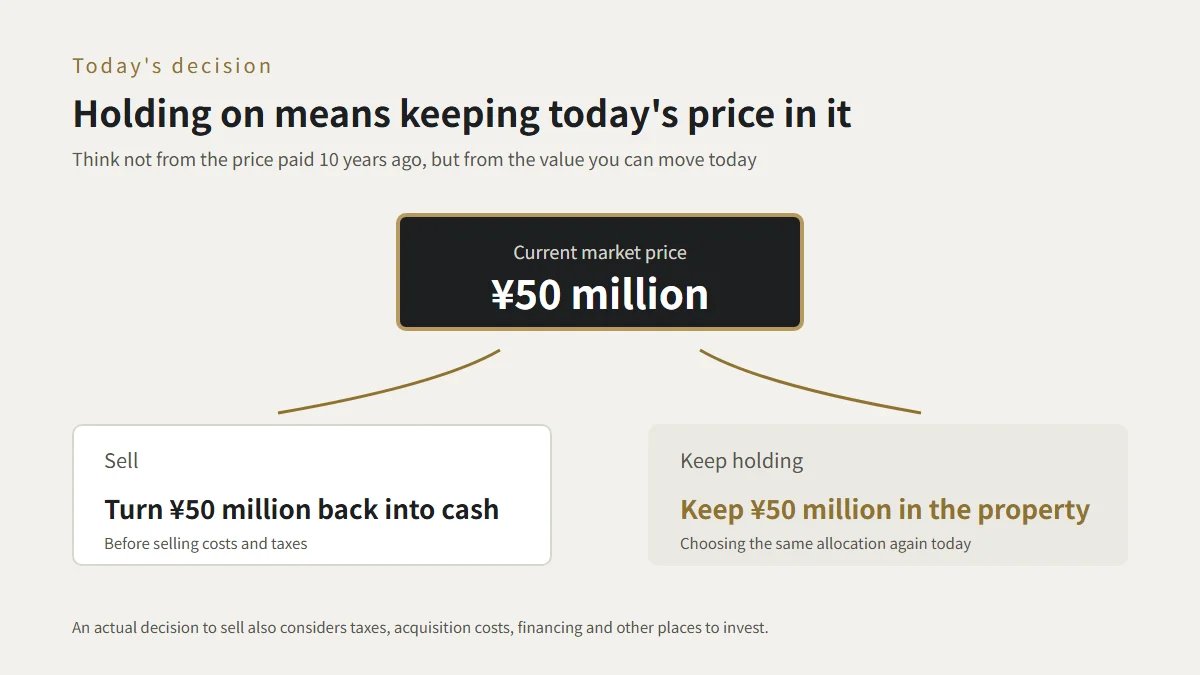
Yet the measures we use differ between when we buy and when we hold.
When buying, we calculate yields. Gross, net, debt-to-income ratio. We line up the numbers and compare.
While holding, we do not do that calculation.
Even if we do, we calculate using the price we paid as the baseline.
The price you paid no longer matters
The following is a fictional example for illustration.
Suppose a property bought 10 years ago for ¥45 million could sell for ¥50 million today.
Here you are tempted to think "I have a ¥5 million gain."
That is true, but it has nothing to do with decisions from here on.
The income this property will generate from now on, and whether it will go down or up from now on, are unrelated to the price you paid.
In the opposite case, this shows even more strongly.
A property bought for ¥45 million would now bring only ¥40 million. Here you think "I can't sell because it's below what I paid."
But the market does not know what you paid. Whether to keep holding a property worth ¥40 million now, at ¥40 million now. That is the only question.
Being below the purchase price is not a reason to keep holding. I understand the feeling, though.
That said, it is not exactly the same
Up to here is textbook talk; in practice, one more consideration comes in.
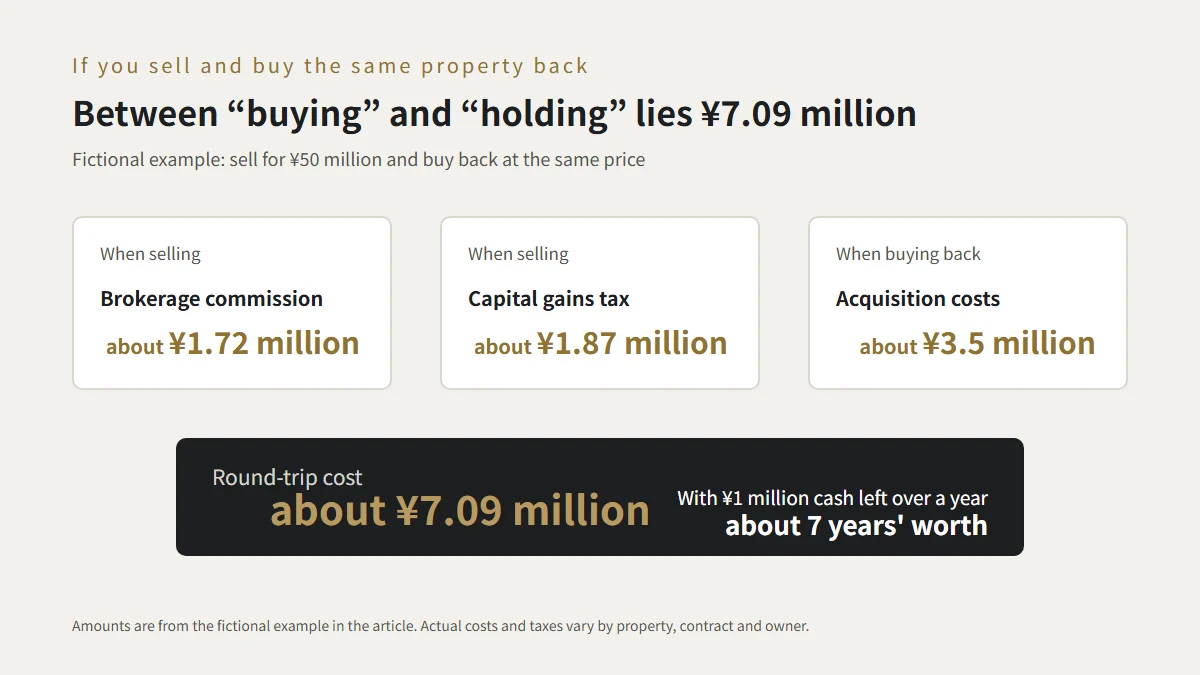
If you sell and buy the same property back, there are costs for the round trip.
Let us calculate with the earlier example.
Of the ¥45 million purchase price, the building is ¥27 million; ¥5.94 million has been depreciated over 10 years, so the book value is ¥39.06 million.
Selling for ¥50 million:
- Brokerage commission: about ¥1.72 million
- Tax on capital gains (transfer income): about ¥1.87 million
And if you buy the same property back, acquisition costs come again. At 7% of the price, ¥3.5 million.
In total, about ¥7.09 million.
Just letting go of a property and buying the same property makes ¥7.09 million disappear.
This is what justifies holding on.
If the annual cash left over is ¥1 million, ¥7.09 million is about 7 years' worth. In other words, unless circumstances change significantly within 7 years, holding on is more advantageous even if you are somewhat dissatisfied.
Between "would I buy at today's price" and "should I keep holding," there is a margin of ¥7.09 million. That is what it comes to.
So, let me fix the question a little
The first question was too harsh. Let me correct it.
It is not whether you would buy at today's price.
Would you buy it if you could buy it for ¥7.09 million less than today's price?
If you still would not buy, the reason for holding on already lies outside the numbers.
I am not saying that is bad. You may dislike the trouble of selling, or have nowhere to put the money next. There can be reasons.
But if you rephrase that as "because it is below what I paid," the decision gets postponed year after year.
And while you hold on, the building ages, and the next buyer becomes less able to get financing.
Do this calculation once a year. I think that alone is enough.
When choosing clothes in the morning, we check the weather forecast.
At that point, we are probably making the right decision.
But when the temperature rises by noon, we keep walking as we are. Thinking it's hot, we do little more than take off our jacket.

Because going back to change is a bother. That is rational in its own way, I think.
But what we are thinking about then is not whether the morning's decision was right.
It is which we choose, the trouble of going back or the heat.