
With the same ¥13.5 million, two people reach different answers
Even with the same own funds, the answer changes with your out-of-pocket limit and the time you can use. Using two fictional examples, we show the steps for checking your own conditions against the 5 axes.

BENERU writes for readers who live in Japan. Taxes, loans and the other rules described here are those of Japan, and they assume a resident of Japan.
This page is a translation of the Japanese original. If the two differ, the Japanese original prevails.
Good day. I'm Nel Shikina.
This is the last episode of this series.
Last time, when I reordered the 5 axes by "who decides," it came out four to one. Four decided by property type, one decided by you.
And only the one you decide yourself (the weight of borrowing) can be settled before you buy. So the order is: the loan amount first.
This time, we actually do the check.
Breaking down the word "suited"
Before that, one word.
"Which one am I suited to?"
This question sounds like a matter of personality. Cautious people go for condominium units, bold people for whole buildings. Some articles sort it that way, and as reading material it is interesting.
But speaking from the position of having looked at the numbers over the last five episodes, what decides whether something suits you is not personality.
It is conditions.
How much you can take out of pocket a year. How much time you can spend a month. How much cash you will need, and in how many years.
If these 3 differ, people with the same personality reach different answers. Conversely, people with opposite personalities reach the same answer if their conditions are the same.
So let us reread "suited" like this.
Which one can you hold without breaking your own conditions?
That can be calculated.
Two people
The following is a fictional example for illustration. These are not real people.
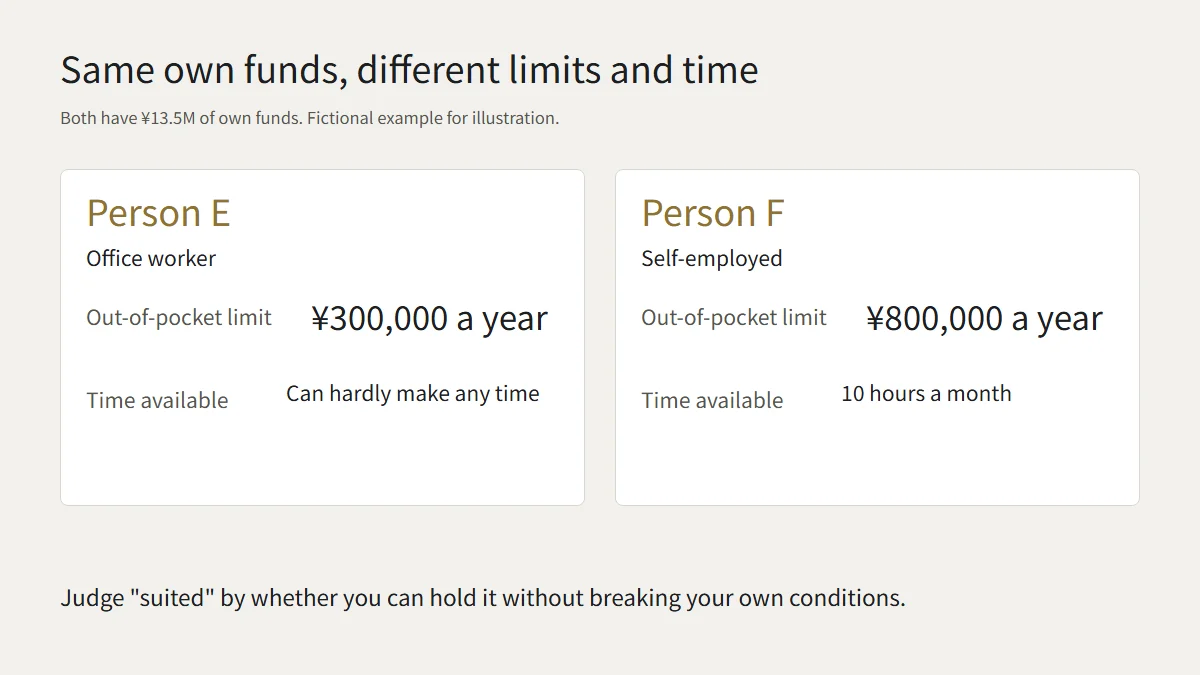
Both have ¥13.5 million in own funds. The 3 options from Episode 4 are the candidates, as they are.
| ① Condo, 1 unit | ② Condo, 2 units | ③ Whole building | |
|---|---|---|---|
| Borrowing | ¥18.5 million | ¥50.5 million | ¥40 million |
| Annual cash left over | +¥127,000 | −¥282,000 | +¥532,000 |
| Worst 1-year result | −¥935,000 | −¥1.345 million | −¥468,000 |
| Deterioration at +1% interest | ¥119,000 | ¥325,000 | ¥257,000 |
The "worst 1-year result" is set as decided last time. For condominium units, "vacant for 1 full year"; for a whole building, "30% vacancy."
For ①, even with zero income, expenses of ¥200,000 and repayment of ¥735,000 go out, so −¥935,000. For ②, with 1 of the 2 units vacant for 1 year, −¥1.345 million. For ③, at 30% vacancy, −¥468,000; with 3 units vacant, −¥768,000.
Note that ③'s cash left over of ¥532,000 is the figure after setting aside ¥192,000 for the exterior walls. Before setting it aside, it is ¥724,000. This ¥192,000 is subtracted every year as an expense, so there is no need to set aside more out of the ¥532,000.
Person E
A company employee. Out-of-pocket limit ¥300,000 a year. Borrowing ceiling, calculated with the method from Episode 5 of Series 1: about ¥46.6 million. Time available for this investment: almost none.
Person F
Self-employed. Out-of-pocket limit ¥800,000 a year. Borrowing ceiling, calculated the same way, is larger than Person E's. Can make about 10 hours a month.
The two have the same own funds. They are looking at the same 3 properties.
Person E's check
We start with Axis 3 (the weight of borrowing).
②'s borrowing is ¥50.5 million. That exceeds Person E's ceiling of ¥46.6 million.
At this point, ② drops out.
This is how the "order" I described last time works. However attractive ② may be, if it exceeds the ceiling, it is not a candidate for comparison. There is no need to look at cash left over or yield.
That leaves ① and ③.
Axis 1 (how income cuts off)
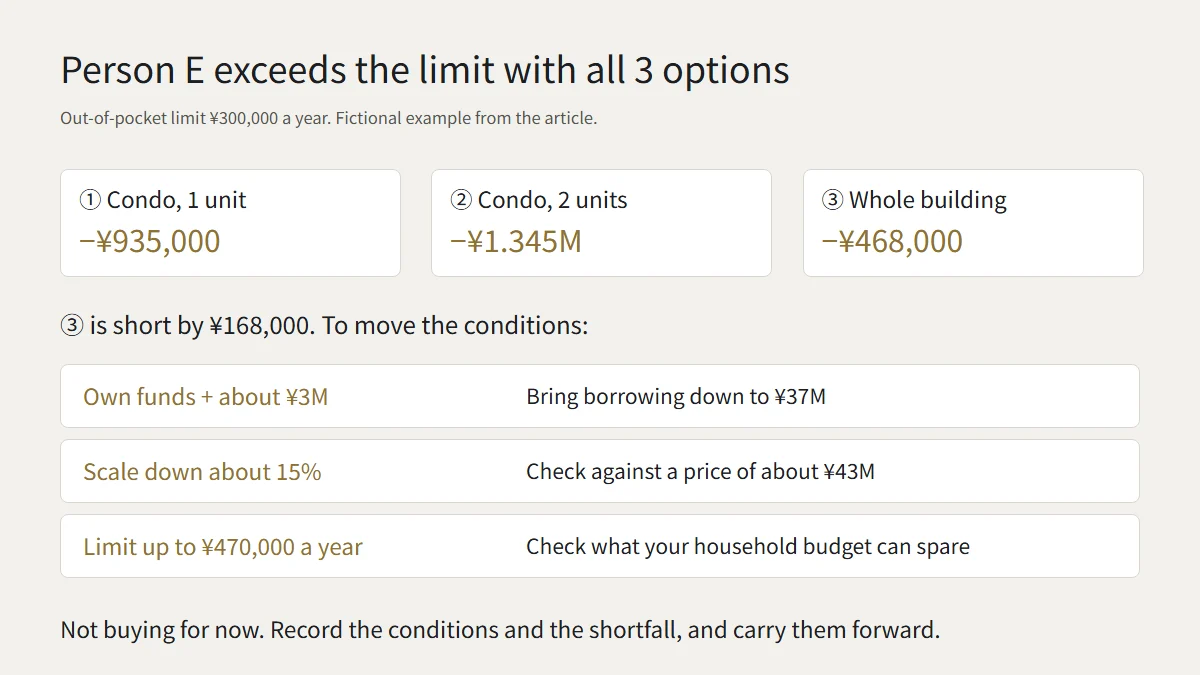
Person E's limit is ¥300,000 a year.
- ①: −¥935,000. Over the limit.
- ③: −¥468,000. Also over the limit.
All 3 have dropped out.
Stopping here is the correct procedure. There is no need to look at Axis 5 or Axis 4.
① does not pass, whatever you do
The reasons for dropping out are different for ① and ③. Let us look at ① first.
For ① to fit within the ¥300,000 limit, the worst 1-year deficit needs to be ¥300,000 or less. With zero income and ¥200,000 of expenses that cannot be moved, the only way is to bring repayment down to ¥100,000 a year or less.
At 2.0% over 35 years, the borrowing that fits within ¥100,000 a year of repayment is about ¥2.5 million.
To buy a ¥30 million property with ¥2 million of acquisition costs on ¥2.5 million of borrowing, you would need about ¥29.5 million of own funds. Practically a cash purchase.
In other words, holding 1 fairly new condominium unit in central Tokyo with borrowing cannot be set up so that it withstands "vacant for 1 full year" with a limit of ¥300,000.
This is not to say the property is bad. As we saw in Episode 2, a condominium unit's income is 0 or 100, and even at zero the fixed expenses and repayment remain. You can withstand it by making the repayment small, but that means not borrowing.
I should add that, in reality, it is not very common for a fairly new studio unit in central Tokyo to stay vacant for 1 full year. What this number measures is not how likely it is, but whether you are still standing if it happens. Deciding not to over-prepare is also a possible judgment. But the fact that you are not prepared is something you should hold knowingly.
③ gets quite close
③'s shortfall is ¥168,000 against the ¥300,000 limit.
This can be moved. There are 3 ways.
1. Increase own funds by about ¥3 million
If you bring borrowing down to ¥37 million, annual repayment is about ¥2.106 million. The deficit at 30% vacancy is ¥297,000, which fits within ¥300,000. The own funds needed are about ¥16.5 million. You currently have ¥13.5 million, so the gap is ¥3 million.
2. Reduce the scale by about 15%
With a property priced at around ¥43 million, with the same ¥13.5 million of own funds, the deficit at 30% vacancy is ¥295,000. It fits within the limit. Borrowing also goes down, so cash left over in a normal year hardly changes. The property is smaller, but that works better than holding a property that does not pass.
3. Raise the out-of-pocket limit to ¥470,000 a year
③'s worst 1-year result was −¥468,000. If the limit exceeds that, it passes under the current conditions. This number comes from the household budget, so it means going back to Episode 3 of Series 1.
Person E's answer is "not buying for now"
All 3 dropped out, so this is the conclusion.
This is not a failure. As I wrote in Episode 9 of Series 1, passing is a kind of decision.
But there is something to do when you pass. Record the conditions, and what was missing.
Person E's record would look like this.
Whole building, price ¥50 million, own funds ¥13.5 million, borrowing ¥40 million (3%, 25 years).
−¥468,000 at 30% vacancy. ¥168,000 short of the ¥300,000 out-of-pocket limit.
Passes with ¥3 million more in own funds, or with the scale reduced by 15%.
With these three lines, the next time you look at a property, you only need to plug in the price and own funds to see whether it passes.
And knowing that what you lack is ¥3 million is completely different from not knowing what you lack. If you can only set aside ¥150,000 a year, it would take 20 years, so reducing the scale would be quicker. That is the kind of judgment you become able to make.
Person F's check
We look in the same order.
Axis 3
Person F's ceiling exceeds ②'s ¥50.5 million. All 3 remain candidates.
Axis 1
Person F's limit is ¥800,000 a year.
- ①: −¥935,000. Over the limit. Drops out.
- ②: −¥1.345 million. Over the limit. Drops out.
- ③: −¥468,000. Within the limit.
Only ③ remains.
Here, the way the order works shows up once again.
①'s borrowing is ¥18.5 million, the smallest of the 3. Even so, it dropped out.
Borrowing little does not help when income stops.
What stops is income; what remains is repayment and fixed expenses. The whole building held up not because borrowing was small, but because its income did not stop entirely. Axis 3 and Axis 1 measure different things.
Axis 5 (time)
10 hours a month. Person F can use ③'s freedom. By changing the property management company, the ¥80,000 a year from Axis 2 can be recovered, and rent can be tested at each round of tenant recruitment. Without the time, none of this happens.
Axis 4 (exit)
This is ③'s weak point. Person F is self-employed with income that swings widely, and situations where cash is suddenly needed can be expected, but ③ can only be sold as all 8 units together.
However, since ① and ② dropped out under Axis 1, ③ is the only form that can be chosen. It will be held with this weak point remaining. The way to deal with it is to set aside the ¥532,000 that comes in each year. That is more reliable than raising cash by selling.
Person F's answer
③.
The same amount, different answers
Person E: "not buying for now." Person F: ③.
Their own funds are the same. The candidate properties are the same 3.
The only differences were the out-of-pocket limit and the time available each month.
In Episode 1, I wrote this.
There is basically no way to raise only the return without taking on risk. When it looks as if the return is rising, it is one of these: there is a risk you cannot see yet, you are doing the work yourself, or you got lucky.
Person F has time, so can go after the return by putting in work. Person E does not.
But in Person E's case, we never got as far as time. It stopped earlier, at Axis 1.
The ③ that Person F chose is not an answer for Person E.
It is the same property. The contents are the same.
The steps to do it yourself
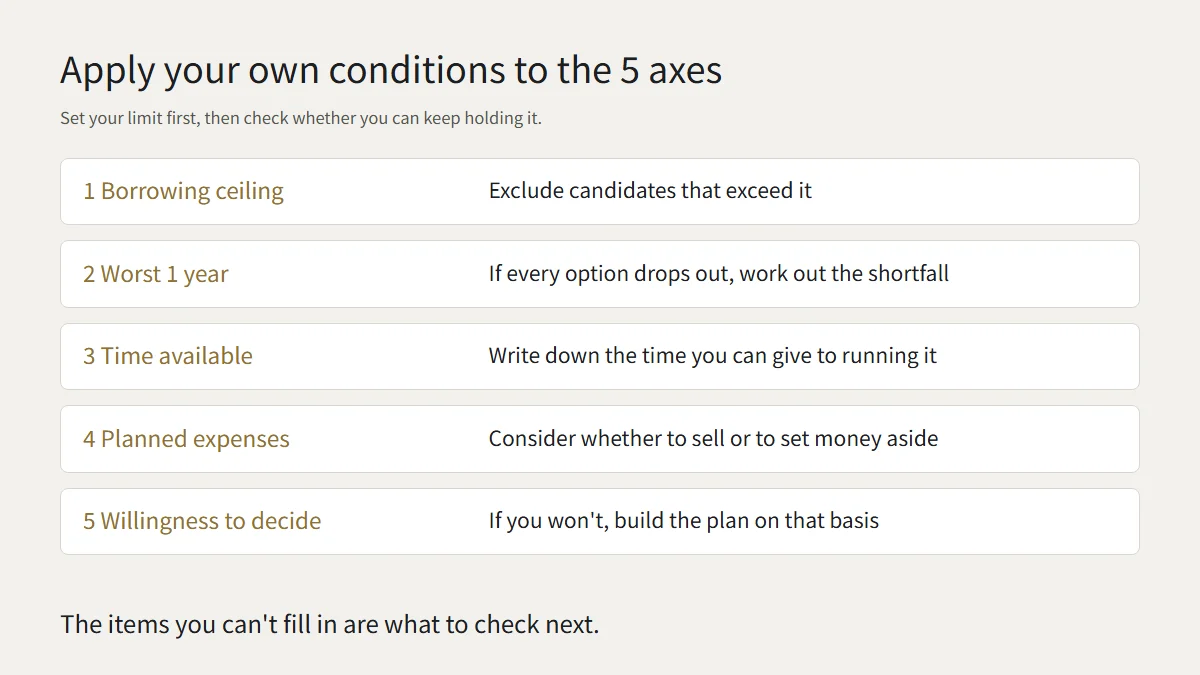
Apply the 5 axes in this order.
- Fix your borrowing ceiling (Axis 3)
Work it out backwards from your out-of-pocket limit. Series 1, Episode 5. Exclude any candidate that exceeds it, however good everything else is.
- Calculate the worst 1-year result (Axis 1)
For a condominium unit, "vacant for 1 full year"; for a whole building, "30% vacancy." Is the resulting deficit within your out-of-pocket limit?
Everything may drop out here. If it does, work out how much you are short. Once you know the shortfall, you can choose which to move: own funds, scale, or your limit.
- Write down the time you can use each month (Axis 5)
If you cannot make the time, calculate as if the advantages of a whole building cannot be used. Do not count as value what you cannot use.
- Check planned expenses within 5 years (Axis 4)
If you plan to need a large sum of cash, is it a form you can sell in parts, or can you set enough aside by then?
- Are you willing to make the building decisions yourself? (Axis 2)
Not being willing is not a flaw. You simply build the numbers on the assumption that you will not. Building them on the assumption that you will, and then not doing it, is the worst.
Quite a few people drop out of everything at 1 and 2.
Stopping there is not failing to move forward; it means you found out before you bought.
If you could not fill it in
I think fewer people can fill in everything. The items you could not fill in are what to check next.
- 1 → Go back to Episodes 3 and 5 of Series 1
- 2 → How to read a property brochure. Episode 6 of Series 1
- 3 → You will not find this by researching. Try recording the time you spend on real estate tasks for 1 month
- 4 → Planned household expenses. Episode 3 of Series 1
- 5 → The answer is "I won't." People who want to do it do not hesitate
In Episode 2 of Series 1, I wrote that the place where your hand stops is where you are right now. It is the same thing.
Finally, our own position
In this series, I have not once presented an actual property. Only fictional examples.
One reason is that BENERU is preparing to obtain a real estate brokerage license under the Building Lots and Buildings Transaction Business Act (Takken Gyōhō), and is not in a position to introduce individual properties. It was a policy that started from a constraint.
But having finished writing, I think this constraint suited the series. Because I could not present properties, I ended up writing only with material from outside the property. The result was last episode's four to one. Most of the material for the decision was on your side, not on the property's side.
Even when we are able to introduce properties, this order will not change. If you show properties to someone whose conditions are not yet decided, they have no standard to compare against, so they end up comparing by the standard we present.
That is not a proposal. It is steering.
What we were looking for was not a good investment.
Risk and return are exchanged. Something with a high yield is high as payment for taking something on. Something that looks safe is something you are paying a price for that safety. Neither is a gain or a loss.
So it is you who decides.
To achieve your own goals, which risks can you take on?
Condominium unit or whole building comes out as the answer to that. It is not something to decide first.
And, like Person E this time, the answer may be that you cannot take on any of them. That is also an answer. If the shortfall has come out as a number, what to do next is also decided.
Thank you for staying with me through six episodes. How to look at properties is covered in Episodes 6 and 7 of Series 1.