
A contract is not signed all at once
When you buy a property with financing, there are 4 moments when you sign. The other party, what gets decided, and what you need to check if you want to back out are different each of the 4 times. We start by drawing a map of what stops being movable at each stage.

BENERU writes for readers who live in Japan. Taxes, loans and the other rules described here are those of Japan, and they assume a resident of Japan.
This page is a translation of the Japanese original. If the two differ, the Japanese original prevails.
Good day. I'm Nel Shikina.
Over the previous series, we worked out your own numbers, translated a property into those numbers, and got as far as deciding whether to buy or pass.
From this article on, we deal with the procedures that come after you decide to buy.
Many people call this whole stretch by a single word, "the contract." In reality, there are 4 moments when you sign. The other party, what gets decided, and what you need to check if you want to stop partway are different each of the 4 times.
One note first. These 4 signings are an explanatory model that organizes a typical transaction using financing into 4 stages. If you pay cash, or sign electronically, the number of signings itself changes. What I want you to remember is not the number, but the shape: the other party and what gets decided differ at each stage.
This time, we make the map. From the next article on, we look at the procedures one at a time.
There are 4 moments when you sign
| What you sign | Other party | What gets decided | |
|---|---|---|---|
| 1 | Letter of intent to purchase (kaitsuke shōmeisho) | Seller (with the brokerage firm in between) | An offer of price and terms |
| 2 | Sale contract | Seller | Formation of the sale, earnest money, terms of handover |
| 3 | Loan agreement (kinsen shōhi taishaku keiyaku) | Lender | Loan amount, interest rate, loan term, collateral |
| 4 | Settlement and registration documents | Seller, lender, judicial scrivener (shihō shoshi) | Payment of the price and transfer of ownership |
Notice that the 2nd and the 3rd are separate.
The contract you sign with the seller and the contract you sign with the bank are different contracts.
This looks obvious, but if you think of them as one continuous thing, you miss the chance to check the financing terms yourself. The brokerage firm is not a party to the sale, and it is not in a position to decide the terms of your contract with the lender either.
What you check when backing out changes with the stage
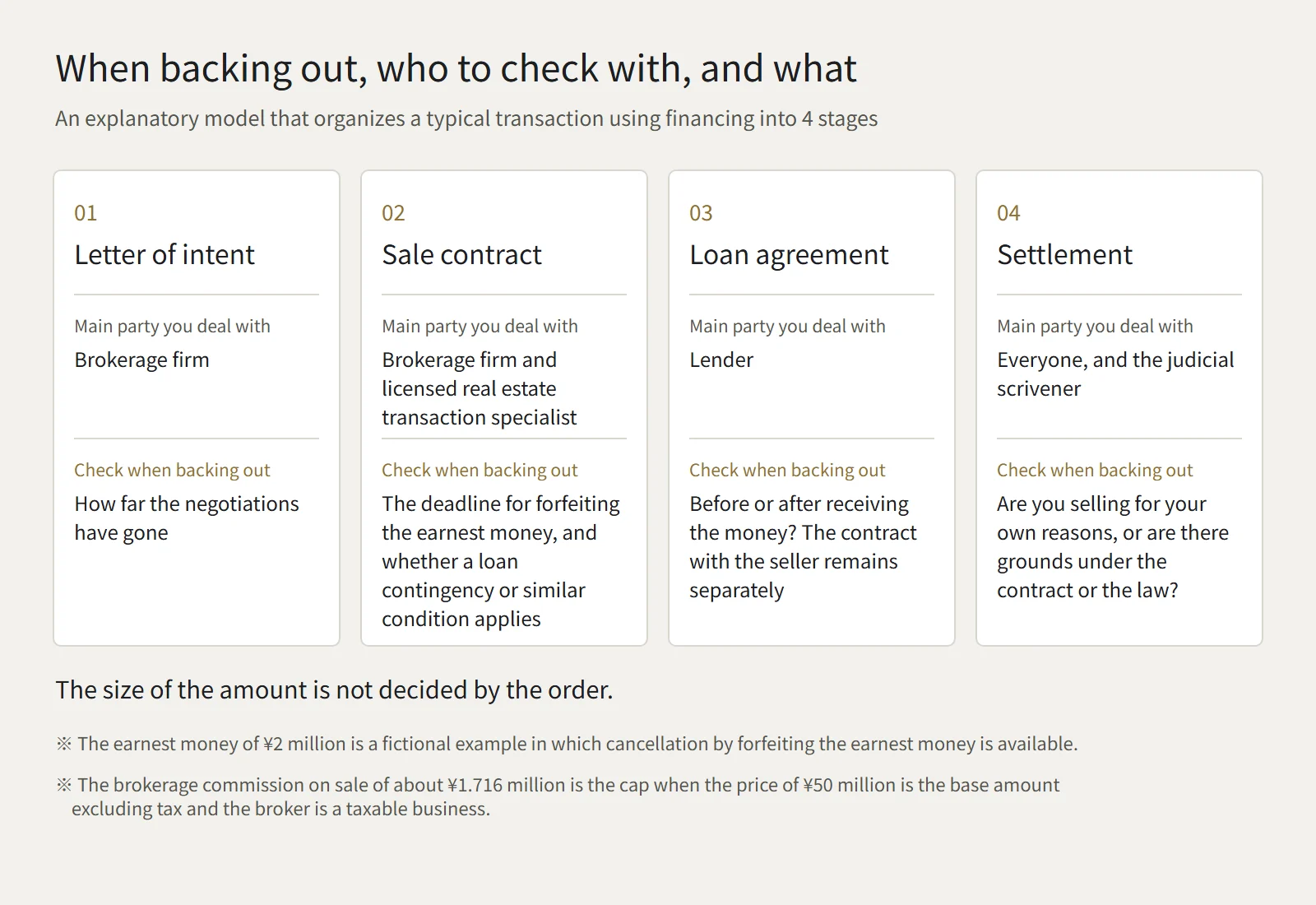
The 4 stages are not simply lined up in a row. When you try to back out, who you check with, and under what conditions, changes.
The following is a fictional example for illustration.
Suppose you sign a contract for an income property with a purchase price of ¥50 million, with earnest money of ¥2 million (4% of the price).
Stage 1: after submitting a letter of intent to purchase
You submitted a letter of intent to purchase, and a letter of consent to sell (uriwatashi shōdakusho) came back. There are court decisions holding that a sale contract was not formed at this stage alone. If the terms cannot be agreed, you can withdraw.
However, the name of the document does not decide the outcome. It depends on what is written and how specifically the parties have agreed. We look at that in the next article.
Normally, no cost arises. What you lose is the trust of the seller and the brokerage firm. This does not show up as an amount, but it is not zero either. The next introduction from the same company becomes less likely.
There is one more exception. If negotiations have advanced considerably, and the other party is acting in the belief that a contract will be formed, breaking off unilaterally can lead to liability under the principle of good faith. It is not settled that this stage always costs ¥0.
Stage 2: after signing the sale contract
Here, for the first time, options with a price attached appear.
If the buyer backs out, it takes the form of forfeiting the earnest money. In this example, ¥2 million. If the seller backs out, the seller must actually tender double the earnest money.
However, this applies only when cancellation by forfeiting the earnest money is available. It cannot be used after the other party has commenced performance of the contract. The contract may also contain a clause setting a deadline. Before the amount, you need to check whether it can be used at all.
There is another route: the financing contingency (loan contingency clause). Its content is that if financing approval is not obtained by a set date, the contract can be cancelled and the earnest money is returned. This is not attached automatically by law; it works only when the parties have agreed to it. To avoid disputes later, the date, the target lender, and the amount are written into the contract.
Stage 3: after signing the loan agreement
The borrowing is fixed. Even so, it is not that there is no route at all. For a loan made in writing, the borrower is considered able to cancel the contract until receiving the money.
Care is needed here. That cancellation concerns the contract with the lender. It does not erase your obligations under the sale contract with the seller. If you cannot pay the price, that becomes a question of breach on that side.
This is where the fact that the 2 contracts are separate starts to matter. We look at it in detail in the article on the 3rd signing.
Stage 4: after settlement is complete
Ownership passes to you. If you want to let go of the property for your own reasons, you sell it.
It is different when there are grounds under the contract or the law. You find something that differs from what you were told, or the other party does not fulfil its obligations. In such cases, the routes of cancellation or claiming damages remain, but that is a matter of "holding someone liable," not "backing out," and the premise is different.
Here are the costs of selling for your own reasons. When the sale price exceeds ¥4 million, as in this example, the cap on the brokerage fee is "3% of the price + ¥60,000," plus consumption tax. This is a quick-calculation formula applied to the whole price; it does not mean that 3% is charged only on the portion above ¥4 million.
For a price of ¥50 million, that is about ¥1.716 million. This calculation assumes the ¥50 million is the base amount excluding consumption tax and the like on the sale, and that the brokerage firm is a taxable business. And it is a cap; it is not settled that the fee will be this amount.
On top of this, if there is a gain, tax on the transfer applies. If you buy again, the acquisition costs of a purchase come round once more.
The size of the amount is not decided by the order
Let me make one thing clear.
It is not the case that the further you go through the stages, the larger the cost.
Line them up using the example above. Earnest money at stage 2: ¥2 million. Cap on the brokerage fee at stage 4: about ¥1.716 million. The fee is smaller. Tax on the transfer does not arise if there is no gain, and buying again does not happen unless you choose it.
So if you remember it as "the later the stage, the more expensive," you will get it wrong.
Then what changes as you go forward?
The number of routes you can choose, and their conditions.
At stage 1, there is the route of withdrawing. At stage 2, there are 2 routes, cancellation by forfeiting the earnest money and the loan contingency clause, and both come with conditions. At stage 3, you have to count the contract with the lender and the contract with the seller separately. At stage 4, it becomes a question of selling or continuing to hold.
It is not that it costs more as you go forward. As you go forward, there is more to check before you choose.
This is what to keep as your map.
The deadline is not the settlement date
This is what I most want to convey in this article.
Many people think of the settlement date as "the day of the final decision."
It is not.
The deadline for your decision is the day you sign the sale contract.
On that day, the conditions for backing out for your own reasons are fixed. If you change your mind because of information that comes out after that, you cannot go back for free unless those conditions apply.
So everything you need to look into must be finished before the contract date.
- Have you seen the site?
- Have you read the contents of the rent roll and the lease agreements?
- Have you checked the repair history and the repairs that will be needed from now on?
- Have you confirmed the boundaries and the certificate of inspection (kensa zumi shō)?
- Have you sounded out lenders on the prospects for financing?
If you try to check these at the contract table, you will not make it in time. It is not unusual for the explanation of important matters (jūyō jikō setsumei) to take place just before the contract, and if there are facts you learn for the first time there, you end up proceeding to the signing without time to judge.
The explanation of important matters is the last chance to confirm, not a chance to investigate.
So ask for the explanation and the documents early. And if unclear points remain, you can choose to postpone, or to pass. There is no rule that you must sign with things unconfirmed.
Let me think about it once from the opposite side.
Then should you simply not sign until you have finished investigating?
That alone does not always work. The seller has circumstances too, and many sellers are moving with a settlement date in mind. If they find they will be kept waiting, they may move on to the next buyer. The order in which letters of intent were submitted is not the order in which sellers will wait.
So what you do is not "delay" but "investigate ahead of time."
Count the few days to 2 weeks between submitting the letter of intent and the contract date as your investigation period from the start. Rather than rushing to move once the contract date is set, decide at the letter-of-intent stage who you will ask about what.
Even with the same number of days, the amount of information that comes in differs between someone who has prepared and someone who has not.
A rough timeline
From the letter of intent to settlement takes roughly 1 to 2 months. A rough breakdown:
- From the letter of intent to the sale contract: about a few days to 2 weeks
- Final loan review: about 2 weeks to 1 month
- From the loan agreement to settlement: about 1 week
This moves a lot depending on conditions. The seller is in a hurry to settle, you are waiting for a tenant to move out, an inheritance is involved and there are several sellers. Each of these changes the timeline.
Who you ask differs by party
At each of the 4 stages, you deal with a different party.
| Stage | Main party you deal with |
|---|---|
| Letter of intent to purchase | Brokerage firm |
| Sale contract | Brokerage firm and licensed real estate transaction specialist (takken-shi) |
| Loan agreement | Lender |
| Settlement | Everyone, and the judicial scrivener |
If you think "the brokerage firm will do everything," the 3rd one gets left out. The type of interest rate, the loan term, whether to take group credit life insurance (dantai shinyō seimei hoken), the fee for prepayment. These are matters between you and the lender, not something the brokerage firm decides.
If you ask the wrong party, the answer you get back is "that's just how it is." It is not a lie. It is simply not that person's area.
One more thing: how much choice you have differs by party.
You cannot choose the seller. The seller comes with the property.
As for the brokerage firm, sometimes the seller's firm acts directly as your point of contact, and sometimes the buyer goes through a firm the buyer engaged. It depends on the form of the transaction.
The judicial scrivener may be designated by the lender. On the other hand, some lenders state that the buyer can choose the scrivener for registrations other than the creation of the mortgage. Ask who will arrange it before the settlement meeting.
And with lenders, you can put the same terms to several of them and line up the results. Of the 4, this is where the act of comparing works most directly.
In the previous series, we saw that much of the difference in interest rates comes not from the borrower's negotiating power but from the lender's circumstances. That is why what you do is choose rather than negotiate. And this is the stage where that choice works best.
The 4 signings are not a staircase that gets steadily heavier.
At the 1st, there is little to check. At the 2nd, the conditions are fixed; at the 3rd, the parties increase; at the 4th, the property moves. All that differs is what you look at at each step.
So the question "how far can I go before there is no turning back?" is framed slightly off. If you are going to ask a question, ask this one:
If I stopped at this stage, who would I have to check with, and about what?
Next time, we look at the 1st signing. What a letter of intent to purchase promises, and what it does not. Even on a sheet that does not bind the other party, there are things you should still write down.