
A letter of intent to purchase does not bind the other party
An ordinary letter of intent to purchase has no power to bind the other party. But the terms you write in it become, as they are, the draft of the sale contract. After separating what binds and what does not, we organize the items to write down and how to handle a request for an application deposit.

BENERU writes for readers who live in Japan. Taxes, loans and the other rules described here are those of Japan, and they assume a resident of Japan.
This page is a translation of the Japanese original. If the two differ, the Japanese original prevails.
Good day. I'm Nel Shikina.
Last time, we made a map showing that there are 4 moments when you sign before you buy a property. This time, we look at the 1st of them: the letter of intent to purchase (kaitsuke shōmeisho).
This sheet is usually explained in roughly one sentence:
"It has no legally binding force."
That is not wrong. But if the explanation ends there, 2 misunderstandings remain.
One is "so you can submit it casually." The other is "so it doesn't matter what you put in it."
Both are wrong.
Splitting "binding force" into 3
Let me break down the phrase binding force.
- Does this form a sale contract?
- Does the other party become obliged to sell?
- Do you become obliged to buy?
With an ordinary letter of intent to purchase, the answer to all 3 is "no."
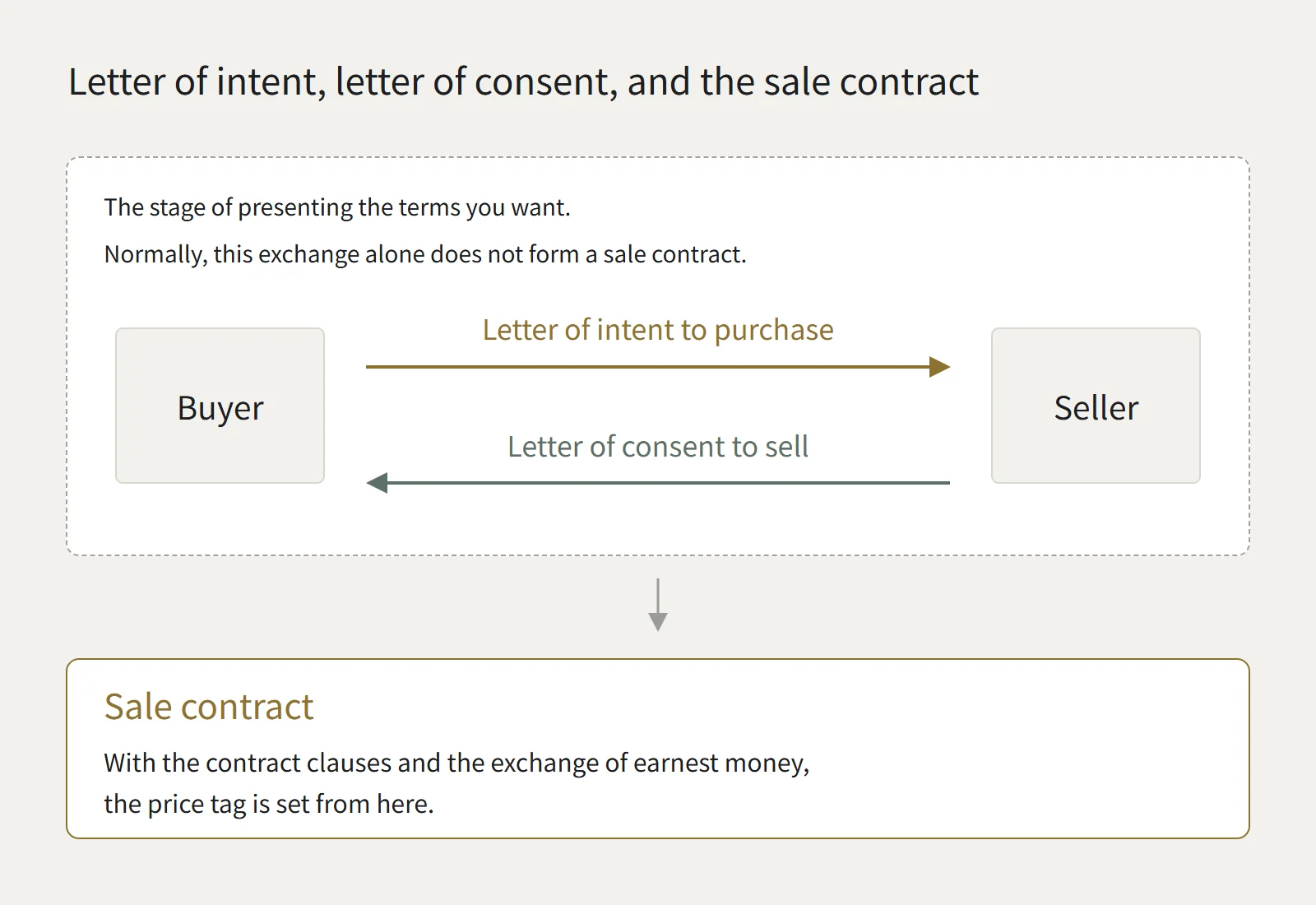
Court decisions broadly follow this line. In its judgment of April 26, 1990 (Heisei 2), the Osaka High Court held, in a case where a letter of intent to purchase and a letter of consent to sell (uriwatashi shōdakusho) had been exchanged, that this alone did not validly form a sale contract. The reasoning is that even if the seller unilaterally indicates an intention to sell, that does not make a contract; a contract is formed only when the seller and buyer negotiate specifically and reach agreement.
There is one reservation that cannot be left out here.
The name of the document does not decide the outcome. What is written, and how specifically the parties have agreed: depending on that, there is room for a contract to be found to have been formed, whatever the sheet is called. The point is not "it is called a letter of intent to purchase, so no contract is formed," but "with the contents of an ordinary letter of intent to purchase, these 3 things are not yet decided."
In its judgment of June 30, 1975 (Shōwa 50), the Tokyo High Court gave weight to the established practice in real estate transactions of preparing a contract and exchanging earnest money or a partial payment. The stage of exchanging these sheets comes before that practice.
In other words, a letter of intent to purchase is treated not as a definitive offer to buy, but as a document expressing a wish to buy.
That is the side of what does not bind.
There is one thing that binds
The terms you wrote yourself.
This is not a legal constraint. It is a constraint in negotiation.
If you write a price, that price becomes the starting point of the negotiation. If you try to lower it later, you will be asked for a reason. If you write an amount of earnest money, that amount is often carried over into the sale contract.
And terms you did not write are not conveyed to the other party.
There is room to add them later and reach agreement. But at that point they are treated as additional terms, and one more separate negotiation is added. If they were written at the letter-of-intent stage, the conversation moves forward from the point where the other party started acting on that basis.
This is where it matters in practice.
While a letter of intent to purchase is a sheet without binding force, it is used as the draft of the sale contract. Many of the terms that appear at the contract table are things you wrote here, carried over as they are.
So, apart from whether it has binding force, its contents matter.
Items to write down
For each item, here is what happens if you do not write it.
| Item to write | What happens if you don't |
|---|---|
| Purchase price | The starting point of negotiation stays at the seller's asking price |
| Amount of earnest money | You have to judge, on the spot, the amount presented at the contract table |
| Whether you will use financing, and the amount | That you are relying on financing is not shared, and you are more likely to be asked to sign without a contingency |
| Deadline for obtaining financing approval | The date in the loan contingency clause gets cut short, counted back from the seller's preferred settlement date |
| Preferred contract date | You cannot secure a period for investigation |
| Preferred settlement date | The schedule is set so that the final loan review cannot make it in time |
| Expiry date of this document | You cannot share with the other party until when your terms are valid |
| Treatment of equipment and items left behind | The condition at handover is not settled, and disputes arise just before settlement |
| Terms for taking over the lease agreements | Gaps between the rent roll and the actual lease contents come out after the contract |
Everything in the right-hand column happens at the sale contract table or after it.
If you write it at the letter-of-intent stage, the other party starts acting on that basis. If you leave it out and raise it at the contract table, it is treated as an additional term. Even with the same content, how it is treated changes with where you put it.
Last time, we saw that the deadline for your decision is the day you sign the sale contract. The letter of intent to purchase is one of the few places where you can set out your terms together before that deadline.
When you are asked for an application deposit
Along with the letter of intent, you may be asked for a sum of about several tens of thousands of yen up to ¥100,000. What it is called varies by company: application deposit (mōshikomi shōkokin), application fee (mōshikomikin), money held in deposit (azukarikin), and so on.
Let me split one term here.
Money held in deposit is not part of the price. It is not earnest money either. It is money you hand over temporarily so that your intention to apply can be confirmed.
If no contract results, it comes back to you.
In the Ministry of Land, Infrastructure, Transport and Tourism's published guidance on interpreting and applying the Building Lots and Buildings Transaction Business Act (Takken Gyōhō), under Article 47-2, a licensed real estate broker refusing to return money held in deposit it has already received, when the other party withdraws an application for a contract, is listed as a prohibited act.
So when you hand it over, there are 2 things to check.
1. Check what you are handing it over as. Is it money held in deposit, or earnest money? If it is treated as having been exchanged as earnest money, the story changes.
2. Check the paper you receive. For money held in deposit, it is a deposit receipt. If a receipt for payment comes out instead, ask what it is a receipt for.
There is one caution here.
The name on the paper does not decide the nature of the money. Whether a contract has been formed, and what the money was exchanged as: those are what decide it, and the name on the paper is only a clue.
There is also the problem in reverse: money that was not in fact exchanged as earnest money, but the receipt is simply titled as earnest money and its return is refused. Among the consultation cases published by Osaka Prefecture is one in which the prefecture issued a written recommendation to a broker that, although no contract had been formed, refused to return an application fee and had issued it as an "earnest money receipt."
Writing "earnest money receipt" on a sheet does not make it earnest money.
It is quicker to ask before you hand it over, so please ask before you hand it over.
The seller has a sheet too
The document the seller issues in response to a letter of intent to purchase is called a letter of consent to sell. It indicates an intention to sell, and it is not a contract either.
The names vary by company. On the buyer's side: purchase application (kōnyū mōshikomisho), purchase offer application (kaitsuke mōshikomisho), letter of intent to purchase. On the seller's side: letter of consent to sell, certificate of intent to sell (uriwatashi shōmeisho).
Look not at the name but at what is written. If an amount, a deadline and terms are written, that is the content of the negotiation, whatever it is called.
One more thing. A letter of consent to sell being issued does not mean your place in line is fixed.
There can be several letters of intent. The seller is not looking only at the price. Financing or cash, the number of days to settlement, the number of contingencies. The seller compares the terms as a whole.
The letter of intent with the highest price is not necessarily chosen. Conversely, a letter of intent with a lower price can get through on terms such as paying cash and settling quickly.
So when you submit a letter of intent, it is easier to move if you do not use price as your only negotiating tool. Among the terms you can offer, there are things the other party wants besides price.
Once, from the opposite side
If it has no binding force, can you casually submit as many as you like?
No. There are 2 reasons.
First: withdrawing after negotiations have advanced can come with a cost.
In its judgment of June 29, 1995 (Heisei 7), the Fukuoka High Court accepted a claim for damages on the basis of culpa in contrahendo (fault in contract negotiations). The reasoning is that if negotiations have advanced considerably, and the other party is acting in the belief that a contract will be formed, breaking off unilaterally can lead to liability under the principle of good faith.
That no contract has been formed and that no liability at all arises are separate matters. As I mentioned last time as an exception, when negotiations have gone deep, it may not end with merely losing trust.
Second: the number of times itself matters.
If you repeat the pattern of submitting and withdrawing letters of intent, the way the brokerage firm treats you changes. The order of introductions is decided not by law but by the other party's judgment. It is a cost that does not show up as an amount, but it is not zero.
On the other hand, if you do not submit one, nothing starts.
So what you do is not "submit fewer" but "decide your terms before you submit." Price, earnest money, financing, schedule. If these 4 are settled in your own mind, your letters of intent will not waver in content however many times you submit them. If they do not waver, you can also explain a withdrawal.
The precision of a letter of intent to purchase is decided not by the time you spent looking at the property, but by the time you spent working out your own numbers.
Let me add one more point, about order.
Start talking to lenders about financing before you submit the letter of intent.
If you start looking for a lender after submitting the letter of intent, the contract date arrives before the review result comes out. Then either the date in the loan contingency clause gets cut short, or you are asked to sign without the contingency. Both narrow the buyer's options.
Recall the rough timeline from last time. From the letter of intent to the sale contract is about a few days to 2 weeks, and the final loan review takes about 2 weeks to 1 month. If you move in that order, you will not make it in time. Talking to lenders about financing is the one task placed before the letter of intent.
Things go faster if you also gather the documents you will be asked for at that point in advance.
- Identification documents, certificate of residence (jūminhyō), seal registration certificate (inkan shōmeisho)
- Withholding tax statement (gensen chōshūhyō) or tax returns (for the most recent 2 to 3 periods)
- Documents confirming your employer and enrollment in social insurance (what to submit depends on the lender's instructions; because the conventional health insurance card expired by December 1, 2025, this will be a My Number health insurance card or a certificate of eligibility (shikaku kakuninsho))
- Something showing the balances of your savings and securities
- Balances and repayment schedules of existing loans (including mortgages, car loans and student loans)
- A single sheet listing your assets and liabilities
The last sheet can be the one you made in episodes 2 and 3 of series 1, as it is. If you can start the conversation with it in hand, you can answer the other party's questions immediately.
Suppose you receive a quotation for renovation work.
Receiving a quotation does not start the work. The amount can change, and you are free not to order it. You are not bound.
But work that was not written in the quotation will later be called "a separate charge." It is not a lie. It really was not written.
A sheet with no power to bind, and yet whether something is written on it matters later.
It is not that what is written binds you; it is that what is not written leaves you with fewer options.
When you face a letter of intent to purchase, the question is not how much to promise.
It is, I think, what you have left out.