
The rules that protect you depend on the seller
The cap on earnest money, the cap on penalties, the limits on special clauses about liability for non-conformity. The buyer protections in the Building Lots and Buildings Transaction Business Act work only when a licensed real estate broker is itself the seller. The seller of an income property is often not a licensed broker, and what remains then is the Civil Code and special clauses. We organize where to check in the sale contract.

BENERU writes for readers who live in Japan. Taxes, loans and the other rules described here are those of Japan, and they assume a resident of Japan.
This page is a translation of the Japanese original. If the two differ, the Japanese original prevails.
Good day. I'm Nel Shikina.
We look at the 2nd signing: the sale contract.
As you will have gathered from the previous articles, this is the deadline for your decision. The moment you sign, a price tag equal to the earnest money is set, and from then on, if you back out for your own reasons, you cannot go back for free. Separately, there are mechanisms such as the loan contingency clause, under which the earnest money is returned if set conditions apply. We look at those too.
This time, the topic is where to look in the contract. Before that, one thing.
Even with the same contract, how the law protects you changes depending on who the seller is.
If you read only the clauses without knowing this, you cannot tell "that's unavoidable" apart from "that's wrong."
Splitting "special clause"
Let me reposition the term special clause (tokuyaku).
It tends to be taken as something added on favorable terms. The loan contingency clause is the typical example, so that is a reasonable way to take it.
But the real role of a special clause is different.
It is a device for rewriting the principles of the Civil Code by agreement between the parties.
The rewriting can go in either direction.
- Loan contingency clause: adds a right of cancellation for the buyer that is not in the Civil Code
- Special clause exempting liability for non-conformity with the contract (keiyaku futekigō sekinin): removes a buyer's right that is in the Civil Code
Under the same name, "special clause," things that add and things that remove sit side by side.
So the question to ask when reading a contract is not "is there a special clause?"
It is which direction the special clause goes.
And how far a removing clause is held in check depends on the seller.
Which rules apply changes with who the seller is
The Building Lots and Buildings Transaction Business Act (Takken Gyōhō) contains rules that apply only when a licensed real estate broker is itself the seller. They are provisions for protecting the buyer, and there are 8 of them.
Here are the 3 that bear directly on the sale contract table.
| Content | Basis | |
|---|---|---|
| Amount of earnest money | The broker may not receive earnest money exceeding 2/10 of the price | Article 39 of the Building Lots and Buildings Transaction Business Act |
| Penalties | The total of liquidated damages and penalties accompanying cancellation for non-performance must not exceed 2/10 of the price | Article 38 of the same Act |
| Liability for non-conformity | For non-conformity in type or quality, special clauses less favorable to the buyer than the Civil Code are prohibited, except a clause making the notice period under Article 566 of the Civil Code 2 years or more from the date of handover | Article 40 of the same Act |
These 3 apply when a licensed real estate broker is itself the seller. They do not apply when a licensed broker is merely in between as an intermediary.
Think back to income property transactions. The seller is usually an individual or a corporation without a real estate brokerage license. A brokerage firm comes in, and the transaction is completed.
In this form, the 3 rules above do not work.
| Seller | The 3 rules above |
|---|---|
| Licensed real estate broker (itself the seller) | Apply |
| Seller who is not a licensed broker (with a brokerage firm in between) | Do not apply |
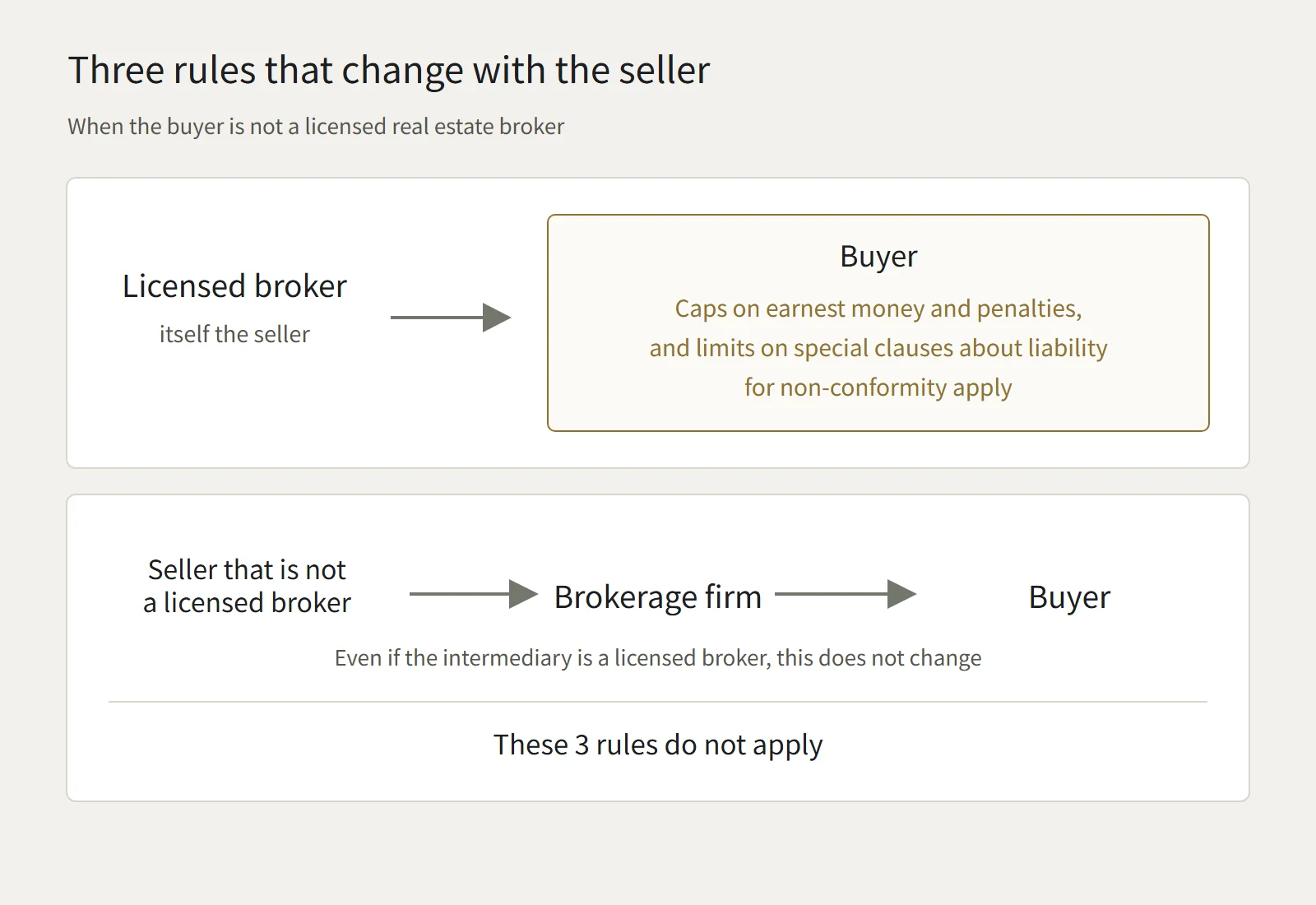
That the brokerage firm is a licensed broker and that the seller is a licensed broker are separate matters. The brokerage firm gives the explanation of important matters (jūyō jikō setsumei), but the cap on earnest money and the check on liability for non-conformity are decided by the attributes of the seller.
Let me look at the other side too.
Article 78, paragraph 2 provides that these 8 rules "do not apply to transactions between licensed real estate brokers." What is excluded is a transaction in which both the seller and the buyer are licensed brokers.
So if the buyer is not a licensed broker, the 3 rules above work, whether the buyer is an individual, an ordinary corporation, or someone running a rental business. It is not decided by how experienced you are with transactions.
What remains is the Civil Code and special clauses
When these 3 do not apply, what remains? The principles of the Civil Code, and the special clauses written in the contract.
Not necessarily only these 2, though. If the seller is a business and the buyer is a consumer, there are situations where the Consumer Contract Act applies. That said, buying an income property can be seen as a contract for business purposes even for an individual, so it is not settled that "an individual means a consumer."
Let me go through them in order.
Cancellation by forfeiting the earnest money
Article 557, paragraph 1 of the Civil Code reads as follows.
When the buyer has delivered earnest money to the seller, the buyer may cancel the contract by waiving the earnest money, and the seller may do so by actually tendering double its amount. However, this does not apply after the other party has commenced performance of the contract.
2 things can be read from this. Cancellation by the seller requires "actually tendering" double the amount; saying so is not enough. And there is a time limit. It cannot be used after the other party has commenced performance.
The second is what causes problems in practice. When "commencement of performance" occurs is judged case by case, so it is often made clear by writing a date in the contract. Sometimes it is just before the settlement date; sometimes it is cut off about 2 weeks after the contract. Please check in your own contract.
There is also no cap on the amount of earnest money. In a contract with a seller who is not a licensed broker, even if you are asked for earnest money exceeding 20% of the price, Article 39 of the Takken Gyōhō does not stop it. In practice, 10% or less is common, but that is custom, not regulation.
There is also a difference regarding the time limit. Article 39 of the same Act provides that, for earnest money received by a broker-seller, whatever its nature, the buyer can cancel by forfeiting it until commencement of performance, and it makes special clauses contrary to this that are unfavorable to the buyer void. With a broker-seller, a special clause cannot move the deadline forward to shut off the buyer's cancellation. A contract with a seller who is not a licensed broker has no such check.
However, whether you can cancel is not necessarily decided by the date alone. The deadline clause, whether the other party has commenced performance, individual agreements. You look at them together.
Liability for non-conformity
This is about when, after handover, you find something that differs from what you were told.
Under Article 566 of the Civil Code, for non-conformity concerning type or quality, the buyer loses the right unless the buyer notifies the seller within 1 year from the time the buyer became aware of it. The starting point is not the date of handover but the time you became aware.
Shortfalls in quantity and non-conformity concerning rights are not covered by this article. Other provisions apply to them.
However, this limitation does not apply if the seller knew of the non-conformity at the time of handover, or did not know of it due to gross negligence.
That is the principle, and this is where special clauses rewrite it.
In sales between individuals, it is said to be common to include a special clause shortening the notice period to about 3 months. Special clauses that limit the scope of liability or exempt part of it are also included.
From the seller's side, there are reasons. Continuing to bear long-term liability for a building bought many years ago is heavy, and rather than being unable to sell, it is rational to lower the price on the condition of an exemption. It cannot be called unfair.
The question to ask is this:
If this special clause is there, who bears the cost after something is found?
Within the scope of the exemption, the buyer. In that case, there is no choice but to finish the investigation before the contract. That is why I repeated "investigate ahead of time" in the last 2 articles.
However, Article 572 of the Civil Code sets out cases where the seller cannot escape liability even with an exemption clause: facts the seller knew of but did not disclose, and rights the seller itself created for, or transferred to, a third party.
The first is the one that matters. A defect the seller knew of and kept quiet about falls outside the exemption clause. It is not "it's exempt, so anything goes."
So the way you ask changes. Instead of "are there any defects?", name items such as roof leaks, water leaks, tilting, and disputes with neighbors, ask about them one at a time, and keep a record.
Loan contingency clause
This is a special clause that adds. Check 4 things in its content.
| Item to check | What happens if it is not written |
|---|---|
| Date by which financing approval must be obtained | It is not settled by when approval must fail for you to be able to cancel |
| Target lender | Whether it applies if you are turned down by a different lender becomes a point of dispute |
| Loan amount | It is not settled whether you can cancel when the full amount is not reached |
| Method and deadline for cancellation, return of earnest money | It is not settled whether cancellation is automatic or by when notice is required |
The 3rd is the one that gets overlooked. If you apply for ¥40 million and only ¥32 million comes through, has "approval been obtained"? If the amount is not written, interpretations divide at that point.
Look at the 4th too. The date for financing approval and the deadline for notice of cancellation are sometimes set separately, and there is the pattern where approval did not come but the notice was late, so the clause could no longer be used.
The explanation of important matters is a place to confirm
Before the sale contract, you receive the explanation of important matters from a licensed real estate transaction specialist (takken-shi). It must be given before the contract is formed, and a document is delivered. What comes up are facts relevant to your decision, such as rights, legal restrictions, and matters concerning cancellation of the contract.
As I wrote 2 articles ago, this is the last chance to confirm, not a chance to investigate.
There is one thing to do. Ask for the statement of important matters and the draft sale contract before the contract date. Legally, there is no obligation to hand them over in advance. But these are documents that often come out if you ask. If they do not, ask why. Just reading them 1 day before reduces the items to confirm at the table from "everything" to "the 3 that caught my attention."
One more thing worth knowing; it changes how you stand.
For licensed real estate brokers, refusing, without justifiable reason, to give the time needed to judge whether to conclude a contract is set out as a prohibited act.
If you feel there is not enough time to read, you may say so. Being rushed and needing to rush are different things. If unclear points remain, you can choose to postpone, or to pass.
Once, from the opposite side
Then should you have every unfavorable special clause removed and make it follow the Civil Code?
No. There are 2 reasons.
First: sellers often will not agree.
Contract terms are decided together with the price. If you ask for terms under which the seller bears liability for a long time, the seller adds that to the price. If that cannot be added, the seller chooses another buyer.
Still, sometimes it goes through. Deciding from the start that it is impossible and not asking is the same as not checking.
In other words, there is a trade-off here too. Remove the special clause, or take the price.
Second: even if it follows the Civil Code, you cannot skip the investigation. Even with a 1-year notice period, finding the non-conformity is the buyer's job. If you cannot find it, the length of the period goes unused. The period is not a substitute for investigation.
So the realistic way to move is this. Treat special clauses as material for price negotiation. If the scope of the exemption is wide, ask for that in the price. If you want the period extended, give ground on other terms. And whichever way it goes, do the investigation yourself.
The purpose of reading the contract is not to be protected. It is to count, before you sign, where the burden will fall on you.
It is a sheet of the same nature as an insurance policy's terms and conditions.
Reading it does not put you at ease. What is written is mostly the cases where it does not pay. Even so, with insurance you joined without reading, you only learn the contents when you make a claim. By then, there is no room to change the terms.
A sale contract, too, has a set period in which it can be read.
Before the 2nd signing, there is still something you can do.
At the 3rd signing, the other party changes.