
A decision not to buy can be undone
Check the property against your own funds, your borrowing limit and your out-of-pocket limit, and confirm that you can keep managing it. Record the conditions for passing and the reasons for your decision, and carry them into the next one.
BENERU writes for readers who live in Japan. Taxes, loans and the other rules described here are those of Japan, and they assume a resident of Japan.
This page is a translation of the Japanese original. If the two differ, the Japanese original prevails.
Good day. I'm Nel Shikina.
By now, all the numbers you need to have are in place.
All that is left is to decide.
But deciding does not only mean "buying."
Deciding is just 3 checks
There is no need to think about whether it is a good property.
As I have written since Part 1, that cannot be settled.
What you check against are the 3 lines you drew yourself.
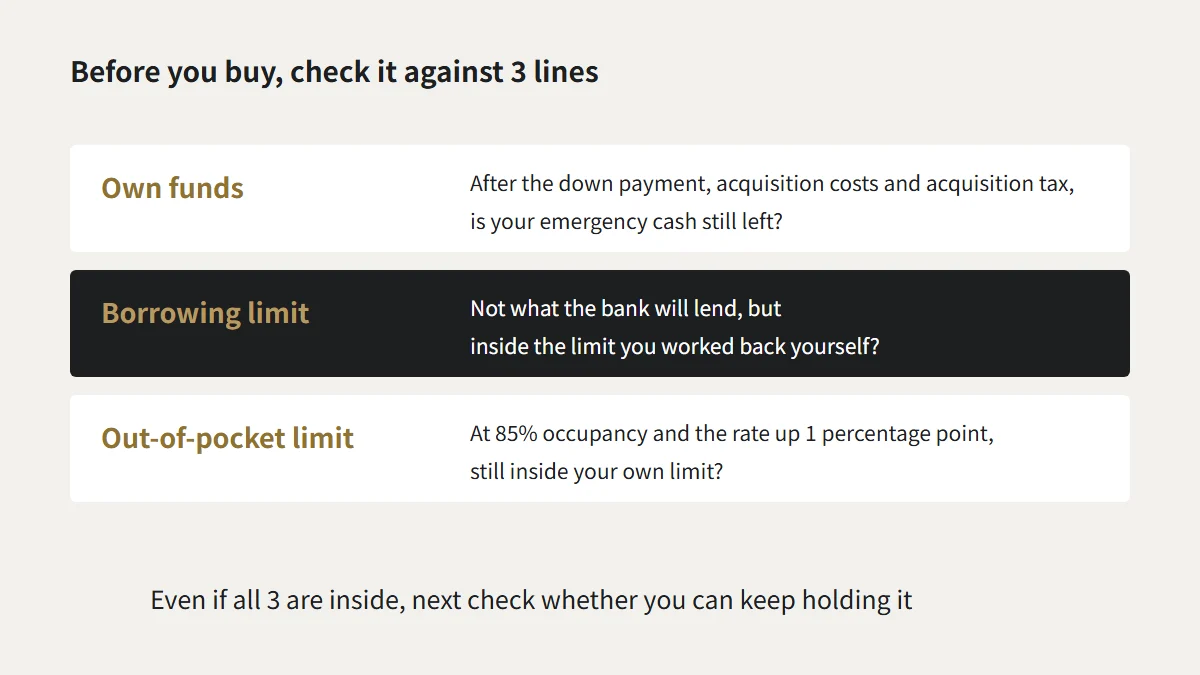
First: is it inside the own funds you can put in?
Including the down payment and acquisition costs, and even the real estate acquisition tax that arrives after settlement, is there still enough left in hand to protect your living?
Second: is it inside your borrowing limit?
In Part 5, we worked this back from your out-of-pocket limit.
Third: when things go wrong, is it inside your out-of-pocket limit?
Calculated at 85% occupancy and the interest rate up 1 percentage point, is the amount left over inside the line?
If all 3 are inside, the property fits within your terms.
If even 1 is outside, it does not fit.
That is all there is to deciding.
Even if it fits, you can choose not to buy
Suppose all 3 are inside.
Even so, it is fine not to buy.
Fitting within your terms and being something you should buy are 2 different things.
To think about this, I would like you to look at 1 set of numbers.
The 2 kinds of failure do not weigh the same
The following is a fictional example for illustration.
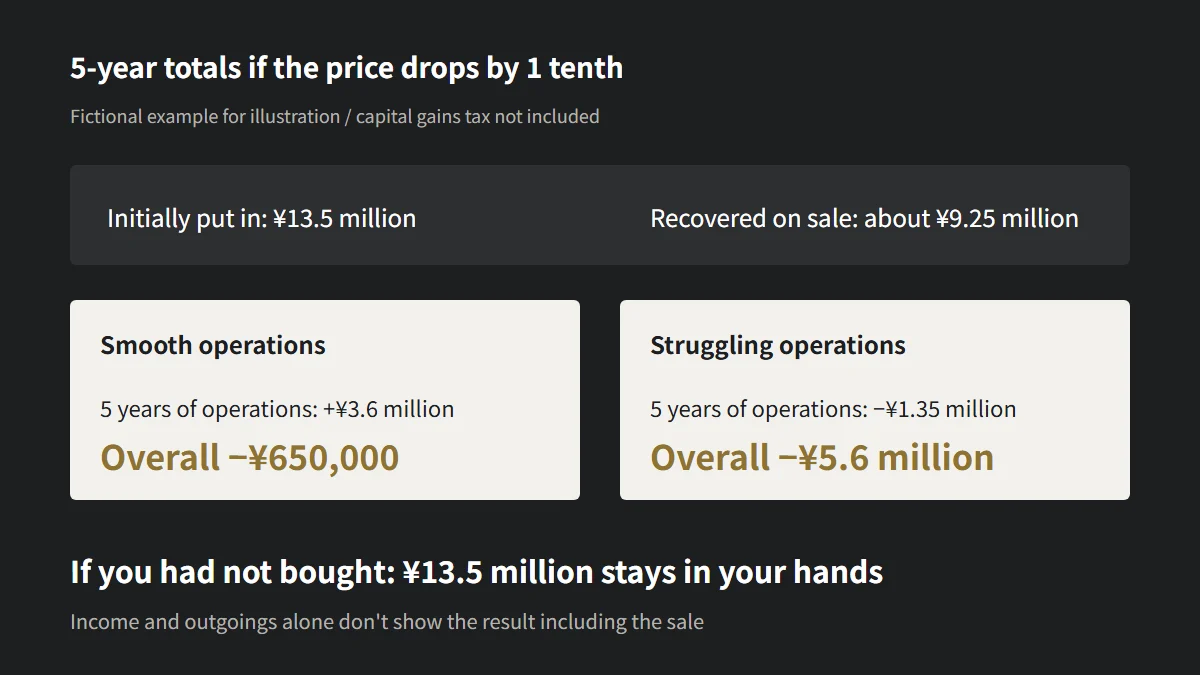
Suppose you bought the property we have been using. What you put in, own funds and acquisition costs together, was ¥13.5 million.
5 years later, for some reason, you have to let it go. The price has dropped by 1 tenth (10%), to ¥45 million.
The remaining loan balance has come down to ¥34.2 million. After the brokerage commission, what comes back to you is about ¥9.25 million.
The ¥13.5 million you put in has become ¥9.25 million. A decrease of ¥4.25 million.
Now add the income and outgoings over those 5 years.
- If it ran smoothly and left ¥720,000 a year: +¥3.6 million → overall −¥650,000
- If it struggled and cost ¥270,000 a year out of pocket: −¥1.35 million → overall −¥5.6 million
The line I would like you to look at is the upper one.
Operations went smoothly, and yet overall it is negative.
No vacancies, no rise in interest rates, ¥720,000 left over every year. Even so, a 1-tenth drop in price is enough to leave it short.
And if you had not bought?
The ¥13.5 million would still be in your hands, untouched.
A failure from not buying can be undone
Put these 2 side by side, and you can see they are asymmetric.
If you fail by not buying, you miss the profit you could have made.
But what you have in hand does not shrink.
When the next opportunity comes, you can move with the same amount.
If you fail by buying, what you have in hand shrinks.
And by however much it shrinks, your next choices narrow. You have used up own funds, credit, and time.
A failure from not buying only misses 1 opportunity.
A failure from buying takes the next opportunity with it.
So when in doubt, pass. That is the rational choice.
Not because of feelings, but because the 2 failures weigh differently.
Still, passing forever is not a decision
Let us think about it from the opposite side for a moment.
When in doubt, pass. What happens if you keep repeating that?
You never buy, for the rest of your life.
If you are satisfied with that, that is fine. There is no reason you have to invest in real estate.
But to keep passing forever while thinking "I would like to buy someday" is simply not making a decision.
"When in doubt, pass" is what people say who have conditions that keep them from being in doubt.
Without conditions, you are in doubt about everything. And you end up passing on everything.
So there is something to settle before you pass.
Write down your conditions for passing first
This picks up what I wrote in Part 1.
"Under what conditions will you decide not to buy?" That item.
Writing them is simple. Just turn the 3 lines from earlier inside out.
- If, after acquisition costs and acquisition tax, there is no cash left to protect your living, do not buy
- If the borrowing exceeds your own limit, do not buy
- If, at 85% occupancy and the interest rate up 1 percentage point, it exceeds your out-of-pocket limit, do not buy
Write these down first, and you will no longer hesitate to pass.
And when the conditions all fall inside, you will no longer hesitate either.
You hesitate because you have no line.
And if you go on hesitating without a line, in the end the decision is made by whoever gave you the last push.
Just 1 thing that lies outside the conditions
Even if all the numbers are inside, there is one more thing to check.
Can you keep holding that property?
Once you buy, you become the manager of that property.
Notices come that a tenant is moving out. You judge repair estimates. You deal with the property management company. You file a tax return.
None of this shows up in the calculation, but it goes on for 10 years.
And the amount of it differs from property to property. Far away or nearby. Condominium unit or whole building. Newly built or old.
Even if the numbers fit, if it is more than you can keep running yourself, that is a separate problem.
If you hand that part to someone else, include the cost of doing so in your expenses.
A calculation that assumes you will overstretch usually breaks down.
After you decide to buy
Finally, just 1 thing.
The 3 lines are inside, and you have judged that you can keep holding it. Even then, there is something to do before you buy.
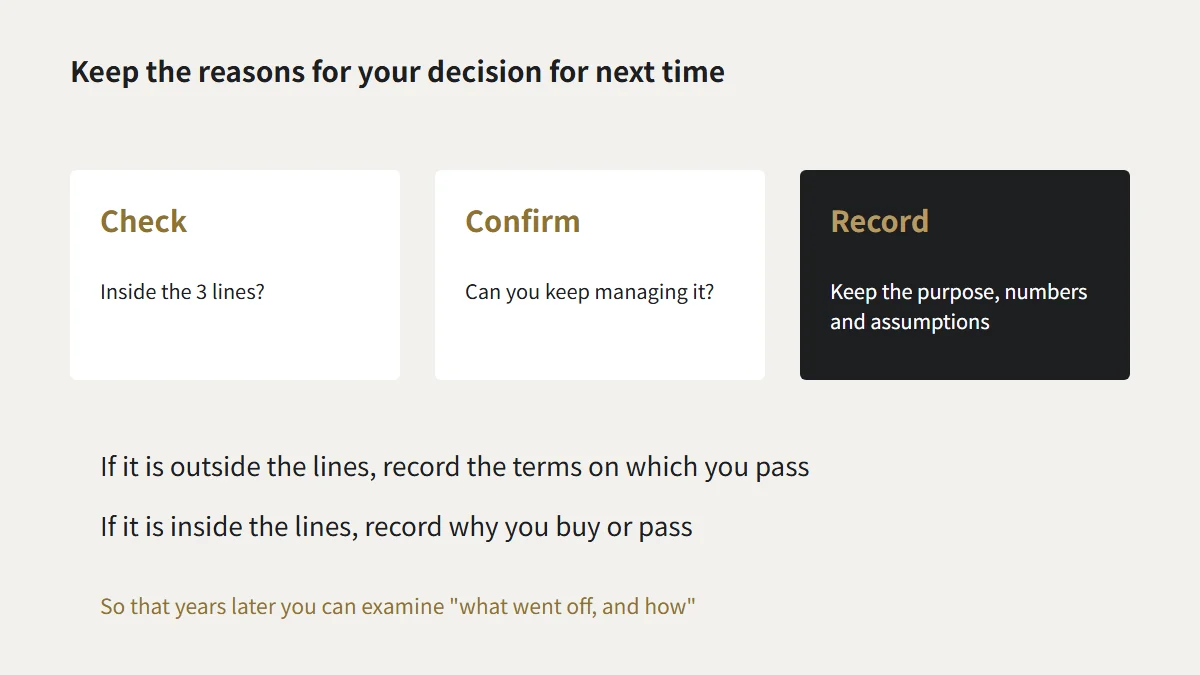
Write down the reasons for your decision and keep them.
For what purpose, looking at which numbers, and which things were inside, did you buy?
A few years on, something you did not expect will happen. It will happen without fail.
When it does, if your original assumptions are written down, you can examine what went off, and how.
If they are not written down, it ends with "this was not supposed to happen."
Then you cannot put it to use next time.
In Part 1, I wrote that properties bought without criteria tend to lead to disputes.
This is the reason. If what you were aiming for when you bought was never decided, you cannot even examine what turned out different, or how.
To buy, or not to buy.
Check against the 3 lines, and see whether all of them are inside.
If any is outside, pass. If they are inside, make sure you can keep holding it.
And write down the reasons you decided.
Passing is not a failure. But to keep passing without having a line is simply not making a decision.
Next time is the last in this series.
I will talk about what comes after buying. Holding on, and letting go. And about a way of deciding that does not fix the exit.