
Fix the exit, and you are betting on it
We check whether a property is "sellable" through the cash left after a sale, financing for the next buyer, and keeping documents in order. We also set out a once-a-year review, and how to think about selling by conditions rather than by date.

BENERU writes for readers who live in Japan. Taxes, loans and the other rules described here are those of Japan, and they assume a resident of Japan.
This page is a translation of the Japanese original. If the two differ, the Japanese original prevails.
Good day. I'm Nel Shikina.
This is the last part of this series.
I will talk about what comes after buying. Holding on, and letting go.
And, before those 2, one more thing.
Fix the exit, and you are betting on it
When you buy, you are sometimes told this:
Let us decide on an exit strategy. On the assumption that you sell in 10 years.
It sounds well planned.
But deciding to sell in 10 years means betting on the market 10 years from now.
What if interest rates have risen that year? What if buyers are finding it harder to get financing? What if more new buildings have gone up in that area?
No one knows what things will be like 10 years from now.
And if you have decided to sell on a fixed date, you have no choice but to accept the conditions of that day.
So you do not fix the exit.
Instead, you do this:
Keep the property sellable at any time.
Rather than deciding the day you sell, keep the property sellable.
That way, you can sell when good conditions come along, and keep holding it if they do not.
Being able to choose is, in itself, a strength.
Putting "sellable" into numbers
This is vague, so let us look at it in numbers.
The following is a fictional example for illustration.
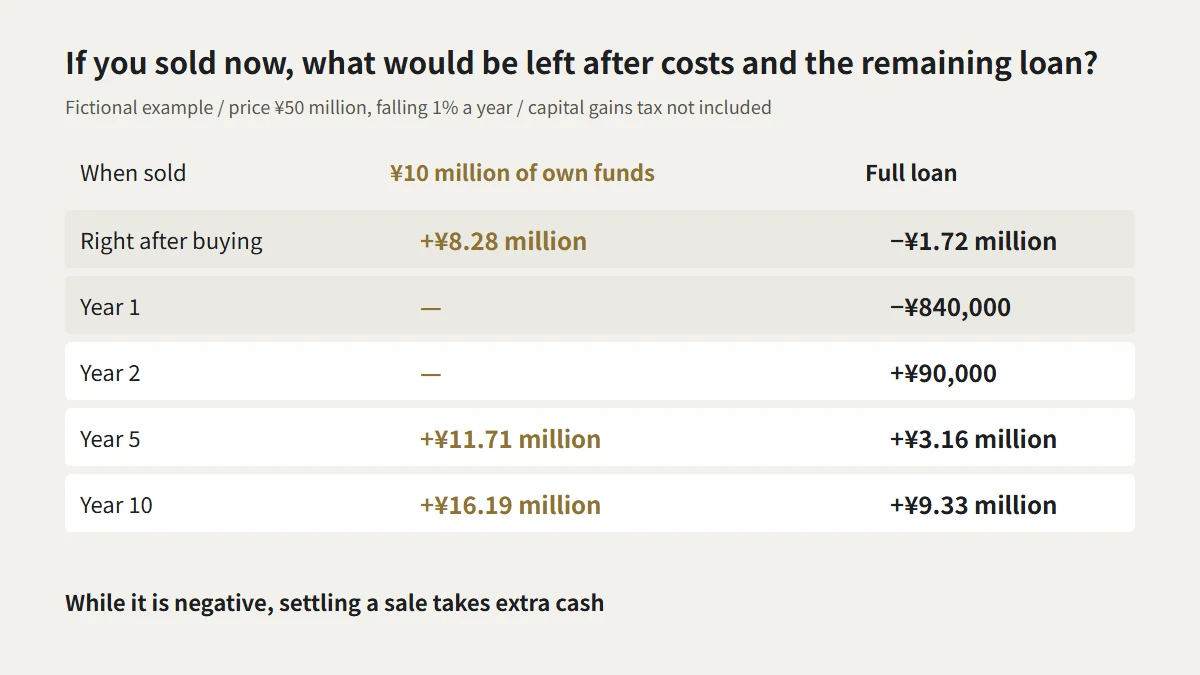
Purchase price ¥50 million. Assume the price falls by 1% a year.
We compare buying it with own funds put in and buying it with a full loan.
From the sale price, subtract the brokerage commission and the remaining loan balance. How much is left in hand?
With ¥10 million of own funds put in
- Right after buying: +¥8.28 million
- Year 5: +¥11.71 million
- Year 10: +¥16.19 million
It is sellable from day one.
With a full loan
- Right after buying: −¥1.72 million
- Year 1: −¥840,000
- Year 2: +¥90,000
- Year 5: +¥3.16 million
- Year 10: +¥9.33 million
For roughly the first 2 years, even if you sell, you cannot pay off the remaining loan.
Unless you fill the shortfall with cash, settlement cannot go ahead.
In other words, for those 2 years this person has no option to sell.
Whatever happens, there is nothing to do but keep holding it.
Putting in own funds is an act that lowers your yield. In exchange, you are buying an exit from the start.
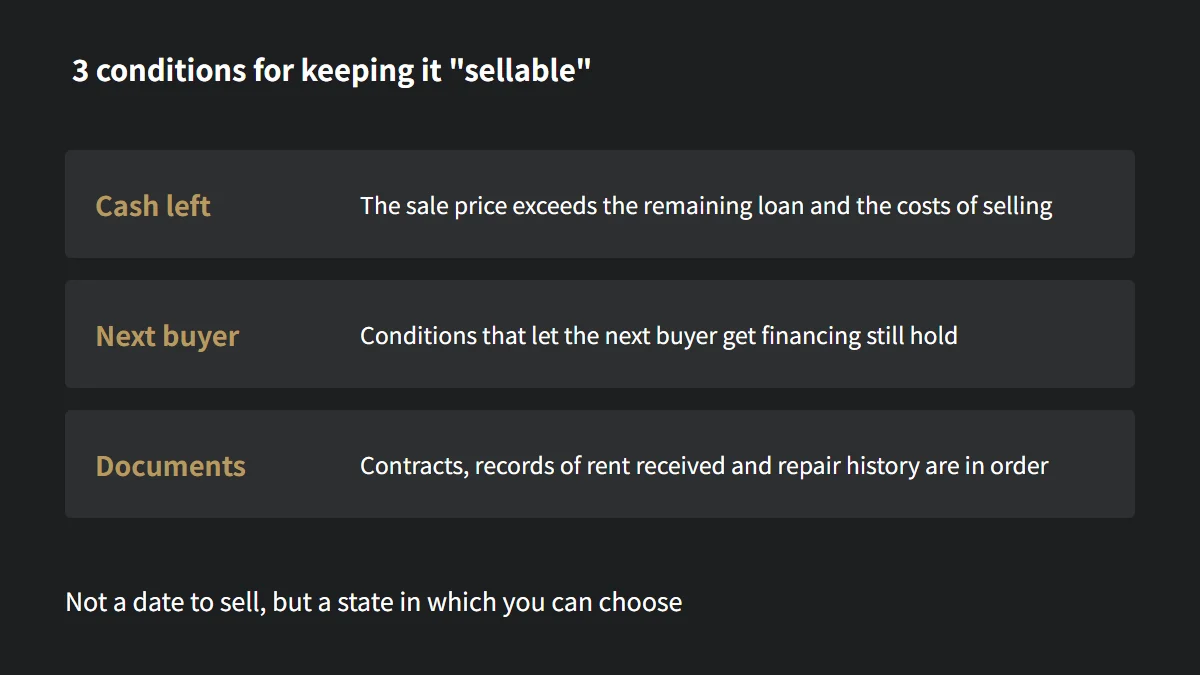
3 conditions for being sellable
There is more to it than numbers.
First: the sale price exceeds the remaining loan balance and the costs of selling.
This is the calculation from a moment ago. Check it once a year by looking at the remaining loan balance and market prices.
Second: the next buyer can get financing.
This is easily overlooked.
How many years of financing could you get when you bought? In 5 years, the property will be 5 years older.
How many years will the next buyer get then?
If the loan term gets shorter, monthly repayments get heavier. If they get heavier, fewer people can buy.
If fewer people can buy, the price falls.
The building stands just as it did, and the tenants are living there as usual, yet the numbers move first.
This is not about the building; it is about the buyer's financing.
Third: the documents are in order.
It is unglamorous, but in practice this is where things stall.
Lease contracts, records of rent received, repair history, copies of tax returns.
Buyers look at these to make their judgment. If they are not in order, the property is valued lower by that much, or the deal does not move forward.
Organize them from the day you buy. That is all.
Holding on is also a decision
While you are holding a property, it feels as if you are not making any decision.
In fact, you are.
If you own a property that would bring ¥50 million if sold, you are continuing to keep ¥50 million in that property.
Every day, you are making that choice.
Yet the indicators people use change between buying and holding.
When buying, they calculate the yield. While holding, they use the price they paid as the benchmark.
A property bought for ¥45 million would now bring only ¥40 million. Here, people think, "It is below what I paid, so I cannot sell."
But the market does not know what you paid.
Being below the purchase price is not a reason to keep holding.
That said, if you sell and buy the same kind of property again, the brokerage commission, taxes and the acquisition costs of buying again add up to several million yen for the round trip.
So keeping hold despite some dissatisfaction is rational. You have leeway equal to that round-trip cost.
Using the purchase price as your reason and using the round-trip cost as your reason are completely different things.
What to do once a year
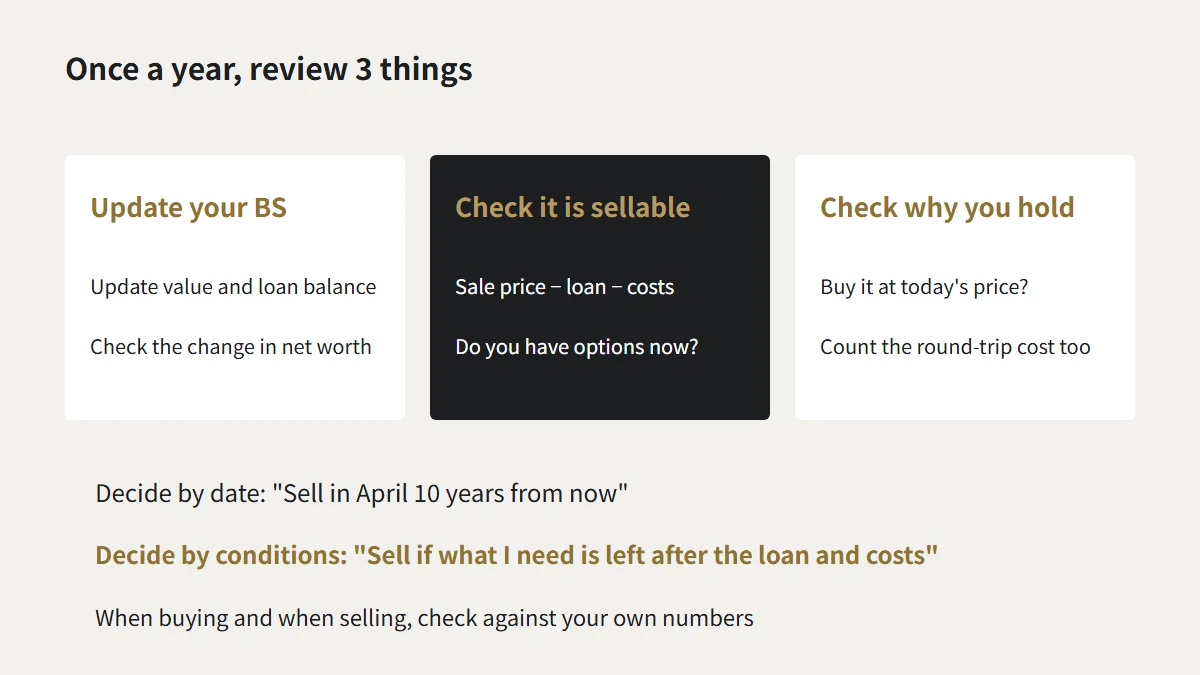
Nothing difficult. Just 3 things.
Update your BS.
This is the 1-page balance sheet you made in Part 2. Rewrite the property's value and the remaining loan balance. Those are about the only figures whose values move, so it takes a few minutes.
This tells you which way your net worth moved over the year.
Not cash flow, but this is the result. As I wrote in Part 1.
Check that the property is sellable.
If you sold now, how much would be left after the remaining loan and costs?
If it is negative, you are currently in a state with no option to sell. Knowing that is what matters.
Ask yourself whether you would buy it at today's price.
Allowing for the leeway of the round-trip cost, if you still think you would not buy it, your reason for holding on lies outside the numbers.
That is not a bad thing. But know that this is the case.
Isn't not fixing the exit just having no plan?
Finally, let us think about it from the opposite side.
Isn't not fixing the exit simply having no plan?
It is not.
Not fixing the exit means deciding on conditions.
Rather than deciding to sell in April 10 years from now,
- Sell if this much will be left after the remaining loan and costs
- Sell before the next buyer can no longer get financing
- Sell if the out-of-pocket amount exceeds your limit
You decide in this form.
Decide by date, and you are at the mercy of that day's market.
Decide by conditions, and the day the conditions are met becomes that day.
This is the same thing we have been doing throughout this series.
Before looking for a property, we decided the conditions for not buying.
In the same way, rather than deciding the day you sell, you decide the conditions for selling.
In closing
There were 10 parts in all.
Looking back, what we were doing was always the same.
Work out your own numbers, draw a line, and check against it.
We wrote out assets and liabilities, counted the yearly surplus, and drew a line called the out-of-pocket limit.
We translated that line into a borrowing limit, brought the numbers in property brochures down to your own numbers, and checked whether they stayed inside when things went wrong.
And this time, we do the same thing when selling.
Not once have we considered whether a property is good.
Not because we did not think about it, but because thinking about it does not settle anything.
In Part 1, I wrote this:
The same information means different things depending on the situation of the person receiving it.
That is why you need to know yourself first.
Over 10 parts, I have tried to turn that one line into numbers.
From here on, you will be calculating with your own numbers.
If, when you do, no one else's proposal has become your benchmark, this series has done its job.