
There is no such thing as a good investment
Before comparing condominium units and whole buildings, we sort out what "safety" means and what it costs. From your own cash, your yearly surplus and your out-of-pocket limit, we think about which risks you can take on.

BENERU writes for readers who live in Japan. Taxes, loans and the other rules described here are those of Japan, and they assume a resident of Japan.
This page is a translation of the Japanese original. If the two differ, the Japanese original prevails.
Good day. I'm Nel Shikina.
In the previous series, we worked out your own numbers.
We wrote out assets and liabilities to get net worth, set how much you can pay out of pocket from your annual income and outgoings, worked back from that to a borrowing limit, and went as far as turning the numbers in property brochures into your own numbers.
Once you have come this far, the next question is pretty much set.
"So, what should I buy?"
A condominium unit, or a whole apartment building? Which one is more advantageous?
This series deals with that question.
But there is something I want to settle first.
This question has the shape of a question with only one answer. In reality, it does not have one. If we do not sort that out first, the comparisons from the next part on will end up being read as "which one wins."
This time, it is only the premises.
When you say an investment is "safe," what are you pointing to?
When people talk about investing, this word almost always comes up.
Safe.
Investments that are safe. Properties that are safe. Ways of buying that are safe.
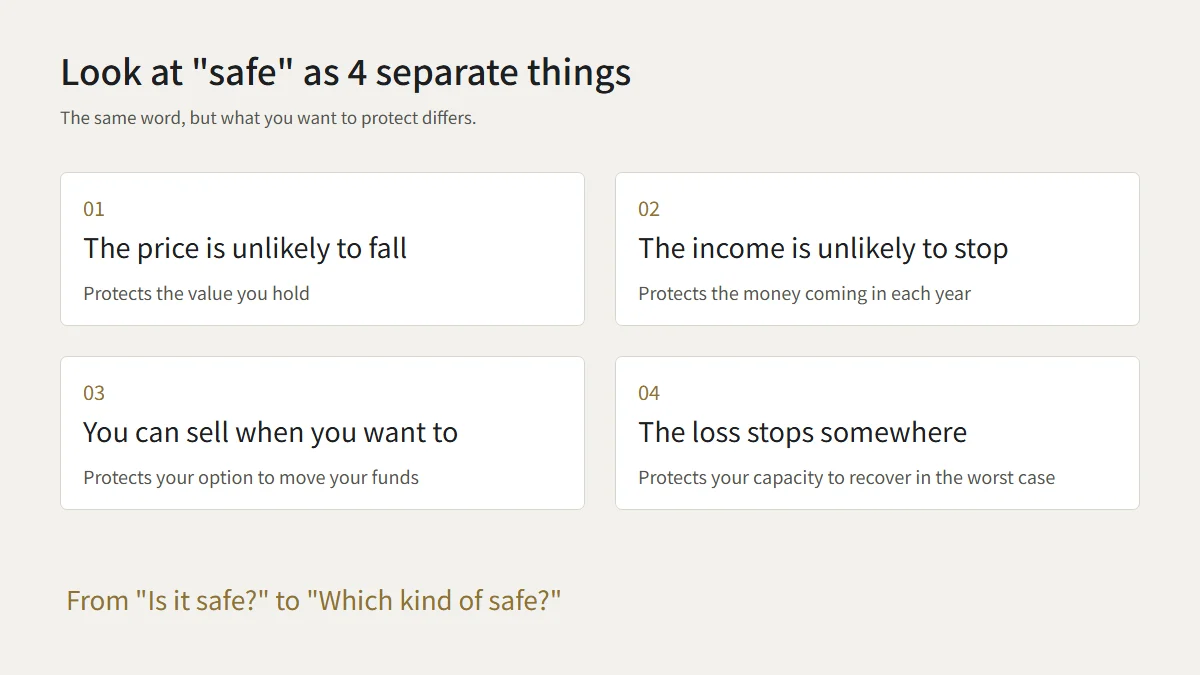
It is a convenient word. But inside this one word are 4 separate things.
- The price is unlikely to fall
- The income is unlikely to stop
- You can sell when you want to sell
- Even in the worst case, the loss stops somewhere
All 4 are called "safe," but they are not the same thing.
And there are combinations where raising one lowers another.
A newly built condominium unit in the city center is high on 1 and 3. Its price is unlikely to fall, and there are many buyers. But it is weak on 2. There is only one unit, so the moment the tenant leaves, income drops to zero.
A whole apartment building in a regional area is strong on 2. With 10 units, if 1 falls vacant, 90% of the income remains. But it is weak on 3. Buyers are limited to investors, so there is no telling whether you can sell when you want to.
Both are "safe." They are simply pointing to different things.
So the question "Is this property safe?" gets no answer. It needs to be asked again.
Which kind of safe?
Those 4 come with a price
This is where the main topic begins.
The 4 kinds of safety are not handed out generously. As long as they are bought and sold, they have a price.
It is quicker to look at numbers.
The following is a fictional example for illustration. These are not real properties.
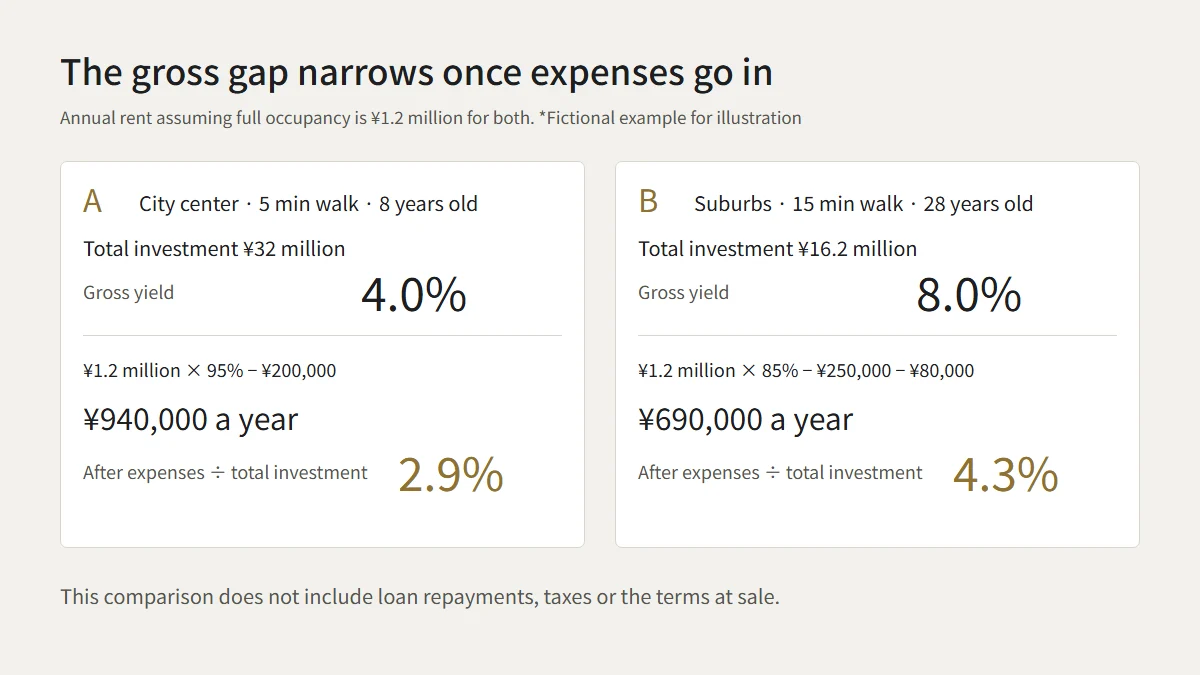
Let us line up 2 condominium units, each with annual rent assuming full occupancy of ¥1.2 million.
A: City center, 5 minutes' walk from the station, 8 years old
- Purchase price ¥30 million / acquisition costs ¥2 million (total investment ¥32 million)
- Gross yield 4.0%
B: Suburbs, 15 minutes' walk from the station, 28 years old
- Purchase price ¥15 million / acquisition costs ¥1.2 million (total investment ¥16.2 million)
- Gross yield 8.0%
On the gross figure alone, B is exactly double.
So is B the better deal?
Let us put in occupancy rates and expenses. A rarely goes without a tenant: annual operating expenses of ¥200,000 and occupancy of 95%. B takes longer to fill, so occupancy of 85% and expenses of ¥250,000; and because the building is older, we also allow ¥80,000 a year for replacing water heaters and air conditioners.
- A: ¥1.2 million × 95% − ¥200,000 = ¥940,000 → 2.9% of the ¥32 million total investment
- B: ¥1.2 million × 85% − ¥250,000 − ¥80,000 = ¥690,000 → 4.3% of the ¥16.2 million total investment
The gap, which was 2.00 times on a gross basis, has narrowed to 1.45 times.
And the exit has not been included here yet.
20 years from now, A will be 28 years old. Buyers will be able to get financing. B will be 48 years old; if it is wooden, it will be long past its statutory useful life, and buyers will be limited to those who can pay in cash. By then, the gap in sale prices widens further.
In other words, what was included in A's price was short vacancy periods, rents that are slow to fall, and many buyers when you sell. What was included in B's yield was the absence of those things.
It is not that the prices differ. What you are buying differs.
A high yield is not a bonus; it is a payment in return.
Let us think about it from the opposite side
If we stop here, the story is a little too neat.
Is it really true that returns never rise without taking on risk?
In practice, there are situations where it seems to happen. Let me give 3.
When there is an information gap
The seller is in a hurry because of an inheritance or a job transfer. A deal reaches you before it goes on the market. In situations like these, you can sometimes buy below the going rate.
When there is room to improve
Fill the vacant units. Bring rents back up to an appropriate level. Change the property management company and lower expenses. Work done after buying raises the income.
When the whole market moves
Interest rates fall. A redevelopment of the area is decided. The value goes up even though you did nothing.
The first and second do look as if "returns rose without taking on risk."
But look closely.
To benefit from the first, you need to be in a position where such deals come to you. The time and relationships spent getting there are an investment paid in advance. And the more you are told to decide quickly, the more the time for checking gets cut. It easily turns out that the reason you could buy cheaply was that you did not check.
The second is even clearer. Filling vacant units, reviewing rents, changing the property management company: these are all work. The extra income is not a payment for risk but a payment for labor. If you do not do it, the income does not rise.
The third is simply luck. If things move the other way, the opposite happens.
So here I will state it plainly.
There is, as a rule, no way to raise only returns without taking on risk.
When it looks as if returns are rising, it is one of these: there is a risk you cannot see yet, you are doing the work yourself, or you were lucky.
None of these 3 is a bad thing. Raising returns through your own work is a legitimate method. But if you interpret it as "I have found a way to make money with no risk," you will get it wrong the second time.
So it is not about choosing a product
Let me bring all of this together.
There are 4 kinds of safety, each has a price, and you cannot buy all of them at once.
Within this structure, the question "Which product is good?" does not hold up.
What does hold up is this:
Which kinds of safety do I put first, and which risks can I take on?
And the material for deciding this has already come out in the previous series.
Cash you can move (what is left of your assets after subtracting your emergency living fund and planned expenses)
If this is thin, you cannot afford to give up liquidity. Tie funds up in an asset that cannot be sold, and you can no longer make your next decision.
What you can set aside each year (the surplus in your annual income and outgoings)
If this is small, you are vulnerable to setups where income stops. A structure with only one unit, where income is zero in any month it is vacant, is hard to take on.
Out-of-pocket limit (the annual amount you can pay from your own wallet in a year when things go wrong)
Once this is set, the swing you can withstand is set. Once the swing is set, the size of the risk you can take is set.
For anyone who has these 3, the range they can choose from is already set. They just have not noticed that it is.
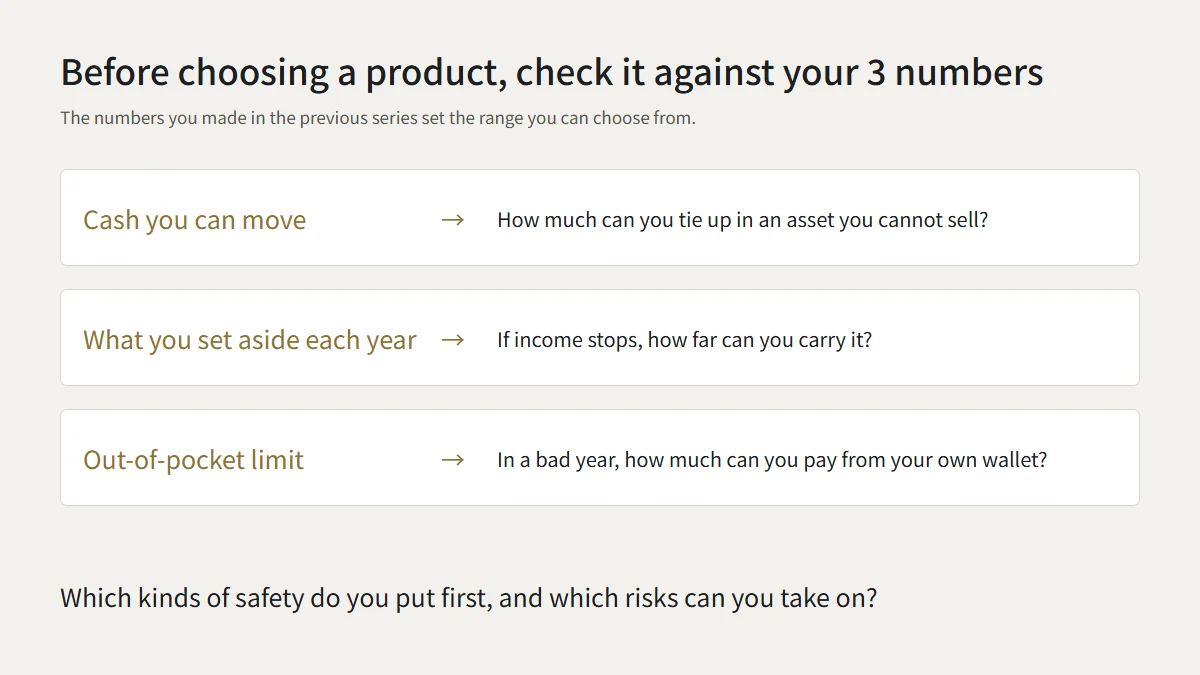
Conversely, if you compare condominium units and whole buildings without these 3 worked out, you have no basis for the comparison.
If you have not done it yet, please go back to Part 3 of the previous series. A single sheet of paper is enough. You can also work out the same 3 with nelBS, which BENERU makes publicly available. The data you enter is processed on your own device, and BENERU does not keep it.
What this series will do
From the next part on, we get into specifics.
- Part 2 When you buy a condominium unit, what are you actually buying?
- Part 3 When you buy a whole apartment building, what are you actually buying?
- Part 4 Put in the same own funds, and line up the numbers for both
- Part 5 Sort into 5 axes where the differences show up
- Part 6 Check against your own 3 numbers, and decide which suits you
Let me say this in advance: even after reading Part 6, you will not find "You are a condominium-unit person" written there.
That is because it cannot be written. Something whose answer changes when the conditions change cannot be decided on the article's side.
What this series hands you is axes you can check against yourself.
What you are looking for is not a good investment.
It is the shape of risk that your own purpose requires.
Next time, we start with condominium units. I will talk about how what you own changes between the inside and the outside of the floor plan.