
What you know will happen is not a risk
We sort things into 3 layers: costs you know will occur, uncertainties you prepare for by their range, and losses you cannot carry yourself.

BENERU writes for readers who live in Japan. Taxes, loans and the other rules described here are those of Japan, and they assume a resident of Japan.
This page is a translation of the Japanese original. If the two differ, the Japanese original prevails.
Good day. I'm Nel Shikina.
Up to last time, we covered the full set of ways to read the numbers.
This time, we talk about when that calculation breaks down.
But simply listing "these are the risks there are" is not much help.
First, let us decide how to sort them.
What you know will happen is not a risk
When you hear an explanation of an income property, certain words always come up.
Vacancy risk. Repair risk. Interest rate risk.
All of them matter. But the way they are lined up feels a little off.
Here, I use the word "risk" to mean "something that may or may not happen."
Then what about vacancies?
A property held for 20 years without a single tenant ever moving out is hard to imagine. Tenants leave at some point.
Repairs are the same. Water heaters break down, and exterior walls deteriorate.
What you know will happen is not a risk but a cost.
If it is a cost, you can subtract it in advance.
Once you can draw this distinction, the ways to prepare split into 3.
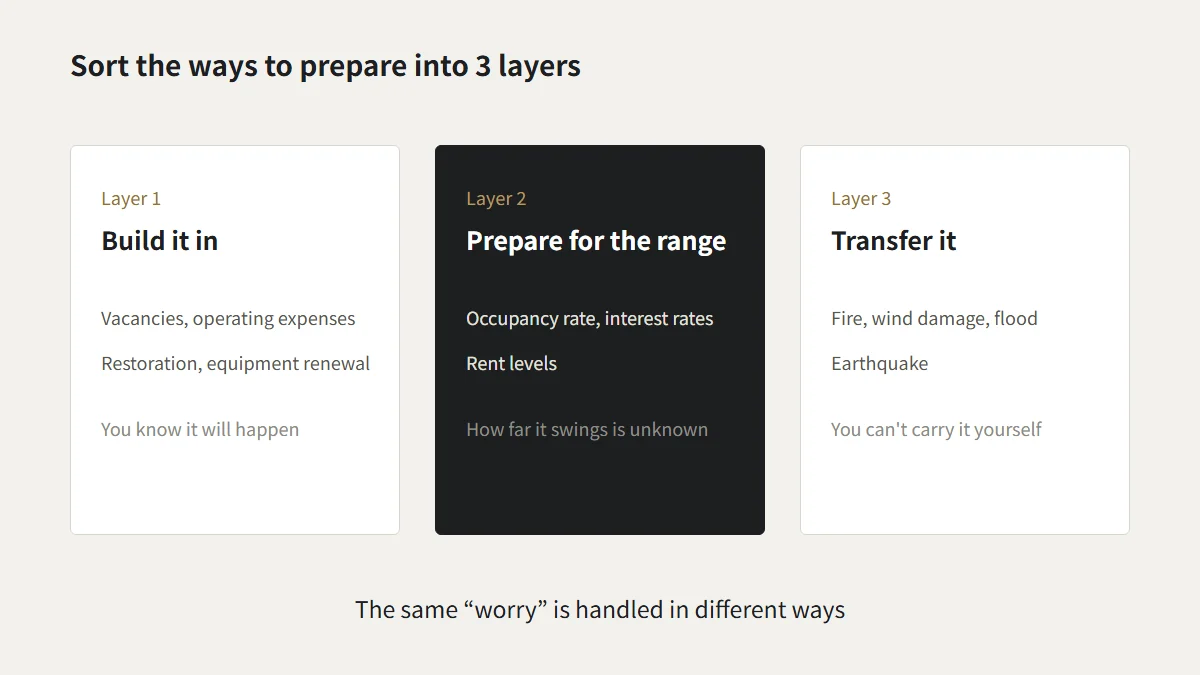
Sorting into 3 layers
Layer 1: Build it in
Things you know will happen. Vacancies, operating expenses, restoration when tenants leave, equipment replacement, fixed asset tax.
Subtract them from the start.
Layer 2: Prepare for the range
Things where you do not know whether they will happen, or by how much. Occupancy rate, interest rates, rent levels.
You cannot put a number on them, so you look at whether you can withstand them when they swing.
Layer 3: Transfer it
Things that are unlikely, but that you could not carry yourself if they happened. Fire, wind damage, flood, earthquake.
Do not hold them yourself; transfer them to someone else through insurance.
Let us go through them in order.
Layer 1: Build it in
We already did this with the property from last time.
The following is a fictional example for illustration.
From ¥4 million of rent assuming full occupancy, subtract 5% for vacancies and ¥800,000 of operating expenses, and you get ¥3 million.
Subtract ¥2.28 million of loan repayment from that, and you have ¥720,000.
At this point, vacancies and expenses are no longer "unexpected."
Let me list the things people tend to forget to subtract.
Restoration costs and advertising fees each time a tenant leaves. Replacing water heaters and air conditioners. Common-area repairs once every few years.
Every one of these will come. If they come but are not in your annual table, they look like "unexpected expenses" when they arrive.
Average them out over the years and include them in expenses from the start.
That alone makes about half of the "risks" disappear.
Layer 2: Prepare for the range
What remains is real risk.
You know vacancies will occur, but not how many years from now, or for how many months.
You know interest rates will move, but not in which direction or by how much.
You cannot put an exact number on these. Instead, you look at the range.
This is what we did in Part 6.
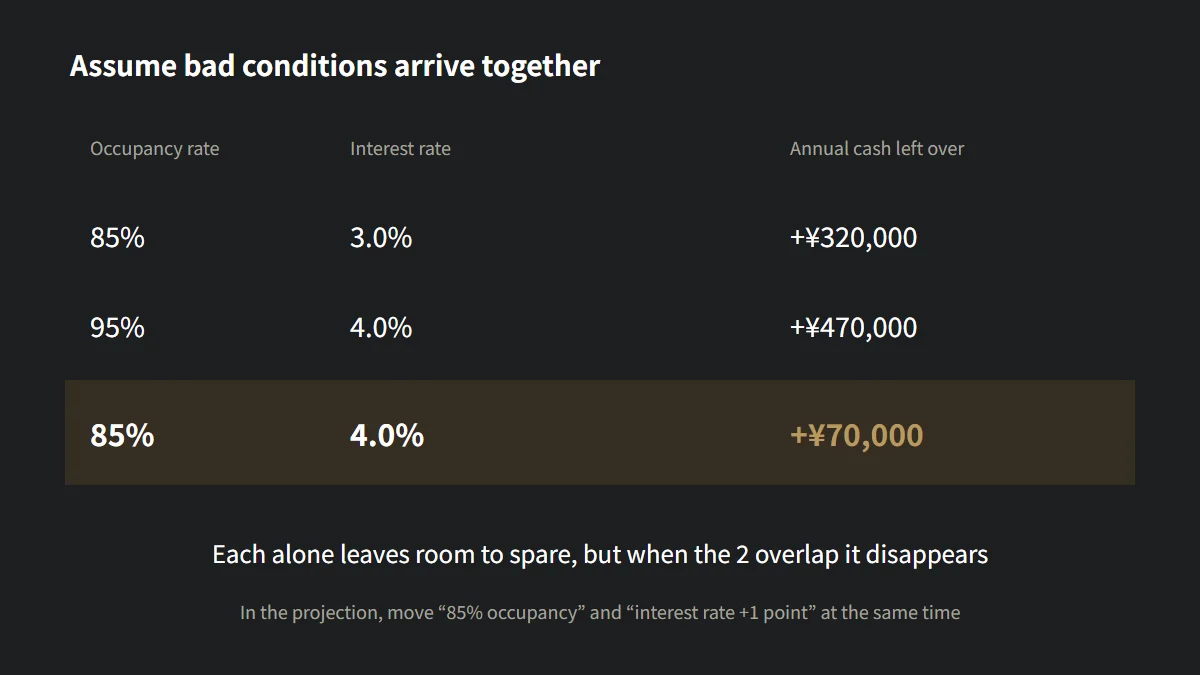
- Occupancy 85%, interest rate 3%: ¥320,000
- Occupancy 95%, interest rate 4%: ¥470,000
- Occupancy 85%, interest rate 4%: ¥70,000
- Occupancy 80%, interest rate 4.5%: −¥270,000
There is one point to note here.
With 85% occupancy alone, ¥320,000 is left. With a 4% interest rate alone, ¥470,000 is left.
On its own, each leaves room to spare.
But when the 2 overlap, it is ¥70,000.
This is not a coincidence.
When you measure the margin one factor at a time, each looks wide. That is because the other conditions are held at their best.
In reality, the periods when vacancies rise and the periods when rents fall usually arrive at about the same time. If a new building goes up nearby, move-outs increase and asking rents fall. These are not separate events.
So you look at it on the assumption that bad conditions arrive together.
When you receive a projection, move just 2 things. Occupancy to 85%, and the interest rate to the current rate plus 1 percentage point.
Is the amount left over inside the line for yourself that you set in Part 3?
Layer 3: Transfer it
Finally, the things you cannot carry yourself.
Fire, wind damage, flood. These can be transferred with fire insurance.
Coverage differs by product, so check the policy document to see what is covered. It does happen that people think they are covered and turn out not to be.
And this one point, please remember.
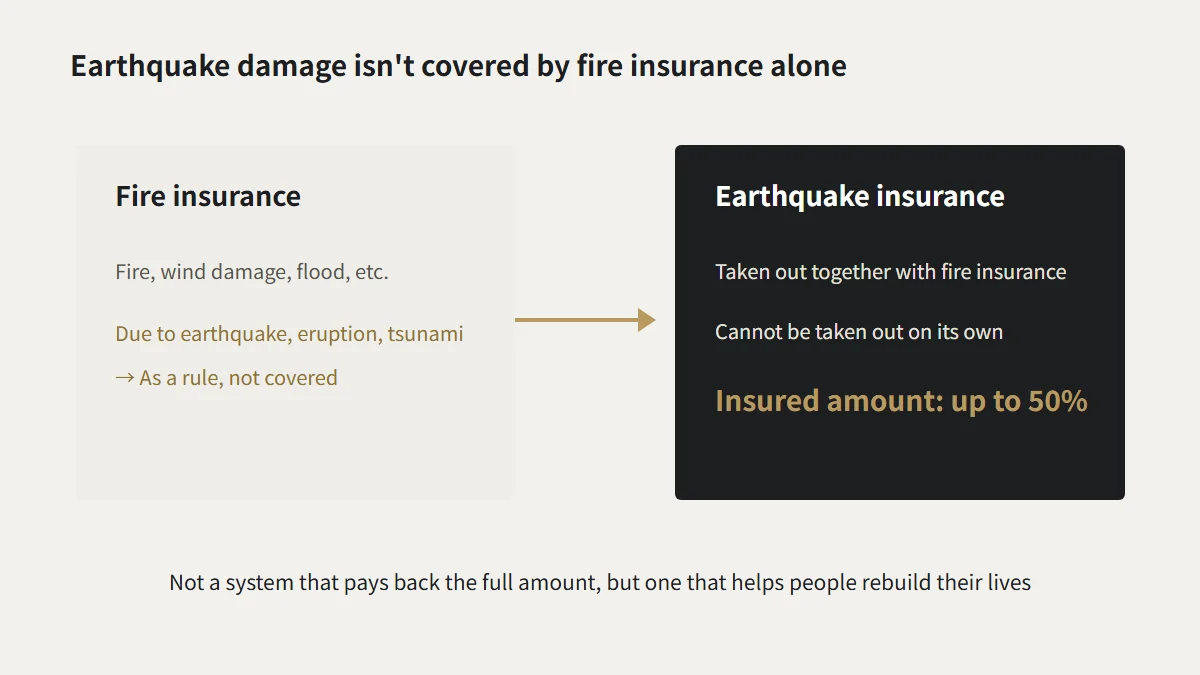
Damage caused by an earthquake is not covered by fire insurance.
Earthquakes, volcanic eruptions, and tsunamis caused by them. Including fires, collapses and buildings being washed away as a result.
If a building burns because of an earthquake, fire insurance does not pay out, even though it is a fire.
To prepare for this you need earthquake insurance, and moreover earthquake insurance cannot be taken out on its own. It must be taken out together with fire insurance (Act on Earthquake Insurance).
One more thing. The insured amount of earthquake insurance can only be set up to half the insured amount of the fire insurance.
It is not a system that pays back the full amount. That is because it is a system meant to help people rebuild their lives.
Also, earthquake insurance is run jointly by the government and private insurers, so its terms and premiums do not differ between insurance companies. There is no point shopping around for it.
All you decide is whether to take it out or not.
Can every risk be eliminated?
Let us think about it from the opposite side for a moment.
If you deal with everything across the 3 layers, does it become safe?
It does not.
Build things in, and the cash left over shrinks by that much. Take a wide range, and fewer properties fit. Take out heavier insurance, and premiums go out.
Eliminate everything, and the amount left over becomes zero.
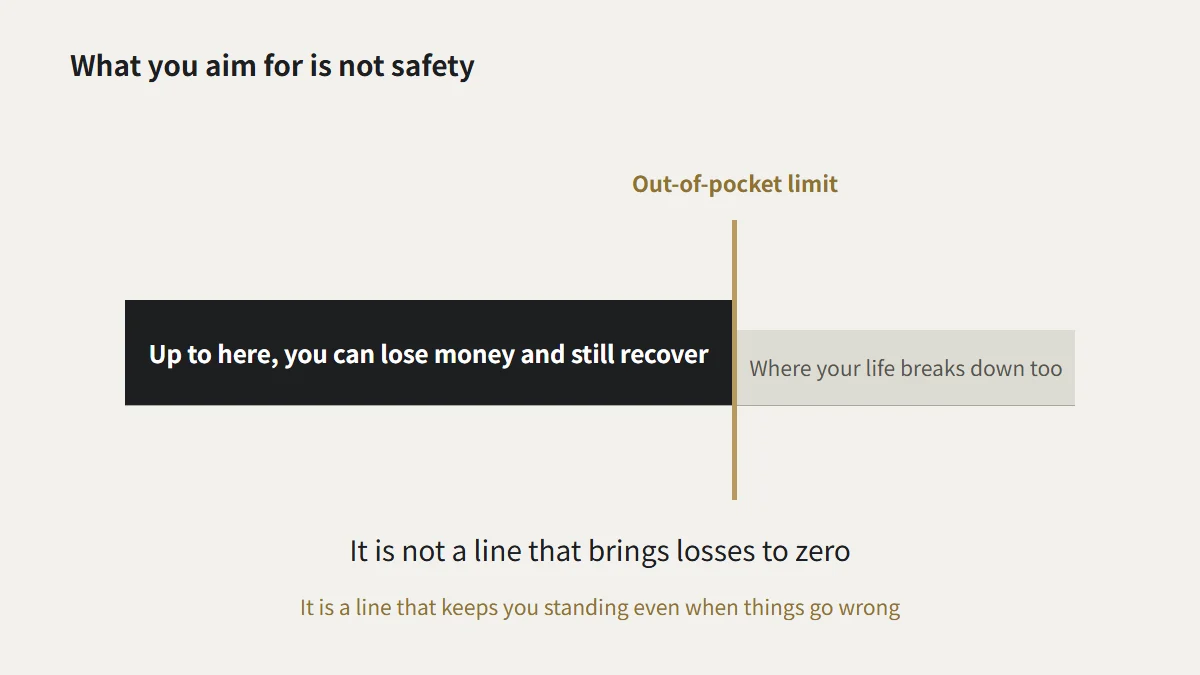
So what you aim for is not safety.
It is you yourself still being left standing when things go wrong.
If that one property fails, can your life go on? Can you stay in a state where you are able to make your next decision?
That is why we drew the line called the out-of-pocket limit. That was Part 3.
That line is not a line meaning "I will lose no more than this."
It is a line meaning "up to here, I can lose money and still recover."
Finally, something I want to separate
Just one more thing.
Talk about risk mixes together things that are frequent and small and things that are rare and large.
A unit falls vacant in a given month. This is frequent and small. It is something to build in.
A major earthquake strikes. This is rare and large. It is something to transfer through insurance.
If you worry about these 2 in the same way, it wears you out.
Worrying about the monthly vacancies and not taking out earthquake insurance is the wrong way round.
Handle the frequent things with numbers. For the rare and large things, make sure you yourself do not disappear when they happen.
What you do about each is different.
When someone explains risks to you, ask one thing.
Is this something we know will happen, or something we do not know?
If it is something known, how much was built in for it?
If it is something unknown, how far can it swing before it becomes unbearable?
And if it is something you cannot carry yourself, has it been transferred?
Next time, it is to buy or not to buy.
I will talk about how to decide, and how to treat the decision not to buy.