
The same property gives you 5 different yields
We show why a single property produces 5 different yields, how to align the numerator and denominator when comparing, and why the final decision should go back to amounts in yen.

BENERU writes for readers who live in Japan. Taxes, loans and the other rules described here are those of Japan, and they assume a resident of Japan.
This page is a translation of the Japanese original. If the two differ, the Japanese original prevails.
Good day. I'm Nel Shikina.
Last time, we brought the numbers in a property brochure down in 4 steps.
This time, we look a little more carefully at the indicators we used.
Let me give the conclusion first.
The same property gives you 5 different yields.
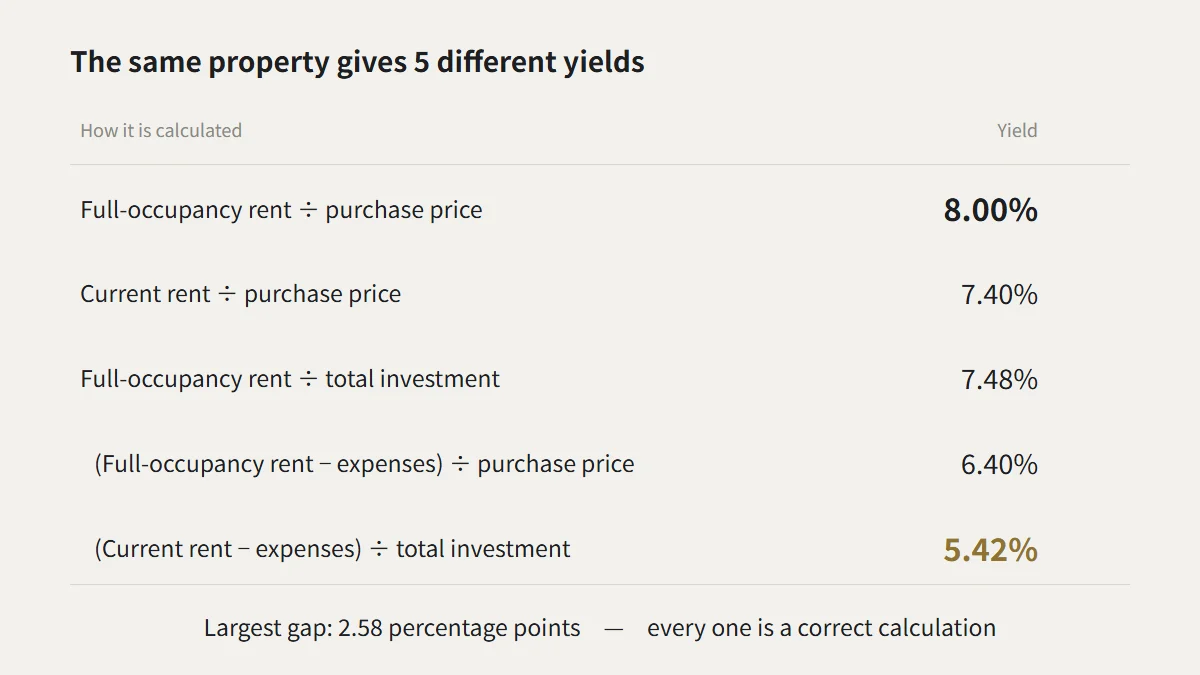
Let us work out 5 for the same property
The following is a fictional example for illustration.
Purchase price ¥50 million. Acquisition costs are ¥3.5 million, so the amount actually put in is ¥53.5 million.
Annual rent assuming full occupancy is ¥4 million. Right now, though, 1 unit is vacant, and the current rent is ¥3.7 million.
Operating expenses are ¥800,000 a year.
Under these conditions, we calculate the yield.
| How it is calculated | Yield |
|---|---|
| Rent assuming full occupancy ÷ purchase price | 8.00% |
| Current rent ÷ purchase price | 7.40% |
| Rent assuming full occupancy ÷ total investment | 7.48% |
| (Rent assuming full occupancy − expenses) ÷ purchase price | 6.40% |
| (Current rent − expenses) ÷ total investment | 5.42% |
The top is 8.00%. The bottom is 5.42%.
The gap is 2.58 percentage points.
And every one of them is a correct calculation.
No one is lying, and nothing is mislabeled. All that changed is what goes in the numerator and what goes in the denominator.
The word "yield" has no fixed definition
One thing follows from this.
You cannot compare properties by yield.
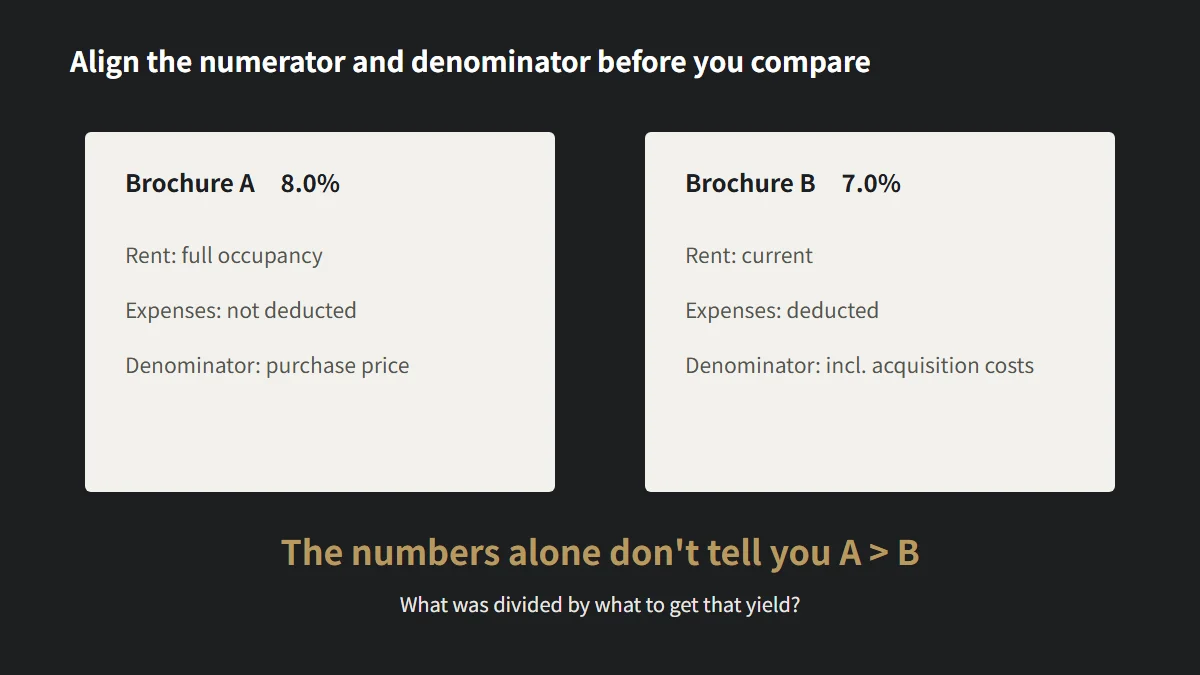
Say brochure A shows 8.0% and brochure B shows 7.0%.
What if A is a gross yield assuming full occupancy, and B is a net yield on current rent?
Aligned on a net basis, B can come out higher.
So when you see a yield figure, ask this:
What was divided by what to get that yield?
Is the rent assuming full occupancy, or current? Have expenses been subtracted? Is the denominator the price, or the price including acquisition costs?
Unless these 3 are aligned, it is not a comparison.
And the aligning is something you will have to do yourself. Brochures are not written in a uniform way.
Compare by rates, and you make one more mistake
There is one more common mistake.
When people express the burden of loan repayment as a rate, they calculate it like this:
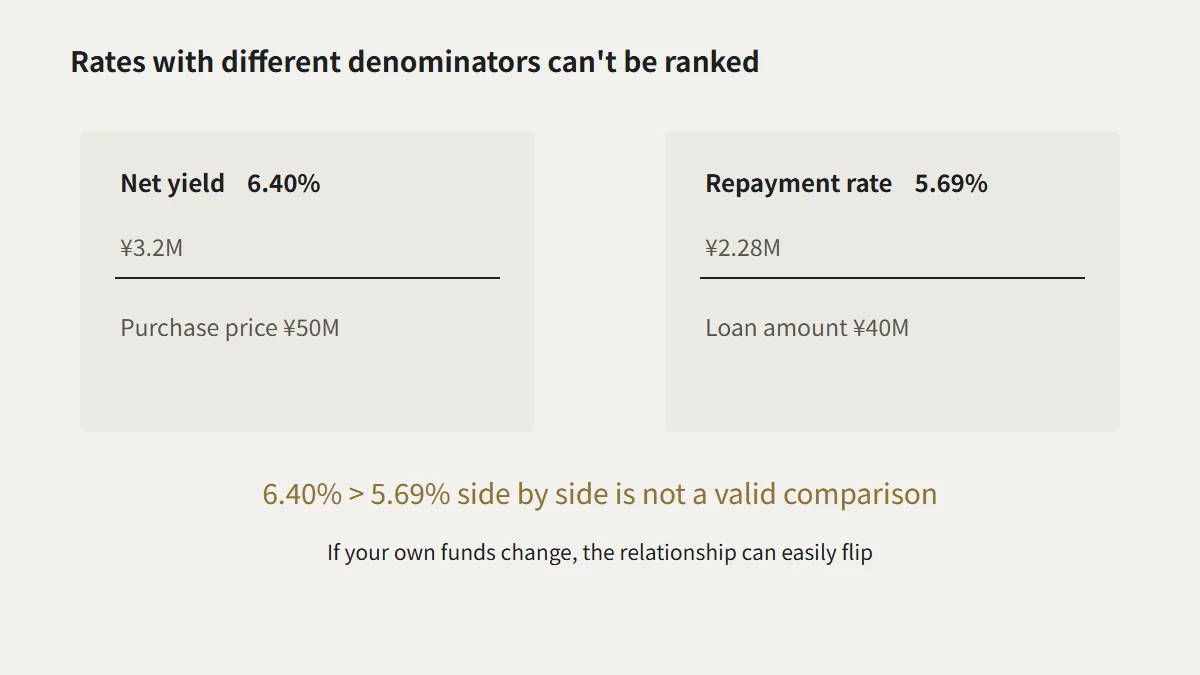
Annual loan repayment ÷ loan amount
Borrow ¥40 million at an interest rate of 3% over 25 years, and annual repayment is ¥2.28 million.
¥2.28 million ÷ ¥40 million = 5.69%
The net yield earlier was 6.40%.
6.40% > 5.69%. The yield is above the repayment rate, so money is left over.
It is tempting to think this way, but this comparison is not accurate.
The denominator of the 6.40% net yield is the purchase price of ¥50 million.
The denominator of the 5.69% repayment rate is the loan amount of ¥40 million.
You are lining up numbers with different denominators and comparing which is bigger.
If the share of own funds changes, this relationship can easily flip.
Compare by amounts, and you will not go wrong
So what do you do?
Drop the rates and compare amounts.
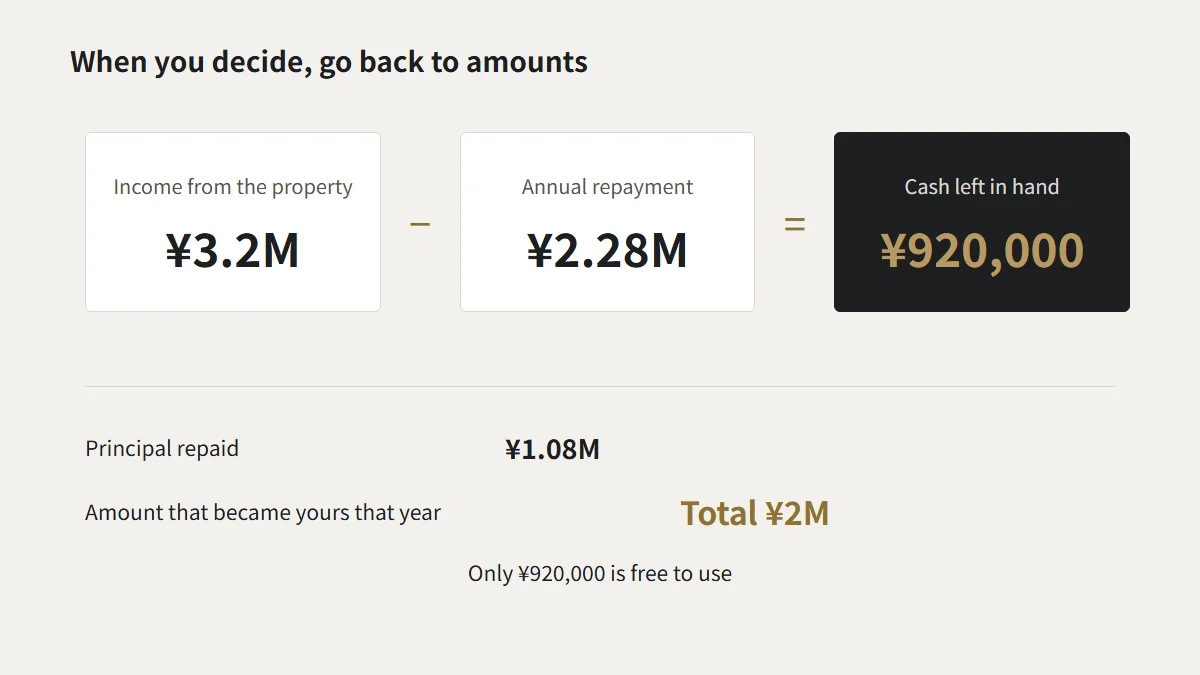
- Income the property generates (rent assuming full occupancy − expenses): ¥3.2 million
- Annual loan repayment: ¥2.28 million
- Difference: ¥920,000
That is all.
There is no need to worry about denominators. Take the money going out away from the money coming in.
Using the current rent of ¥3.7 million, it is ¥2.9 million − ¥2.28 million = ¥620,000.
This is faster and more reliable than calculating 5 yields.
Rates are handy for lining up things of different sizes. But they take the effort of aligning denominators.
If all you need is to decide whether you will buy, amounts are enough.
So is yield meaningless?
Let us think about it from the opposite side for a moment.
If the definitions vary, is there any point in looking at yields?
Not quite.
Yield has a convenience that amounts do not.
When you line up properties in different price ranges to narrow things down. When you want a sense of the going rate in an area.
Line up a ¥50 million property and a ¥100 million property by amounts, and you cannot compare them at a glance. As rates, you can.
So it comes down to using each for its purpose.
Rates when searching. Amounts when deciding.
At the stage of surveying broadly, it is fine to narrow down by rates.
But if you are still looking at rates when you finally decide whether to buy, the difference in denominators will trip you up.
There is one more number to look at
Finally, something that tends to be forgotten.
Everything we have calculated so far is about cash.
But the annual repayment of ¥2.28 million includes principal.
In the first year, it is roughly ¥1.2 million in interest and ¥1.08 million in principal.
The principal disappears from your bank account, but your debt goes down by the same amount. It has not vanished; it has only moved.
So there is the ¥920,000 left in hand, and the ¥1.08 million of principal.
Together, ¥2 million has become yours that year.
However, only the ¥920,000 is free to use.
Mix these 2 up, and you end up in the state of "I should be making money, but I have no cash."
In Part 1, I wrote that cash flow alone cannot measure results.
That point turns into numbers here.
When you see a yield in a brochure, ask just one thing.
What was divided by what to get that number?
And when you decide for yourself, drop the rates and go back to amounts.
Take the money going out away from the money coming in. Is the amount left over inside your own line?
Next time, we talk about when that calculation breaks down.
Not starting from what will happen, but from separating what you know will happen from what you do not know.