
The yield in the brochure is not your number yet
Starting from the gross yield, subtract vacancies, expenses and loan repayments in turn, and convert it into a number measured against the money you actually put in.
BENERU writes for readers who live in Japan. Taxes, loans and the other rules described here are those of Japan, and they assume a resident of Japan.
This page is a translation of the Japanese original. If the two differ, the Japanese original prevails.
Good day. I'm Nel Shikina.
At last, we look at a property.
It may feel heavy, but we have already prepared 4 numbers.
- The own funds you can put in
- The investment capital you can add each year
- How much you can afford to pay out of pocket when things go wrong
- The borrowing limit worked back from that
With these 4 in hand, the way you read a property brochure changes.
The yield in the brochure is not your number yet
A property brochure usually shows a yield.
In most cases, that number is the gross yield.
It is the annual rent assuming full occupancy, divided by the price.
It is not a lie. But it is not your number, either.
From there, we bring it down in 4 steps.
4 steps to make it your own number
The following is a fictional example for illustration.
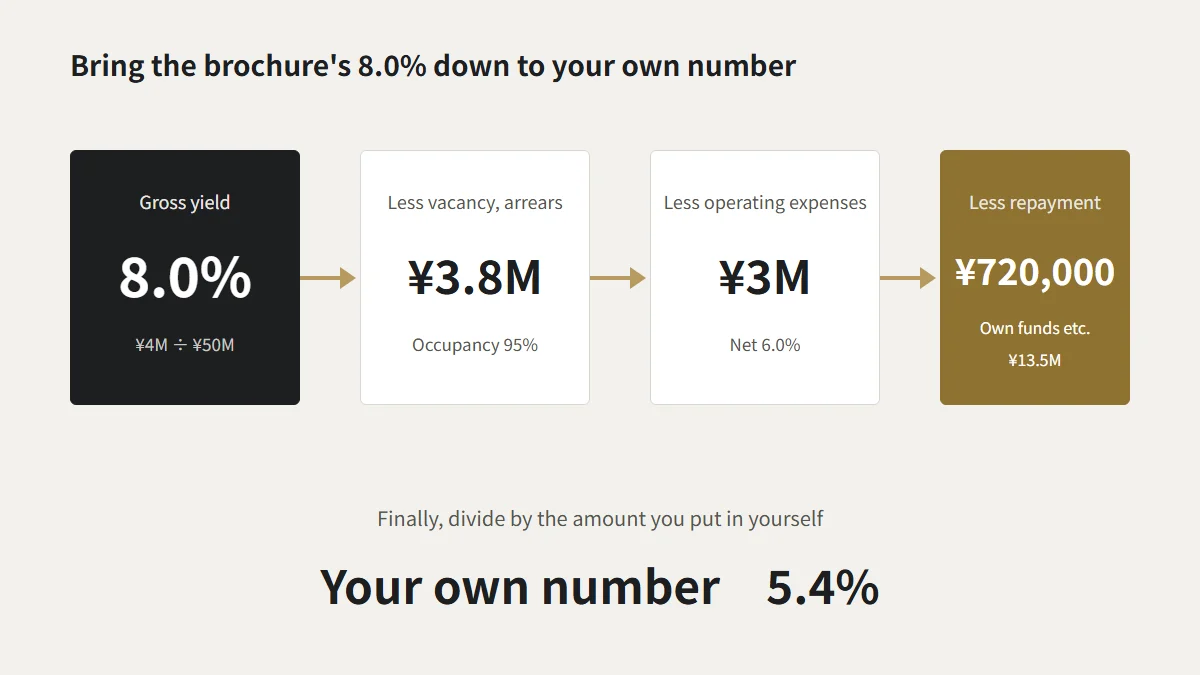
Purchase price ¥50 million. Annual rent assuming full occupancy ¥4 million.
Step 1: Gross yield
¥4 million ÷ ¥50 million = 8.0%
This is as far as the brochure goes.
Step 2: Subtract vacancies and arrears
Full occupancy never lasts forever. Let us assume 5%.
¥4 million × 95% = ¥3.8 million
Step 3: Subtract operating expenses
Management fees to the property management company, utilities and cleaning for common areas, repairs, insurance, fixed asset tax. Let us assume ¥800,000 a year.
¥3.8 million − ¥800,000 = ¥3 million
Divided by the price, that is a net yield of 6.0%.
8.0% has become 6.0%. Up to this point, anyone who does the calculation gets the same result.
Step 4: Put in your own terms
From here on, the result differs from person to person.
Own funds ¥10 million, borrowing ¥40 million. Interest rate 3%, 25 years.
Annual loan repayment is ¥2.28 million.
¥3 million − ¥2.28 million = cash left in hand: ¥720,000
And what you actually put in was ¥10 million in own funds plus ¥3.5 million in acquisition costs: ¥13.5 million.
¥720,000 ÷ ¥13.5 million = 5.4%
The number shown as 8.0% in the brochure has become 5.4% as your own number.
Both are correct calculations. They are measuring different things.
Only now can you hold it up against your own line
We have arrived at 5.4%.
Whether that is high or low, we cannot tell yet.
What you need to look at is what happens when things go wrong.
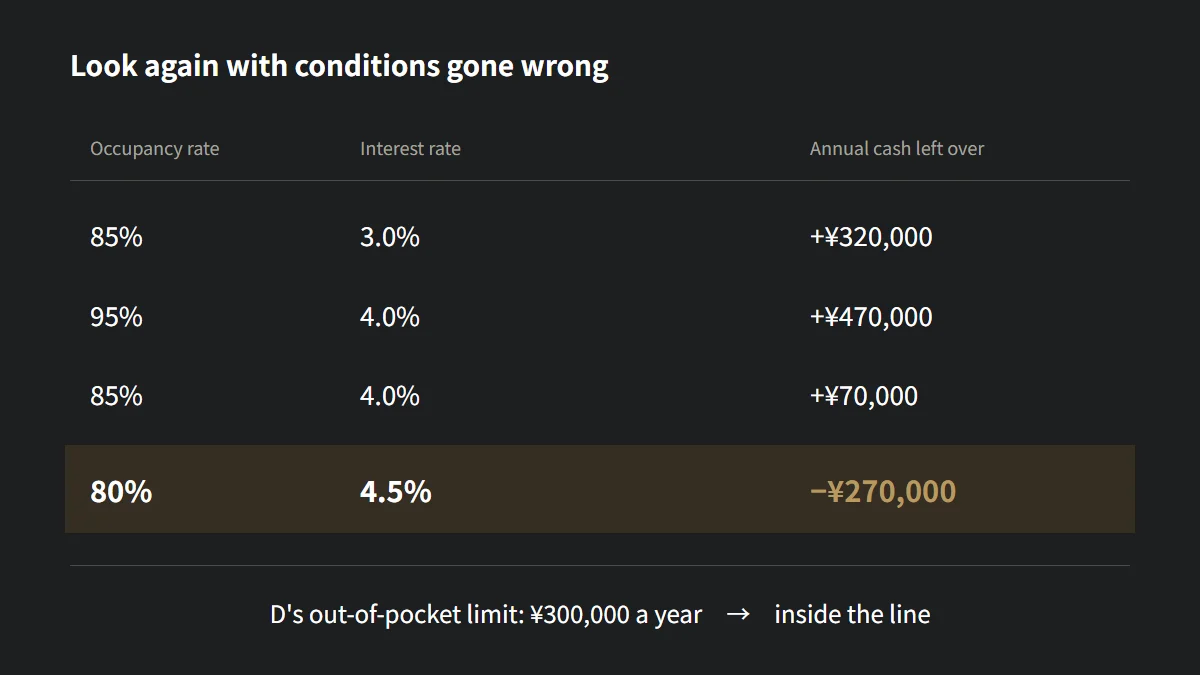
Keeping operating expenses the same, we move the occupancy rate and the interest rate.
- Occupancy 85%, interest rate 3%: ¥320,000
- Occupancy 95%, interest rate 4%: ¥470,000
- Occupancy 85%, interest rate 4%: ¥70,000
- Occupancy 80%, interest rate 4.5%: −¥270,000
Only in the last line does it turn negative. You would pay ¥270,000 a year out of your own wallet.
So we turn back to Part 3.
D's out-of-pocket limit was ¥300,000 a year.
¥270,000 fits within it.
Then, in Part 5, we worked out a borrowing limit that could withstand a 1 percentage point rise in interest rates: about ¥46.6 million.
The borrowing on this property is ¥40 million. That fits as well.
In other words,
this property fits within D's terms.
I have not written that it is a good property.
I have written only that it fits within D's terms.
If someone whose out-of-pocket limit is ¥100,000 a year looked at the same property, it would not fit.
What I wrote in Part 1 has turned into numbers here.
The same information means different things depending on the situation of the person receiving it.
What the brochure does not show
Now that the calculation is done, it may look like enough.
But everything we have calculated so far uses numbers that appear in the brochure.
Let me list, as they come to mind, the things that do not.
Would the current rent be achieved at the same amount if the unit were advertised today?
How long have the tenants lived there? Are all the contract dates bunched together?
What repairs have been done in the past? And what is coming next?
Is the bicycle parking overflowing? What about the garbage area? Can laundry be hung in the outside corridor?
These things act directly on rent and on how long units stay vacant. And none of them appear in the brochure.
They are missing not because they are being hidden. A brochure exists to outline the property, not to show what it is like to live there. That is all.
Still, while you line up the things that can be compared, the things that cannot be compared drop out of view.
Once the calculation fits, these are the things you will go and ask about.
When no property fits your terms
Let us think about it from the opposite side for a moment.
There is no property anywhere that fits within your line.
This happens all the time. In fact, it is usually the case.
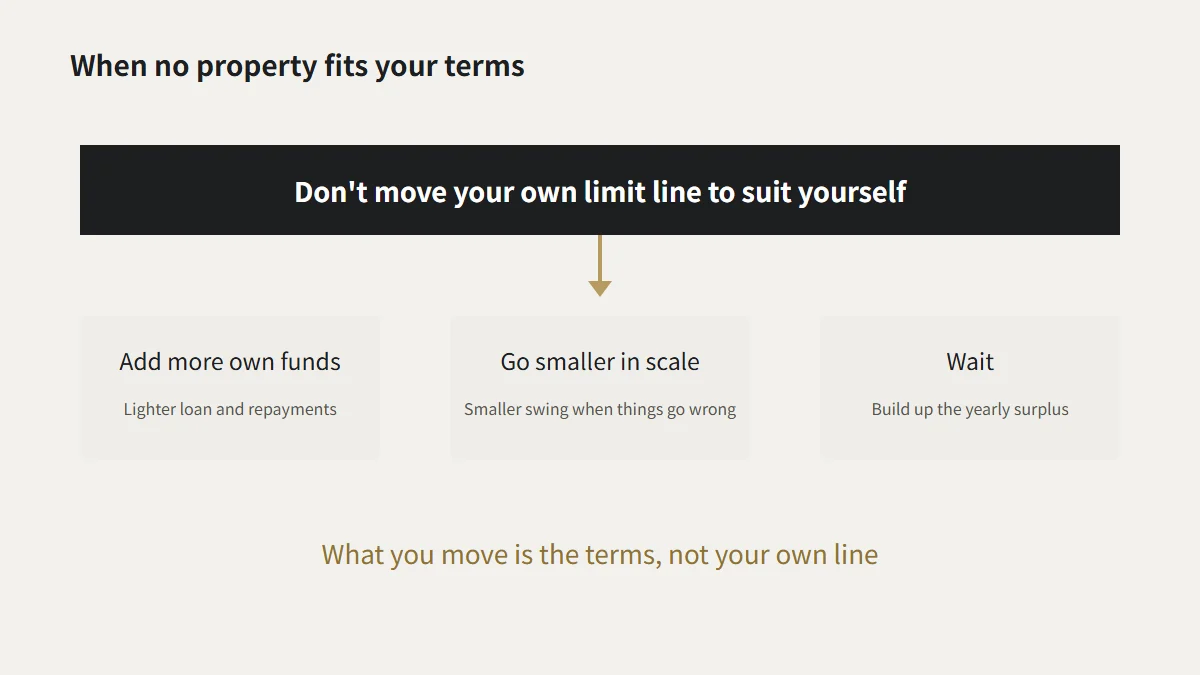
What you must not do then is move the line.
If you raise your out-of-pocket limit from ¥300,000 to ¥500,000 a year, the number of properties you can choose from goes up. But where would that ¥500,000 come from?
What you should move is not the line but the terms.
If you put in more own funds, the loan shrinks and repayments become lighter.
If you go smaller in scale, the swing when things go wrong also becomes smaller.
If it still does not fit, now is a time to wait.
Waiting does not mean doing nothing. Build up the yearly surplus and raise your out-of-pocket limit. That is the next thing to do.
I think that is faster than forcing through a property that does not meet your terms.
When you look at a brochure, try bringing the number down in 4 steps.
Gross. Subtract vacancies. Subtract expenses. Subtract repayments.
Finally, divide by the amount you put in yourself.
Then do it once more, with 85% occupancy and the interest rate up 1 percentage point.
Is the amount left over inside your own line?
That is all.
Next time, we will look a little more carefully at the indicators used in this calculation.
Gross and net. The relationship between yield and repayment. And the places where how a number is built changes how it looks.