
What you can borrow and what you should borrow are different
The amount a lender can lend and the amount of borrowing you can bear are separate. We sort out how to work backwards from your out-of-pocket tolerance to a borrowing limit, and how to look not only at the interest rate but at the loan term and annual repayment.

BENERU writes for readers who live in Japan. Taxes, loans and the other rules described here are those of Japan, and they assume a resident of Japan.
This page is a translation of the Japanese original. If the two differ, the Japanese original prevails.
Good day. I'm Nel Shikina.
Last time, we wrote down a purpose and a plan.
Up to that point, you could decide everything yourself.
From this time, that changes.
You cannot decide the terms of financing yourself.
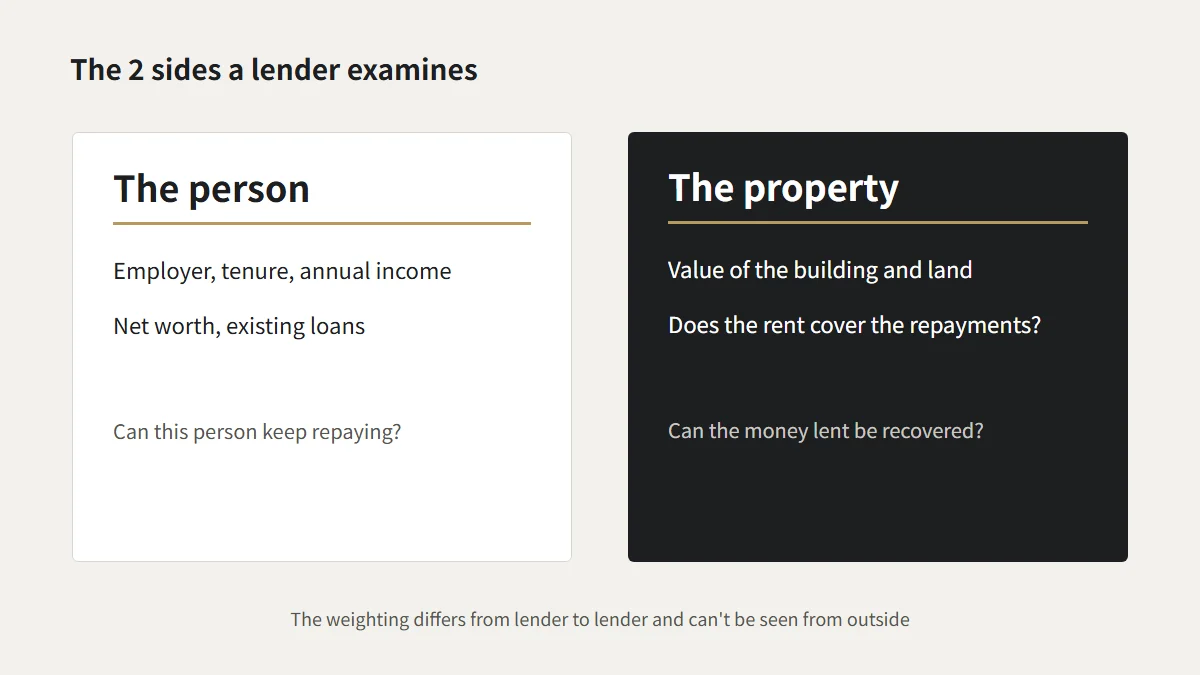
Lenders look at 2 things
Broadly speaking, 2 things are looked at.
One is the person.
Your employer, years of service, annual income. And the net worth you have built up through the previous articles, along with your existing borrowing.
The reason I asked you to write down student loans and installment payments in article 2 is that they are used here. Even if you haven't kept track of them, the other side is looking.
The other is the property.
How much value the building and land have. And whether the rent it generates covers the repayments.
How much weight is placed on each differs from lender to lender. And that weighting is not made public.
So there is no exact answer in advance to "how much can I borrow?"
The only way is to ask.
But there are things you can decide before you ask.
What you can borrow and what you should borrow are separate
This is the core of this article.
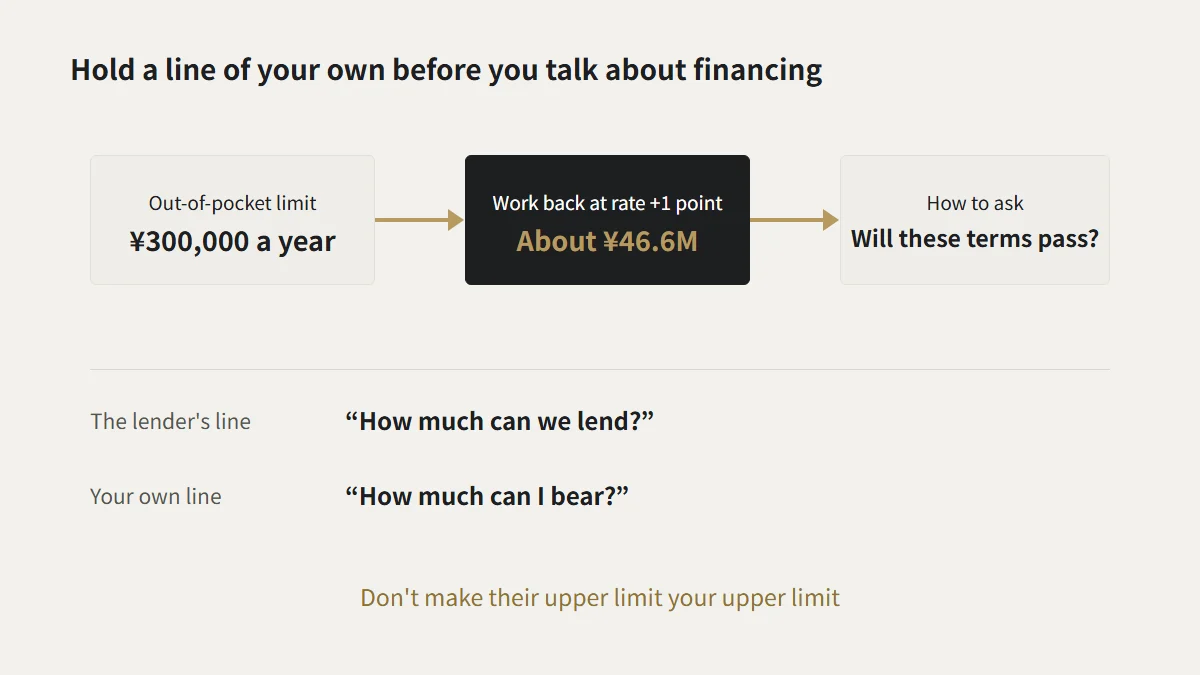
What the lender decides is "the amount it can lend." That is the other side's judgment about whether the money might not come back.
What you decide is "the amount you should borrow." This is decided by whether you can hold out when things fall apart.
The 2 are completely separate numbers.
Through the previous articles, we have already drawn this line.
Remember Person D from article 3. ¥1.5 million in cash that can be moved, and ¥150,000 left over each year. From that, we drew the line "at ¥300,000 a year, it lasts 5 years."
Let's translate this ¥300,000 into a loan amount.
How much more you pay when the interest rate rises 1 percentage point
The interest rates below are assumed values for illustration.
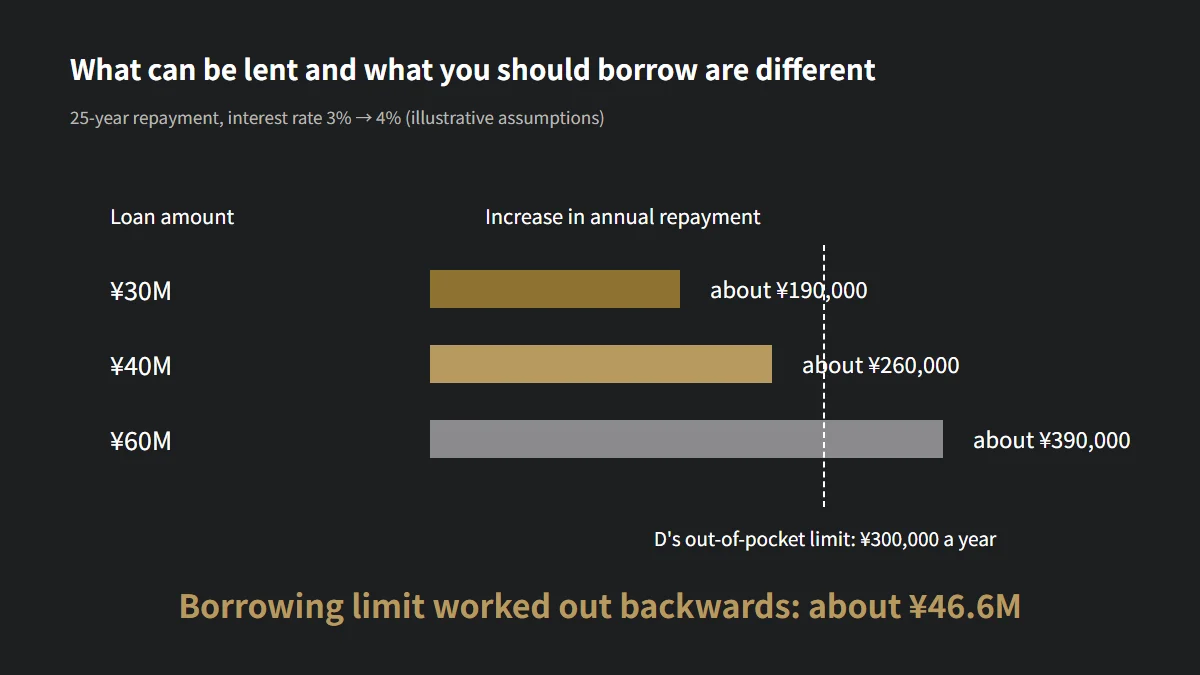
When repaying over 25 years, if the interest rate rises from 3% to 4%, annual repayment increases by this much.
- Loan amount ¥30 million: about ¥190,000
- Loan amount ¥40 million: about ¥260,000
- Loan amount ¥60 million: about ¥390,000
D's tolerance was ¥300,000 a year.
Working backwards, the loan amount that can withstand a 1 percentage point rise in the interest rate is about ¥46.6 million.
Go beyond this, and a move of just 1 percentage point in the interest rate takes you past what you can bear. Before any vacancy even appears.
Even if a lender says "we can lend up to ¥60 million," for D it is a different matter.
This is how the amount that can be lent and the amount you should borrow drift apart.
And if you don't have your own line, the other side's line becomes your line as it is.
"The proposal becomes your criteria," which I wrote about in article 1, happens here too.
The term matters more than the interest rate
There is one more thing that is easy to overlook.
The interest rate is written as a percentage, so it is easy to compare. That is why people end up looking only at that.
But the money that goes out each year is not decided by the interest rate alone.
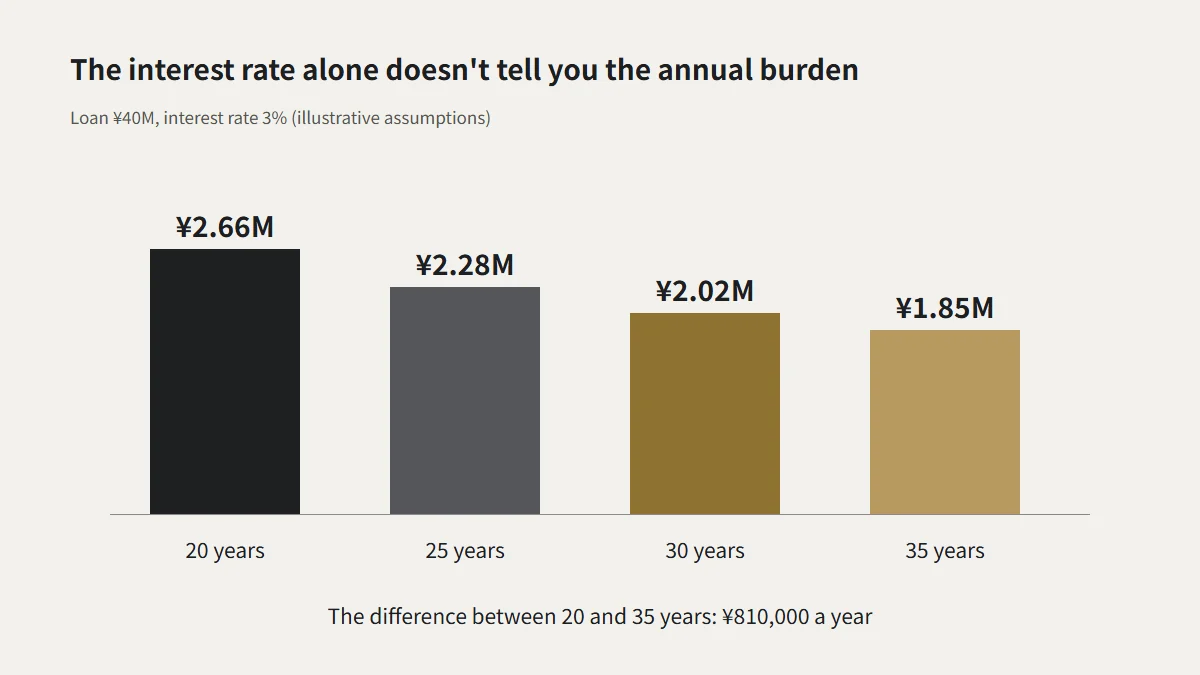
Take the case of borrowing ¥40 million at the same interest rate of 3%. Change the term.
- 20 years: ¥2.66 million a year
- 25 years: ¥2.28 million a year
- 30 years: ¥2.02 million a year
- 35 years: ¥1.85 million a year
Between 20 years and 35 years, the difference is ¥810,000 a year.
Compare that with the earlier "¥260,000 a year for 1 percentage point of interest rate."
A 15-year difference in term has about as much effect as a difference of nearly 3 percentage points in the interest rate.
So comparing by interest rate alone leads to wrong decisions.
When you see an interest rate in the documents, put the annual repayment amount next to it and divide it by the loan amount.
That number is the real burden rate.
Variable and fixed rates are set in different ways
Finally, the types of interest rate.
The short-term prime rate, the benchmark for variable rates, is linked to the Bank of Japan's policy rate.
The long-term prime rate, the indicator for fixed rates, is set based on things such as government bond yields.
In other words, long-term interest rates are not decided by the Bank of Japan. Market views, including on public finances and overseas interest rates, come into it.
If you lump it all together as "interest rates went up," it becomes unclear which one you are talking about.
And interest rates are actually moving.
The Bank of Japan's policy rate was raised to around 1.00% in June 2026 and to around 1.25% in September (Bank of Japan, Monetary Policy Meetings).
Interest rates rising is not a hypothetical; it is happening.
That is why there is value in calculating in advance the earlier "how much more if it rises 1 percentage point."
If the terms are bad, is it better not to borrow?
Let's think about it once from the opposite side.
A high interest rate, a short term. If those are the only terms offered, should you give up?
Not necessarily.
Bad terms and a deal that doesn't work are different things.
The order of judgment is this.
On those terms, how much is the annual repayment? Does that number divided by the loan amount exceed the yield the property generates?
If it does, no cash will be left over, however low the interest rate is.
If it doesn't, it works even if the interest rate is high.
And the terms will not stay the same forever. As you build a repayment record and your net worth grows, the next terms will change.
But the worse the terms, the narrower the range you can bear.
So the question is not "borrow or not borrow" but on those terms, up to how much can I bear? That is the question.
Lower the amount, and even bad terms can sometimes work.
Before you go to talk about financing, let me name just one thing to bring.
A borrowing limit worked out backwards from your own out-of-pocket tolerance.
That's all.
If you bring this, instead of "how much can I borrow?" you can ask "will this amount go through on these terms?"
When the way you ask changes, the information you get back changes too.
From next time, we will finally look at properties.
Looking at them with the 4 numbers from so far in hand, the same documents should look like something different.