
Borrowing raises returns, on one condition
From a fictional example in which a 3% interest rate over 30 years leaves more cash than a 2% rate over 20 years, we explain why the interest rate and the loan term should be considered as a set when looking at borrowing terms.
BENERU writes for readers who live in Japan. Taxes, loans and the other rules described here are those of Japan, and they assume a resident of Japan.
This page is a translation of the Japanese original. If the two differ, the Japanese original prevails.
Good day.
Using borrowing raises the yield on the money you put in yourself.
This is correct. But there is one condition.
Outside that condition, the same mechanism works in reverse.
The following is a fictional example for illustration.
A ¥50 million property. Own funds of ¥10 million, borrowing of ¥40 million.
The income the property generates, after vacancies and expenses, is ¥3 million a year. That is 6% of the purchase price.
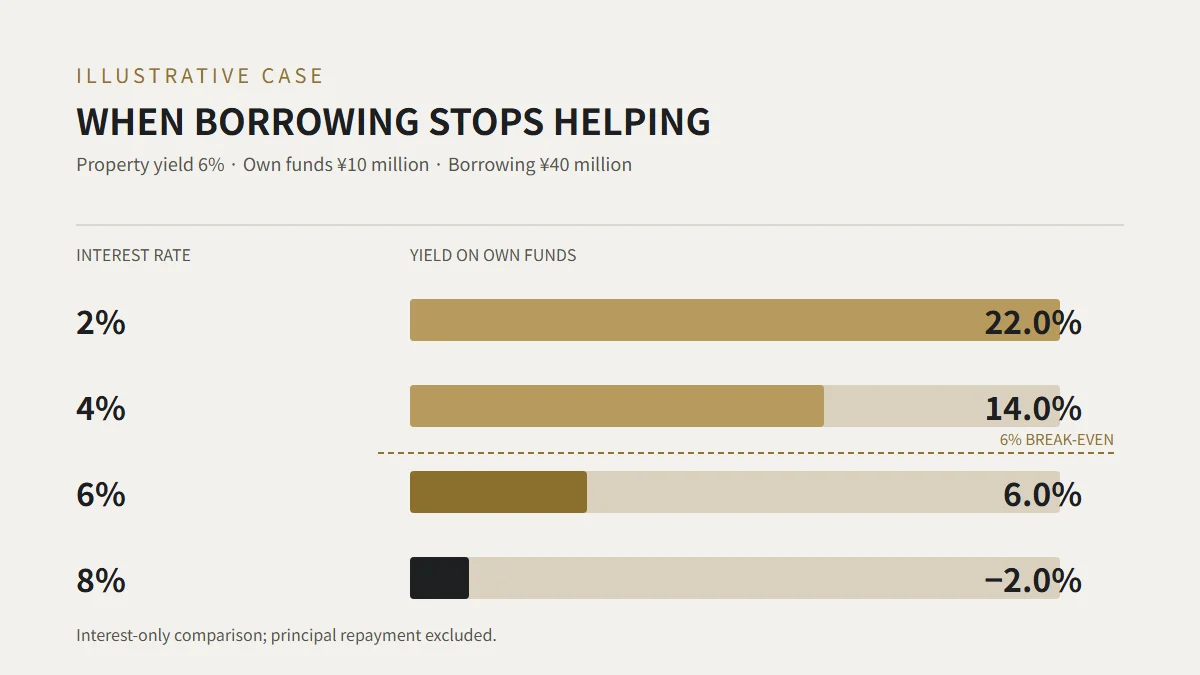
First, let us subtract only interest.
- Interest rate 2%: interest ¥800,000 → ¥2.2 million left → 22.0% on own funds
- Interest rate 4%: interest ¥1.6 million → ¥1.4 million left → 14.0%
- Interest rate 6%: interest ¥2.4 million → ¥600,000 left → 6.0%
- Interest rate 8%: interest ¥3.2 million → −¥200,000 left → −2.0%
Look at the 6% interest rate.
The yield on own funds is 6.0%. This is the same as buying a ¥10 million property without borrowing.
In other words, the point of borrowing ¥40 million has disappeared.
And at 8%, the sign flips.
The boundary is the yield the property itself generates. In this example, 6%. The moment the interest rate exceeds it, borrowing switches to the side that pushes profit down.
In reality, it gets hard sooner
The calculation just now leaves something out.
Principal repayment.
Interest alone would be fine, but in reality principal also goes out every month. Principal is not a loss, but it does reduce your bankbook.
Here a number more important than the interest rate appears.
What percentage of the remaining loan balance is the annual repayment?
Let us calculate with the same ¥40 million of borrowing.
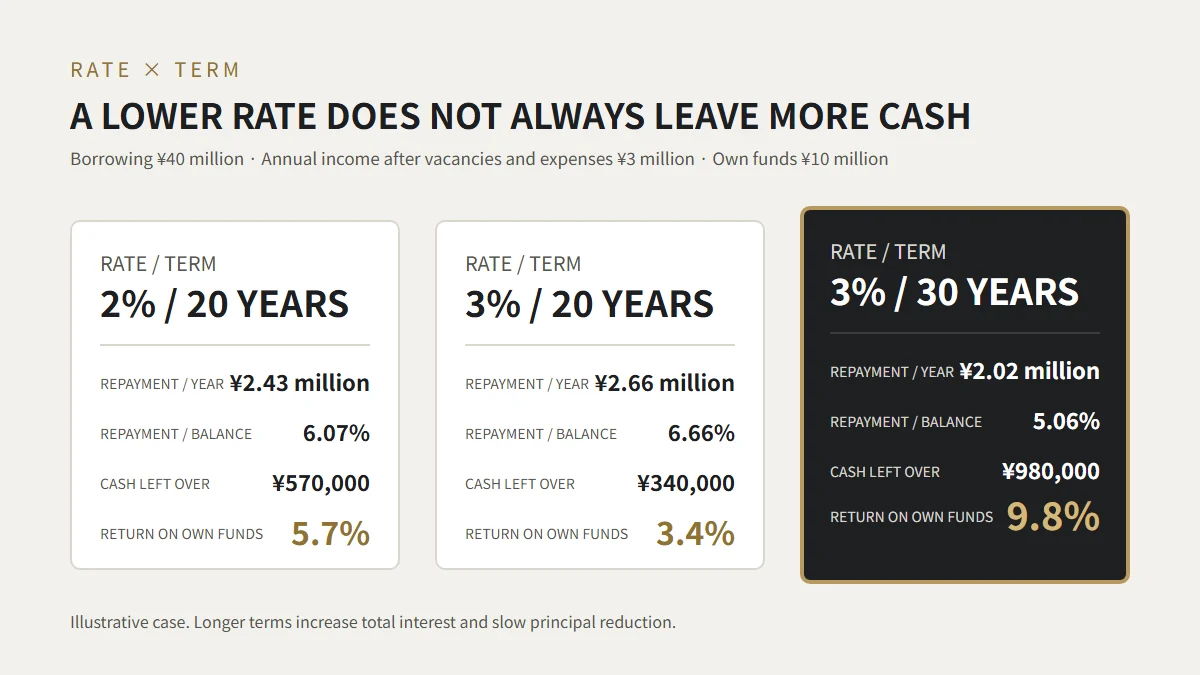
- Interest rate 2%, 20 years: annual repayment about ¥2.43 million. 6.07% of the balance
- Interest rate 3%, 20 years: about ¥2.66 million. 6.66%
- Interest rate 3%, 30 years: about ¥2.02 million. 5.06%
Even at a 2% interest rate, if you repay over 20 years, 6.07% goes out every year.
The property generated 6%. Even at a 2% interest rate, under these terms the yield left in hand falls below the 6% of buying without borrowing.
A higher interest rate can leave more
Let us look at the cash left in hand against own funds of ¥10 million.
- Interest rate 2%, 20 years: cash left over about ¥570,000 → 5.7%
- Interest rate 3%, 20 years: about ¥340,000 → 3.4%
- Interest rate 3%, 30 years: about ¥980,000 → 9.8%
Lined up, it is clear.
3% over 30 years far exceeds 2% over 20 years in cash left over.
Even though the interest rate is 1 percentage point higher.
So "the interest rate is low, so it's fine" sees only half of it. The interest rate and the term only have meaning as a set.
Then is a longer term always better?
It is not that simple either.
Extending the term increases the cash left over each year. But the total interest paid increases. Principal also goes down more slowly, so the speed at which net worth builds up drops.
And the term is not something you can choose yourself. It is decided by the type of building, its age, and the lender's way of thinking.
In other words: thicken the cash each year, or hold down the total and build net worth faster. It is the same fork in the road as the early repayment story I wrote about before.
Here too, the deciding factor is not the interest rate.
When you see the interest rate in the materials, put the annual repayment next to it and divide by the remaining loan balance. Check whether that number exceeds the property's yield.
If it does, however low the interest rate, borrowing makes the yield left in hand lower than buying without borrowing.
Walking around the canals, you sometimes see a black kite circling.
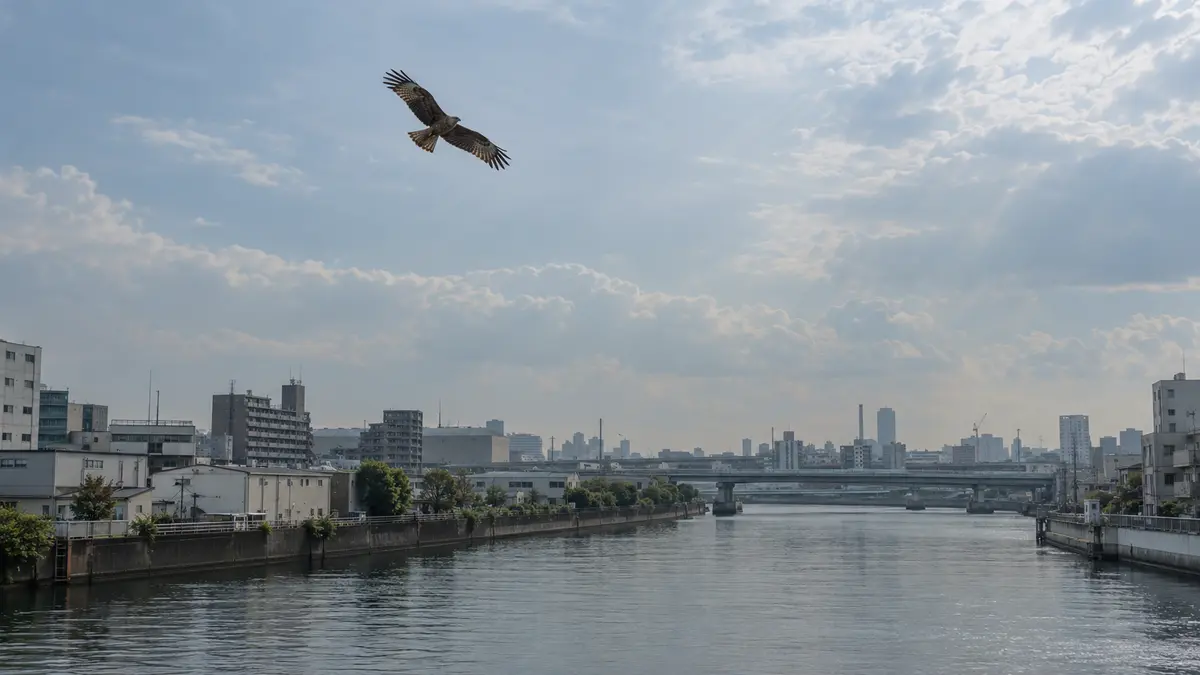
Without flapping, it rises little by little. I was told it is not its own strength, but riding rising air.
That is probably why it can go so far.
But when the air current stops, it simply comes down. The wings are the same. Only what is outside has changed.
While it is rising, you probably cannot tell whether it is thanks to its own wings or thanks to the wind.