
When the purpose differs, the same numbers give a different answer
Monthly cash, net worth, or a specific function. What you prioritize changes the answer for the same numbers. Using a comparison of loan terms, we sort out how to set a purpose and a plan.

BENERU writes for readers who live in Japan. Taxes, loans and the other rules described here are those of Japan, and they assume a resident of Japan.
This page is a translation of the Japanese original. If the two differ, the Japanese original prevails.
Good day. I'm Nel Shikina.
Two articles ago we made a BS, and last time a PL.
With that, where you are now and how much you can move each year are in numbers.
Next is what to point them at.
But if someone tells you "set a goal" at this point, doesn't your hand stop?
It is only natural that it does. Nobody tells you what to write.
"I want to grow my money" is not a purpose
When you try to write down a purpose, words like these usually come out.
I want to grow my money.
I'm worried about retirement.
My current salary alone feels insufficient.
I think all of these are true.
But they are not purposes. They are starting points.
Why can't they be used as a purpose? There is one reason.
Because they don't change your decision.
Suppose there is one set of terms in front of you. Do you go ahead on those terms or not? Apply "I want to grow my money," and no answer comes out. Whether it grows or not is not decided by those words.
So whether a purpose is working can be checked like this.
When you apply that purpose, does your answer to the choice in front of you change?
If it doesn't, it is not yet working as a purpose.
A purpose can be written by choosing which of 3 to make the main one
Staying abstract gets you nowhere, so let me show you a shape.
What you can go after through real estate is broadly 3 things.
- Thicker monthly cash (you want money you can move on hand)
- Faster growth in net worth (you want to reduce debt quickly)
- A specific function (a hedge against inflation, how it is treated in inheritance, spreading income sources beyond your salary, and so on)
Which of these you put as the main one is how you write your purpose.
And what matters is that you cannot have all 3.
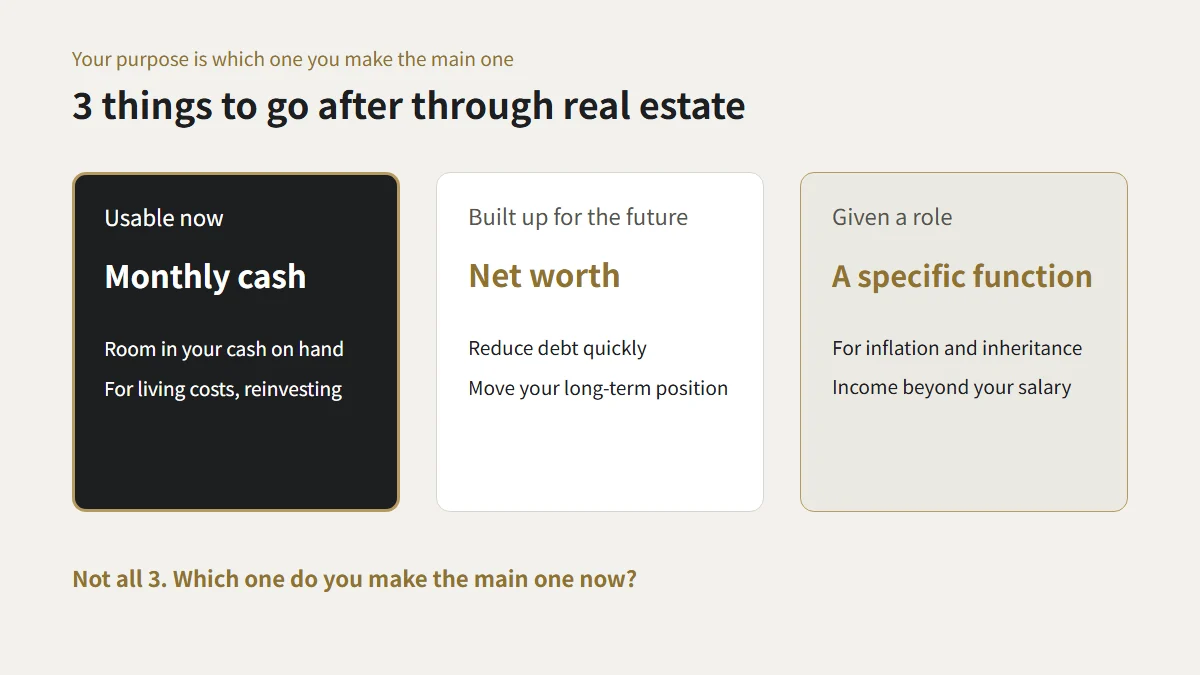
Put into words, it sounds obvious, so let me show you in numbers.
Same borrowing, changing only the loan term
The following is a fictional example for illustration.
Borrow ¥40 million at an interest rate of 3%. Let's set the property aside for now. We compare only how the money is borrowed.
Repaying over 20 years
Annual repayment is ¥2.66 million.
Repaying over 30 years
Annual repayment is ¥2.02 million.
The difference is ¥640,000. With 30 years, ¥640,000 more stays in your hands every year.
Now let's look at what the repayment is made of.
Repayment is split into interest and principal. Interest simply goes out, but principal is the amount by which your debt goes down, so it goes into your own assets.
Interest in the first year is 3% on ¥40 million, so it is ¥1.2 million in both cases. It is the same even though the terms differ.
Then,
- 20 years: ¥2.66 million − ¥1.2 million = principal ¥1.46 million
- 30 years: ¥2.02 million − ¥1.2 million = principal ¥820,000
The difference is ¥640,000.
Have you noticed?
The ¥640,000 difference in annual repayment is entirely a difference in principal.
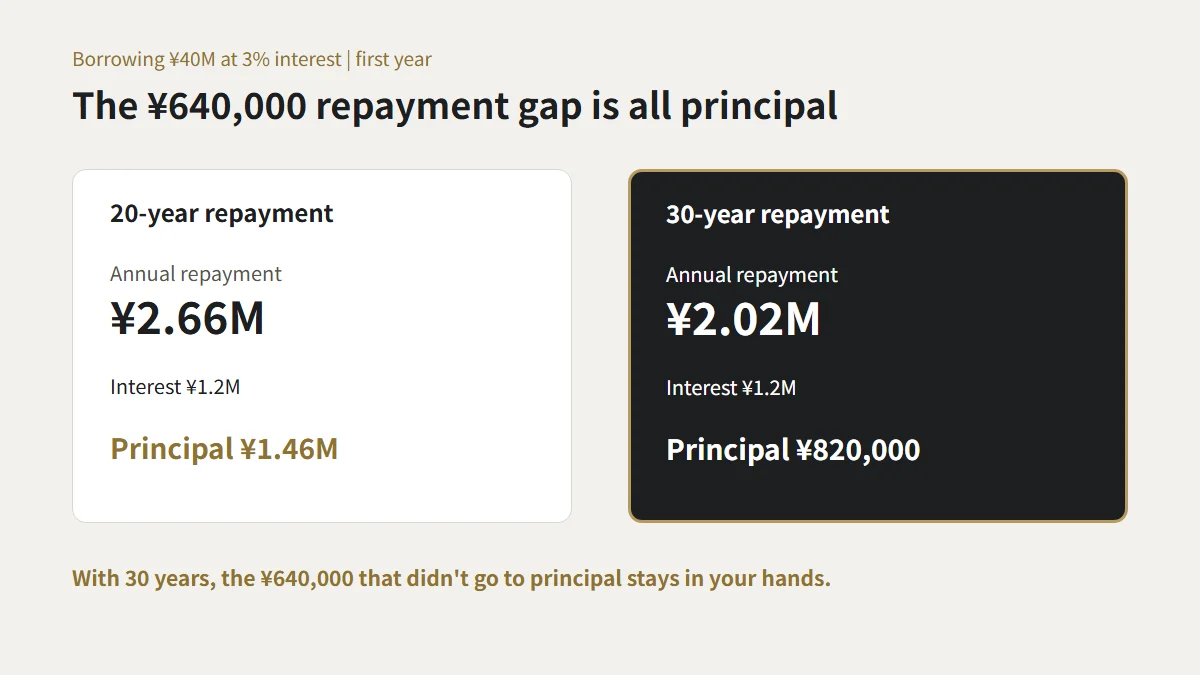
Choose 30 years, and ¥640,000 stays in your hands every year. That ¥640,000 is the part that was not used to reduce the debt.
Nothing has increased or decreased. It is just kept in a different place.
After 10 years, it looks like this
Run the same terms for 10 years.
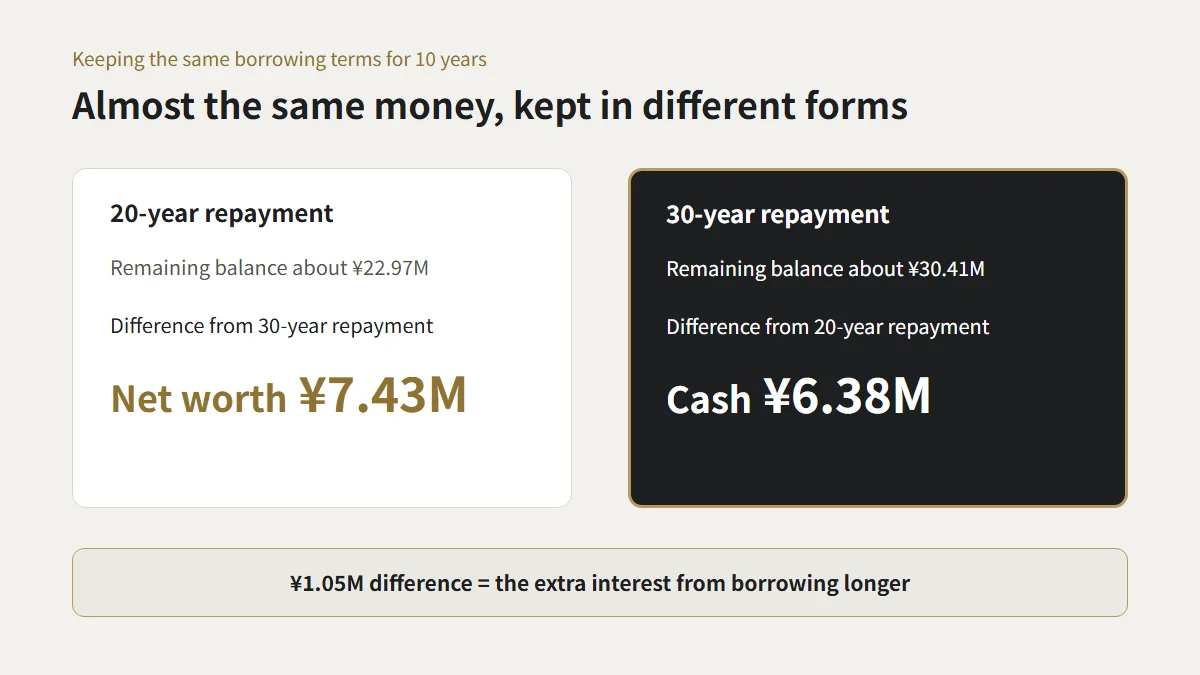
If repaying over 20 years
The remaining balance is about ¥22.97 million. The debt has gone down by ¥17.03 million.
If repaying over 30 years
The remaining balance is about ¥30.41 million. The debt has gone down by ¥9.59 million.
The difference in net worth is ¥7.43 million.
Meanwhile, the side that chose 30 years kept ¥640,000 in hand every year. Over 10 years, that is ¥6.38 million.
¥7.43 million and ¥6.38 million.
The difference is ¥1.05 million. This is the extra interest paid for borrowing longer.
In other words, over 10 years,
- the person who repaid over 20 years has ¥7.43 million as net worth
- the person who repaid over 30 years has ¥6.38 million as cash
Almost the same amount, kept in different forms.
At this point, we come back to where we started.
Make monthly cash thicker, or grow net worth faster.
These 2 are competing for the same money.
That is why you cannot have both.
Put in a deadline, and the plan comes out on its own
Once the purpose is decided, next is the plan.
There is no need to think about anything difficult. You just put in a deadline and an amount.
For example, try writing it like this.
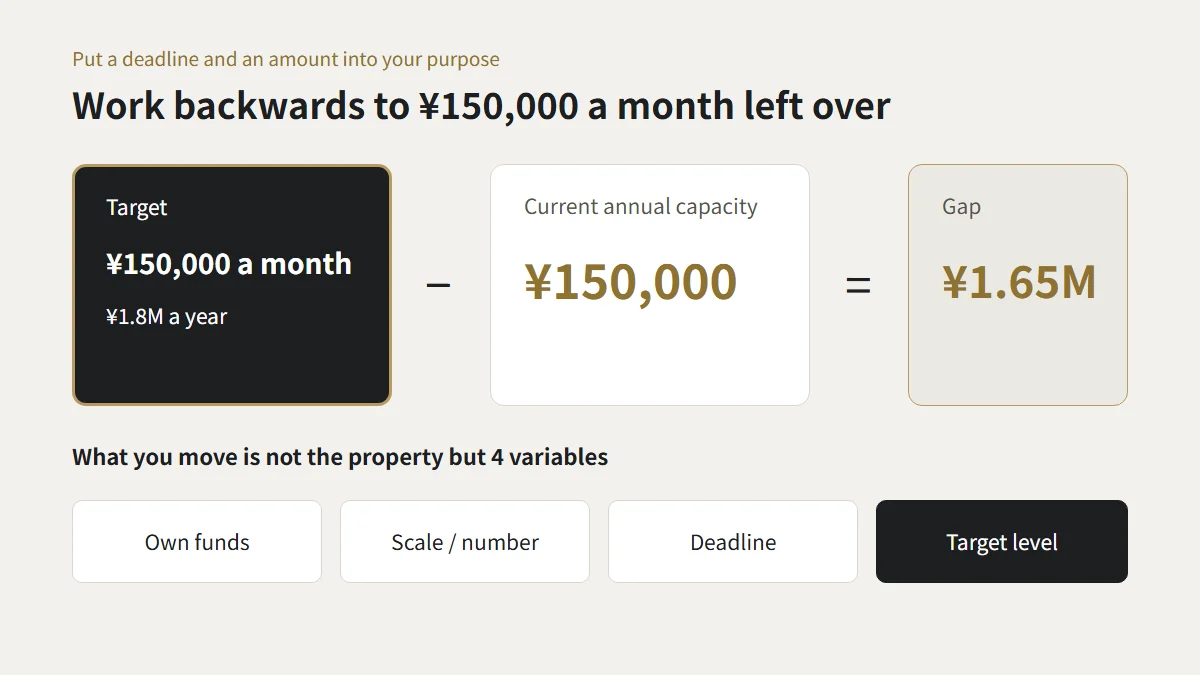
By age 65, I want the cash left over from rent to cover half of my living costs.
If living costs are ¥300,000 a month, half is ¥150,000 a month. That is ¥1.8 million a year.
Now go back to last time's PL. If your current surplus was ¥150,000 a year, the gap from ¥1.8 million is ¥1.65 million.
The question that comes out is not "which property should I buy."
- Increase your own funds and reduce borrowing
- Increase the scale and add more properties
- Extend the deadline
- Lower the target level and decide that ¥100,000 a month is enough
Which of these you move is the plan.
If the number you get by working backwards is not realistic, looking for properties won't solve it. The only way is to fix the purpose, the deadline, or your own funds.
This is why we made the BS and the PL first. Without numbers, you cannot work backwards.
If you just can't decide on a purpose
Having read this far, I think some of you still can't write one.
Let's think about it once from the opposite side.
If you can't decide on a purpose, does that mean you can't start anything?
Not necessarily.
There are several reasons a purpose doesn't get decided.
Is it that you really can't decide? That you can't decide because you don't know the options? Or that you don't like that deciding means giving up the others?
If it is the third, the answer is already out. Wanting everything means having no order of priority.
And if you go ahead with no order of priority, you end up thinking in the order shown by the person in front of you.
In the first and second cases, it is fine to set one provisionally.
Decide provisionally that, for you right now, monthly cash is what you need more. If your situation changes a year later, rewrite it.
A purpose is not something you can never change once decided. But having nothing written and having something written, even provisionally, lead to different ways of making decisions.
With a provisional purpose, you can ask of the terms you are offered, "does this fit my order of priority?" With nothing, the question itself cannot even be asked.
Once you have written a purpose, please check it one last time.
When you apply that purpose, does your answer to the choice in front of you change?
If it doesn't, there is still room to rewrite it.
Next time, I will talk about financing, the tool that actually puts this plan into motion.
Because the loan term and the interest rate are not things you choose yourself; they are decided by the other side.