
It's not about how much is left each month
A monthly surplus alone does not tell you your capacity to invest. Put your annual income and expenses, emergency fund, investment capital and tolerance for out-of-pocket payments in a deficit into numbers.

BENERU writes for readers who live in Japan. Taxes, loans and the other rules described here are those of Japan, and they assume a resident of Japan.
This page is a translation of the Japanese original. If the two differ, the Japanese original prevails.
Good day. I'm Nel Shikina.
Last time, we wrote down assets and debts and worked out net worth.
And at the end, I asked you to look at 3 things. How much cash you have. How large your debts are. And how much per year you could pay out of your own pocket.
Only the third one is still left.
That is because it doesn't show up when you look at balances.
This time, we fill that in. Please prepare just one more sheet of paper.
This is not about keeping a household account book
When the topic is household finances, it usually ends up here.
So much on food, so much on daily necessities, so much on socializing. Break the expenses into detailed categories and record them every day.
If that works for you, please keep it up. It is useful.
But it is not what you need for investment decisions.
You only need 3 things.
- The amount that comes in
- The amount that always goes out
- The amount you can cut
Whatever the categories, it is enough if things are split into these 3.
Why don't you need to go into detail?
Because what you use in an investment decision is not "did I spend a lot on food this month," but "how far can I hold out when things fall apart."
What sets how far you can hold out is the line between the amount that always goes out and the amount you can cut.
Rent, loans, insurance premiums, phone and internet, school fees, taxes. These always go out.
Eating out, travel, hobbies, clothing. These can be cut.
How much you can cut is, as it is, your staying power.
Look at it by month, and you will get it wrong
I will be definite here.
Personal income and expenses are looked at by year, not by month.
The reason is simple: there are expenses that don't go out every month.
Someone who says "I have ¥50,000 left over every month" looks at their savings at the end of the year, and they haven't grown. It is a common story.
Why?
The following is a fictional example for illustration.
- Fixed asset tax: ¥100,000
- Automobile tax: ¥40,000
- Vehicle inspection (1 every 2 years, annualized): ¥30,000
- Annual insurance payments: ¥80,000
- Trips home and travel: ¥100,000
- Replacing appliances, repairs to the home: ¥50,000
- Weddings and funerals, medical costs: ¥50,000
That totals ¥450,000.
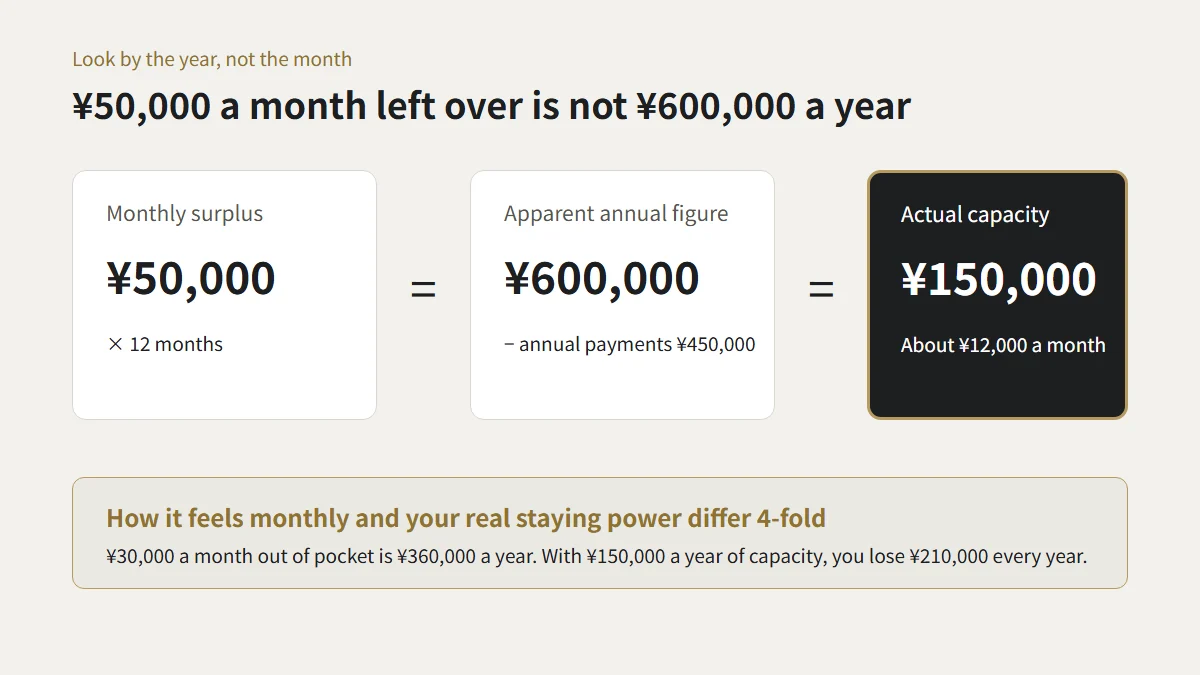
A surplus of ¥50,000 a month is ¥600,000 a year.
Since ¥450,000 goes out of that, what is left after 1 year is ¥150,000.
So the real capacity of someone with ¥50,000 left over each month is about ¥12,000 a month.
That is a 4-fold difference.
What happens if you judge by the monthly number alone and buy a property that requires ¥30,000 a month out of pocket?
That is ¥360,000 a year. In a household with only ¥150,000 a year left over, money goes down by ¥210,000 every year.
It isn't the property's fault.
It was never enough from the start.
Cutting spending by ¥10,000, versus a pay rise
Here is one slightly surprising calculation.
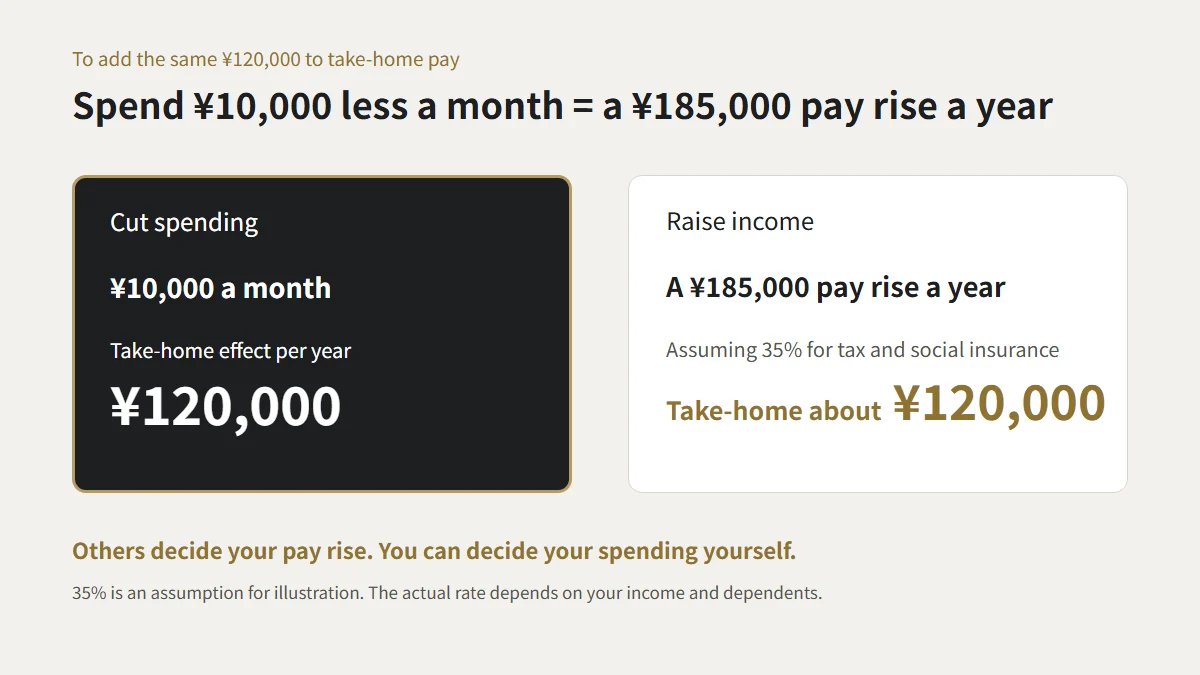
Suppose the person above cuts spending by ¥10,000 a month. That is ¥120,000 a year.
The annual surplus goes from ¥150,000 to ¥270,000. That is 1.8 times as much.
Then how big a pay rise would it take to create the same ¥270,000 on the income side?
Take-home pay would need to rise by ¥120,000 a year.
However, a pay rise is subject to income tax, resident tax and social insurance premiums. Let's assume they come to 35% combined. The actual rate depends on your income and dependents, so this is only an assumed figure.
¥120,000 ÷ 0.65 = about ¥185,000
In other words, cutting spending by ¥10,000 a month has the same effect as a pay rise of ¥185,000 a year.
No tax is charged on cutting spending.
There is one more thing. A pay rise is decided by someone else, but your spending is decided by you.
This is not to say that saving money is about putting up with things. It is that spending is the only variable you can control yourself.
That is another reason to know how much you can cut.
What is left over and what you can put in are also different
That ¥150,000 cannot be used for real estate as it is, either.
There are things to subtract first.
Emergency fund
If your cash on hand is still thin, build this up first. How many months' worth to keep differs from person to person, but if you put money into investment before this is filled, your plan ends with the first vacancy.
Expenses that are already decided
Education costs, replacing the car, caring for parents, repairs to the home. Anything whose timing and amount you can roughly see, set aside first.
What remains after subtracting these 2 is the amount you can put into investment.
And here, let me separate the terms, because they are easy to mix up.
- Own funds you can put in at the start: the lump sum you can put in from your cash on hand now. This comes from last time's BS.
- Investment capital you can add each year: the amount you can keep adding from each year's surplus. This comes from this time's PL.
- Out-of-pocket tolerance you can bear in a deficit: the amount you can pay from your own pocket in a year when the income and expenses fall apart. This comes from both.
All 3 are different things.
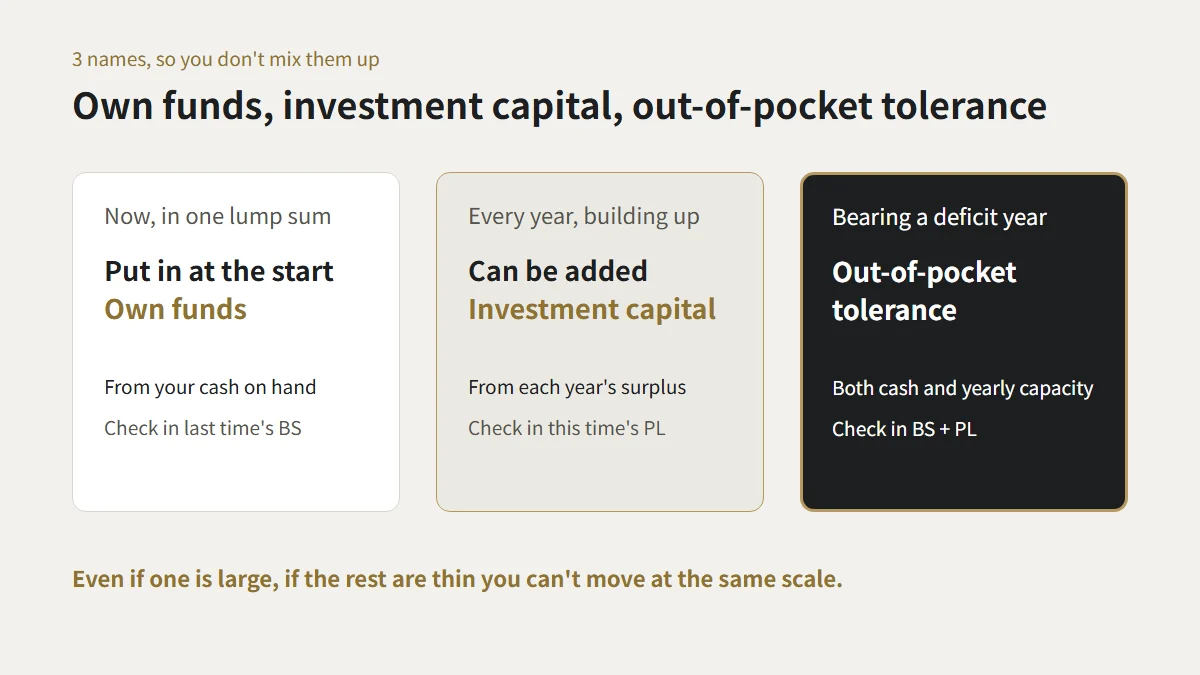
Even if the first is large, you cannot grow your scale if the second is small. Even if you have the second, if the third is thin, a single vacancy leaves you stuck.
Put the 2 together, and you can draw a line
Let's go back to Person D from last time.
The following is a fictional example for illustration.
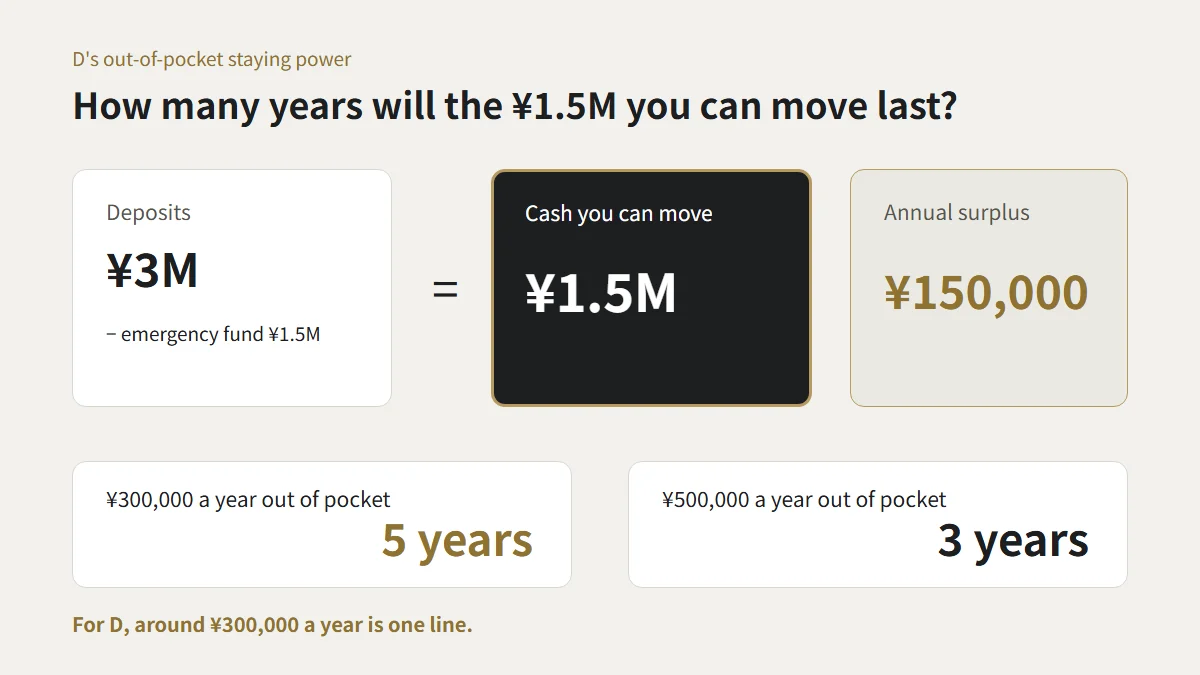
D had a home, insurance and a car, and ¥3 million in deposits. If living costs are ¥250,000 a month, D wants to keep 6 months' worth, ¥1.5 million, as an emergency fund.
That leaves ¥1.5 million in cash that can be moved.
And from this time's PL, what is left each year was ¥150,000.
From here, you can think like this.
If the out-of-pocket amount is ¥300,000 a year, ¥1.5 million lasts 5 years. At ¥500,000 a year, it lasts 3 years.
Do you think it is enough to last 5 years, or do you want to hold out for 10 years?
That answer decides the out-of-pocket amount you can tolerate.
There's a number.
In D's case, around ¥300,000 a year is one line. A property with terms beyond that is not a property D can buy.
It isn't that the property is bad. It just doesn't fit D's conditions.
If someone with ¥20 million in cash bought the same property, it would be a completely different decision.
If the surplus is small, is giving up the only option?
Having read this far, some of you may have noticed how small your surplus is.
Let's think about it once from the opposite side.
If only ¥150,000 a year is left over, does that mean you can't do real estate investment?
Not necessarily.
It isn't that you can't. It's just that the scale is decided.
You can't buy a property that requires ¥30,000 a month out of pocket. That is ¥360,000 a year, so it is not enough from the start.
But if the terms only require ¥5,000 a month out of pocket, that is ¥60,000 a year. It fits within the ¥150,000.
Putting in more of your own funds reduces the out-of-pocket amount. A longer loan term makes the monthly burden lighter. Making the property smaller in scale also makes the swing smaller when things fall apart.
So the question "how much surplus do I need?" has no answer.
Instead, let's rephrase the question.
With my current surplus, up to what scale does it work?
Put it this way, and you get an answer. And you can get it today.
If you feel it isn't enough, rather than waiting until it is, find out first what scale is enough. That way, what to do next is decided.
For income, look at how it breaks down, not the amount
Finally, the side that comes in.
Look not only at the amount, but at what it is made of.
Does it work on your monthly salary, or only when bonuses are included?
Income and expenses that rely on bonuses fall apart in a year when the bonus goes down. And when bonuses go down, they go down all at once.
So check once whether your fixed costs are covered by your monthly salary alone.
If they aren't, that is the place to work on before investing.
The same goes if you are counting side income or a spouse's income: look at what remains if one of them stops.
Lenders also look at the stability of income. However, which income they count, and how far, differs from lender to lender, so this is something you can only ask them.
The BS and the PL are not separate things.
What is left over on the PL increases the cash on the BS. As cash increases, both the own funds you can put in and the out-of-pocket amount you can bear increase.
Put the other way round, if your cash is thin, searching for properties won't make the terms any better.
Fixing the PL first is faster.
Once you have both sheets, the BS and the PL, on paper, you can see in numbers, for the first time, what position you are in to choose from.
Next time, we will decide what to aim for from that position.
Because when the purpose differs, the answer changes even for the same property.