
Turning your assets into numbers
How to enter your home, insurance, car, pension and loans on a personal BS. Work out your net worth from current values and debts, and sort out how much money you can actually move.

BENERU writes for readers who live in Japan. Taxes, loans and the other rules described here are those of Japan, and they assume a resident of Japan.
This page is a translation of the Japanese original. If the two differ, the Japanese original prevails.
What stops you is the very first word
"Assets"
This is the word where your hand stops.
If you think of it as everything you own, you can't write anything down. Your watch, your furniture, your keepsakes are all things you own.
That is not what assets means here.
There is only one standard.
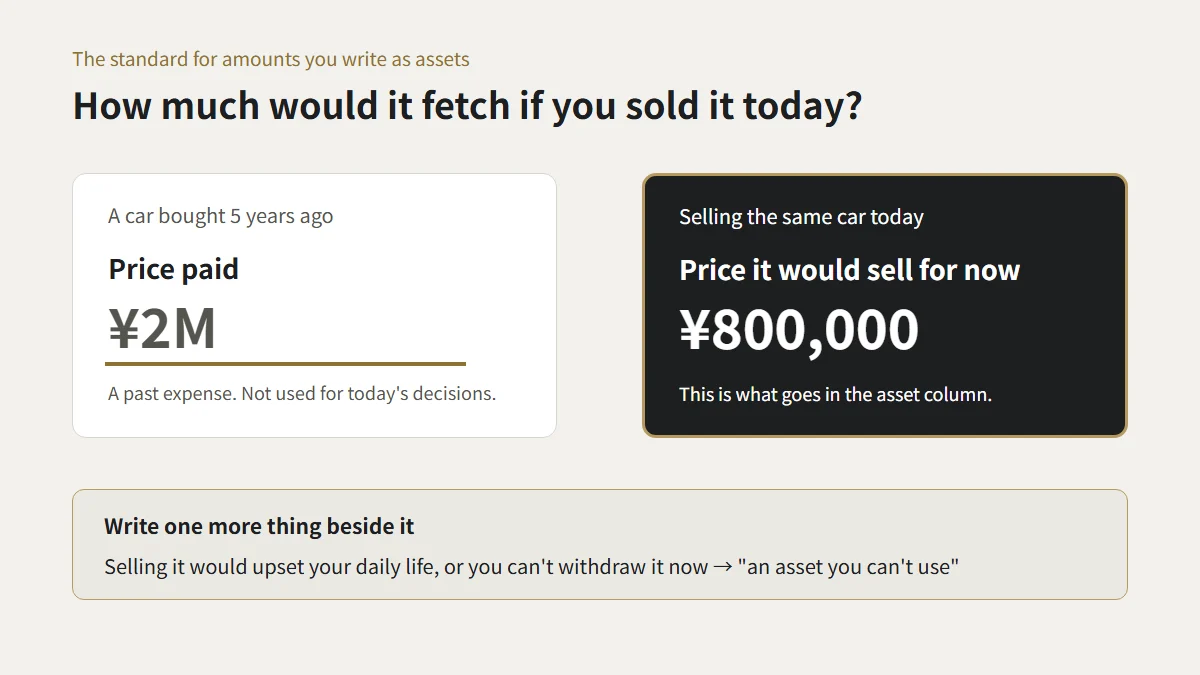
How much would it fetch if you sold it today?
Not what you paid for it.
A car you bought for ¥2 million 5 years ago is worth ¥800,000 if it would only sell for ¥800,000 now. Not ¥2 million.
Why the current price?
Because the current price is the only one you can use for a decision.
The same goes for when a lender looks at you. They are not interested in how much you paid in the past. They only look at how much it is worth now.
Once you switch to this standard, it becomes clear what you can write down and what you can't.
Your home goes on both the asset and the debt side
Where people get stuck most is their home.
Is it an asset or a debt? It is often debated, but there is no need to hesitate over how to write it down.
You write it on both sides.
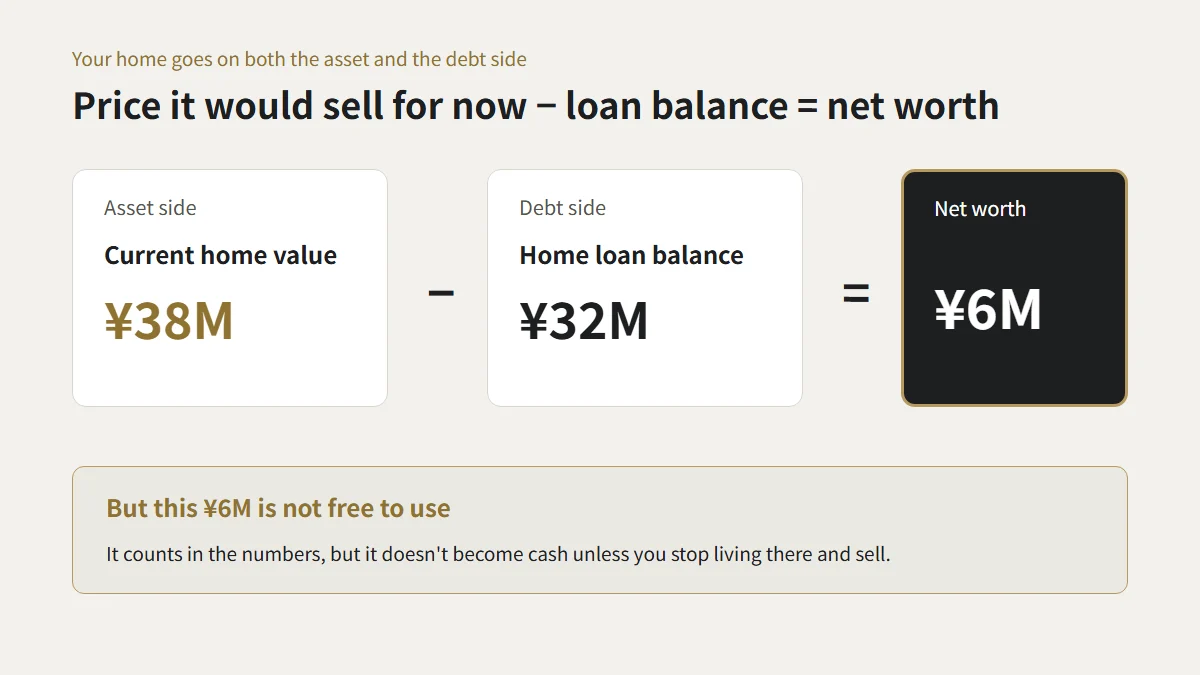
- On the asset side, the price it would sell for now
- On the debt side, the balance of the home loan
The following is a fictional example for illustration.
- Price paid: ¥45 million
- Price it would sell for now: ¥38 million
- Home loan balance: ¥32 million
What goes into your net worth is the difference, ¥6 million.
The feeling of "I own a ¥45 million home," versus the ¥6 million that actually counts.
That gap is how far you are misreading your own situation.
The price it would sell for now does not have to be exact. You can get a rough idea by looking at what other units in the same condominium, or similar homes nearby, are listed for. For a detached house, just looking up the land price gives you a guide.
Reviewing it once a year is enough, so you don't need to chase precision.
But please add one line beside it.
This ¥6 million cannot be used unless you stop living there.
As a number, it goes into your net worth. But it is not an asset you can use.
If you don't separate this out, you will later end up in a state of "I have net worth, but I can't move."
This settles the ones you're unsure about
Let's go through them in order.
Life insurance and education endowment insurance
If it is a type with a surrender value, include it. What you write is "the amount you would get back if you cancelled it now." It appears in notices from the insurer or on its policyholder pages. If it is term insurance with no cash value, it does not go in.
Car
Include it at the price it would sell for. But if your daily life would not work without it, it is an asset you cannot use. Note that beside it.
Defined contribution pension (iDeCo, corporate DC)
Include it at its current valuation. However, as a rule, you cannot withdraw it until you reach a certain age. This is also on the cannot-use side.
Employee stock ownership plan, stock options
The stock ownership plan goes in at its valuation. Stock options depend on the conditions for exercising them, so if you don't know, it is enough to leave them out for now and write them in the notes.
Retirement allowance
Do not include it.
I will be definite here. Money you have not yet received is not an asset. It is future income, not your current wealth.
Even if your company shows an estimated amount, that is not for the asset column but a number to use in later planning.
Once you start including money you expect to receive in the future as assets, your net worth can swell without limit. If you decide on borrowing based on a swollen number and that premise falls apart, nothing is left in your hands.
You don't have to force yourself to fill in what you don't know. If you leave it blank and write "unknown," that becomes information too.
The other side looks at your debts before you do
Many people work hard on their assets but go easy on their debts.
These are what to write down.
- Home loan
- Car loan
- Student loan
- Card loans, cash advances
- Revolving payments, remaining installment payments
- Loans from your employer, borrowing from family
- Unpaid taxes or social insurance premiums
Of these, quite a few people leave out their student loan.
The interest rate is low and the monthly amount is small. I think it just doesn't feel like debt.
But it is a debt. And if you apply for financing, the lender will of course look at it.
The worst state is when you are the only one not looking at it.
It means you don't have the information the other side has, so even when you are offered terms, you can't judge whether they are reasonable.
The same goes for remaining installment payments. Even if the amount is small, they count in the debt-to-income calculation.
Annual income and net worth are different things
Let me show you some numbers here.
The following is a fictional example for illustration.
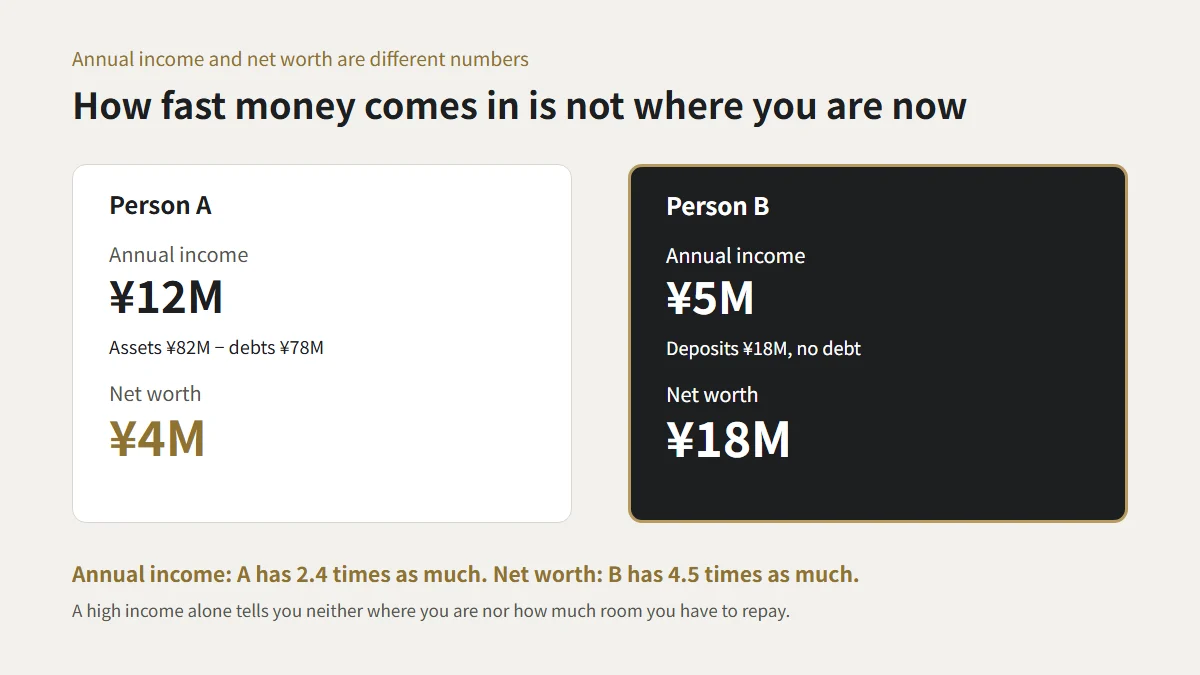
Person A. Annual income ¥12 million.
Owns a condominium in the city center. If sold now, ¥80 million. Remaining home loan balance ¥75 million. ¥3 million left on a car loan, and ¥2 million in deposits.
Assets ¥82 million − debts ¥78 million = net worth ¥4 million
Person B. Annual income ¥5 million.
Lives in a rented home. ¥18 million in deposits. No debt.
Net worth ¥18 million
In annual income, A has 2.4 times as much.
In net worth, B has 4.5 times as much.
They are reversed.
On top of that, their monthly payments are different. A pays around ¥250,000 a month on the home loan and car loan. B pays nothing.
When it comes to borrowing more from here, which of them has more room? A's annual income is high, but a large part of it already goes to repayments.
Annual income is "how fast money comes in." Net worth is "where you are now."
Running fast and having come a long way are not the same thing.
Knowing where you stand now means exactly this.
Once you have the number, read 3 things from it
Add up the assets and subtract the debts. The number you get is your net worth.
But that is not the end. The amount of net worth alone does not tell you your situation.
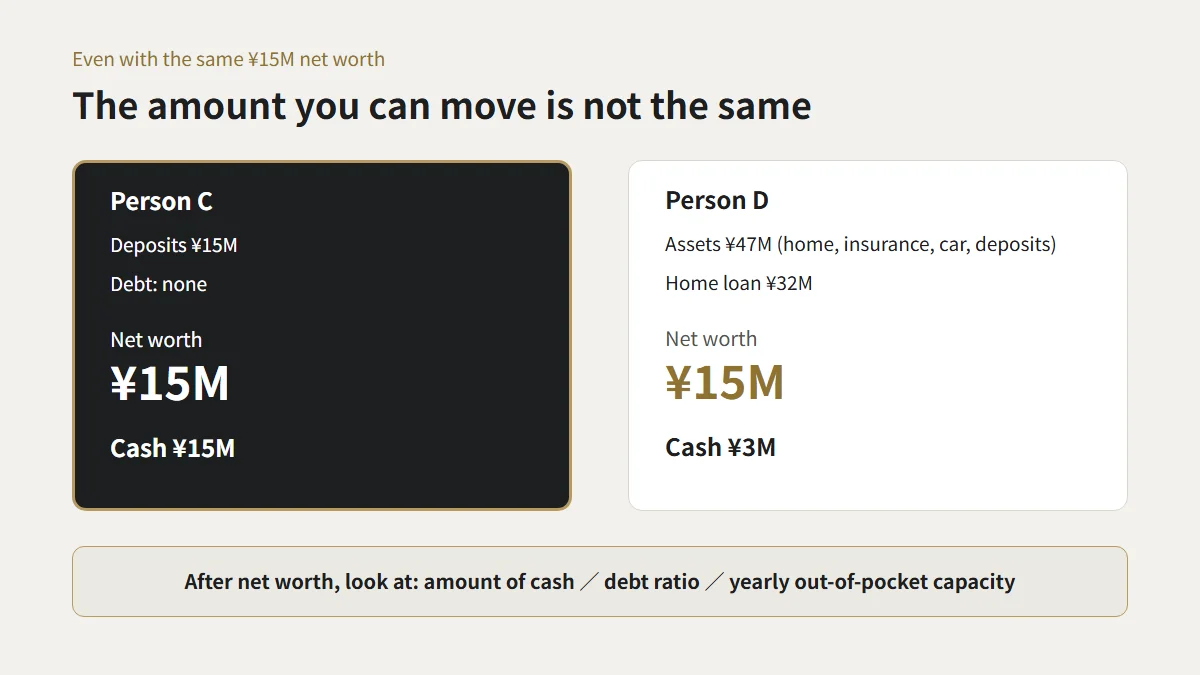
Let's look at an example where both people have a net worth of ¥15 million.
The following is a fictional example for illustration.
Person C: ¥15 million in deposits. No debt.
Person D: Home ¥38 million, insurance surrender value ¥4 million, car ¥2 million, deposits ¥3 million. Debt: home loan ¥32 million.
Both are ¥15 million.
But only C can move.
D's net worth is tied up in the home, the insurance and the car, and there is only ¥3 million in deposits.
So once you have your net worth, go on to look at 3 things.
First: how much of your net worth is cash
How much money you can move right away. If it is all in real estate or insurance, you may be wealthy on paper, but in practice you can do nothing.
Second: what share of your assets your debts make up
D has ¥32 million of debt against ¥47 million of assets. About 68%. The higher this ratio, the faster your net worth disappears when asset values fall.
Third: how much per year you could pay out of your own pocket if the income and expenses fall apart
This comes from 2 things: what is left over each month after income and expenses, and how much cash you have on hand. This will be the number that matters most later, when you judge a property.
If it's small, does that mean you can't buy?
Having read this far, some of you may feel your numbers are small.
Let's think about it once from the opposite side.
Does a small net worth mean you can't do real estate investment?
Not necessarily.
There are many reasons a net worth can be small. You are young and haven't built it up yet. You have just taken out a home loan. You have put it into a business. Each means something different.
And lenders don't look only at net worth. They also look at the stability of your income, your employer, and your past repayment history.
So the question "how much do I need to be able to buy?" has no answer.
Instead, let's rephrase the question.
Which one is missing for me right now?
Is it cash you can move right away? Is it the amount you can add each year? Or is it the capacity to hold out when the income and expenses fall apart?
These 3 are different things, and the way to fill each gap is different.
If you lack cash, save. If what is left over each year is too small, fix your spending. If you lack the capacity to hold out, make the scale smaller in the first place.
Once you know which one is missing, what to do next is decided.
This gets you further than feeling down about the amount.
The number you get usually feels wrong somewhere
When you actually do it, something usually bothers you.
It was less than you thought. There was hardly any cash. Your net worth was negative.
That is your current situation.
If it feels uncomfortable, that means you were able to read the numbers. If you couldn't read them, you would feel nothing.
Once you have made it, from then on you only need to update it. The only things whose prices move are roughly your home and your securities, so once a year is enough.
And these numbers are not for showing anyone. When you apply for financing, you will redo them in the lender's format anyway. What you are making now is a single sheet for your own decisions.
There is no need at all to make it look neat. A handwritten note is fine.
If you use BENERU's nelBS, you can shorten the work of building this sheet by picking up the numbers from documents you already have, such as your tax return and insurance policies. The data you enter is processed in your browser and is not sent to or stored on BENERU's servers.
Know your own assets, by yourself.
Investing is also the act of thinking about how to protect and grow this net worth.
Once the numbers are out, the next question is what to use them for.
By the way, how should you think about your monthly income and expenses? Did you wonder about that?
How much per year you could pay out of your own pocket. I will cover that next time.
Even if you have assets, you cannot move if your monthly income and expenses leave no room.