
Should you start with a condominium unit or a whole building?
Should you start with a condominium unit or a whole building? From the differences in vacancy, repairs, financing, and the size of losses, we sort out the criteria for deciding what suits you.

BENERU writes for readers who live in Japan. Taxes, loans and the other rules described here are those of Japan, and they assume a resident of Japan.
This page is a translation of the Japanese original. If the two differ, the Japanese original prevails.
Good day.
There is a question I am often asked.
Should I start with a condominium unit or a whole building?
Let me say first that this question has no answer.
But I can explain the differences. Please bear with me for a bit.
The following is a fictional example for illustration.
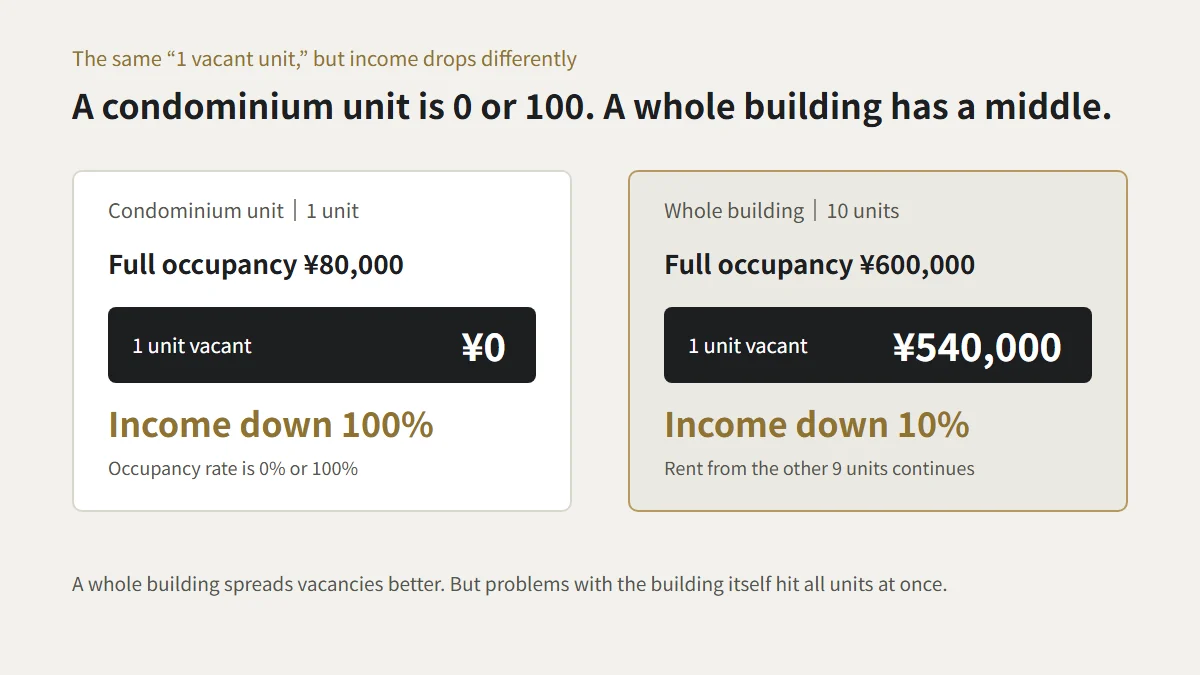
A condominium unit, ¥20 million. Rent is ¥80,000 a month.
A whole building with 10 units, ¥80 million. Rent is ¥60,000 a month per unit, ¥600,000 a month at full occupancy.
Now suppose 1 unit becomes vacant in each.
- Condominium unit: income is zero
- Whole building: ¥540,000 a month. The decrease is 10%
It is the same "1 unit became vacant," but the numbers move in completely different ways.
A condominium unit's occupancy rate is either zero or 100. There is no in-between.
This is the biggest difference.
The second difference is who decides on repairs
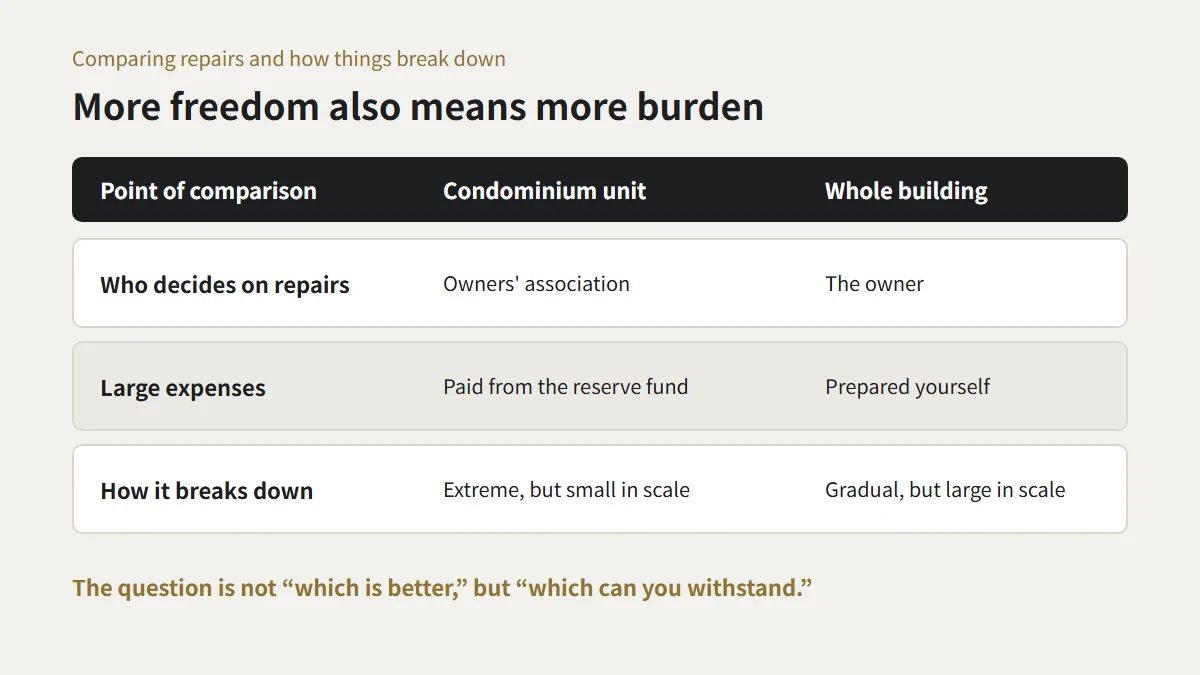
With a condominium unit, major repairs to the building are done by the owners' association.
You pay into the repair reserve fund every month, and when the time comes, the exterior walls and the roof are paid for from it.
You do not need to find contractors yourself. Nor do you need to prepare several million yen at once.
It is easy.
But you cannot decide.
The reserve may be raised because it is not enough. The content and timing of the work are not decided by your wishes.
A whole building is the opposite.
When to repaint the exterior walls, whom to hire, how much to spend. You can decide all of it yourself.
In exchange, you prepare several million yen yourself. If you have not saved for it, it goes out all at once that year.
Freedom and burden. These two only come as a set.
The third is how lenders look at it
For financing a single condominium unit, the buyer's employer and annual income tend to weigh heavily. Because the property is small, the lender looks at whether the person can repay.
With a whole building, the income the property generates is also looked at. Whether it works as a business.
Which is easier to get approved depends on the lender and on the person's situation.
But one thing is certain.
With a whole building, the larger amount alone means fewer people can buy it. There are people who can choose it from the start, and people for whom it is not an option at all.
The question "which should I start with" is a question for people who can choose either.
Then is a whole building the better choice?
Because I wrote that spreading the vacancy risk works, it may have looked as if I were recommending a whole building.
Not really.
The spreading only works for vacancies. There is only one building, so leaks, pipes, the ground, and the surrounding environment affect all units the same way.
If it is far from the station, all 10 units are far together.
And the scale when things fail is different too. A loss on a ¥20 million condominium unit and a loss on an ¥80 million whole building lead to different aftermaths.
A condominium unit breaks down in an extreme way, but even when it breaks, it is small.
A whole building breaks down gradually, but when it breaks, it is large.
Let me fix the question a little
Which should I start with? This question does not produce an answer.
Instead, try asking this.
Which way of breaking down can I withstand?
It sits vacant for half a year and income goes to zero. During that time, can you pay the full repayment out of your own pocket?
One year you suddenly find that the exterior walls will cost ¥3 million. Can you pay that in that year?
If you cannot withstand either, it means you are not yet at the stage of buying.
In that case, thinking about which to start with will not settle anything.
I once saw a room with just one potted plant in it.
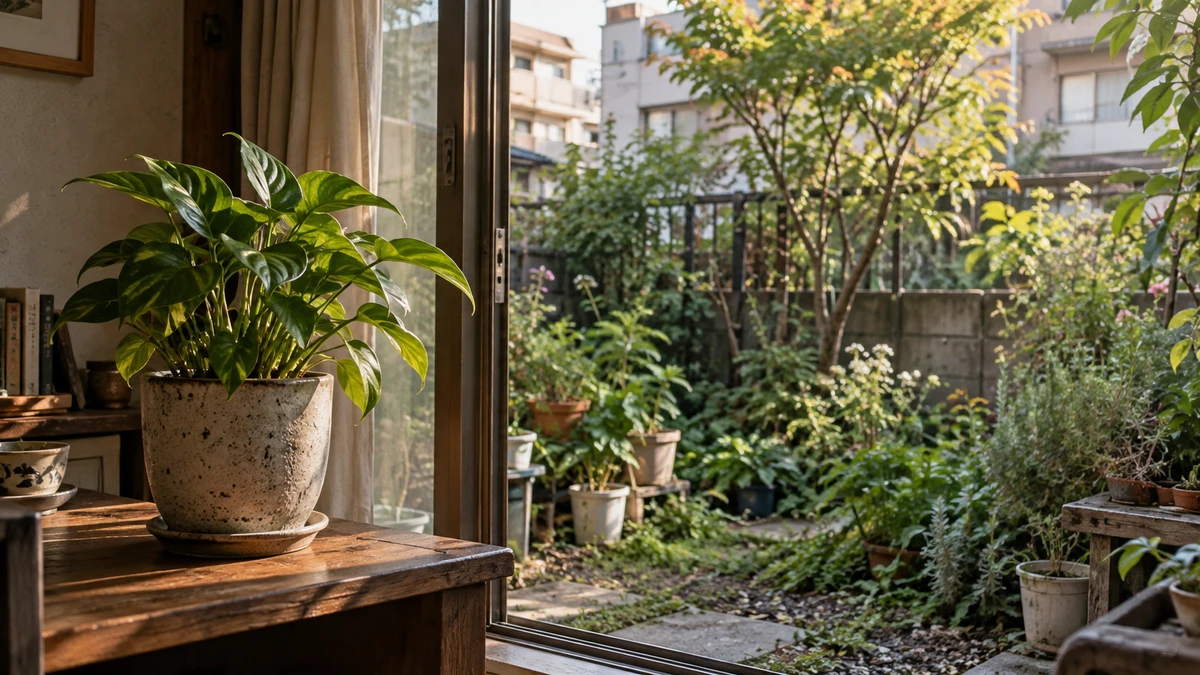
It was well cared for, and the watering and its place were all decided for that one plant.
But if it withers, that is the end.
A person with a garden still has the rest even if one withers. In exchange, they cannot watch each one individually.
It is not about which is right; it is about how many minutes you can spend on watering, I think.