
Cut ¥10,000, and it comes to ¥480,000
Is it really better to cut rent by ¥10,000 to fill a unit faster? We compare 4 years of total income with an advertising fee, and sort out the long-term effect a rent cut leaves behind.

BENERU writes for readers who live in Japan. Taxes, loans and the other rules described here are those of Japan, and they assume a resident of Japan.
This page is a translation of the Japanese original. If the two differ, the Japanese original prevails.
Good day.
This is something I heard from a person who runs a shop.
When sales are slow, they hesitate between giving a discount and adding a little something extra.
Both cost money, but a discount cannot be taken back next time. An extra ends with that one sale.
So, I am told, they touch the price last.
The same thing happens in rentals.
The following is a fictional example for illustration.
A unit with rent of ¥80,000 has become vacant.
At this rate, it looks like it will take 3 months to sign a tenant.
The property management company makes a suggestion. Let's cut it by ¥10,000. Then I think it will be filled in 1 month.
The vacancy gets 2 months shorter. It sounds like a reasonable idea.
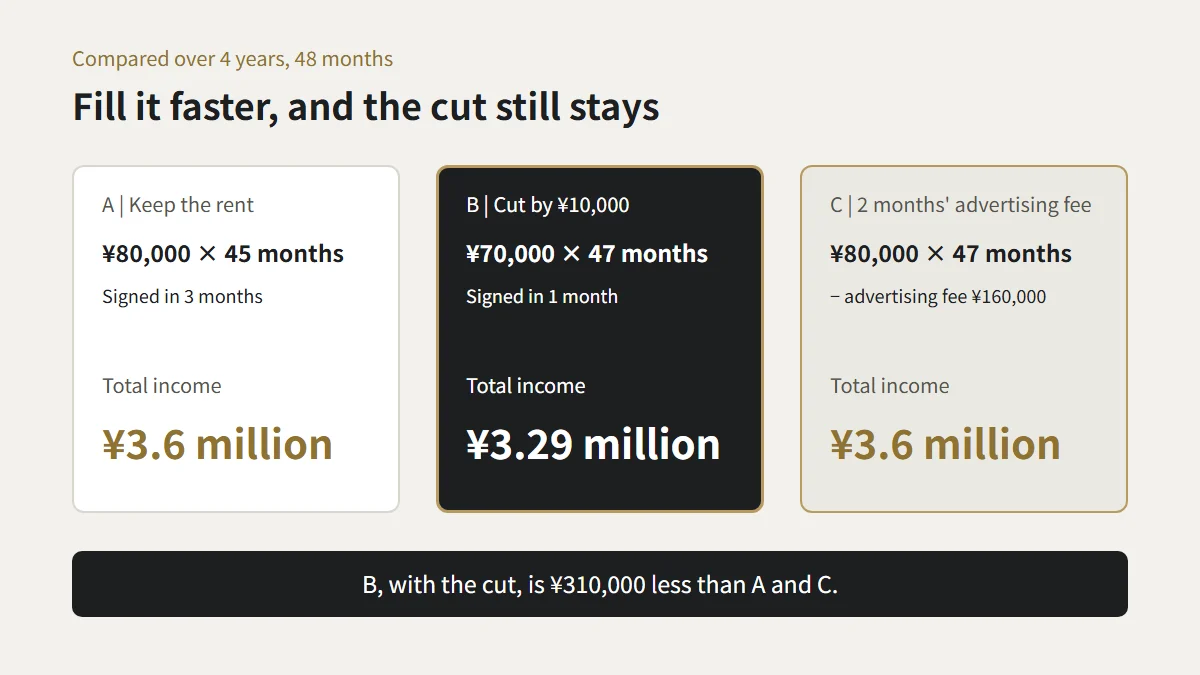
Let us compare over 4 years, that is, 48 months.
A: Don't cut, and fill it in 3 months
¥80,000 × 45 months = ¥3.6 million
B: Cut by ¥10,000, and fill it in 1 month
¥70,000 × 47 months = ¥3.29 million
The difference is ¥310,000. Cutting gives you less.
To shorten the vacancy by 2 months, you gain ¥160,000 and pay for 47 months of the reduction.
A lowered rent continues until that tenant moves out
The reason is simple.
A vacancy ends once the unit is filled. A 3-month loss is 3 months' worth.
A lowered rent continues for the whole time that tenant lives there.
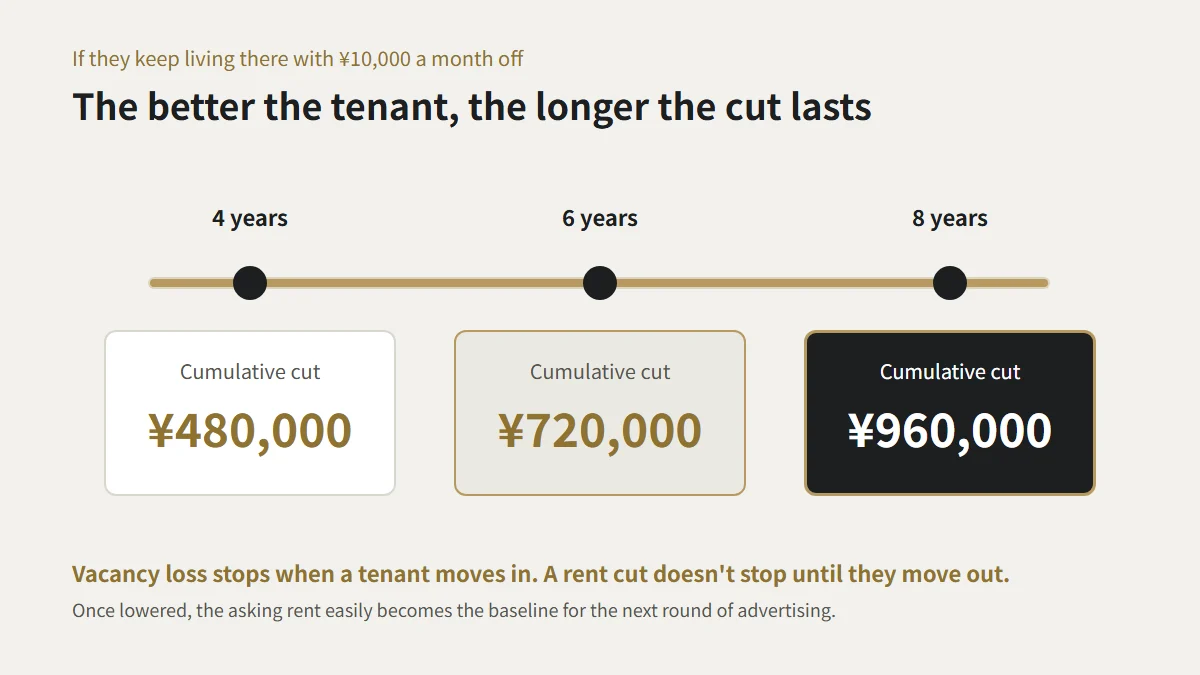
If you cut it by ¥10,000:
- If they stay 4 years, ¥480,000
- 6 years, ¥720,000
- 8 years, ¥960,000
The longer they stay, the larger the loss from the cut.
You lose the most when they turn out to be a good tenant.
This is the slightly mean part.
What corresponds to the extra
Then is there nothing to do but leave it empty?
There is another way.
C: Don't cut the rent, pay an advertising fee of 2 months' rent, and fill it in 1 month
¥80,000 × 47 months − ¥160,000 = ¥3.6 million
The same as A.
¥310,000 more than B, where the rent was cut.
The advertising fee ends with that one time. The rent cut does not end.
This is the difference between a discount and an extra.
And there is one more thing.
The next time that unit is advertised, the baseline will be the rent after the cut.
Once you lower it, it is hard to bring it back. In other words, the effect does not end with the first tenant.
Even so, not cutting is not the right answer either
This calculation rests on a big assumption.
The assumption that it will be filled in 3 months.
If that becomes 7 months, the conclusion flips. And how many months it takes to fill cannot be known until it is filled.
To begin with, if the current rent is higher than the market, lowering it is not a discount but an adjustment. In that case, lowering it early keeps the loss smaller.
To decide, you need to know how much similar properties nearby are advertised for, and how long they take to be filled.
You can find this out by asking the property management company.
There is something to ask along with it.
Are people coming to view the unit? Are there viewings but no signing, or are there no viewings at all?
If there are no viewings, the problem is the rent. If there are viewings but no signing, the problem is the unit itself.
In the latter case, cutting the rent will not get it filled.
There is one thing to ask
If you are offered a rent cut, try asking this.
Compared with not cutting and offering a larger advertising fee instead, which do you think would fill it faster?
If either would fill it in about the same time, the advertising fee leaves nothing behind afterward.
If they still recommend the cut, there must be a reason. That reason is more important information than the rent.

Let me go back to the shop from the beginning.
Which to choose, a discount or an extra?
That person said it was because a discount means changing the shop's prices.
Customers who remember a price that was once lowered think the list price is expensive the next time they see it. So they do not touch the price until the very end.
Instead, they are quite generous with that day's extra.
I think they have done the math.