
When 2 overlap, the margin disappears
Vacancy and rising interest rates may be bearable on their own, but when they happen at the same time, they wipe out the margin. Using a fictional example, this piece sorts out how to read a stress test that moves 2 conditions at once.

BENERU writes for readers who live in Japan. Taxes, loans and the other rules described here are those of Japan, and they assume a resident of Japan.
This page is a translation of the Japanese original. If the two differ, the Japanese original prevails.
Good day.
When considering a property, what people usually calculate is the case where things go well.
At full occupancy, with the interest rate as it is now and the rent as it is now, this much remains each year.
This time, I will look at it from the opposite side.
How bad does it have to get before it stops?
The following is a fictional example for illustration.
A whole building with 10 units. Annual rent at full occupancy is ¥6 million. Operating expenses are ¥1.3 million a year.
¥60 million is borrowed at a 3% interest rate over 25 years, and annual repayment is ¥3.41 million.
The cash left over is ¥1.29 million.
From here, I will draw 3 lines.
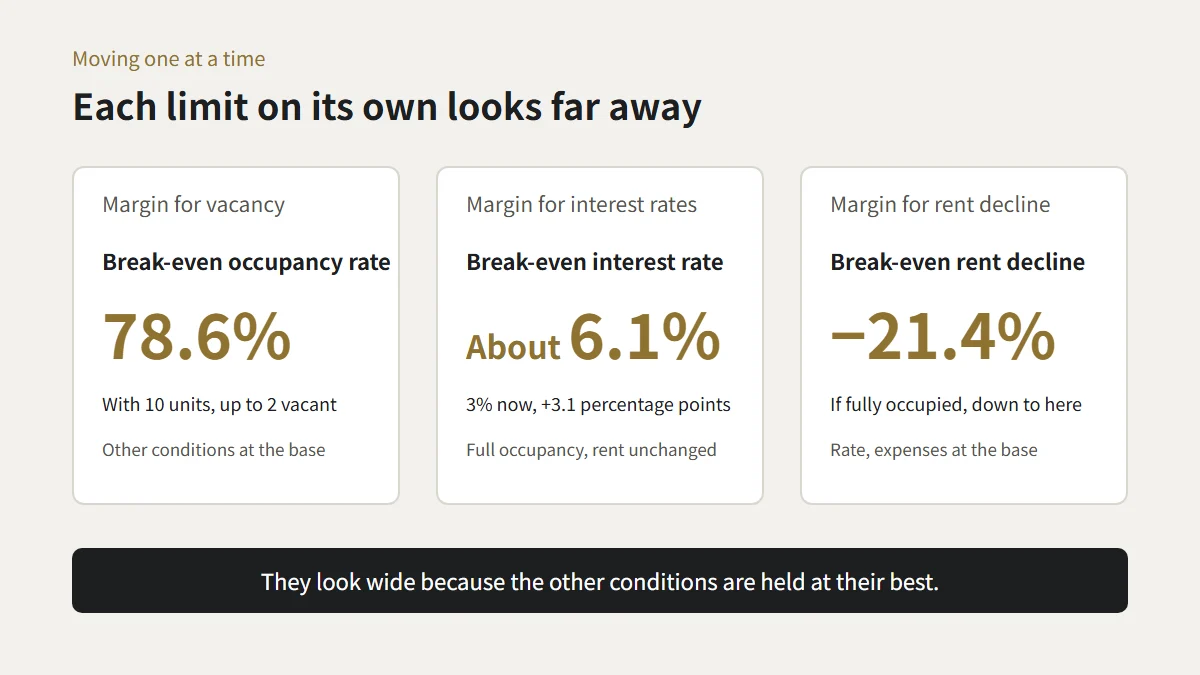
How much vacancy can it withstand?
It can no longer cover expenses and repayment at an occupancy rate of 78.6%.
With 10 units, up to 2 units. Beyond that, the money comes out of your own pocket.
How high an interest rate can it withstand?
If it stays fully occupied, up to about 6.1%.
The rate is 3% now, so there is a margin of 3.1 percentage points.
How far can rent fall?
While fully occupied, down to minus 21.4%.
All 3 may have more margin than you thought.
You can think so because you are looking at them one at a time.
When 2 overlap, it disappears
Under the same conditions, overlap 2 of them.
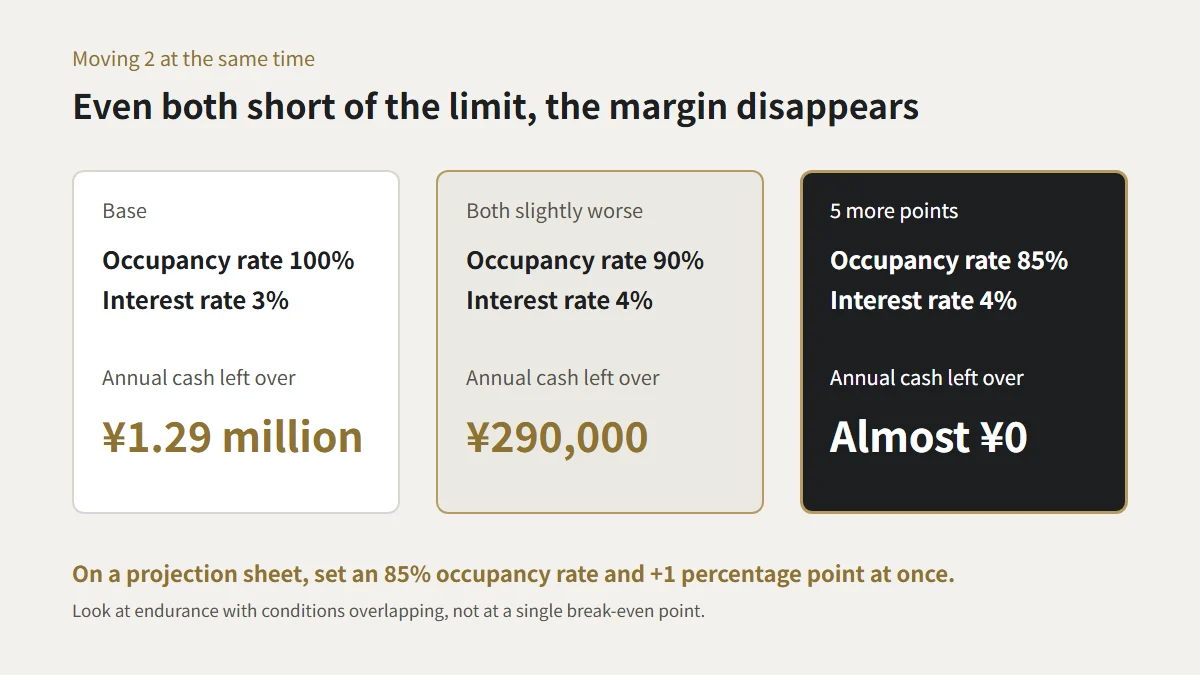
An occupancy rate of 90%. That is a perfectly respectable level. Add an interest rate of 4%. It has only risen by 1 percentage point.
The cash left over is ¥290,000. From ¥1.29 million, it has fallen to less than a quarter.
Let's move them a little more.
Occupancy rate 85%. Interest rate 4%.
The cash left over is almost zero.
On their own, the occupancy rate could withstand down to 78.6%. The interest rate could withstand up to 6.1%.
85% and 4%. Both are short of the limit.
Even so, when they overlap, the margin disappears.
This is not a coincidence
When you measure the margins one at a time, each looks wide.
That is because, at that moment, you are holding the other conditions fixed at their best.
But in reality, the phase when vacancies increase and the phase when rents fall usually come around the same time.
If a new building goes up nearby, move-outs increase and asking rents fall. They are not separate events.
Interest rates are also connected to the economy and prices. They don't move independently of everything else.
In other words, it is closer to reality to think on the premise that bad conditions come together.
I think judging that you have a margin from knowing each limit one at a time is a little premature.
Then, how to look at it
There is no need to do anything complicated.
When you get a projection sheet, try moving just 2 things.
An occupancy rate of 85%. The interest rate at the current rate + 1 percentage point.
Is the amount that remains within a range you can bear?
If nothing remains, how many years' worth of that shortfall can you keep on hand?
This decides most of whether it is all right to buy.
The seller will do the calculation for the case where things go well. What you do yourself, this is enough.

Even on a windy day, if it isn't raining, there is no problem. Your hair just gets messed up.
On a rainy day, too, if there is no wind, an umbrella is enough.
The trouble is when both come.
When the rain comes in from the side, the umbrella loses its meaning. You get wet even holding it, and if anything, carrying it makes you harder to move.
And wind and rain usually come together.