
Money moves only when a tenant is placed
The payment for rental management looks like the management fee, but the property management company's income moves the most when tenant placement is decided. Using a fictional example, this piece compares a 10-year long-term tenant with turnover every 2 years, and sorts out what to confirm with the property management company at renewal time.

BENERU writes for readers who live in Japan. Taxes, loans and the other rules described here are those of Japan, and they assume a resident of Japan.
This page is a translation of the Japanese original. If the two differ, the Japanese original prevails.
Good day. I'm Nel Shikina.
When you entrust rental management, what you pay is the rental management fee. 5% of rent is one rough guide, I suppose.
As the name suggests, it looks like the payment for management.
But when you count where a property management company's revenue comes from, the management fee is not the main part.
Setting 2 cases side by side over 10 years
The following is a fictional example for illustration.
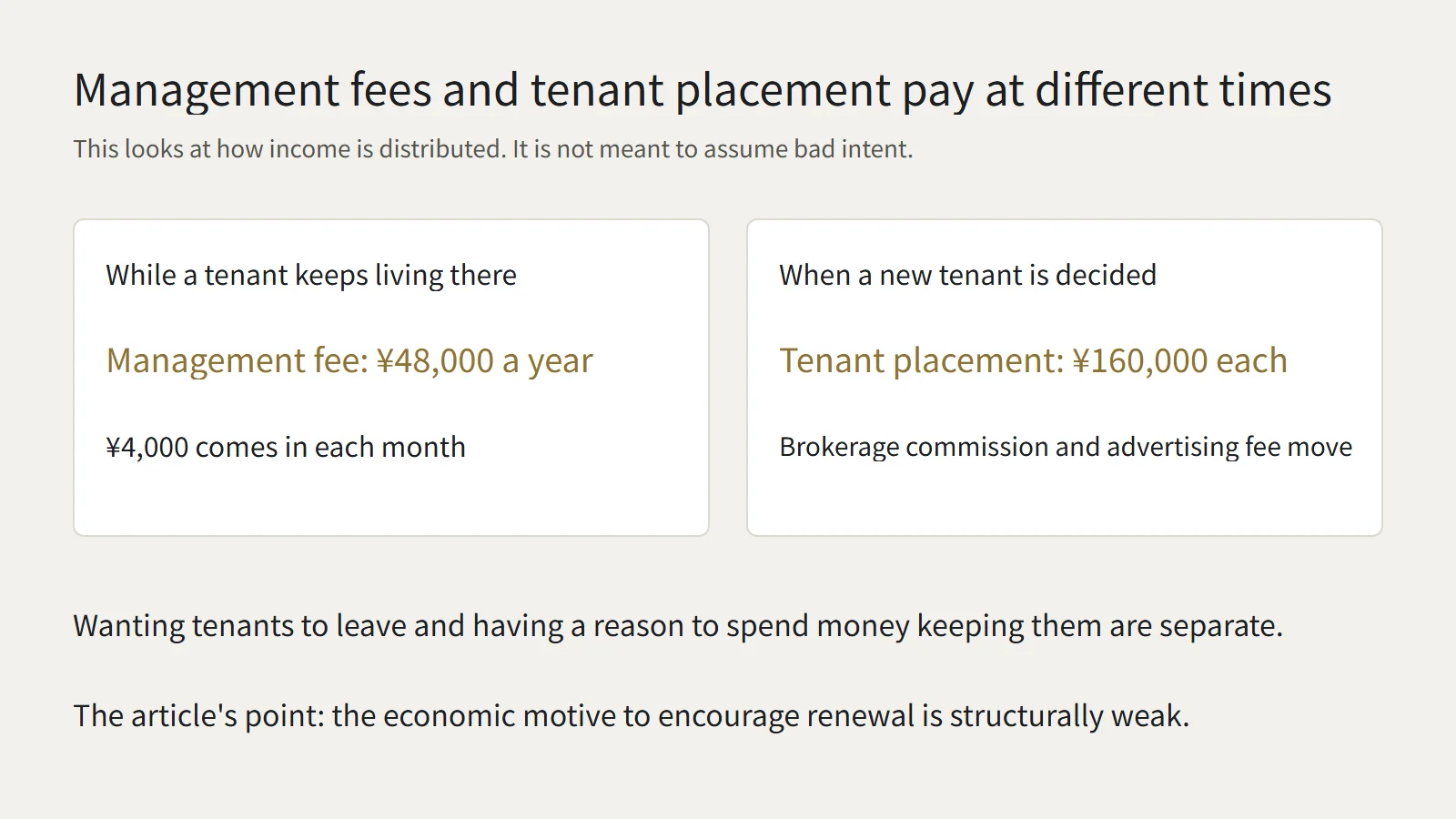
You entrust a room with rent of ¥80,000, at a management fee of 5%. ¥4,000 a month, ¥48,000 a year.
Let's look at 10 years in 2 ways.
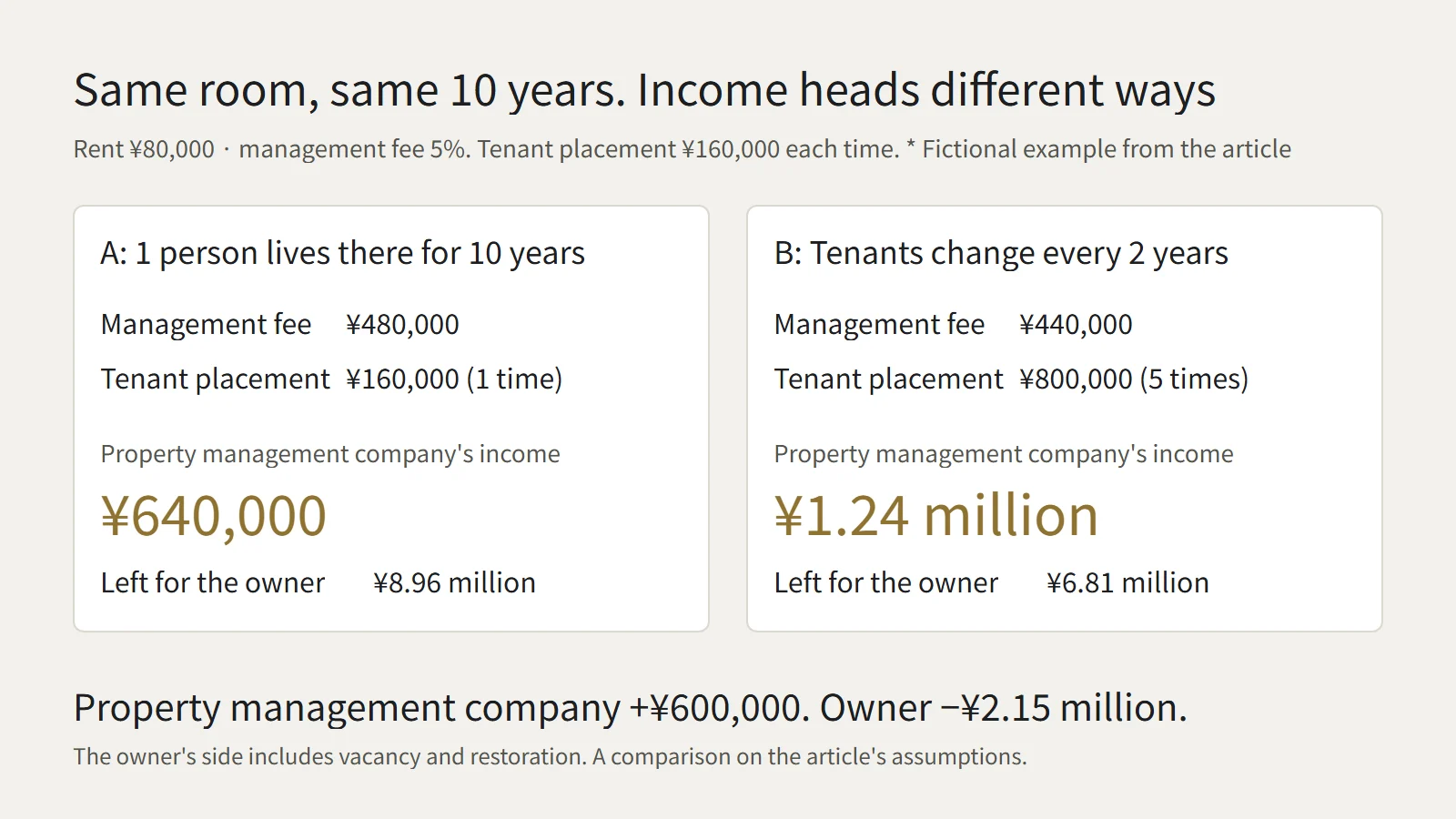
A: 1 person lives there for 10 years
The management fee is 120 months' worth, ¥480,000. Tenant placement happens only once, at the start.
B: Tenants change every 2 years
It turns over 5 times. Assuming it sits vacant for 2 months each time, the management fee arises for 110 months, ¥440,000. Tenant placement happens 5 times.
When tenant placement is decided, the brokerage commission and the advertising fee move. Here, take them together as 2 months' rent, ¥160,000.
Side by side:
| Management fee | Tenant placement | Property management company's income | |
|---|---|---|---|
| A Long-term tenant | ¥480,000 | ¥160,000 (1 time) | ¥640,000 |
| B Turnover every 2 years | ¥440,000 | ¥800,000 (5 times) | ¥1.24 million |
The same room, the same 10 years.
The management fee differs by only ¥40,000. The totals differ by ¥600,000.
The owner's side points the other way. A is rent of ¥9.6 million minus ¥640,000, leaving ¥8.96 million. B loses ¥800,000 to vacancy, and on top of that, restoration 5 times costs ¥750,000, so expenses are ¥1.99 million. What remains is ¥6.81 million.
The property management company gained ¥600,000, and the owner lost ¥2.15 million.
This is not about bad intent
If I stopped here, it would read as if the property management company wants tenants to leave.
I don't think that is right. Let me look at it once from the other side.
First, no management fee comes in while a unit is vacant. Turnover leaves a gap for the property management company too.
Next, long-term tenants take little work. Handling complaints, chasing late payments, attending inspections: most of this is unpaid labor included in the management fee. Each time tenants change, that work starts over from the beginning.
And if a company caused unnatural turnover, the owner would drop it. Losing the management contract would leave it with nothing.
So you probably can't go as far as saying it wants tenants to leave.
But since the numbers are what they are, there is one thing you can say.
The economic motive to encourage renewal is structurally weak.
It is not that the company wants tenants to leave, but that it has no reason to spend money keeping them. These are 2 different things.
Against a management fee of ¥48,000 a year, 1 tenant placement brings ¥160,000. That is 3 years' worth. That the company works more eagerly on tenant placement is probably a matter of how the money is distributed, not of character.
Ask at renewal time
This does not come up in the investigation before buying. It is the part you learn after you own the property.
So please look at it at renewal time.
- Does the company do anything to approach the tenant at renewal?
- When a notice of move-out came, did it ask the reason? Did it try to keep the tenant?
- Who receives the renewal fee and the renewal handling fee, and how much?
- Is the management fee charged during vacant periods?
- Who decides the amount of the advertising fee? What happens when tenant placement is requested from another company?
The last 2 are written in the contract. Many people have not read it.
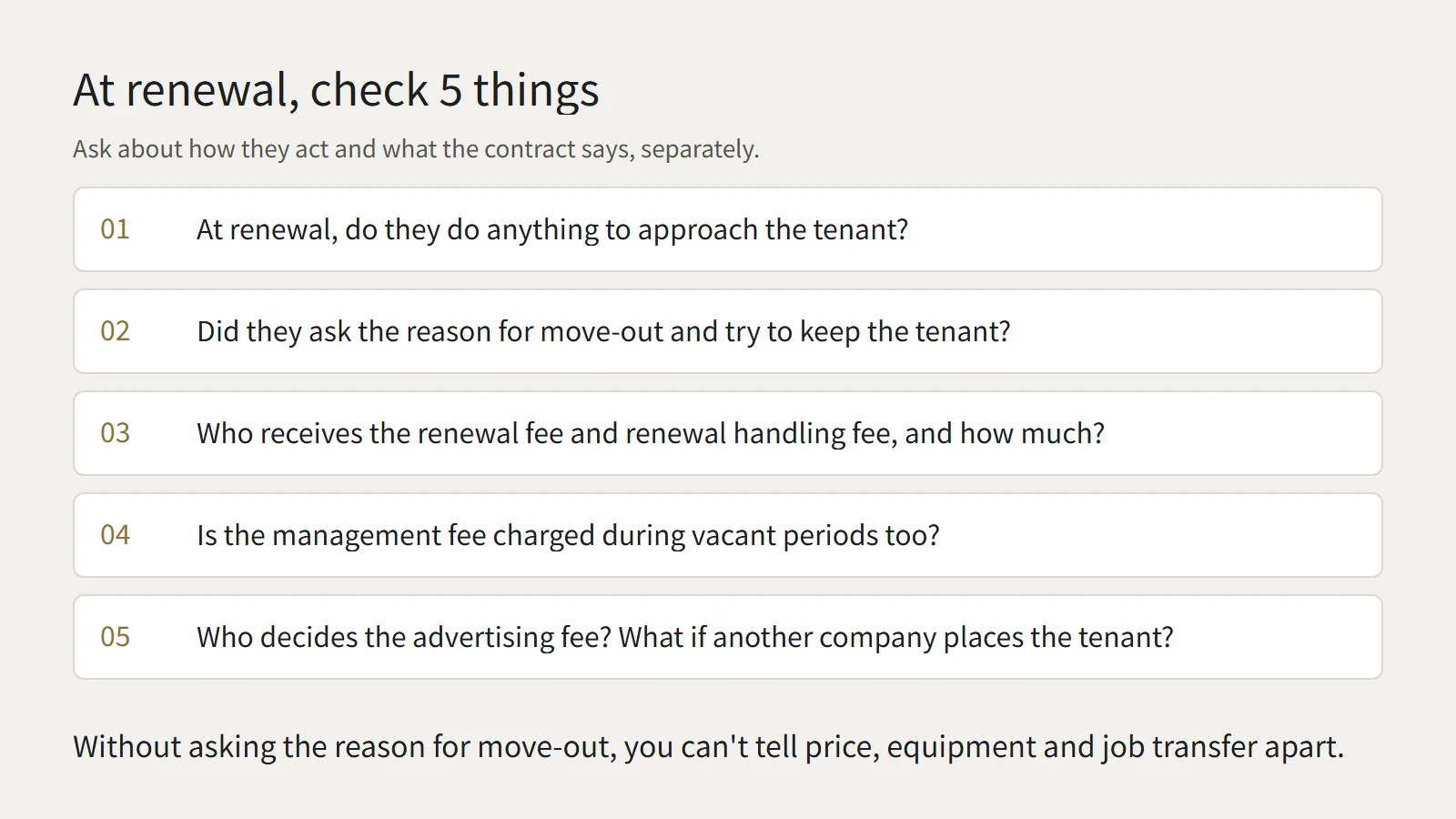
And a property management company that has not asked the reason for move-out has no way of looking into it further. If the reason is "the rent is high," it is a pricing problem; if it is "the equipment is old," it is an investment problem. If it is "a job transfer," nothing can be done.
None of them can be told apart if nobody asked.
Without telling them apart, a proposal to lower the rent comes with the next listing. That is how the order goes.
I once had someone introduce me to a person.
The one who introduced us was eager up to the point of getting us to meet. They adjusted the schedule, stood in between, and even sat in on the first meeting.
What happened after that, I was never asked.
I didn't think badly of them. For that person, the job was complete once we had met. Whether it continued was someone else's domain.
The management fee is the name attached to that "someone else's domain."
It would be good to check, just once, how much you are paying and what it includes.