
A contract arrived in which a "guarantee company" pays the rent. How is it different from an ordinary rental contract?
A guarantee company that pays on behalf of a tenant in arrears and a sublease, in which a company becomes the tenant and sublets, are different contracts. The name "rent guarantee" is the source of the confusion. What you look at in the contract is who the tenant is.

BENERU writes for readers who live in Japan. Taxes, loans and the other rules described here are those of Japan, and they assume a resident of Japan.
This page is a translation of the Japanese original. If the two differ, the Japanese original prevails.
I answered this question on a Q&A site.
A tenant looks likely to move into a rental property I own, but the brokerage firm sent me a contract with a rent guarantee company placed in between. We never talked about that. Should I send it back? Please tell me what it means to place a rent guarantee company in between.
While exchanging messages with the person who asked, there were points to watch out for and things I learned as a business operator, so I will share them. What we found out later was that the contract that arrived was of the form in which "the guarantee company, not the tenant, pays the rent."
Owners of rental properties, please take it as a reference.
What is a guarantee company?
In the practice of real estate rental contracts, the landlord who is the real estate owner is called the lessor, and the person who rents is called the lessee.
Please understand clearly who is the landlord and who is the tenant. It is important.
In this case, since it said a guarantee company would be placed in between, I carelessly assumed the guarantee contract that the lessee signs. This misunderstanding seems likely to happen often, so it was a lesson for me. For a real estate business operator, a guarantee company at the time of a rental contract usually means a guarantee company that takes on the role of the lessee's guarantor.
In rental practice today, being screened by a guarantee company has become more common than getting a guarantor. In the old days you would have your parents become your guarantor, but now it is different.
The role of the guarantor here refers to, for example, paying on the tenant's behalf when the tenant falls behind on rent.
A company that takes on this payment for a set guarantee fee is called a "guarantee company."
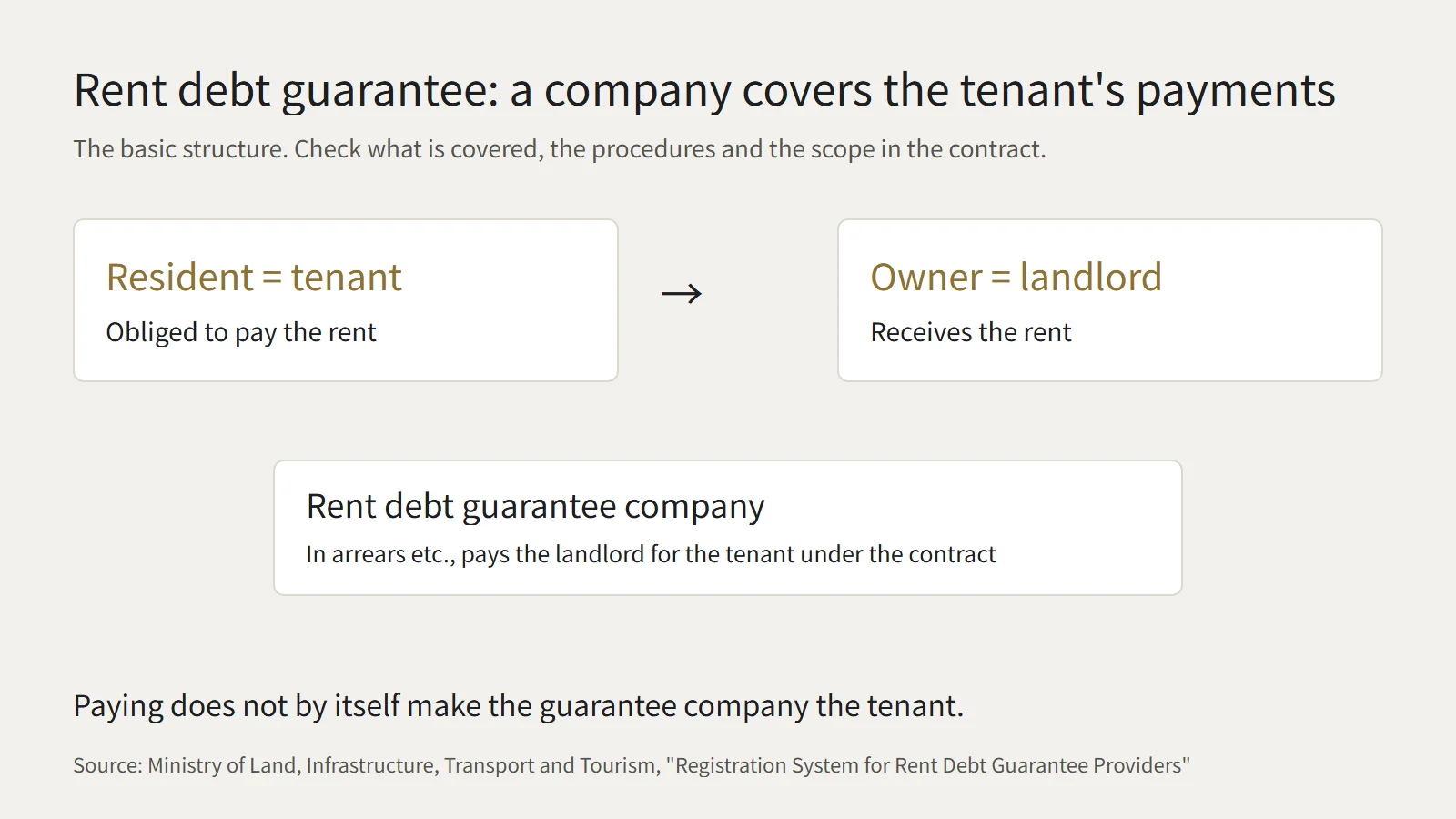
The role of a guarantee company brings large benefits to the landlord, so in today's rental contracts it is almost common sense for the lessee to get a guarantee from a guarantee company. Materials from the Ministry of Land, Infrastructure, Transport and Tourism also state that some form of guarantee is required in 8 in 10 lease contracts, and that rent guarantee companies are used in 8 in 10. It is also common for tenants who do not pass the guarantee company's screening to be unable to rent a room.
The tenant was a subleasing business
Now, the case dealt with in this question was probably a different matter.
It was a case in which the tenant was a subleasing business.
I'm not certain, but I think that was probably it. Subleasing is a business in which an operator leases rooms and sublets them. You can probably picture it if you think of private lodging (minpaku) or monthly rentals.
In that case, the tenant is a corporation.
Then why is this case confused? Because there is a tendency to call this sublease arrangement a "sublease."
And the fact that sublease contracts are sometimes referred to as "rent guarantees" is the source of the confusion.
The "rent guarantee" in a sublease is something like a "pet name." It is not the correct name of the contract. (Rent debt guarantee, which pays on the tenant's behalf when the tenant falls behind, is a separate thing that even has a registration system by the Ministry of Land, Infrastructure, Transport and Tourism.)
It is something like the advertising phrase "We will pay the rent no matter what the occupancy of a given room is."
If you think calmly about the reality, you can understand it: it is just that a corporation is the tenant, so of course it pays the rent. Having rented a room, whether you live in it or not is up to the tenant, isn't it?
However, as long as it is the tenant, that corporation can also request a rent reduction under the Act on Land and Building Leases (Shakuchi Shakuya Hō). Even if it is called a "guarantee," it does not mean the amount stays fixed forever. The Ministry of Land, Infrastructure, Transport and Tourism's guidelines also tell operators that if they write "rent guarantee," they must write right next to it that the rent may be reduced.
So I think treating what is called a sublease contract as a rent guarantee contract is misleading. Today, a sublease contract essentially consists of 2 kinds of contracts: a master lease contract and a sublease contract. The contract between the lessor (owner) and the operator is called the master lease, and the contract between the operator and the resident is called the sublease. In the law (the Act on Proper Rental Housing Management Operations), the contract between the owner and the operator is called a "specified lease contract," and the operator must explain important matters in writing before the contract.
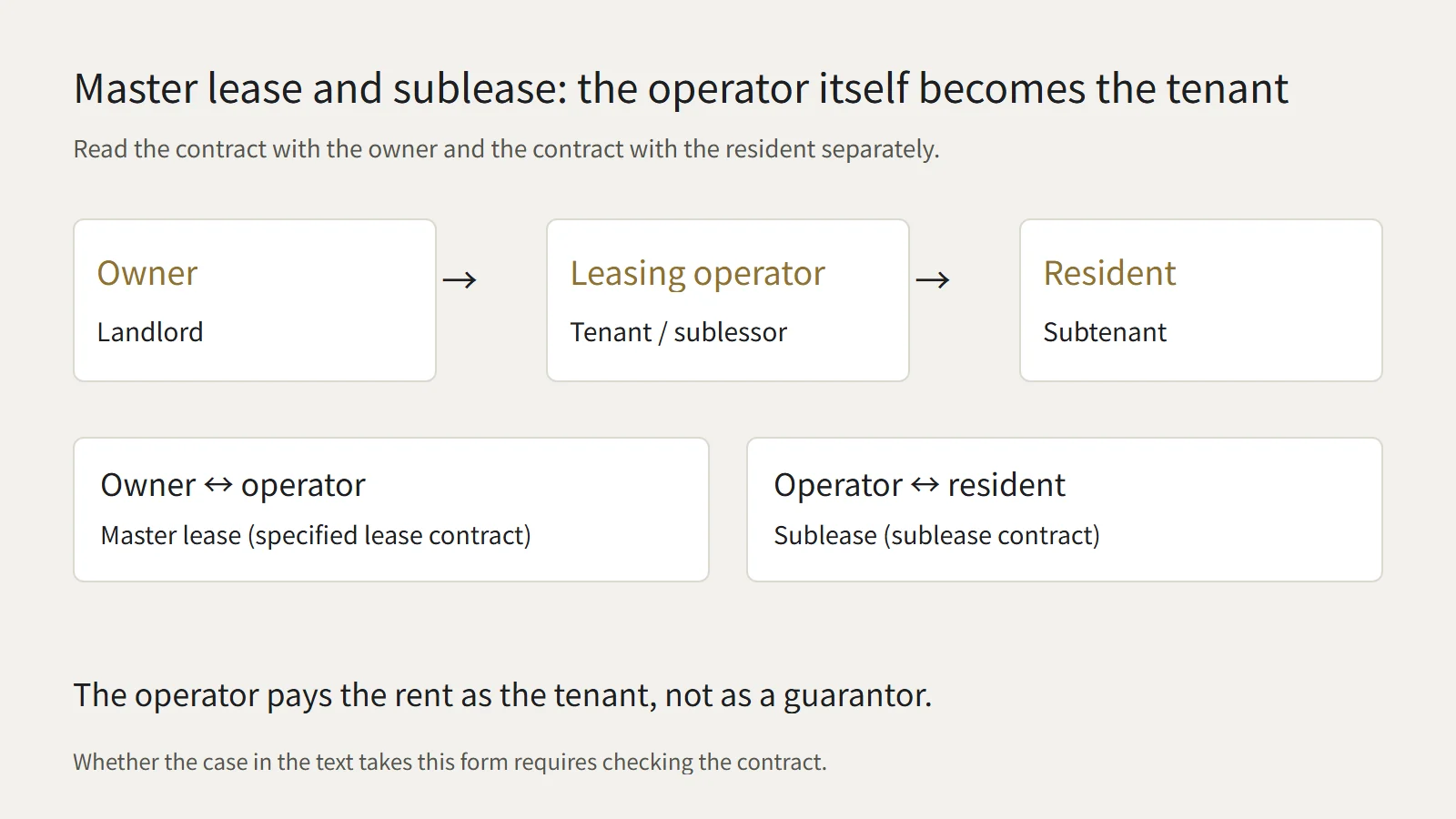
So calling everything, including the contract with the owner, a "sublease" in one word is not accurate. It refers to the subleasing business, which is a set of 2 contracts.
There are separate "rent guarantee" services handled by rental management companies.
Sublease contracts, as the term is used in the world today, are misunderstood in many ways.
I think the influence and fallout of that brought about the confusion in this question.
What matters is to think simply about who the tenant is and what the rental contract contains.
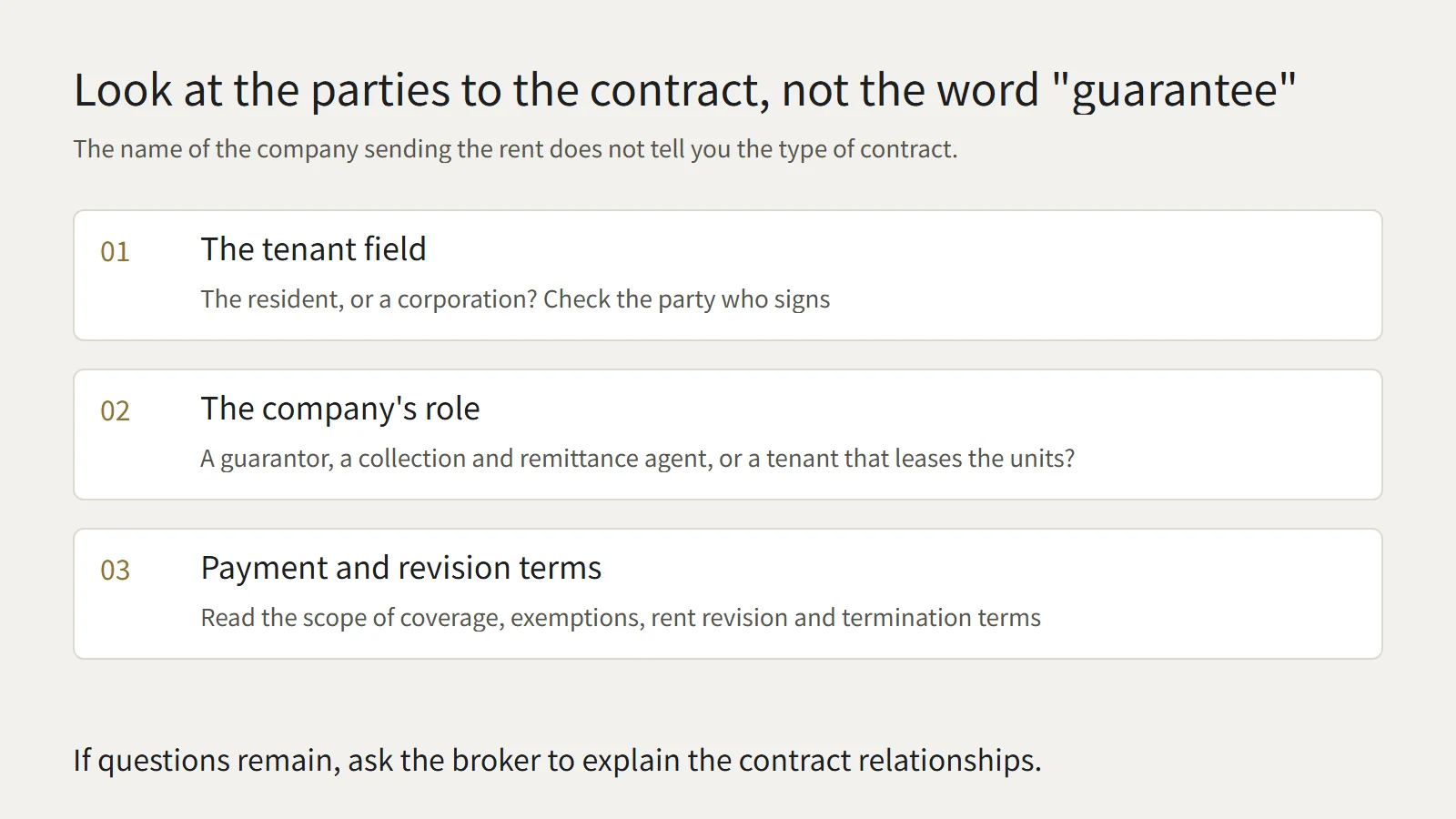
A corporation being the tenant is not bad in itself
There is a reputation that sublease contracts are no good, but there are any number of cases in the world where the tenant is a corporation. It should be easy to picture if you think of renting a company dormitory.
A corporation has more capacity to pay, so it is not a bad tenant in particular.
However, when a corporation from the real estate industry stands as the tenant, negotiations such as rent increases become difficult, and you may feel it is somehow suspicious, or become wary of a counterpart well versed in the industry.
If you are anxious about the future as a landlord, a rental contract that fixes the lease period as a "fixed-term building lease" rather than an "ordinary lease" is also possible. With a fixed-term lease, if you attach a special agreement on rent revision, the provisions on requests for reduction do not apply either.
Check the details with a specialist. It may be necessary to have a real estate person you can trust among your acquaintances.