
The one who lets is in the weaker position
Starting from the single point that a sublease operator becomes the lessee, we explain the possibility of reductions under a rent guarantee, the limits on cancellation, and what the explanation of important matters means.

BENERU writes for readers who live in Japan. Taxes, loans and the other rules described here are those of Japan, and they assume a resident of Japan.
This page is a translation of the Japanese original. If the two differ, the Japanese original prevails.
Good day.
When talking about rent guarantees, there is one thing worth checking first.
In that contract, who is the lessor, and who is the lessee?
Once you know this, you can usually work out the rest.
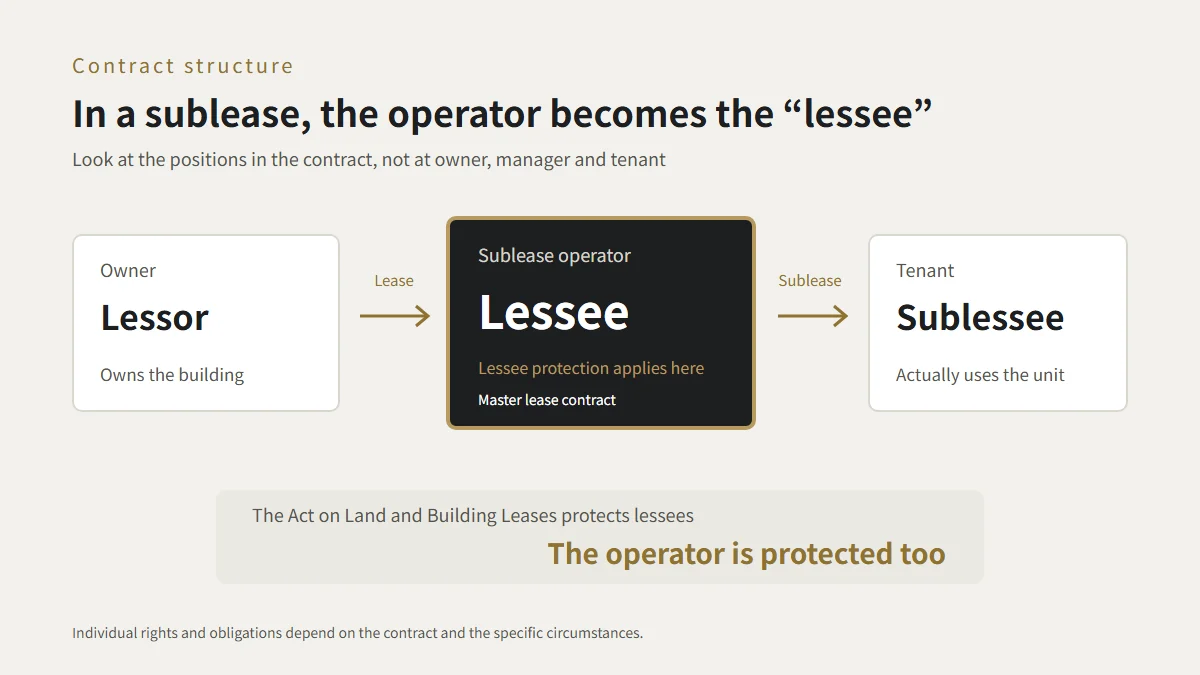
In a sublease, the owner lets the building to an operator. The operator sublets it to tenants.
In other words, between the owner and the operator,
- Owner = lessor
- Sublease operator = lessee
That is the relationship.
And the Act on Land and Building Leases (Shakuchi Shakuya Hō) is a law for protecting lessees.
It protects the side in the weaker position, so that no one suddenly loses their place to live. That is the purpose of the law.
Then, in a sublease contract, which side does that protection go to?
The operator's side. Because it is the lessee.
2 things follow from this
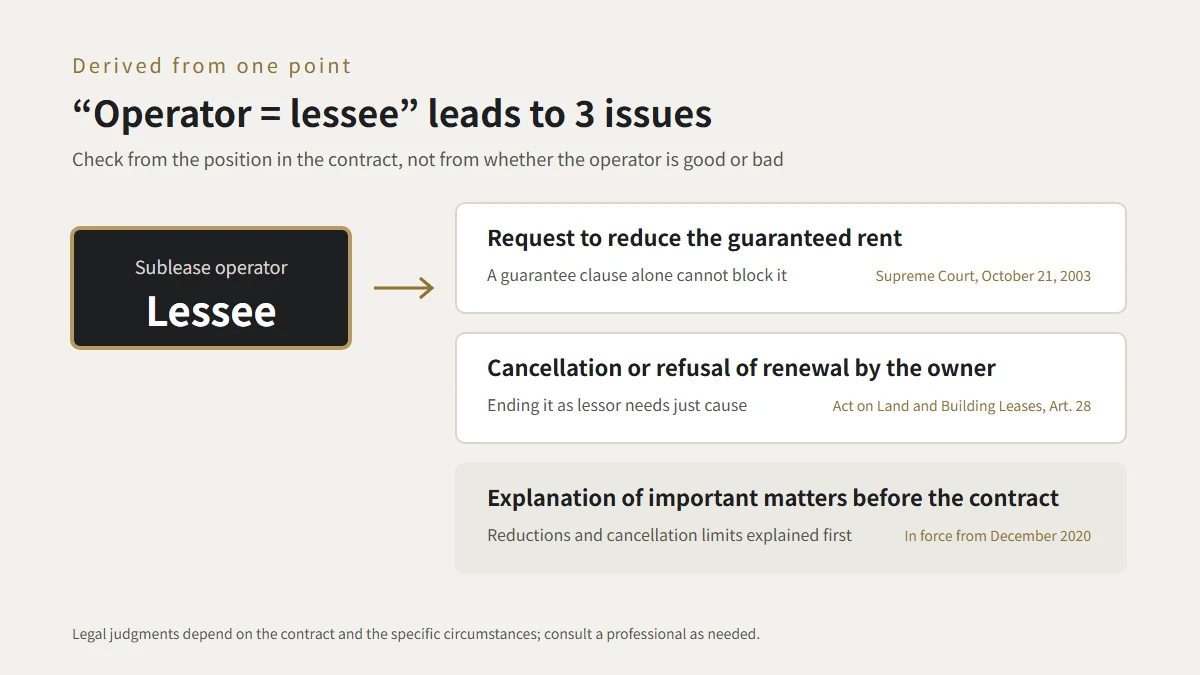
First. The operator can request a reduction of the rent set under the guarantee.
The Act on Land and Building Leases has a provision allowing a request for an increase or decrease when rent has become unreasonable. In ordinary rentals, it is the basis on which a tenant can ask for the rent to be lowered.
This also applies to master lease contracts. The Supreme Court has ruled so (judgment of October 21, 2003 (Heisei 15)).
Moreover, it is held that even with a special agreement on a rent guarantee, that alone does not shut off a request for a reduction.
In other words, a "30-year rent guarantee" does not mean the same amount is promised for 30 years.
It means that for 30 years, the operator pays rent whether or not there are tenants. The amount is a separate matter.
Second. The owner cannot easily end it.
Even if you try to end the contract because you cannot accept a reduction, the Act on Land and Building Leases requires just cause for cancellation or refusal of renewal by the lessor.
It is your own building, yet the side that lets it finds it hard to end.
This is not because the operator is cunning, but because it is the lessee. The law is designed that way.
That is why explanation became mandatory
This asymmetry caused disputes, so the system moved.
The Act on Proper Rental Housing Management Operations, the so-called new sublease law. Its provisions on subleases came into force in December 2020.
Exaggerated advertising and improper solicitation were prohibited, and an explanation of important matters before the contract became mandatory.
If you display "rent guarantee for X years," you must state the possibility of reductions alongside it. You must also show that there are limits on cancellation by the owner.
The Ministry of Land, Infrastructure, Transport and Tourism's guidelines even require explaining that, even when a rent revision date is set, a request for a reduction can be made on other days as well.
So today, it is written in the statement of important matters.
It is not that it goes unexplained; you sign after it has been explained. That is the state of things now.
Then what are you buying?
Having written this far, it may look as if I am against it, but that is not so.
What you buy with a sublease is flattening the swings from month to month.
Even if a unit becomes vacant, that month's income does not drop to zero. You do not arrange tenant placement or restoration yourself.
If you own a single condominium unit far away, and your income goes to zero when it is vacant, flattening has meaning.
The price for that is the gap between the market rent and the rent set under the guarantee. And handing over part of your power to decide.
The problem is when you bought flattening but think you bought a level.
If you think that way, a reduction notice a few years later looks like a breach of contract. Even though it is exactly as the contract says.
There are 3 things to check.
How many years apart rent revisions are. How much it has been revised in the past. And what happens when you want to end it yourself.
The third is something you ask before the contract. It is a nuanced matter, so if you need a concrete judgment, please consult a lawyer or a licensed real estate transaction specialist (takken-shi). I am not a legal professional.
When you lend someone a book, things get a little strange afterward.

It does not come back. But it is hard to press for it.
You are the one who lent it, and you are the owner. Even so, you are the one who has to bring up "that book."
The other person probably means no harm. They have probably just forgotten.
But owning something and being able to say "give it back" were, it seems, separate things.