
My parent says they will sell the family home to keep their business's cash flow going. Is there any option other than selling?
Before selling the family home to keep a business's cash flow going, it is worth checking whether financing can be obtained with the house as collateral. I write about the difference between selling and secured financing, what happens when you can no longer repay, and what you learn if you cannot borrow.

BENERU writes for readers who live in Japan. Taxes, loans and the other rules described here are those of Japan, and they assume a resident of Japan.
This page is a translation of the Japanese original. If the two differ, the Japanese original prevails.
I answered this question on a Q&A site.
My father, who was in the real estate industry for a long time and is now self-employed, says he will put the family home up for sale because his company is doing poorly. Isn't giving up an owned home in times like these a risk? Or is it an unavoidable choice?
I take what might happen by giving up an owned home to be the "risk."
If you take that way of thinking, after moving out, whether you can or can't rent a room.
When you try to buy a home again, whether you can or can't take out a loan.
There are risks in parts like these.
As for "Is it an unavoidable choice?"—well, I suppose it is. Otherwise, I don't think it would come to selling the home.
If what you want to ask is something like wanting to borrow some wisdom—"Does it look like there are other ways to handle it?"—then I'll continue a little.
An option other than selling: borrowing with the house as collateral
From here on, I answer only for the case in the question.
Since the business is in a difficult state, he is selling the home to raise money, but what I wondered is: can't he get financing with the home as collateral?
If it can be sold, then it is presumably a home and land with no remaining loan balance, so how about putting a mortgage on the land and building and getting financing?
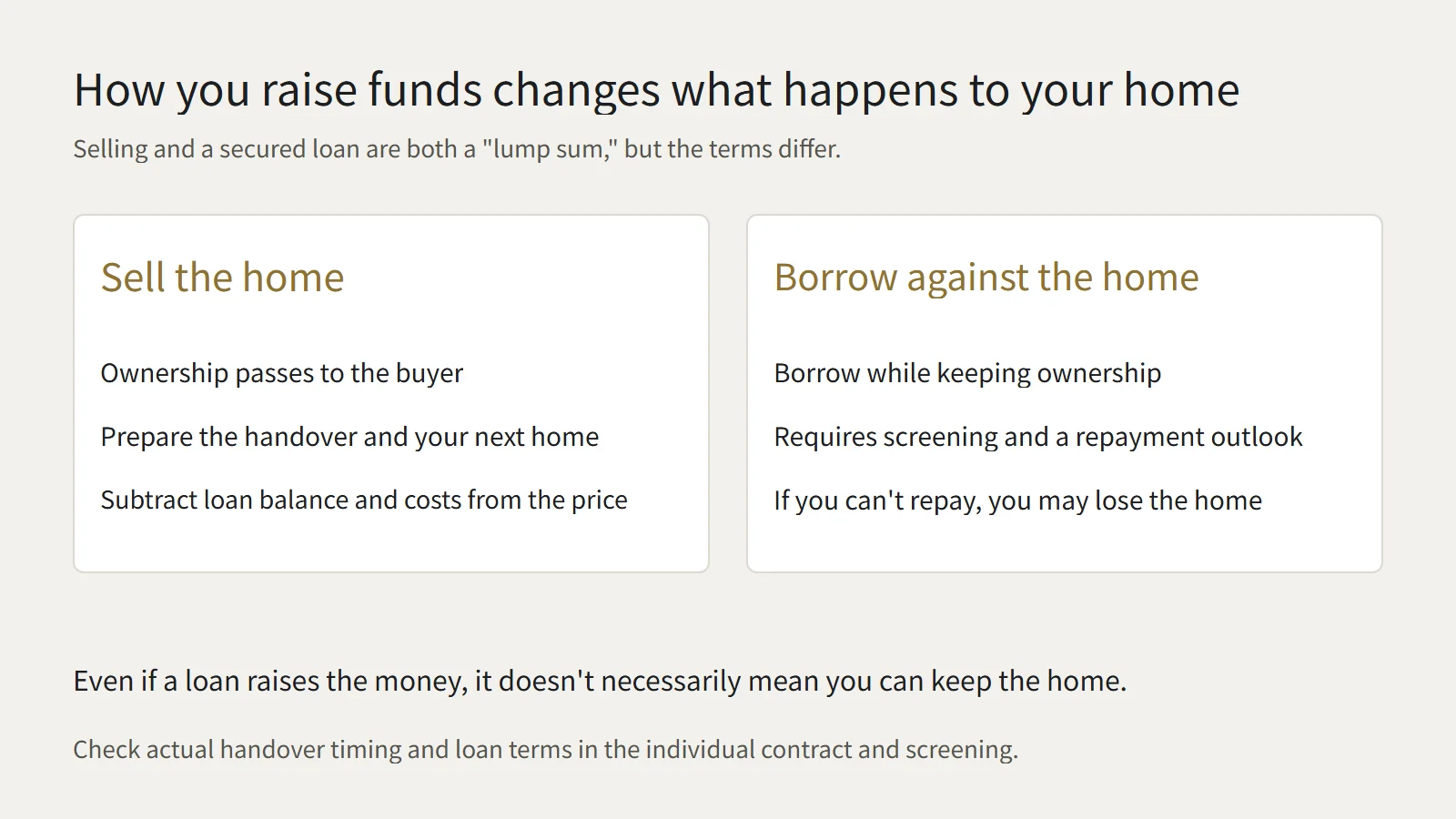
You may think, how is that different from selling? But if you sell, moving out becomes certain.
You lose ownership and a handover becomes necessary, so selling and moving out go together.
In contrast, with financing, moving out is not necessary.
This difference is quite large.
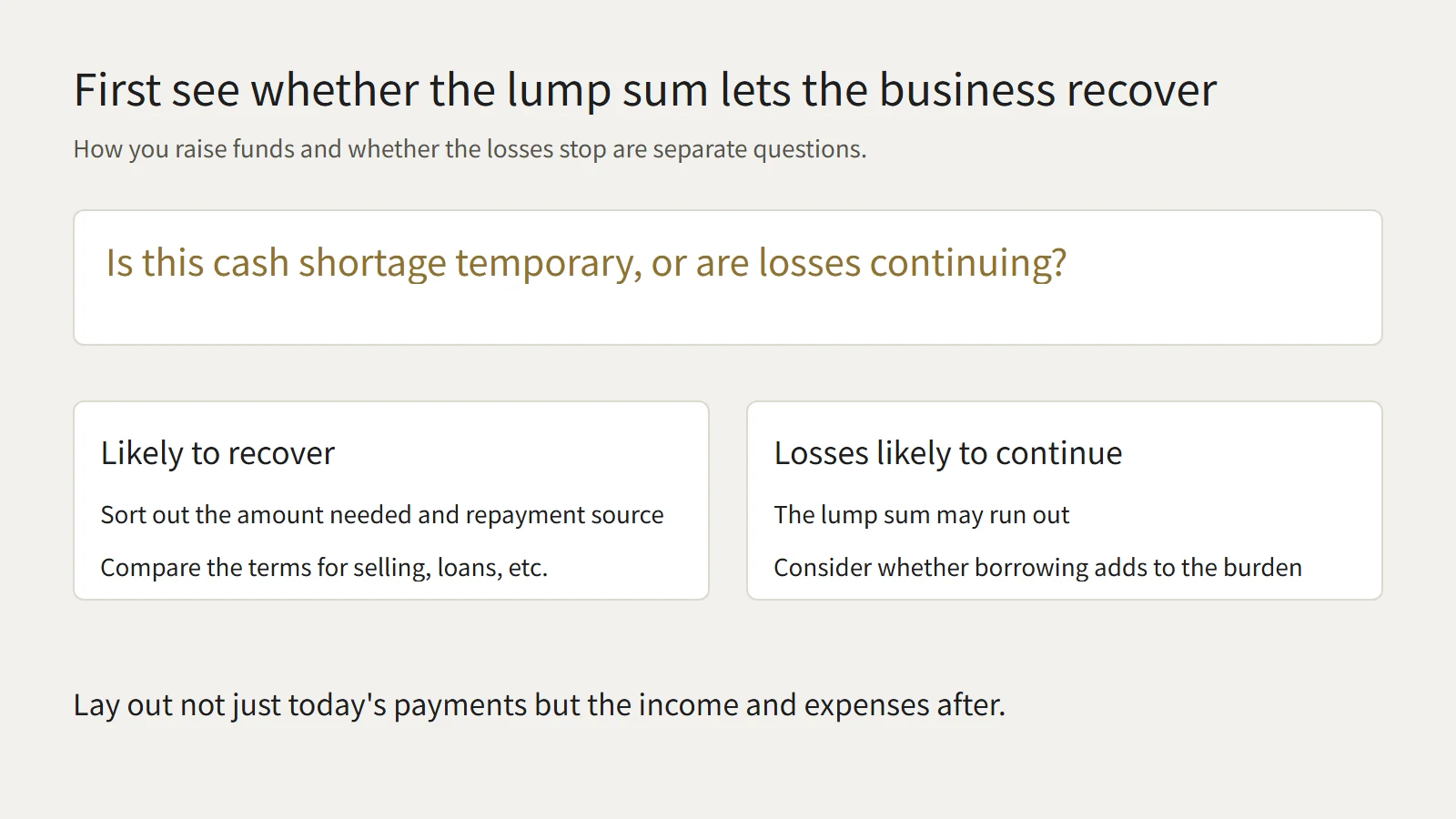
Since the business is already in a tough situation, it is in the red on the PL, right? I don't know whether creating a lump sum would get it through, but since it says things are tough, in the worst case it is possible to melt away the lump sum and still keep running a deficit.
Honestly, I don't know what would lead to that state, but I suppose there are debts that can't be paid without selling the home.
What happens if you can no longer repay
I'll talk about something rather unpleasant, but if you put the home up as collateral and get financing, when you can no longer repay, the bank can petition for an auction based on its mortgage.
While the auction procedure proceeds, you can go on living there for the time being. However, the person who buys at auction can demand that you vacate through the court's order of delivery. The former owner retains no right to keep living there. You had better not misunderstand this point. If anything, your father probably understands this sort of thing.
Even so, if you keep talking with the bank once repayment becomes difficult, there is room to create time and options, such as reviewing the repayment conditions, or finding a buyer yourself with the bank's consent—a so-called voluntary sale (nin'i baikyaku). If you sell and move out, the situation of having no place to live is certain right now. I think this difference is large.
Comparing the means of selling to create a lump sum with the means of getting financing with the land as collateral, I think financing may be better to the extent that it lets you gain the benefit of "securing a place to live." However, that is the case only when there is a prospect of the business recovering. If it doesn't recover, the house will be given up in the end, and if it goes to auction, the terms tend to be worse than selling in the ordinary way.
If you can't borrow, that is an answer too
However, it may be that he is already in a state where he can't borrow. Even so, since there is collateral, I suggest at least checking the option of financing.
If the bank won't lend, it means the state of your father's company's financial statements is not one that can be lent to, even with collateral.
That in itself may be worth thinking about. In a difficult state, no matter how much money there is, sometimes "what's impossible is impossible." Even if you get through today thinking only about money, the strength to keep going may eventually run out.
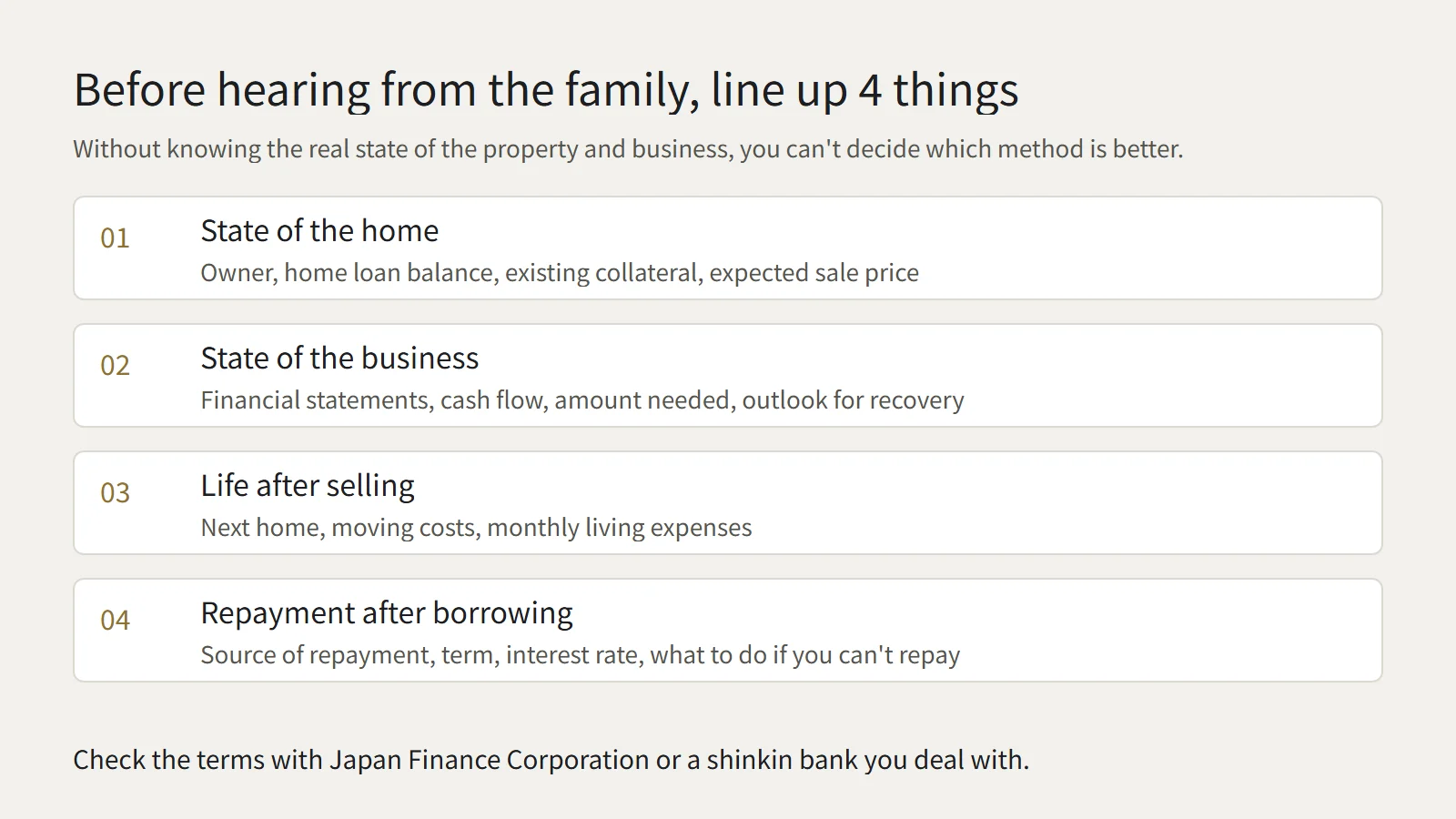
How about first talking to the Japan Finance Corporation or a local shinkin bank? After that, I think it would be good to lay out the options on the table and for all of you to think carefully about what is best to do.
Beyond this, I don't know the property's location, ages, family makeup, the nature of the business and so on, so there is nothing more I can answer, and I also don't think this is a place to write about such complicated matters. But I suppose you are clutching at straws, wondering if there isn't some way to handle it.
It may be pointless to do so, but please at least try hearing what they have to say.
For what comes next, I recommend going to talk to the shinkin bank you have dealings with, with your family present too.