
Unpublished properties are not hidden
An unpublished property is not a secret shelf; it is a property whose turn to reach the market has not come yet. We sort out the direction of cause and effect, that the reason for a low price lies not in being unpublished but in the seller's circumstances, and 4 questions to check before the property itself.

BENERU writes for readers who live in Japan. Taxes, loans and the other rules described here are those of Japan, and they assume a resident of Japan.
This page is a translation of the Japanese original. If the two differ, the Japanese original prevails.
Good day. I'm Nel Shikina.
Unpublished properties.
When you hear these words, it feels as if there were a secret shelf somewhere, and only chosen people were allowed to see it.
What actually happens is a little more administrative.
The order of release has a deadline
There are stages before a property reaches the market.
The seller decides to sell. The seller signs a brokerage agreement with a firm. The firm reaches out to buyers it already knows. The firm registers the property with the designated real estate information network (REINS). It appears on portal sites and in advertising.
In this sequence, the gap between the third and fourth steps is what is called "unpublished."
But there is a deadline here.
Under an exclusive brokerage agreement, there is an obligation to register with REINS within 7 days of the agreement, and under an exclusive-and-sole brokerage agreement, within 5 days (Article 34-2 of the Building Lots and Buildings Transaction Business Act (Takken Gyōhō) and its Enforcement Regulations). Days the firm is closed are not counted.
In other words, with the exclusive types, the time a property can be kept off the market is, under the rules, about one week at most.
A general brokerage agreement has no registration obligation, so this can stretch a little longer. Even so, the seller wants to sell, so there is no reason to keep it hidden.
Being unpublished is not a state of being hidden. It is a state in which the turn has not come yet.
An early turn has a price
Even if the difference is only a few days, it is not zero. People who see a property first really do exist.
The question is whether you can stand in that position for free.
The people who are contacted early are, from the firm's point of view, "people with whom things move quickly if I call." They have bought before. Where their money comes from is clear. They reply quickly. That accumulated track record is a kind of advance payment.
And there is one more thing they pay.
Early information leaves little time to check.
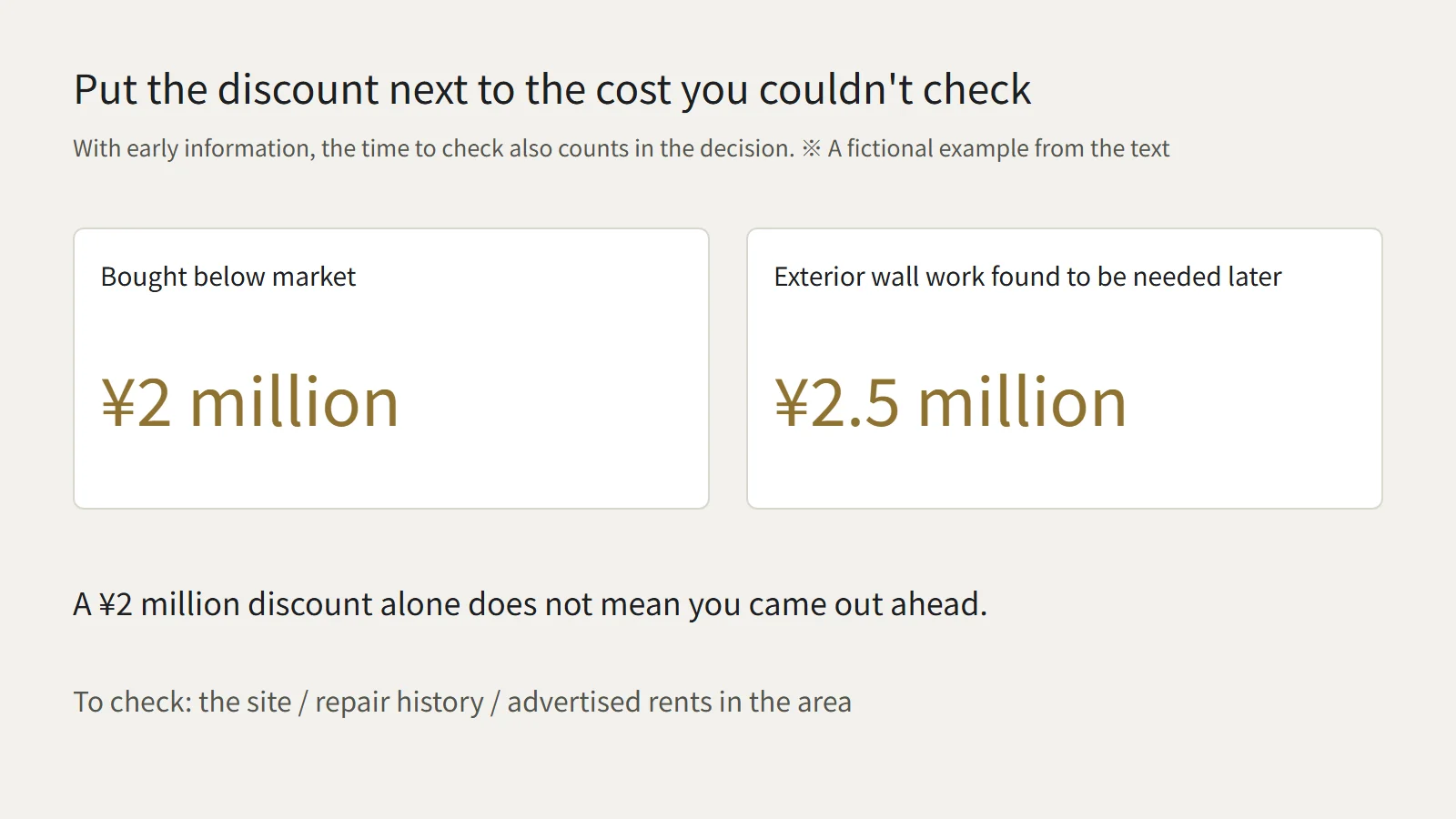
Suppose you were able to buy for ¥2 million below market. In exchange, you finish the on-site check, the reading of the repair history, and the comparison with advertised rents in the area in 3 days.
If you later find that repainting the exterior walls costs ¥2.5 million, nothing is left of the ¥2 million discount.
Having bought cheaply, and having come out ahead. These two are not the same, I think.
It is not cheap because it is unpublished
That said, I am not saying early information is meaningless.
Properties cheaper than the market do exist. Cash is needed for an inheritance. A deadline has been set in a voluntary sale (nin'i baikyaku). A firm wants to reduce its inventory at the end of its fiscal year. When there are circumstances like these, the price goes down.
But do not get the direction of cause and effect backward.
It is cheap because the seller is in a hurry. Not because it is unpublished.
A seller in a hurry does not have time to advertise widely and let buyers compete. So they first contact the people who will decide quickly. As a result, it is sold before it reaches the market. That is the order.
Being unpublished is not the cause but the result.
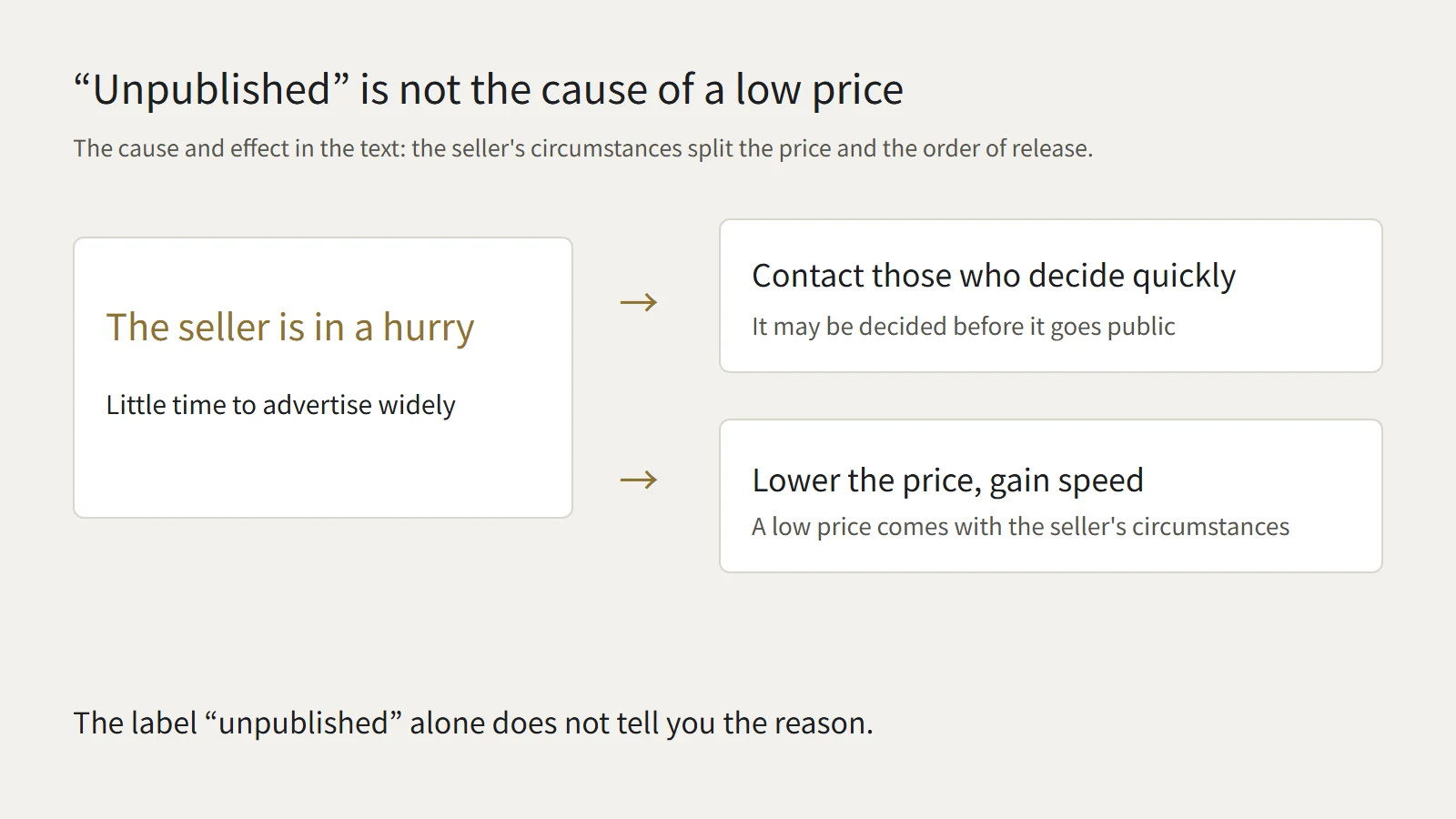
If you get this direction wrong, you end up reading it as "as long as it is unpublished, it is cheap." In reality, the reason it did not reach the market may not be "the seller was in a hurry" but "everyone who was contacted first turned it down."
The word is the same, unpublished. What is inside points the opposite way.
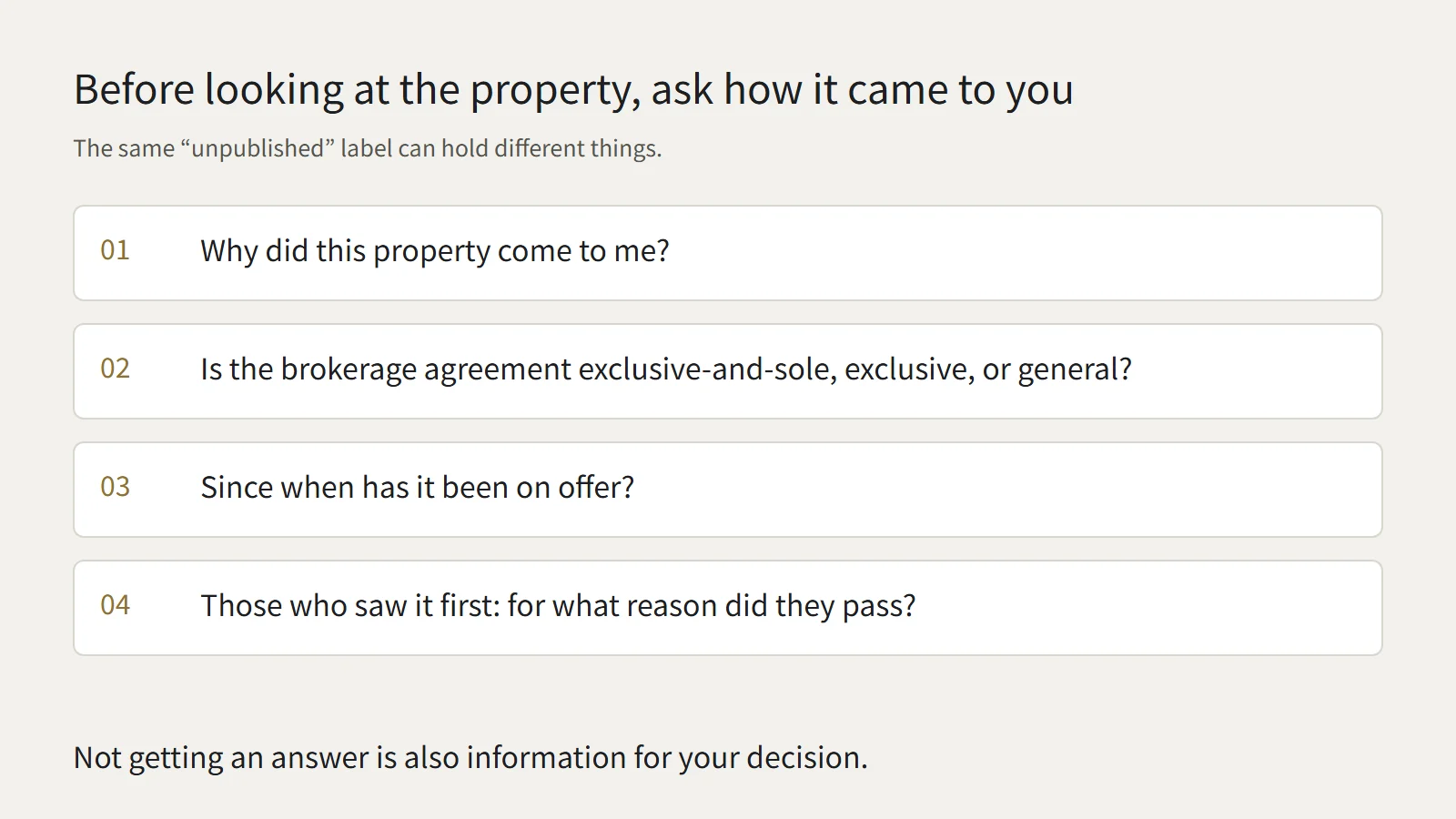
So before the property itself, there are things to ask.
- Why did this property come to me?
- What type of brokerage agreement is it (exclusive-and-sole, exclusive, or general)?
- Since when has it been on offer?
- Was anyone contacted before me? If so, for what reason did they pass?
To the last one, you may not get an answer. Not getting an answer is itself a piece of information, I think.
At the first station on the line in the morning, you can get a seat.
But the people sitting came 10 or 20 minutes early and lined up on the platform.
People who board at a station along the way cannot sit. In exchange, they used those 20 minutes for something else.
Seats are not handed out; they are exchanged for time. Which is better depends on what that person was doing with those 20 minutes.
Unpublished properties sit in the same place. An early turn is for sale, and its price is paid in maintaining relationships and in having less time to think.
Whether to pay that price is yours to decide.
But please check, once, the assumption that there is a seat you can get without paying.