
What is left, and what is received
Inheritance planning with real estate may lower the assessed value, but it leaves problems with funds for paying the tax and with how easily the property can be turned into cash. Using a fictional example, this piece sorts out the difference between the assessed value the person leaving the estate optimized and the cash the people receiving it need.

BENERU writes for readers who live in Japan. Taxes, loans and the other rules described here are those of Japan, and they assume a resident of Japan.
This page is a translation of the Japanese original. If the two differ, the Japanese original prevails.
Good day.
This time, I will tell you about a certain person.
The following is a fictional example for illustration.
When this person was in their 70s, they bought a whole apartment building.
The purpose was clear. Holding real estate rather than cash lowers the assessed value at the time of inheritance.
That is correct.
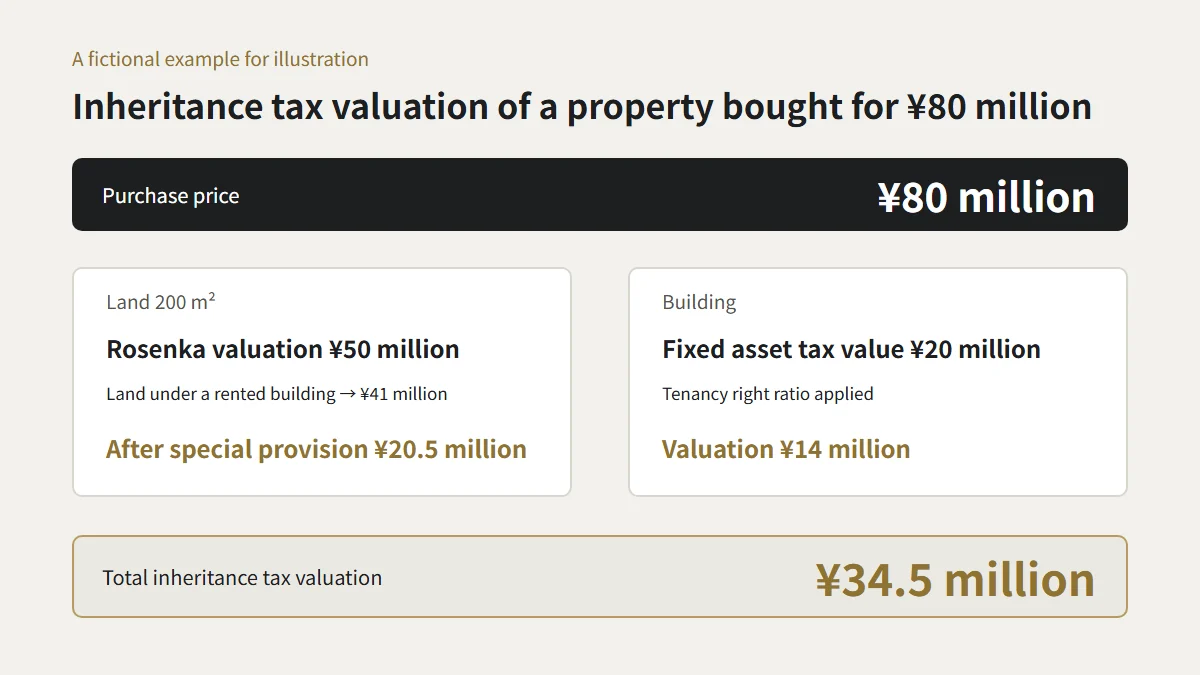
Land of 200 square meters, a purchase price of ¥80 million. Let's calculate the inheritance tax valuation.
The land's valuation by road-rating land values (rosenka) is ¥50 million. Because it is the site of a building rented out to others, it is reduced by the leasehold ratio and the tenancy right ratio, to ¥41 million (leasehold ratio 60%, tenancy right ratio 30%, assuming full occupancy).
Then the special provision for small-scale residential land. Up to 200 square meters, it is halved, to ¥20.5 million.
The building is the fixed asset tax assessed value of ¥20 million minus the tenancy right ratio, ¥14 million.
The total is ¥34.5 million.
Something bought for ¥80 million is, on the valuation, a little over 40%.
The purpose has been properly achieved.
And then, they pass away
It was about 6 years after the purchase.
There are 3 children. All of them work far away, and none of them plans to be a landlord.
First, a deadline comes.
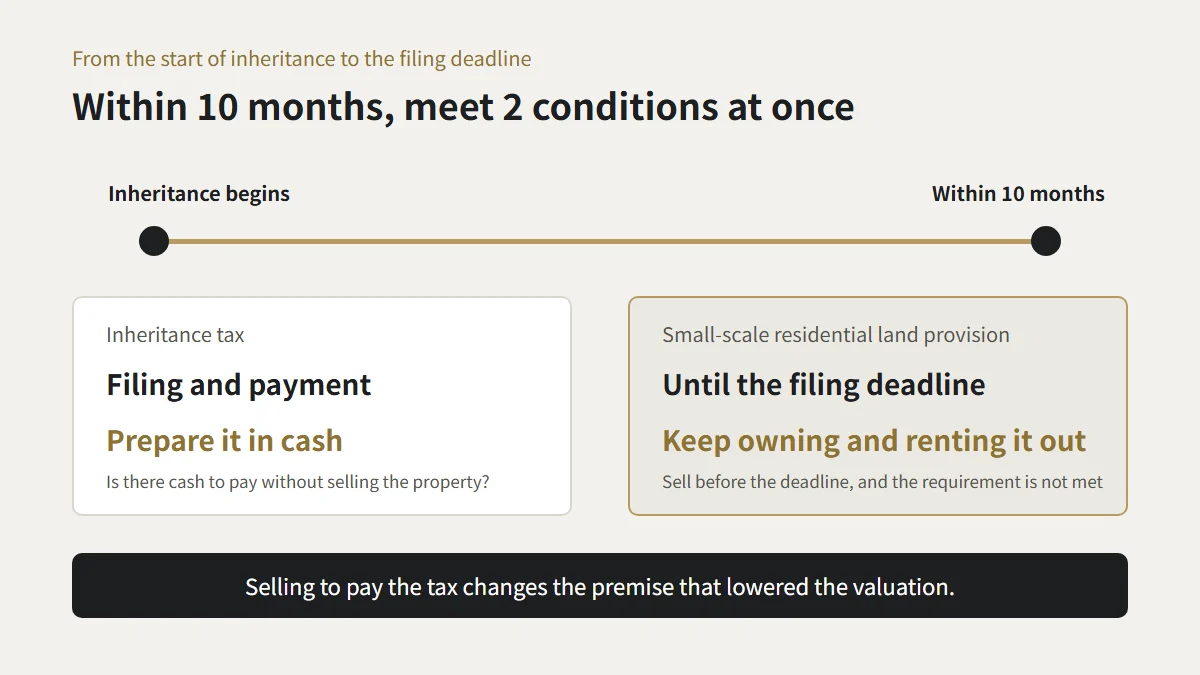
Filing and paying inheritance tax is due within 10 months from the day after learning of the death. In principle, in cash.
The 3 of them think: we can sell that apartment building and pay out of that.
But it doesn't work that way.
The special provision for small-scale residential land, which halved the valuation, has a requirement: continue to own the property and continue renting it out until the filing deadline.
In other words, if you sell within 10 months, the valuation is not halved. The tax goes up.
Selling to pay the tax increases the tax.
One more thing: everyone must agree
To begin with, it cannot be sold right away.
Without a will, the estate is co-owned by the 3 of them until its division is decided.
Selling co-owned real estate requires everyone's agreement. If 1 of them says, "Couldn't we hold on to it a little longer?", it stops there.
And if the filing deadline arrives before the division is settled, the special provision cannot be used at that point. If the division is decided later, there is room to apply it retroactively, but that requires a procedure.
I imagine reading this is starting to feel tedious.
It actually is tedious.
The purpose has been achieved
Let me make one thing clear.
The purpose of the person who bought has been achieved.
¥80 million was valued at ¥34.5 million. Had it stayed as cash, the ¥80 million would have been the assessed value as it was.
They used the system correctly. They did not fail.
But what was optimized was the assessed value.
And what the heirs wanted was cash.
These 2 are different things.
To lower the valuation, the asset was changed into a form that is hard to turn into cash. It can also be told as that kind of story.
Real estate is valued low partly because it is hard to sell. That difficulty in selling falls on the heirs in the same way.
There are 2 things to check
This is not to say that using real estate for inheritance planning is bad. The effect is real.
But I think it is better to ask 2 things.
One. Do the heirs want to hold that property?
If they want to hold it, the lower valuation is simply a gain. If they don't, the arrangements for turning it into cash need to be decided in advance.
Two. Where will the cash for the tax come from?
Is there enough cash set aside separately to pay without selling the property?
If these 2 are decided, the result of the same planning can differ quite a lot.
There is one more point, about timing. For rental real estate bought within 5 years before an inheritance, a revision is moving forward so that, for inheritances on or after January 1, 2027 (Reiwa 9), it would be valued based on the transaction price rather than road-rating land values (the FY2026 (Reiwa 8) tax reform outline, and the National Tax Agency's draft circular). In this example, 6 years have passed since the purchase, so the calculation so far holds. If the inheritance occurs soon after buying, the valuation changes greatly.
Note that I have kept this to an explanation of the system. The requirements are divided in detail, and individual determinations are the domain of a tax accountant (zeirishi).

Sometimes a cardboard box arrives from my family home.
When I open it, it is full of vegetables. Good ones. They would cost a fair amount if you bought them.
But I live alone.
They don't fit in the refrigerator, and they spoil before I can use them up. I could give them away, but on weekdays I don't see many people.
The sender is trying to give me something good. That is true.
But the giver is probably thinking about the value of the vegetables, and the receiver about the capacity of the refrigerator.