
Why are management fees in high-rise condominiums high despite the many units?
With many units, the burden per unit should be spread thinner, yet management fees in high-rise condominiums are high. This piece separates the management fee from the repair reserve fund and sorts out the reasons from both the number of units sharing the cost and the total cost. It also looks at the Ministry of Land, Infrastructure, Transport and Tourism's guideline figures for the repair reserve fund.
BENERU writes for readers who live in Japan. Taxes, loans and the other rules described here are those of Japan, and they assume a resident of Japan.
This page is a translation of the Japanese original. If the two differ, the Japanese original prevails.
I answered a question like this on a Q&A site.
Why are management fees in high-rise condominiums higher than in other condominiums? In theory, I would think they should be cheaper because more residents share the maintenance costs.
There are 2 kinds of money you pay each month
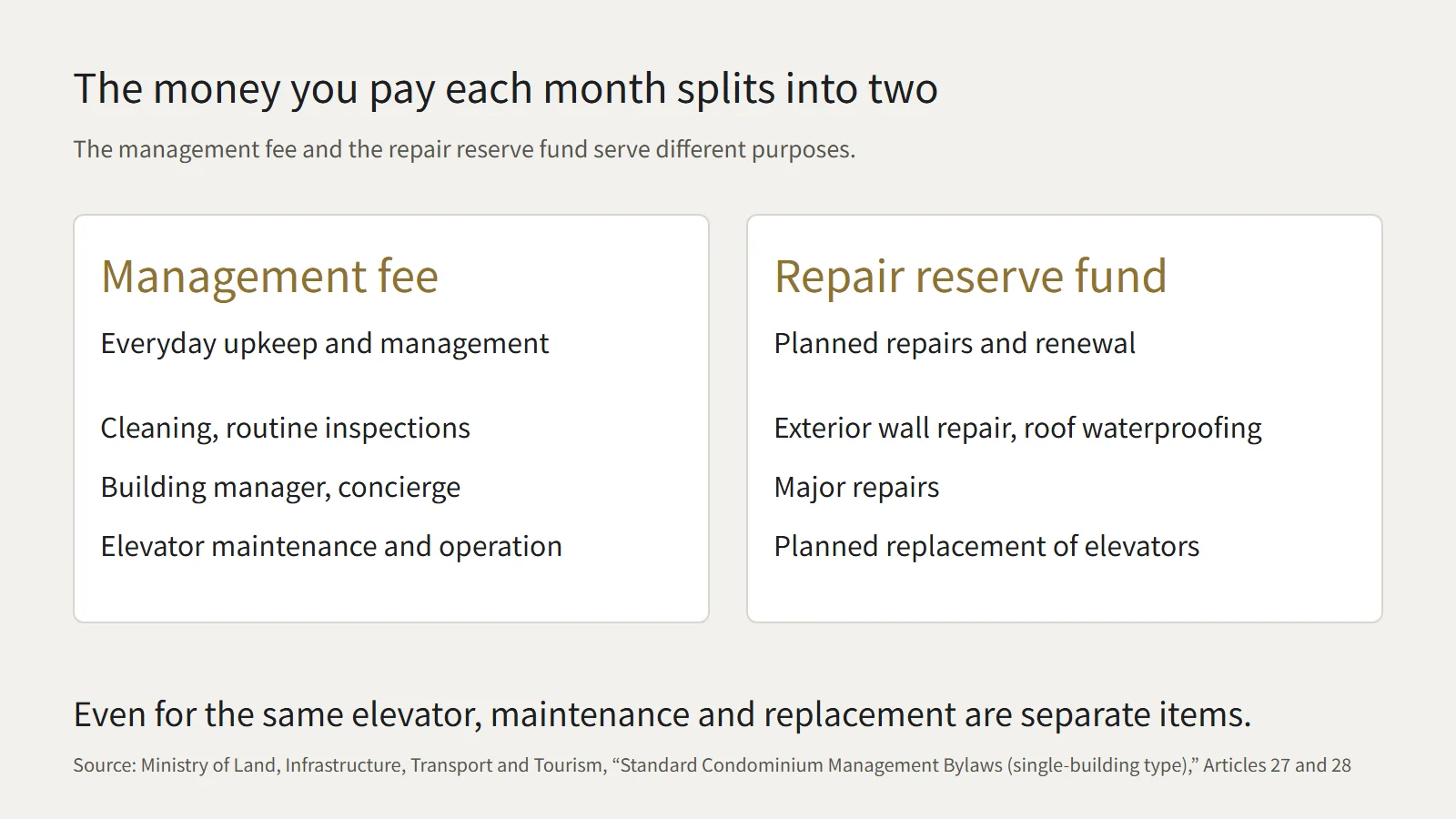
The monthly condominium management costs generally understood as "management" come in 2 kinds: the "management fee" and the "repair reserve fund."
The repair reserve fund is money collected each month from each unit owner and used to carry out repairs to the building and equipment called major repairs.
Major repairs refer to repairs that cannot be called everyday, such as repairing the exterior walls, waterproofing the roof, and replacing elevators.
In contrast, the management fee is used for the everyday upkeep and management of the condominium.
Upkeep and management here refers to the costs of cleaning the condominium, routine inspections, and arranging and keeping a building manager.
The difference in condominium management fees is the difference in everyday costs incurred each month.
Even shared, it is high if the base is high
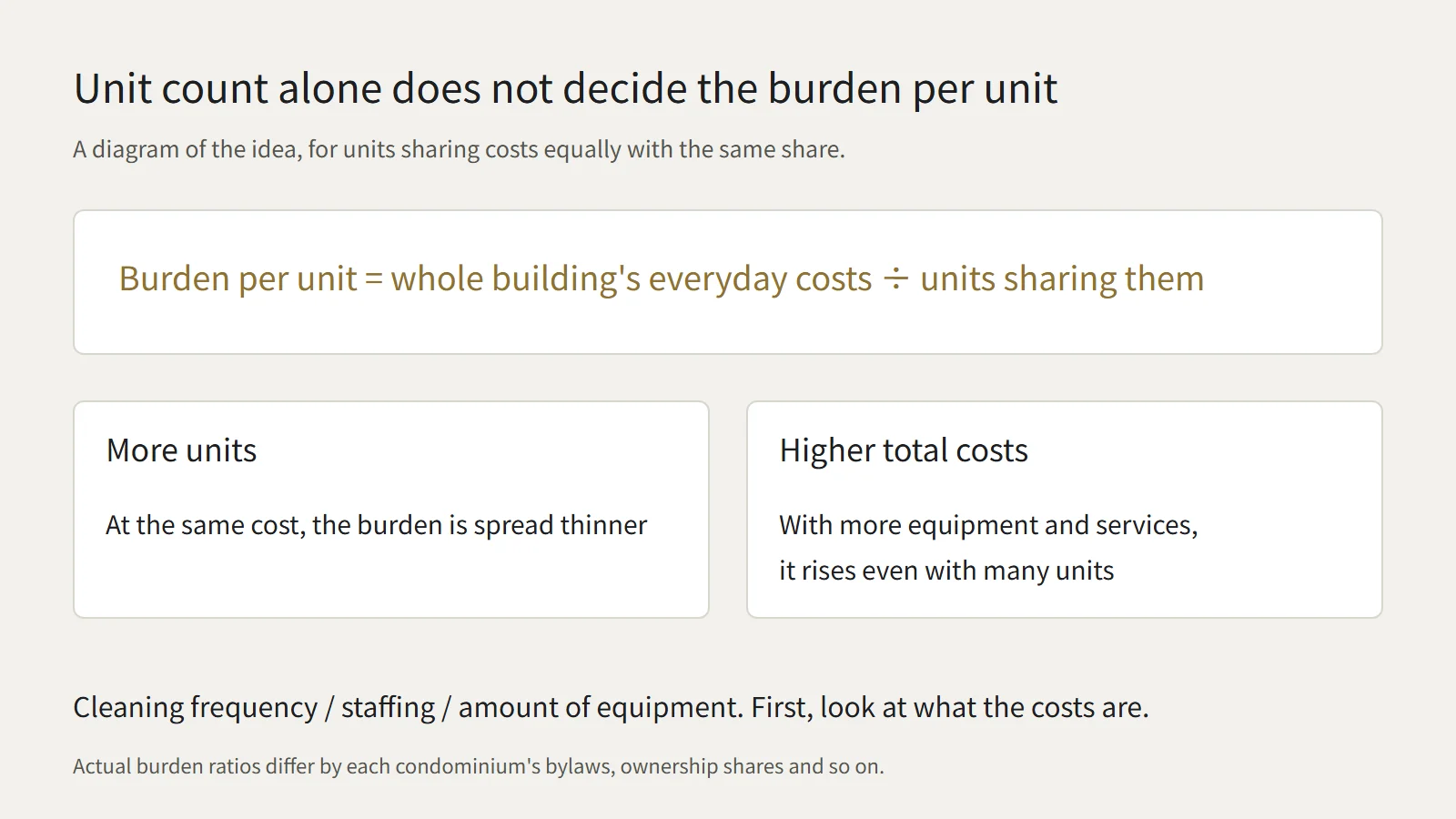
So, if expense items increase, such as frequent cleaning to keep the place clean or a concierge on site, the management fee rises in proportion.
It is a correct understanding that as the number of units in a building increases, each unit's burden is reduced by sharing. That is the same for both the management fee and the repair reserve fund.
However, if the cost of the management fee itself, the base being shared, becomes high, then by that logic it is still high even when shared.
For example, maintenance and inspection of elevators is fairly expensive. Everyday maintenance and inspection is a management fee item, and planned repairs and replacement are repair reserve fund items.
It is easy to imagine if I say that 4 elevators cost more to maintain than 1 elevator.
Costs incurred because the building is high-rise
Now, it is not that there are no costs that pile up because a building is high-rise.
The Ministry of Land, Infrastructure, Transport and Tourism's guidelines set the guideline figure for the repair reserve fund of condominiums with 20 or more floors in a separate category. That is because repairs to the exterior walls and the like require special scaffolding, and the proportion of common areas is also higher.
The average guideline figure is ¥338 a month per 1 ㎡ of exclusive area for 20 or more floors. For buildings under 20 floors with a total floor area of 5,000 ㎡ or more, it is ¥252 to ¥271.
What is interesting is that small buildings under 20 floors with a total floor area of less than 5,000 ㎡ come to ¥335, almost the same as 20 or more floors. As you wrote, as the number of units increases, the burden per unit decreases. It is true that scale has an effect.
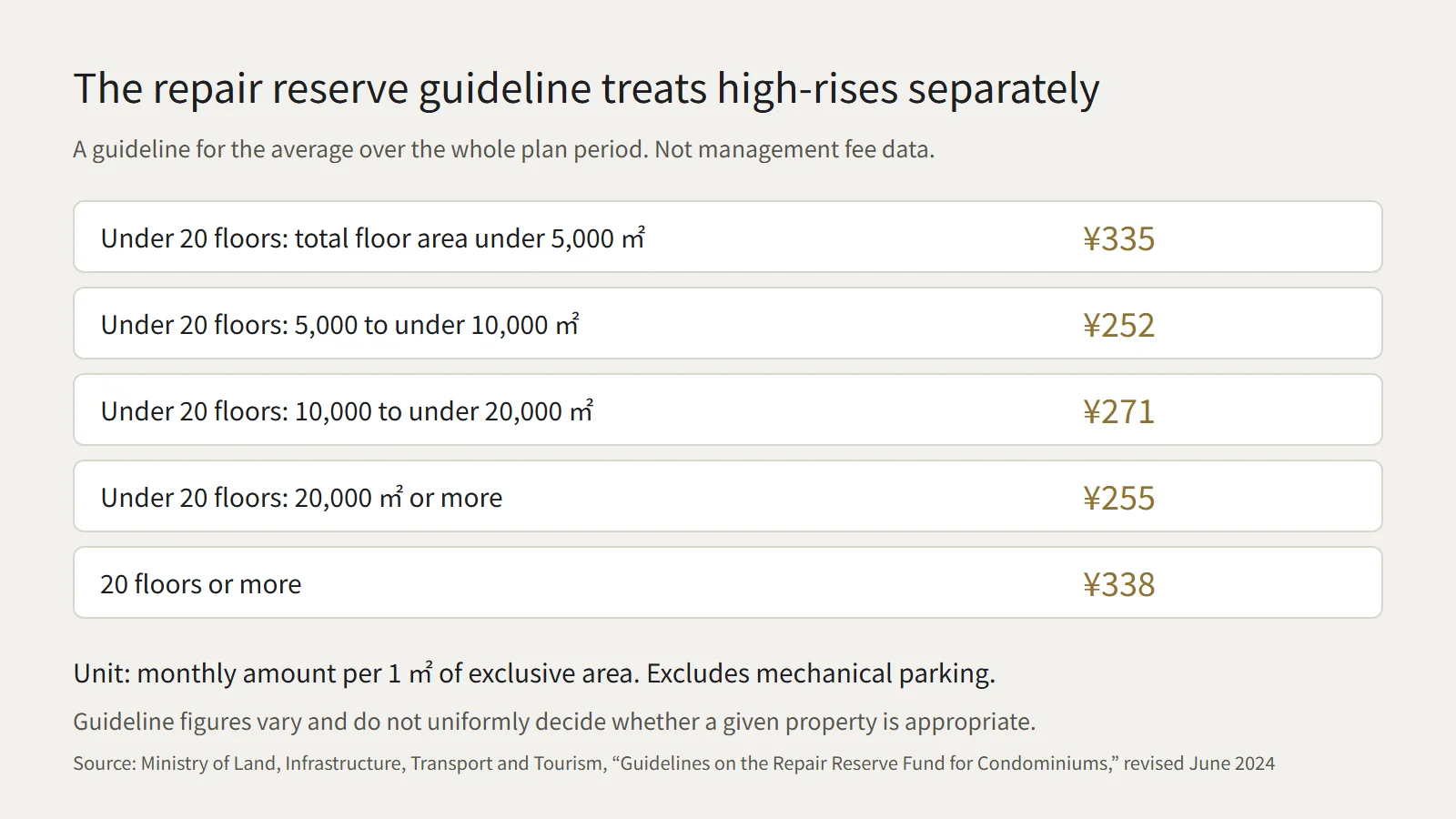
In other words, in high-rise condominiums, the costs that come from being high-rise eat up what should have been thinned out by scale. Being high-rise alone does not make the management fee jump especially high.
The biggest reason is "luxury"
As for the management fee, whether a building is "luxury" has more effect than whether it is high-rise.
Maintaining luxury cannot be done without cost, after all. Convenient, clean, and comfortable is not cheap.
The biggest reason management fees pile up at tower condominiums and the like is that they are luxury buildings. Okay?