
You delegated the work, not the call
Restoration, rent arrears, insurance, rent reductions. Even if you outsource management, the one who decides is the owner. Yet it does not reach you in the form of a decision; it becomes an after-the-fact report. We sort out why that happens, and the one number to decide before it does.

BENERU writes for readers who live in Japan. Taxes, loans and the other rules described here are those of Japan, and they assume a resident of Japan.
This page is a translation of the Japanese original. If the two differ, the Japanese original prevails.
Good day. I'm Nel Shikina.
When you outsource management, most things leave your hands.
Tenant recruitment, contracts, checking payments, arranging equipment work: the property management company does them. That is what you outsource it for, so that is as it should be.
But some things do not leave.
This time I will separate those out.
"Leave it to them" points to 2 things
Let me split one word first.
Leaving it to them contains 2 things: leaving the work to them, and leaving the judgment to them. What moves under a management contract is usually only the former.
Let me line up common situations.
| What happens | Who does the work | Who decides |
|---|---|---|
| Restoration when a tenant leaves: how much to charge the tenant | Property management company | Owner |
| When arrears arise: when, and how far, to step in | Property management company / guarantee company | Owner |
| How much fire insurance to take out | Agent | Owner |
| When asked to lower the rent: whether to agree | Property management company | Owner |
| Whether to change property management companies | ― | Owner |
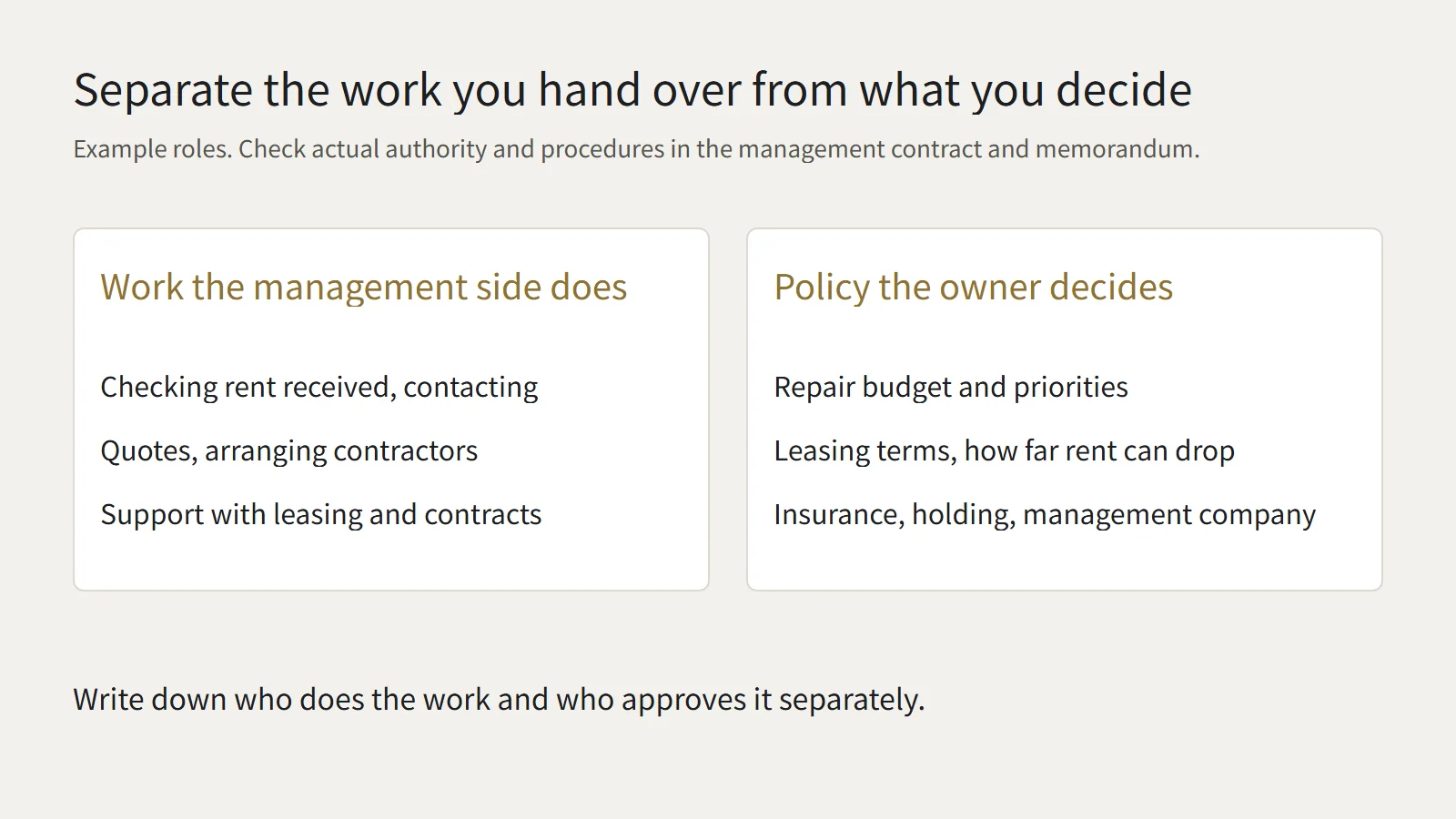
The right-hand column stays with the owner unless the contract arranges otherwise.
Take restoration as an example. In the Ministry of Land, Infrastructure, Transport and Tourism's guidelines, restoration does not mean "returning the place to how it was when rented." The cost of aging and wear from ordinary use is borne by the landlord, on the thinking that it is already included in the rent. The tenant bears only the part caused by intent or negligence, or by use beyond ordinary use.
Where to draw this line is judged case by case on site. The one in a position to judge is the owner.
Yet in practice, most people do not make this judgment.
They don't make it, and yet it is decided.
Decisions turn into reports
A property management company handles volume.
It is not working for just one building or one unit; it runs hundreds of units with the same staff. If it got confirmation from each owner every time someone moved out, every time there were arrears, every time equipment broke, it could not keep up.
So it handles things by custom. And it reports afterward.
"We settled the cleaning fee with this split."
"The guarantee company made a subrogated payment."
"We repaired it for ¥XX."
The reports are accurate. There are no lies, either. I talked before about how there are no lies in a sales explanation; this is the same structure. Everything written is correct.
But what was originally a decision is arriving in the form of a report.
The custom is not wrong. In many cases it is reasonable. The problem is that the custom is set to the conditions of an average owner.
For someone with little room for out-of-pocket costs and someone with plenty, the judgment on the same repair changes. For someone thinking of selling within two years and someone holding for twenty, whether to repair or replace equipment changes.
That difference is known only to the one receiving the report.
One number to decide is enough
So what do you do?
Making everything subject to prior approval is not an option. We will look at that in the next section.
You do one thing. Draw a line with an amount.
- Up to how much can the property management company go ahead on its own judgment and just report afterward?
- Above how much do you want to be contacted before work starts?
Just putting this one line into the management contract or a memorandum turns part of the notices that were reports back into decisions.
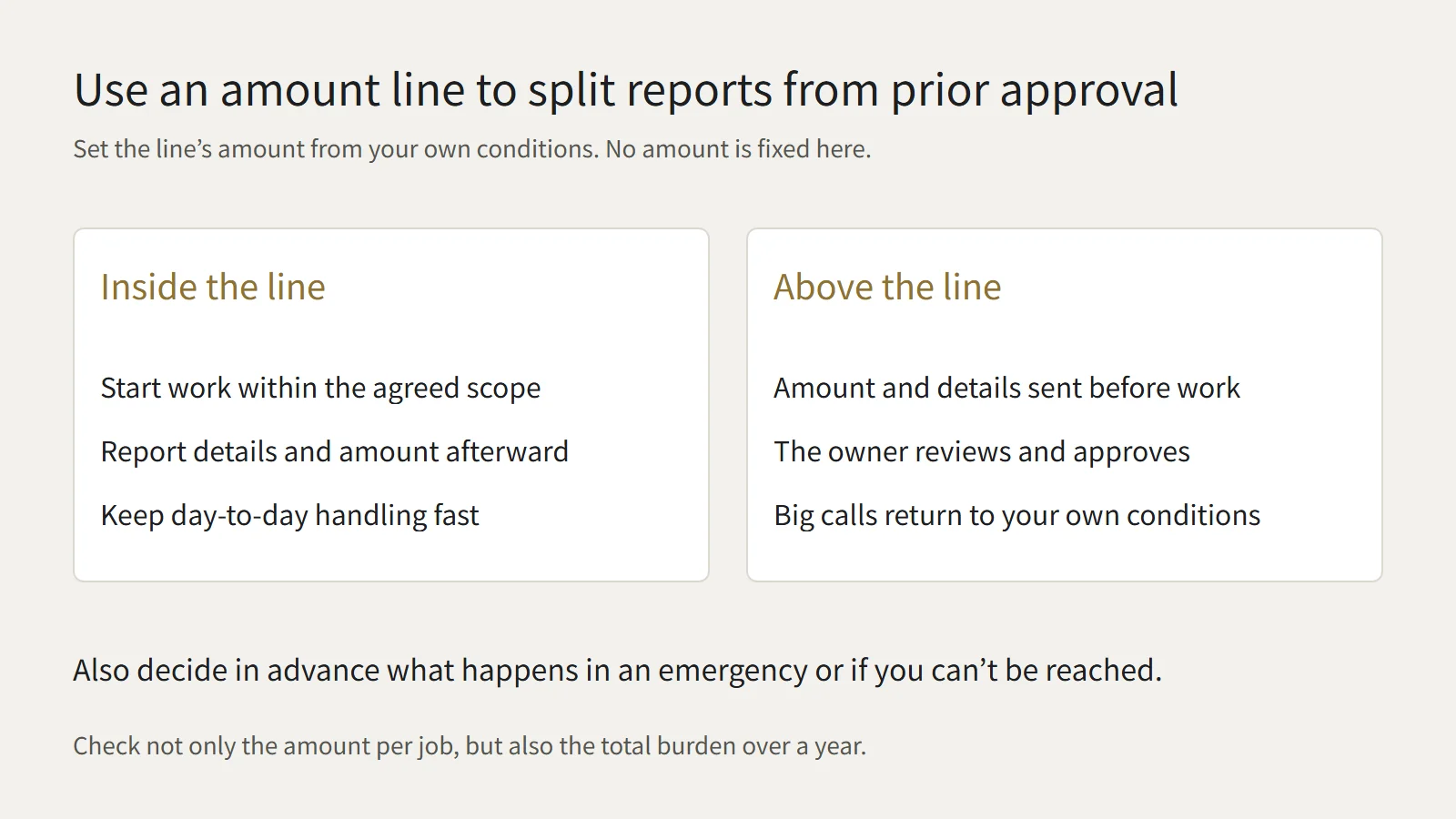
What happens without a line?
A ¥50,000 water heater repair and a ¥500,000 exterior wall repair get the same treatment. Both arrive as "we repaired it." Or both become prior consultations, and the property management company's hands stop.
Work out the height of the line backward from how much you can pay out of pocket in a year. If your out-of-pocket limit is ¥300,000 a year, a ¥200,000 job is an amount that affects your annual plan. If the limit is ¥2 million a year, a report is enough for ¥200,000.
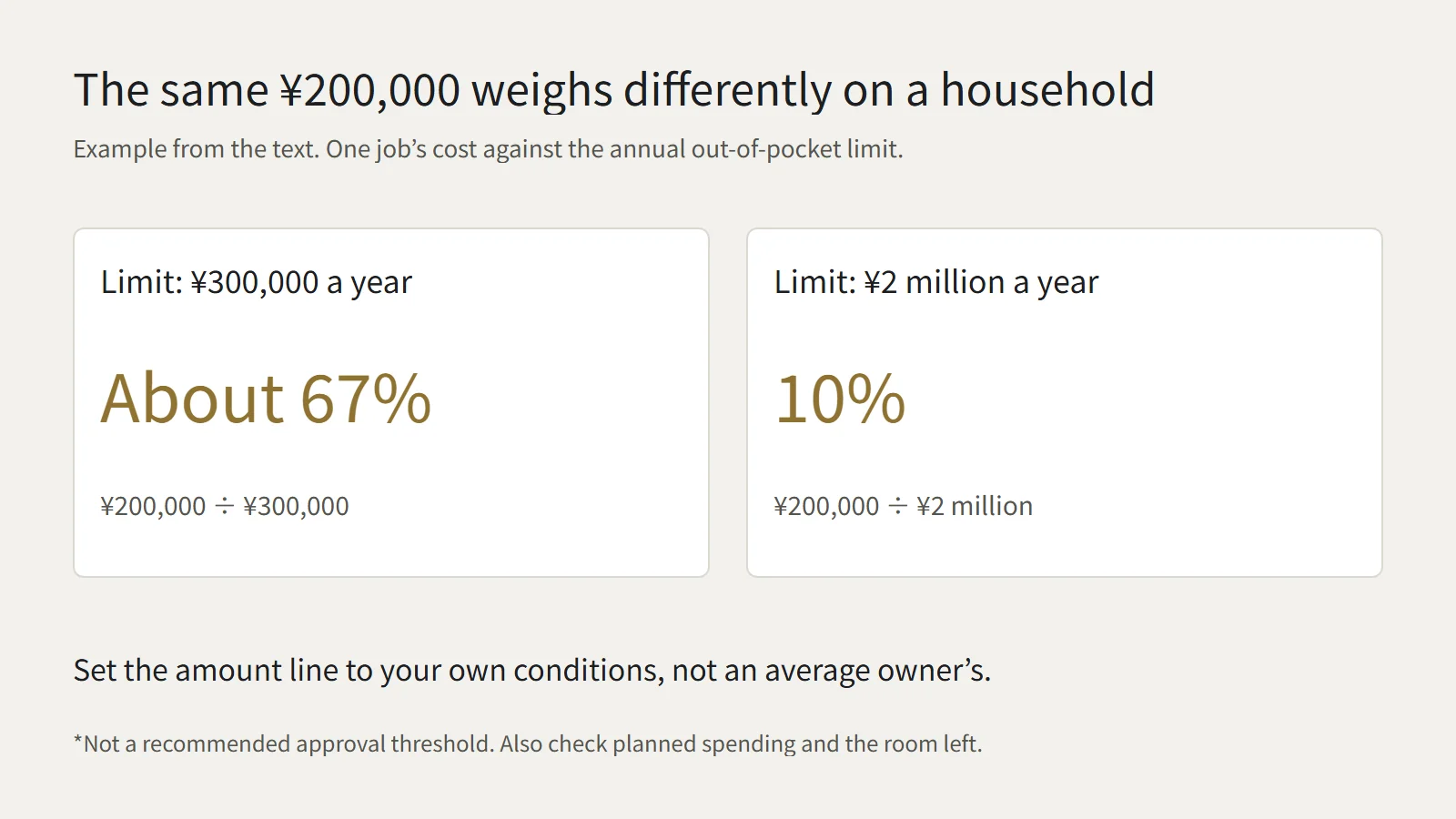
The same amount becomes a decision item for one person and a report item for another. That is why you have no choice but to set the line yourself.
Once, from the opposite side
Then should everything require prior approval?
No.
One of the values of management is speed. When a rental application comes in, when equipment breaks, whether they can act on the spot changes the outcome. If you put approval in front of everything, things move that much more slowly.
A property that takes 3 days to reply after an application comes in has a harder time getting tenants. A room where the water heater broke and stayed broken for 2 days is remembered at renewal time.
In other words, there is a trade-off here. Take speed, or take the decision.
If you decide everything yourself, the judgment is yours, but it is slower. If you leave everything to them, it is fast, but your own conditions are not reflected.
Not leaning to either side, but drawing a line and dividing. That is how to use the form called outsourcing, I think.
Not having drawn a line is not "leaving it to them." It just means you are putting off the job of drawing the line.
When you ask someone to clean your house, you hand over a spare key.
What you handed over is the right to enter. You also handed over the right to clean.
Then, did you hand over the right to throw away the old chair that was in the storage room?
You did not. But you did not say so, either.
The person asked is unsure. Throw it out because it's in the way, or leave it because throwing it out without asking would be wrong. Whichever they choose, it cannot be called a mistake.
Coming home and being troubled can happen either way.
You handed over the key, but not how far they may go. Most outsourcing starts from this state.