
Why is a broker's valuation so different from a dealer's buyout price?
A broker said it would likely sell for ¥12 million through brokerage, while a dealer offered ¥3 million to buy it outright. This gap is the difference between the price an individual buyer pays and the price a dealer pays to acquire stock. This piece sorts out what differs between brokerage and buyout, including commissions and the scope of liability.
BENERU writes for readers who live in Japan. Taxes, loans and the other rules described here are those of Japan, and they assume a resident of Japan.
This page is a translation of the Japanese original. If the two differ, the Japanese original prevails.
I answered a question like this on a Q&A site.
I am thinking of selling a property. A dealer estimated it could sell for about ¥12 million, but a real estate company said it would buy it for ¥3 million. Can there really be this big a difference?
I don't know what you are selling or where, so I can't say anything for certain, but if the question is whether purchase prices and handling prices can differ between dealers, then yes, that is how it is.
The 2 numbers are saying different things
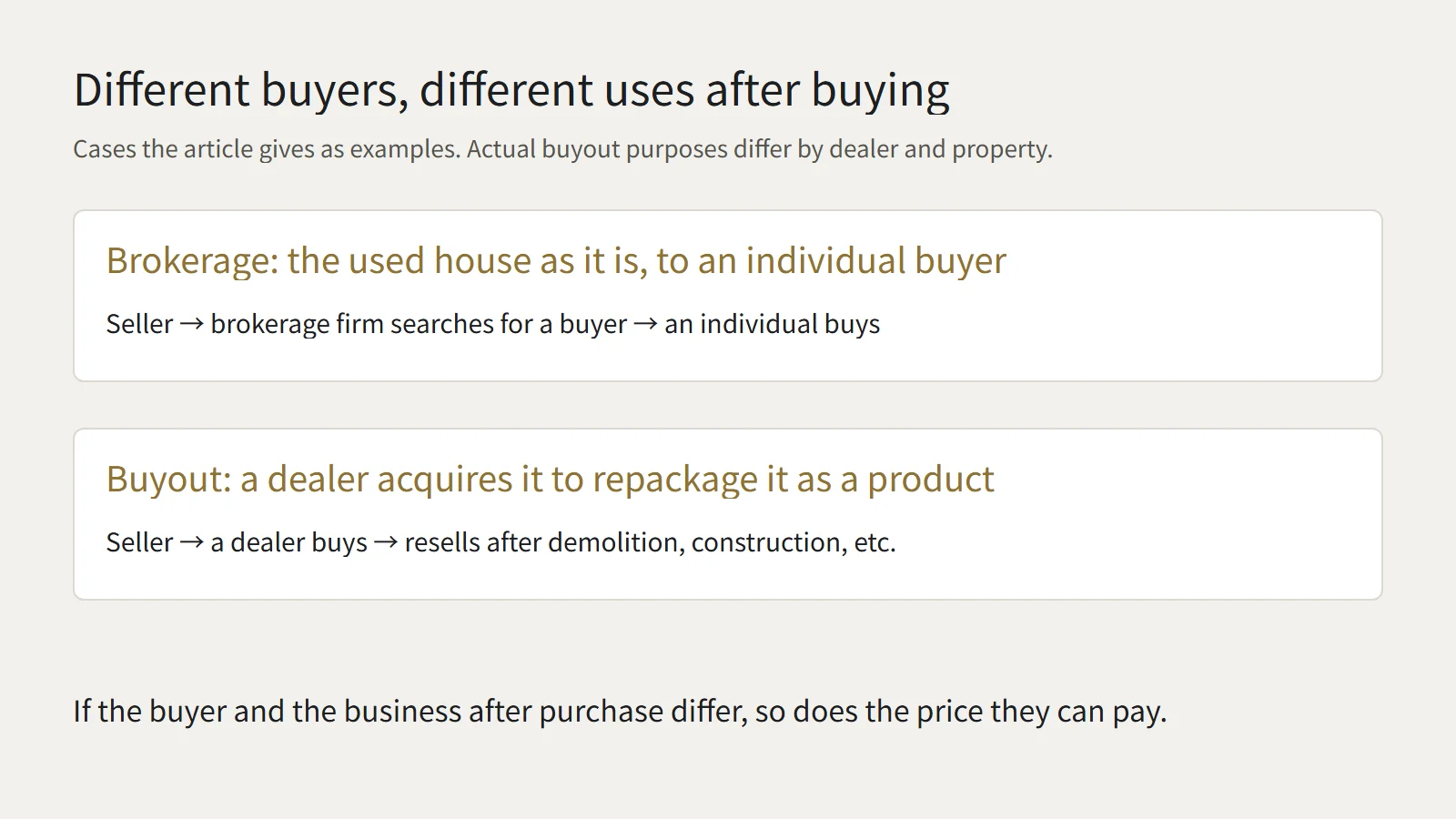
For example, if the first one, who estimated it could sell for about ¥12 million, is a "brokerage firm," and the one saying they will buy it for ¥3 million is a "land acquisition dealer" (a dealer that acquires land and turns it into ready-built houses and the like), the logic is simple.
What the brokerage firm is saying is just that if the current used detached house is put out through brokerage to individual buyers, comparing with the area, a deal through brokerage at about ¥12 million might be expected.
And the latter is just saying that if they demolish the building and sell a ready-built house, they could buy it if they take the land at ¥3 million.
If the question is what this price difference is, it is the difference between the price an end buyer (an individual buyer) pays and the price at which a dealer takes it over.
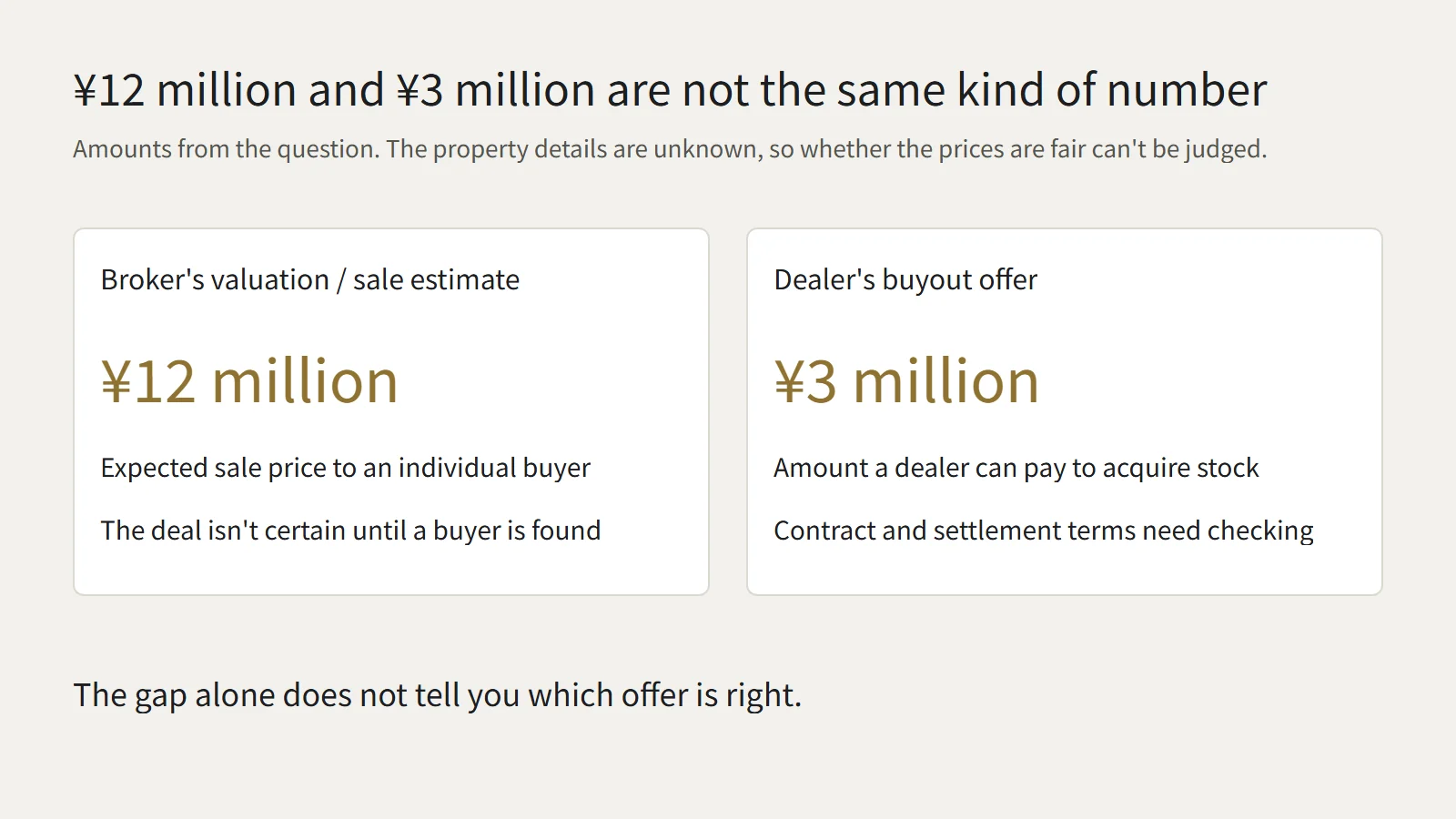
That used property is probably in a market where it would fetch about ¥12 million at an end-buyer price. Isn't it an area where new houses go for about ¥26 million to ¥32 million? So, looking at the land alone, about ¥3 million is probably the market price for land acquisition.
Higher is not necessarily better
The answer is that the price differs depending on whether an individual buys or a dealer buys. Then you would think the former is better, right?
However, with brokerage, the deal does not go through unless an end buyer is found, so the deal is not certain. It is only a matter of possibly selling high if you patiently search for a buyer. Moreover, if it sells through brokerage, a brokerage commission is also incurred. For ¥12 million, the upper limit is ¥462,000.
With the latter, the dealer takes it over, so you can settle right away, and your responsibility as seller (liability for non-conformity with the contract (keiyaku futekigō sekinin)) is often waived by a special clause. However, defects you knew about and kept quiet about are not waived.
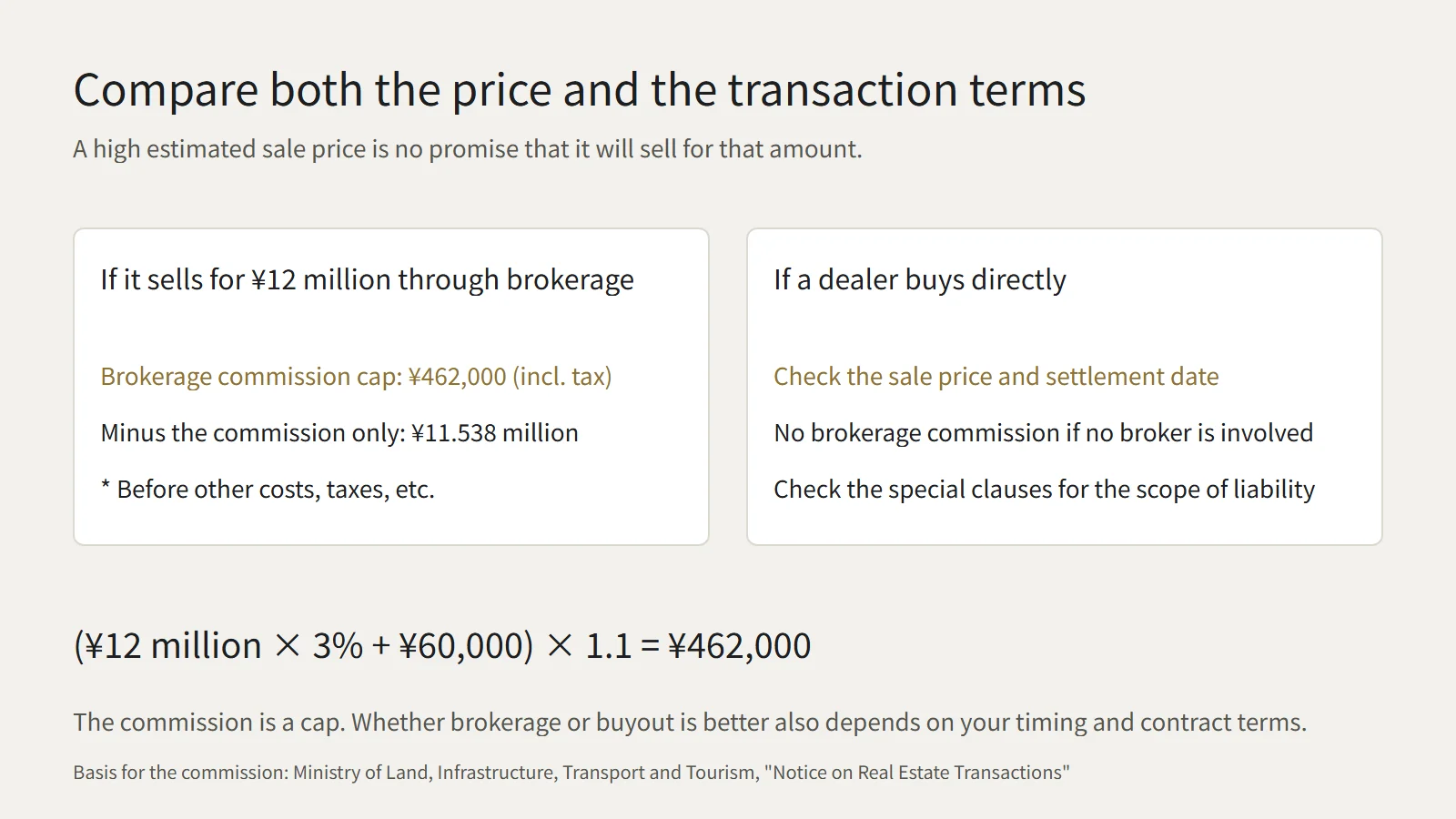
It is not a question of which is better, but of choosing the transaction method that suits you.
I think it would be good to search for something like "brokerage buyout difference." In real estate transactions, a "valuation" does not mean much. It doesn't, but writing too much would be tedious, so I will limit my answer to your question and end here.