
Your first property is your education
If you start real estate investment in your mid-20s, think of your first property as your education. Owning one condominium unit makes cash flow, tax returns, and the PL and BS make sense as your own business. I also write about how to tell firms apart.
BENERU writes for readers who live in Japan. Taxes, loans and the other rules described here are those of Japan, and they assume a resident of Japan.
This page is a translation of the Japanese original. If the two differ, the Japanese original prevails.
On a Q&A site, I answered a question like this.
When a company employee in their mid-20s starts real estate investment, what method do you recommend? Please tell me about used studio condominiums, city center or suburbs, recommended real estate firms, banks to get financing from, and so on.
I'll answer as a professional.
If you are thinking about something similar, please use this for reference.
Annual income, assets, monthly disposable income, and annual investment funds are all unknown, so I can't give guidance. I understand wanting information easily, but a casual approach only gets casual answers back.
That would be boring, so I'll write down some things that might be useful.
Since you used the words "used studio condominium," I take it that, as a product category, you want to think about used condominium units. It's a genre that many people choose among those considering investment, so it's not strange.
As of 2024, many lenders will work with package loans at interest rates of around 1.6%, and with full-loan proper loans at about 2%.
As for properties, yields in Tokyo are around 4% to 5%. The current market is: low 4% range in the city center, high 4% range within the 23 wards, and maybe reaching 5% out toward the edges. Something at 6% or higher, you won't find unless you search even in Adachi, Katsushika, Edogawa, or Nerima wards.
Can you understand what I've written so far?
If you understood all of it smoothly, you're fine. Keep gathering information as you are and buy one you like.
Those who didn't understand. I think there are many. It's fine. That's not the problem.
Why do it, and why a used condominium unit
Study what I write from here, in order.
"Why are you doing real estate investment?"
Please think about this question.
Those who say it's obviously for profit. Is that really so? You won't make much. Not with condominium units.
"Why a used condominium unit?"
Think about this one too.
Those who thought it's because new studios are a scam. You're being carried along by rumors out there quite a bit. New and used each have their own product characteristics. There is no single answer that it's one or the other.
Those who think investing in a whole apartment building is better.
It's not bad. But if you don't already understand what's been written so far as a matter of course, and can't understand what's written from here, I think it's still too early.
All right?
Buy anything
If someone in their mid-20s is considering real estate investment, then with condominium units, "you can buy anything."
At the level where you could roll a pencil to decide, anything is fine.
You can buy any of the new units handled by your run-of-the-mill condo developers, and for used units, whether it's a property on a real estate portal or one a real estate firm recommends, anything is fine.
So just hurry up and buy.
You'd do fine buying a studio condominium within 5 minutes of a station in Tokyo's 23 wards, 25 square meters, no more than 15 years old, regardless of yield.
Start studying after you buy.
Your first property is your education.
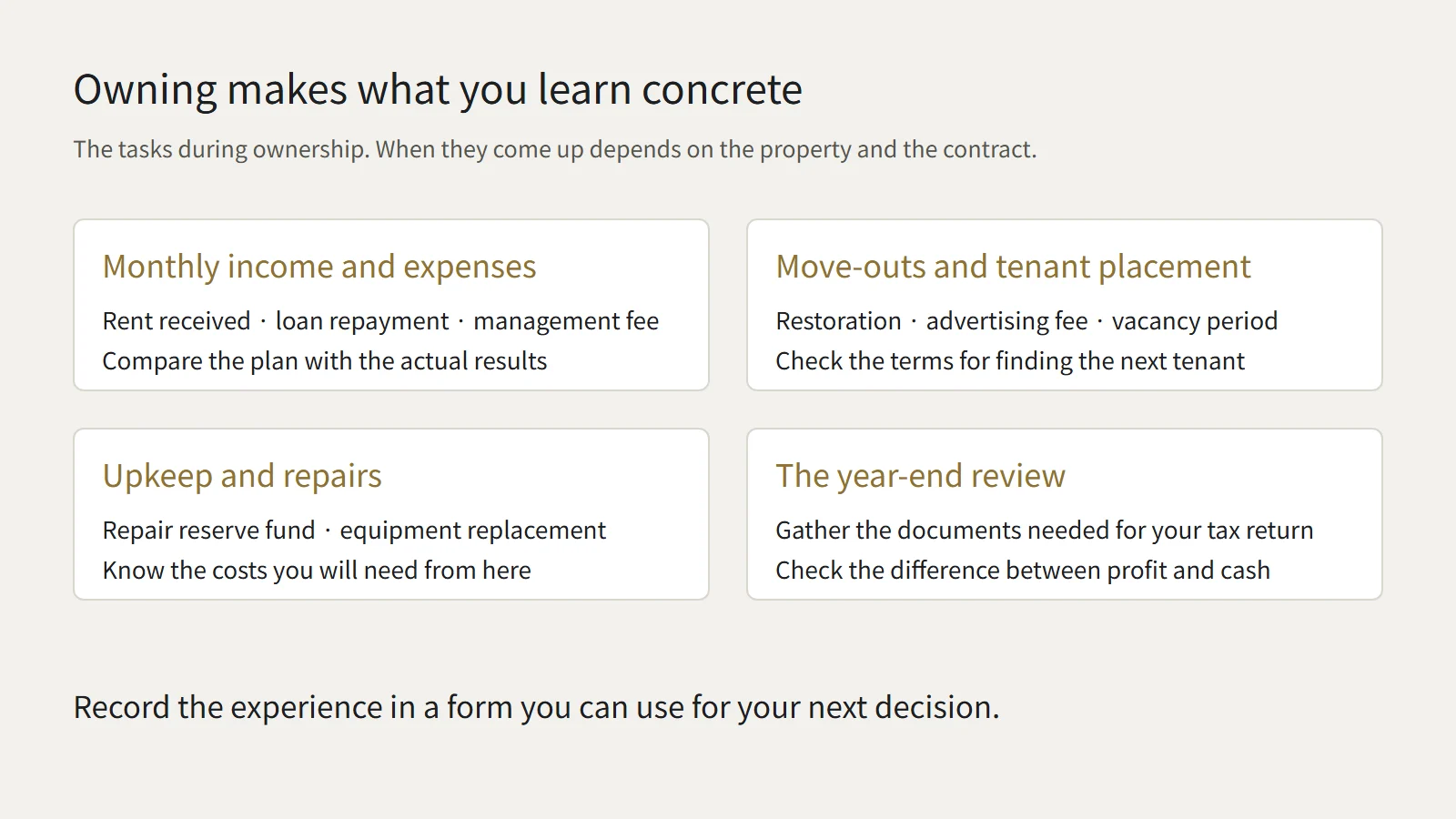
With this one condominium unit, learn the flow of a year as an owner. Experience teaches more than anything. Do it and you'll see. That spending pointless time on your first property meant nothing.
And you'll understand the meaning of the words "hurry up" when it comes to starting.
What you come to understand once you own one
When you own a property, everything changes.
You'll find yourself oddly concerned with the property's income and expenses.
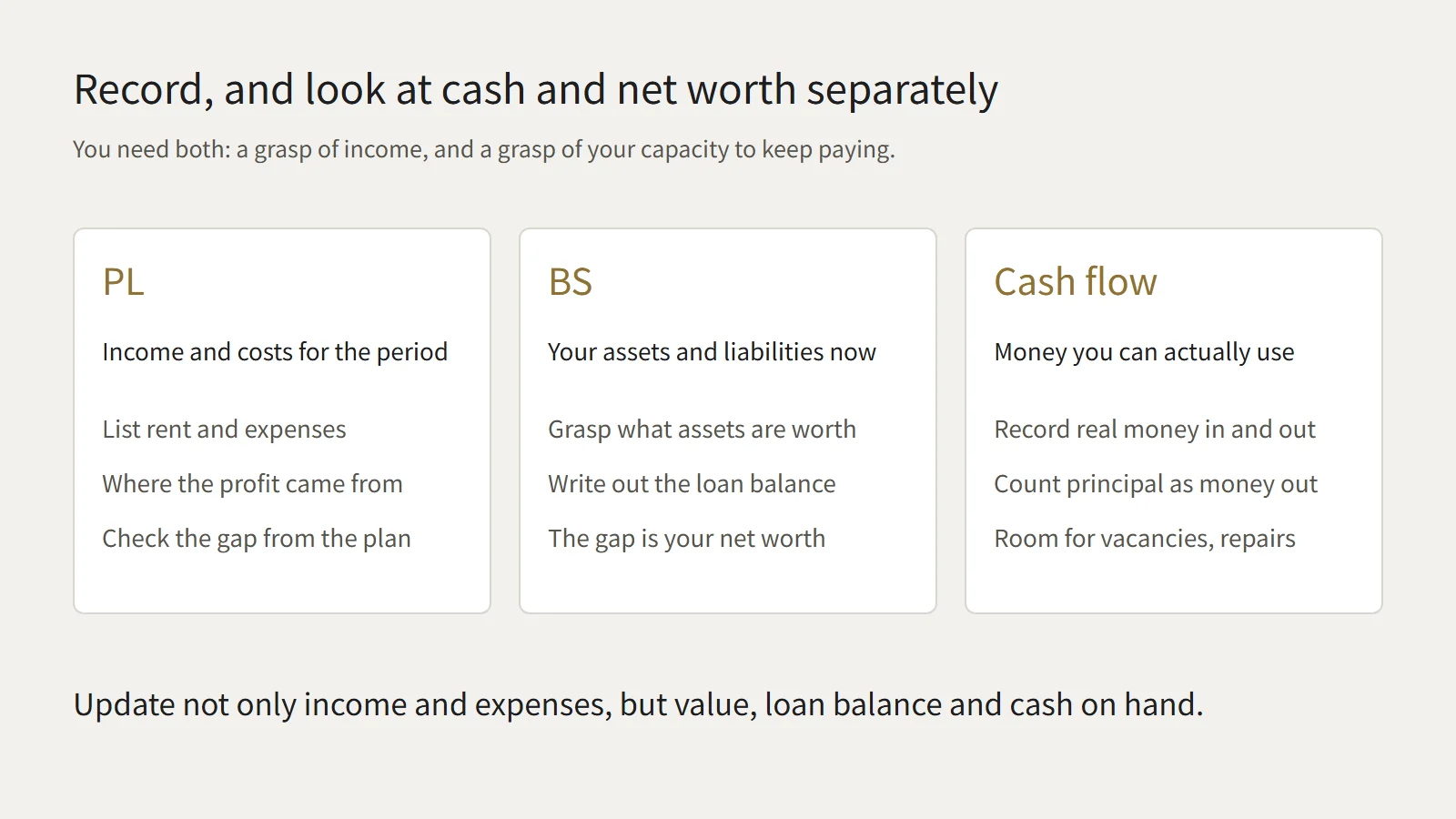
And you'll notice how important it is to write a PL as an individual. You'll start thinking about how much rental income comes in and how much spending goes out.
You'll understand what the management fee and the repair reserve fund are. You'll experience move-ins and move-outs and get used to cleaning. You'll come to understand how tenant placement works and why vacancies are called a risk.
And when a year has passed, you'll be filing a tax return.
Do this yourself. By doing so, you'll understand the idea of income on the books. You'll understand depreciation, understand taxes, and understand offsetting losses against other income.
Investment profit is understood as how much your net worth has grown.
So you'll notice that if you can't write a BS (balance sheet), you can't calculate your own unrealized gains.
Once you can write a BS yourself, you'll understand the cap rate (capitalization rate). Once you understand the capitalization rate, you'll be able to understand both property selection and exit strategy.
Getting used to the PL and BS of your personal assets from your 20s is worth as much as a lifetime of income.
What changes will there be for you, now that you've started thinking about money?
First, waste disappears. When you start managing your assets from a bird's-eye view, you can't help noticing your spending. Just as there's such a thing as a recording diet, people gain an enormous deterrent by keeping records.
When you record your money, you'll start aiming for it to be in the plus. So the will to save up investment funds is born.
Just being able to take on this money training makes your learning in your 20s a score of 100.
Don't think of it as an irreversible purchase; just hurry up and buy. With one condominium unit, even if you fail, it often stays within a range you can turn into learning. It's a different thing from buying your own home with a mortgage. Hurry up and buy, if only to understand this part.
How to tell firms apart
As for whether a firm is good or bad, I can't comment on that. Can't be helped.
But let me tell you how to tell them apart.
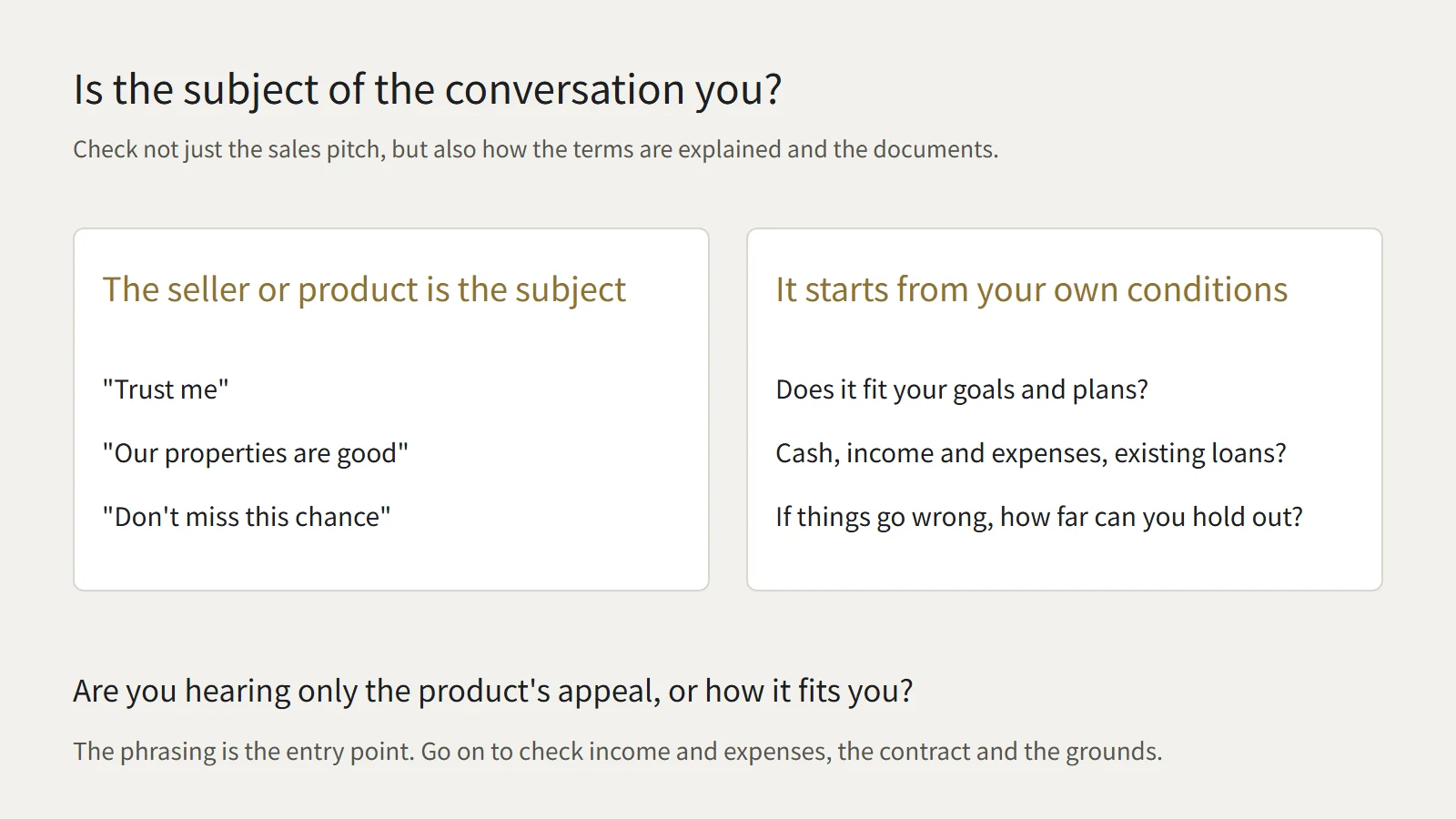
It's good to choose someone who talks with you as the "main character."
Trust "me"! "Our" properties are good! Don't miss "this" chance!
In expressions like these, the main character is never you.
"In XX's case," "going by XX's thinking," "if we consider XX's household situation."
Someone with whom the conversation moves forward with you as the main character is the better kind of consultant or salesperson.
Now and then I see amateurs trying to find and buy a property on their own, but it's better not to. It only raises your odds of getting burned. The ones acting big online are mostly armchair players who've never actually done it.
It's obvious when someone hasn't done it. It's "I can see the market" talk not worth listening to. You can ignore it.
Even on online Q&A, the only people worth reading are those who openly say they are "owners." The rest are at the level of "what is this guy even talking about?", so you can ignore them.
What self-proclaimed investors say is hit or miss too.
It's not that they're wrong, but most of it is opinions that make you go, "well, for you, sure."
Most of them just want to show off how well they're doing. Not much use as a reference.
As an amateur, understand that well and go into your first investment.
What matters in your first investment is not success. You just need to avoid a big failure.
It's even fine to grab a failure. A property with lots of trouble probably teaches you more. Take it on positively. You'll be fine.
You don't need to swallow online opinions whole.
Studios don't make money, apartment buildings are this or that; there are all kinds of opinions, but you can ignore everything that doesn't come with a "why."
They're just vague impressions. I'll say it again: it's just armchair players saying stuff.
The comment section of a certain popular video about real estate investment had around 1700 comments. Of those, only one struck me as probably genuine. The rest were armchair players and amateurs. 1/1700. That's how it is. Did I read them? Yes, I read them. As work.
Full-time landlords and seasoned players probably don't bother posting comments in the first place. They have no need to get involved. I suppose that's how rumors catch fire.
What "doesn't make money" means
Studio condominium investment doesn't make money.
That's right. But I recommend starting there. Even seasoned players working on whole buildings say this.
Listen very carefully to what they say. They're only saying "I wouldn't buy it."
Why? With the literacy and experience they have, they have the strength to take on products with yields that match. To them, having grown into full-fledged investors, low-yield products for beginners hold no appeal anymore.
"They're only saying the profit is low, not that it doesn't make money."
Risk and return come as a pair. You study with something low-yield that doesn't take on risk.
Did you understand everything written here? You didn't, did you? Are you planning to start only once you can understand all of it? Then who knows when you'll be able to start. You learn faster while doing it.
That's why "just hurry up and buy anything."
Any questions?
Supplement (BENERU PRESS editorial team)
The interest rates and yields in the text are figures as of 2024. Interest rates have risen since then.
When you sell, if the remaining loan balance is more than the sale price, you pay the difference yourself. Before you buy, decide how much monthly out-of-pocket cost you can keep up.