
I was told that incorporating is pointless unless we build 1 more apartment building. Is that true?
You do not need to build 1 more apartment building in order to incorporate. If you move individually owned properties to a corporation, depreciation can be taken again. However, taxes are incurred when moving them. Before that, the first thing is to grasp how much the family's assets amount to.

BENERU writes for readers who live in Japan. Taxes, loans and the other rules described here are those of Japan, and they assume a resident of Japan.
This page is a translation of the Japanese original. If the two differ, the Japanese original prevails.
I answered this question on a Q&A site.
My family has built 8 apartment buildings through a construction company. Because depreciation on the 1st building will end in a few years, the construction company's tax accountant (zeirishi) brought up incorporating as a tax measure. At that time, we were told it is necessary to build 1 new apartment building in order to create a loss in the corporation. It is the countryside, where the population is declining, so I am reluctant to add any more. Is it true that it is pointless unless we build a new one?
8 apartment buildings is quite something. From the expression that it has been decided to incorporate, I suppose they are still individually owned now. Does it mean creating an asset management corporation and having that corporation hold 1 building?
Since it says depreciation on the 1st apartment building will end in a few years, I suppose the story is that the depreciation on the individually owned apartment buildings (probably wooden) runs out, so you can no longer produce a negative through offsetting losses against other income, so let's build 1 more building and create a loss.
In that case, I would think it is pointless unless the individual with the income holds it, but perhaps the suggestion was something like: now that you have as many as 8 buildings, why not incorporate with inheritance in view?
What concerns me is the borrowing situation. You own the land and built the buildings on it, so naturally there are loans, right? And for as many as 8 buildings. Total borrowing of about ¥400 million? I don't know the size of the apartment buildings, though.
What does the balance sheet (BS) of the owner—probably your parents?—look like?
How about having an accountant re-evaluate the apartment buildings you own at current prices and examine what state they are in? You are probably large landowners, but don't you have considerable borrowing for construction costs?
It would be better for the family to receive an explanation of what state the family's net worth is in, and of the movements of the PL and BS over the last few years and every year from now on.
Isn't it unclear how much property you yourselves have?
"Family" doesn't tell me. Who is the owner? Does one individual owner hold 8 apartment buildings?
I think the merits of having an asset management corporation also depend on things like the number of people in your family.
How many heirs are there?
Hmm, I would like to give advice, but I can't say anything without hearing clear details. And since it is fairly large in scale and complicated, it is really a matter that should be examined by a specialist.
At the very least, I don't really see the point of incorporating because you are dazzled by executive compensation.
Are you moving ownership of the 8 apartment buildings to an asset management corporation? And then generating rental income in that corporation, putting family members in as officers, and paying executive compensation?
You can have a corporation hold them without building new
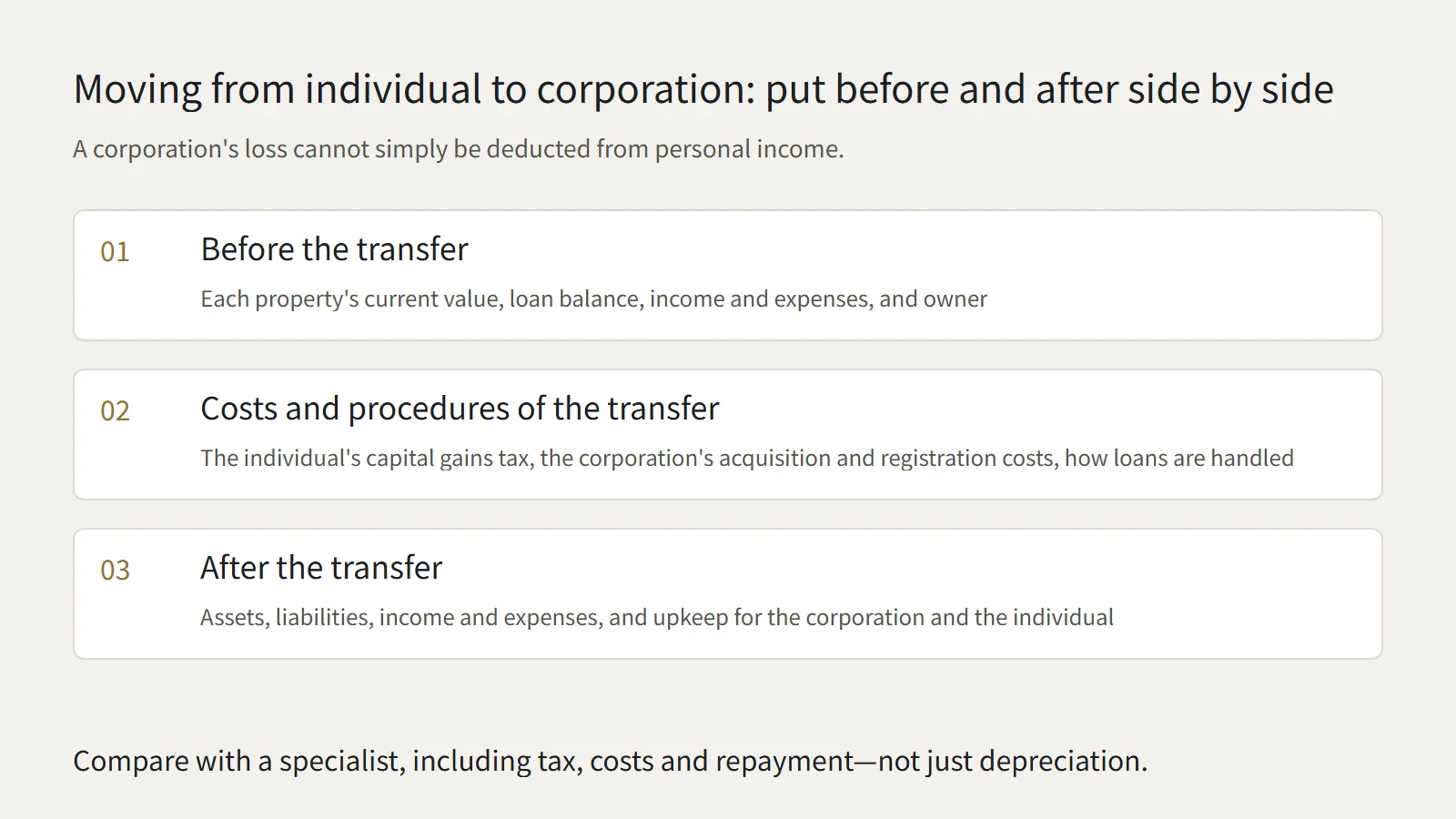
In that case, I would think that even without building 1 new building, the corporation would take out borrowing and buy the properties from the individual. Those apartment buildings have remaining loan balances, don't they? How are you going to have the corporation you create hold the apartment buildings? You would make it an asset management corporation, take out borrowing as joint and several co-obligors, and move the individually owned apartment buildings over, right?
Then if you take depreciation again from there, you can create a short-term loss within the corporation, so there's no problem, is there? There is no need to increase the number of apartment buildings.
However, if you move properties from an individual to a corporation, the individual is taxed on capital gains (transfer income), and the corporation incurs real estate acquisition tax and registration and license tax. If you sell to the corporation for less than half of market value, it is treated as having been sold at market value. A trial calculation of this before moving them is essential.
Any way I put it seems likely to be rude, so I am choosing my words quite carefully, but building apartment buildings as an inheritance tax measure seems to have been rather mistaken from the start, so I think it would be best to do whatever leaves you convinced.
The answer: it is not true
First, I would like you to sort out what you want to ask.
Next, I would like you to decide what you want to become.
"My family has built 8 apartment buildings through a construction company. It has been decided to incorporate, but is it true that it is pointless unless we build 1 new building at that time?"
If I answer this, it is not true.
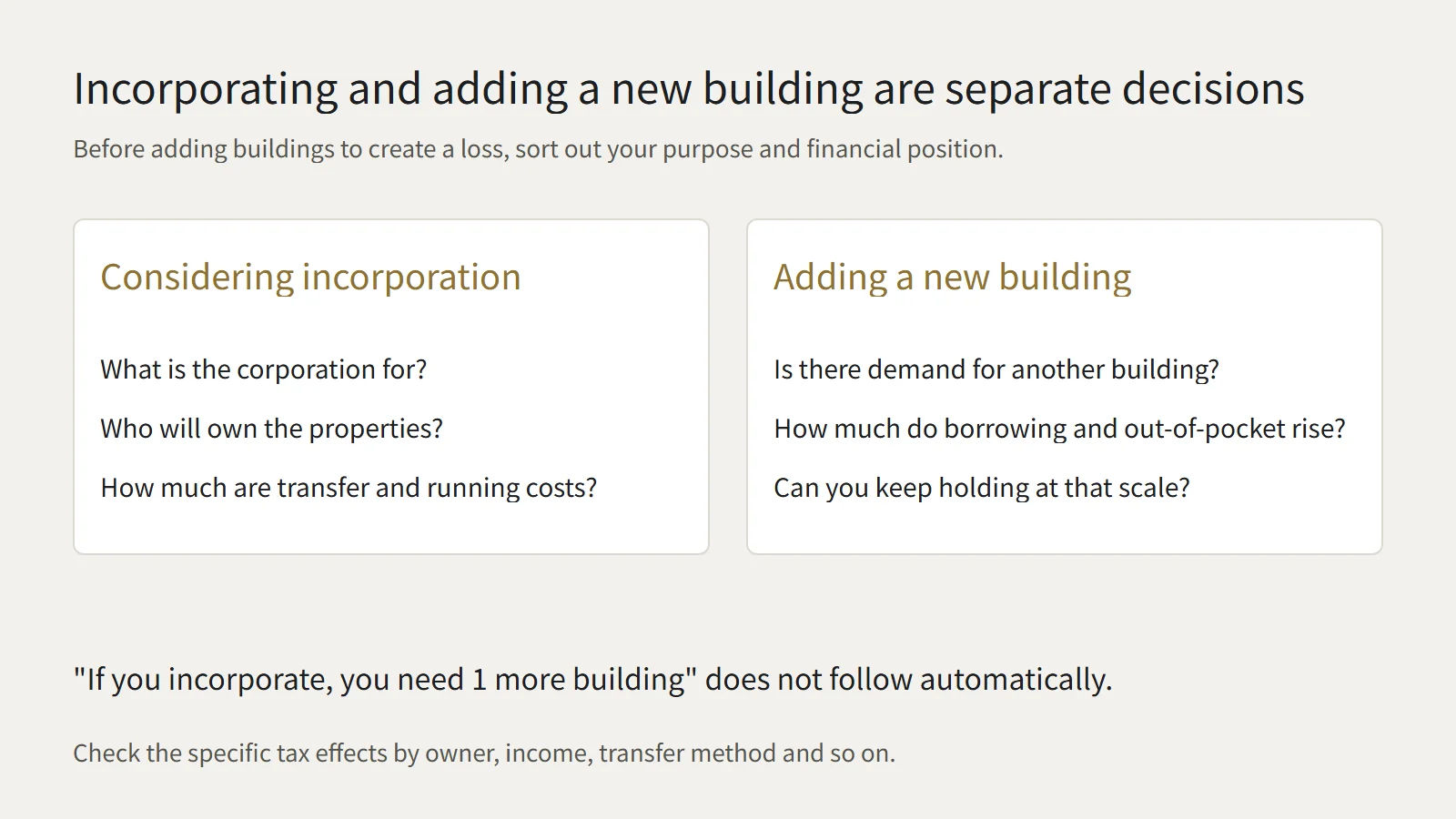
I don't know what "true" means here, but an incorporation that is pointless unless it produces a negative—isn't incorporation itself pointless to begin with?
Is it something like 8 buildings with 8 units per building? Rent of about ¥300,000 per building? That makes ¥2.4 million/month, and ¥28.8 million a year—that's quite a lot.
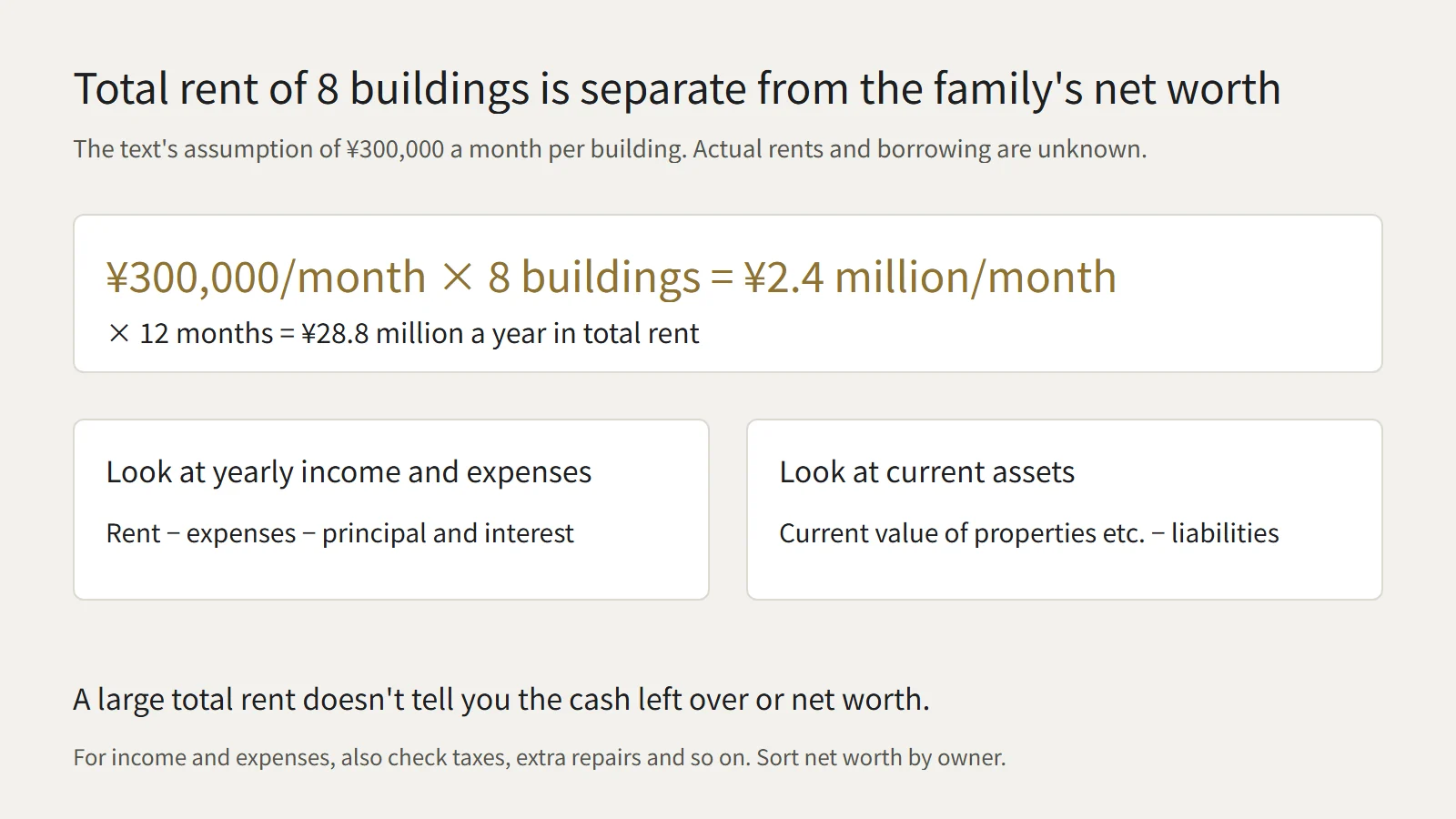
Yes. After all, my advice is to have an accountant who understands real estate teach you about your own financial situation.
If you don't understand that part, thinking only about tax measures won't do, and being told that executive compensation is advantageous won't do either.
Because "you yourselves don't understand what on earth is advantageous."
It seems you have been doing something you don't really understand all along, but I think it is about time the family understood it.
Ah, you went and built as many as 8 apartment buildings in the countryside without thinking ahead—you're getting a little scared, aren't you?
I have a feeling that sense is right.
Grasp your own assets
If you want to try evaluating them yourselves, gather the following information.
The rent of each of the 8 buildings
The remaining loan balance
The cap rate where the properties are located—that is, the capitalization rate. You can get a rough idea by looking at the yields of nearby apartment buildings for sale on real estate portal sites.
In a place where apartment buildings don't get a valuation, it is quite something to think about. It would be a bit scary if the apartment buildings had little value and only the liabilities were clearly several hundred million yen.
Evaluate the 8 apartment buildings you own from this kind of information and understand the balance sheet yourselves. You will have to study anyway in your generation, so learn it now.
And if it turns out that net worth is surprisingly small, that is something to think about.
My advice is: "Grasp your own assets properly."
Then you will be able to compare before and after the change, right? And with that you can be convinced. If you can't understand everything written here smoothly, then first of all, have someone teach you how to understand your own assets.