
How much investment financing can you get while still carrying a home loan?
Even with a remaining home loan balance of ¥76 million, there is room to obtain investment financing. This piece looks at an example with an annual income of ¥9.1 million through 2 lenses, the income multiple and the debt-to-income ratio. The main text is an answer as of 2025, with a supplementary estimate using different interest rates.

BENERU writes for readers who live in Japan. Taxes, loans and the other rules described here are those of Japan, and they assume a resident of Japan.
This page is a translation of the Japanese original. If the two differ, the Japanese original prevails.
I answered a question like this on a Q&A site.
I am interested in real estate investment. Is there any chance I could get financing? I work at a listed company with an annual income of ¥9.1 million. I bought a home in Tokyo 10 months ago, and the remaining home loan balance is about ¥76 million. I have no other borrowing. I have about ¥25 million in stock assets.
Yes, there is. Not just whether it is possible, I will also show you how much room there is. I am writing about the situation as of 2025.
Looking at the income multiple
Under the terms of what are called package loans, which are loans tied up with real estate companies, lenders may look at an income multiple of around 8 to 14 times. This range exists because it differs by the lender providing the financing.
At 14 times, total borrowing could be viewed up to ¥130 million, which means there is room for financing.
Looking at the debt-to-income ratio
Next, what a bank considers when providing financing is the debt-to-income ratio, which looks at what share of total income the monthly loan payments take up.
I don't know your monthly home loan payment, but on a 35-year loan it is probably about ¥180,000 a month. Annual loan payments of ¥2.16 million come to 23% of your annual income. With a lender that will finance up to a debt-to-income ratio of 35%, it would allow loan payments of up to ¥1.09 million a year remaining.
The formula is 35% - 23% = 12%, and ¥9.1 million × 12% = ¥1.09 million.
From this, you could take out a loan with monthly payments of about ¥90,000, and considering it together with total borrowing credit, you could probably buy a studio (1R) condominium of up to about ¥35 million. If you can borrow this much, you could buy one in more or less any location.
For an apartment building
If you consider an apartment building, the standard this time is individual credit assessment under what is called a proper loan.
In this case, the evaluation of your financial situation differs depending on the value of the properties you own, so you would have to ask each bank to know, but the thinking on income multiple, total borrowing, and debt-to-income ratio does not change, so there may be room for financing up to about ¥50 million. Your funds on hand are a little thin, so putting in the interim payment for an apartment building might make things tight.
Still, whether a condominium unit or an apartment building, it looks like you can consider it.
Your age, health, and personal credit information are unknown, so I cannot say anything for certain, but you can probably think of it as likely fine. Please go ahead and consider it.
Supplement: recalculating with different interest rates (BENERU PRESS editorial team)
The main text is an answer as of 2025 and assumes the low interest rates of that time. Keeping the same way of thinking, we recalculated by changing only the interest rate. All figures are assumptions.
We use the main text's guidelines of an income multiple of 14 times and a debt-to-income ratio of 35% as they are. Neither is a standard common to all lenders.
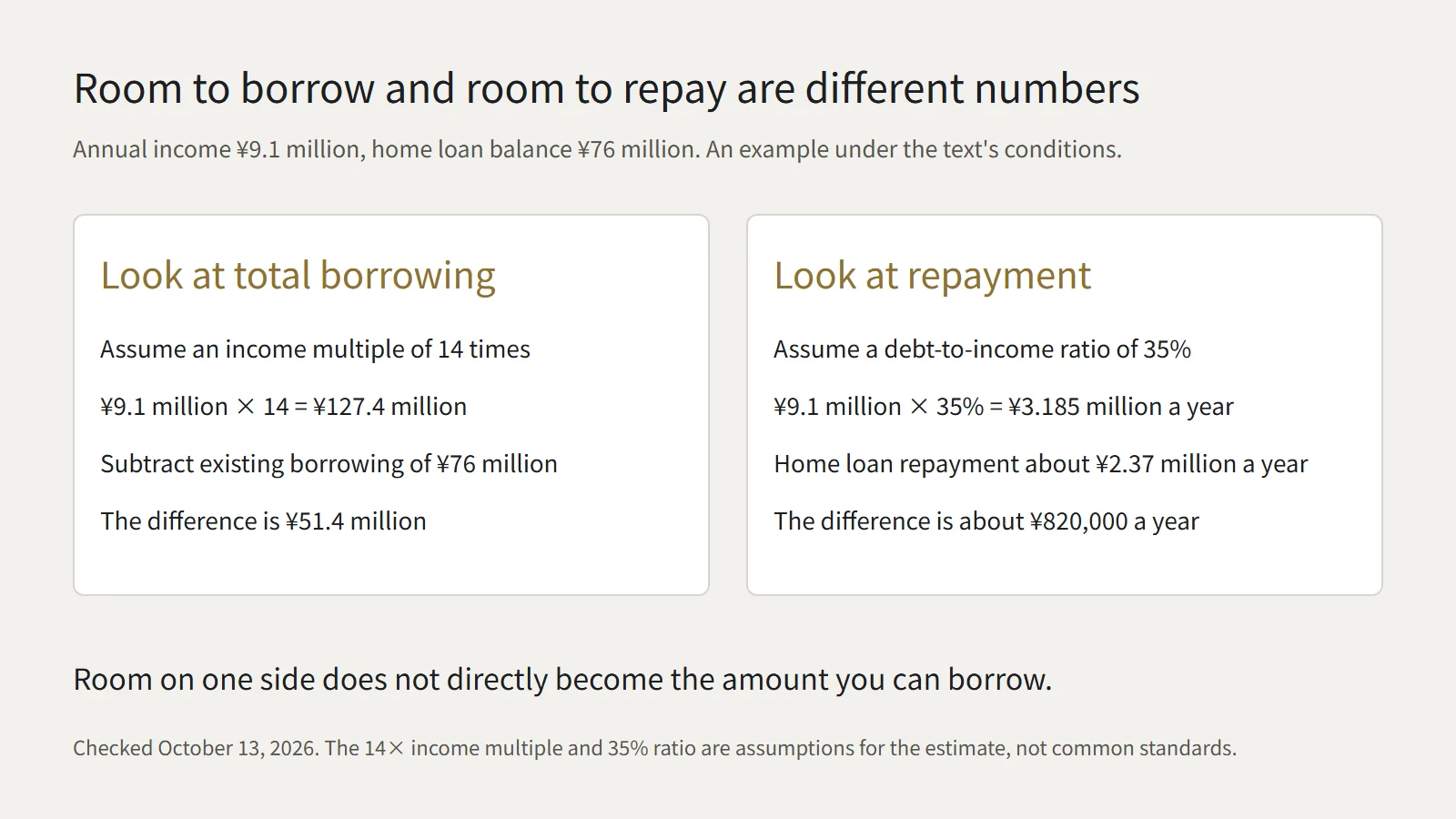
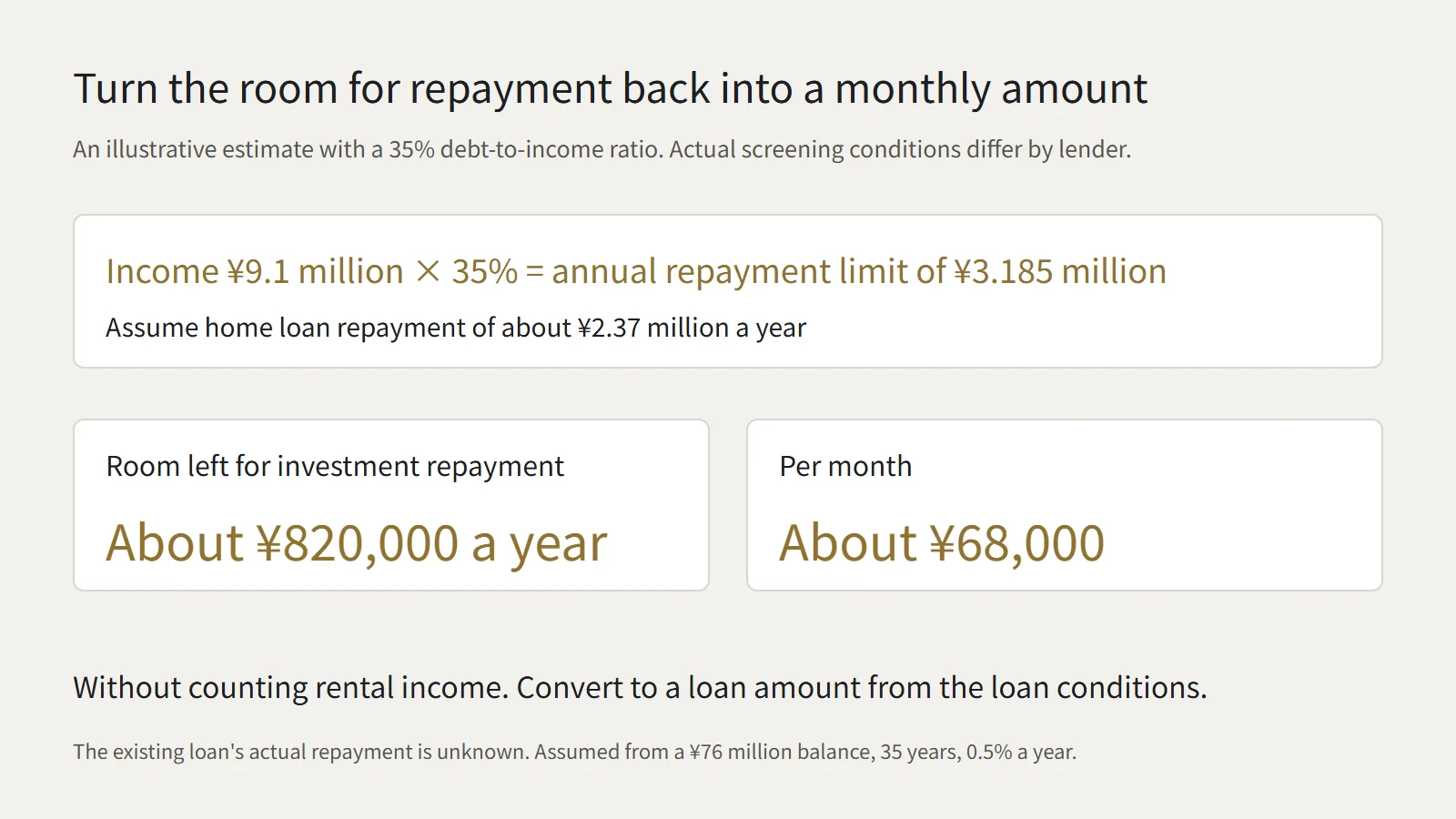
Assume the home loan repays the remaining balance of ¥76 million over 35 years at an interest rate of 0.5%. Repayment is about ¥197,000 a month, about ¥2.37 million a year, which is about 26% of the annual income of ¥9.1 million. Up to a debt-to-income ratio of 35%, the room left for investment is about ¥820,000 a year, about ¥68,000 a month.
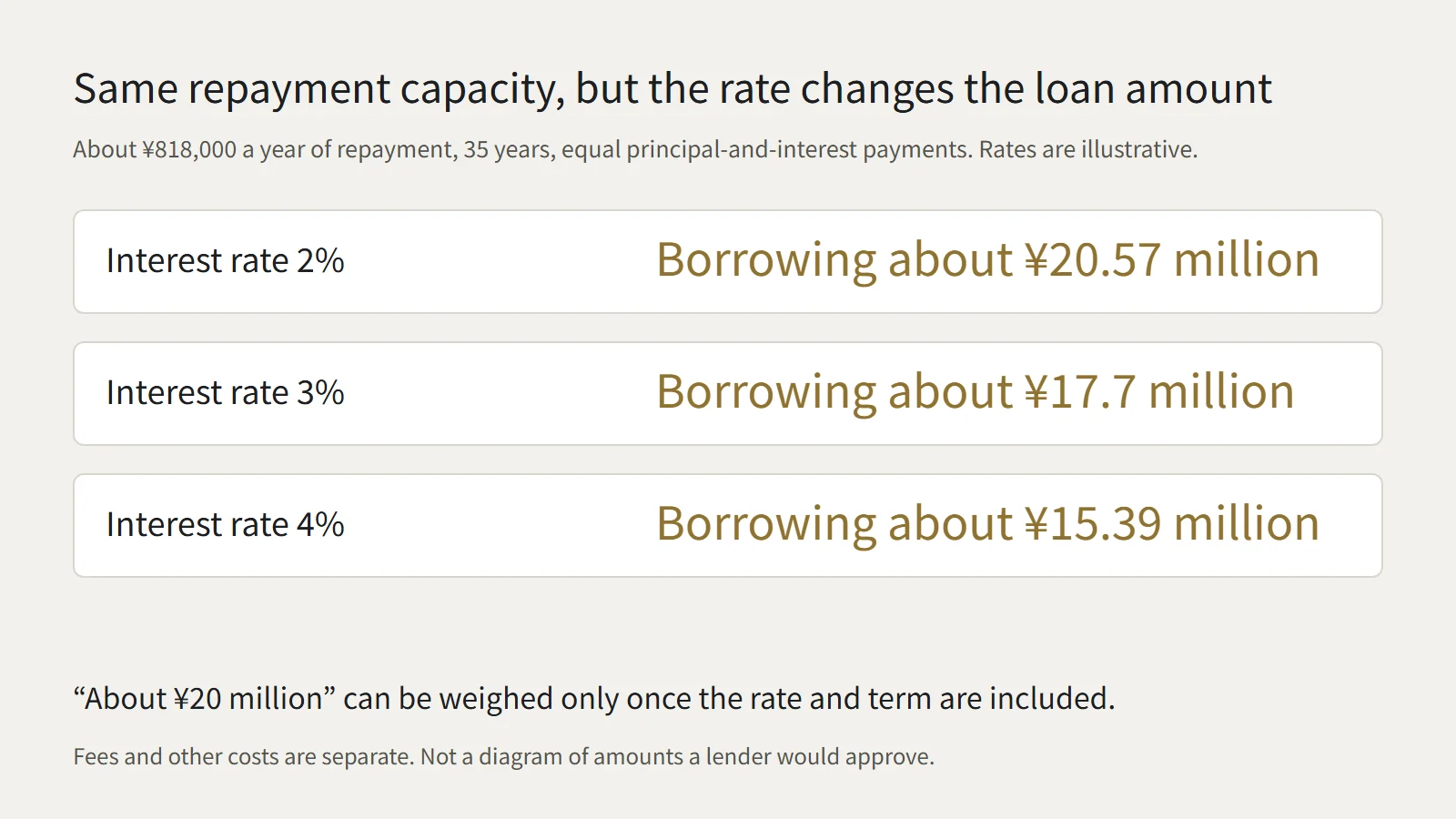
The amount you can borrow within this limit, with 35-year repayment, is about ¥20.57 million at 2% interest, about ¥17.7 million at 3%, and about ¥15.39 million at 4%. The higher the interest rate, the smaller the amount you can borrow for the same repayment.
These are figures without counting rental income. With lenders that factor rental income into the debt-to-income ratio, the limit widens beyond this. When you actually consider it, please plug in the amounts from your own repayment schedule and the interest rate and term of the loan you will take out.