
Prices are not moved by population
We sort out why real estate prices don't fall even though the population is shrinking, by separating it into the number of households and the 2 variables that set prices. Rental demand and investment demand are separate things, and they work in different directions and at different times.
BENERU writes for readers who live in Japan. Taxes, loans and the other rules described here are those of Japan, and they assume a resident of Japan.
This page is a translation of the Japanese original. If the two differ, the Japanese original prevails.
Good day. I'm Nel Shikina.
There is a question that comes often.
Why don't real estate prices fall even though the population is shrinking?
It is a reasonable doubt. But this question contains 2 premises, and both are slightly off.
This time, I will separate them.
The population is shrinking, but households are growing
The first.
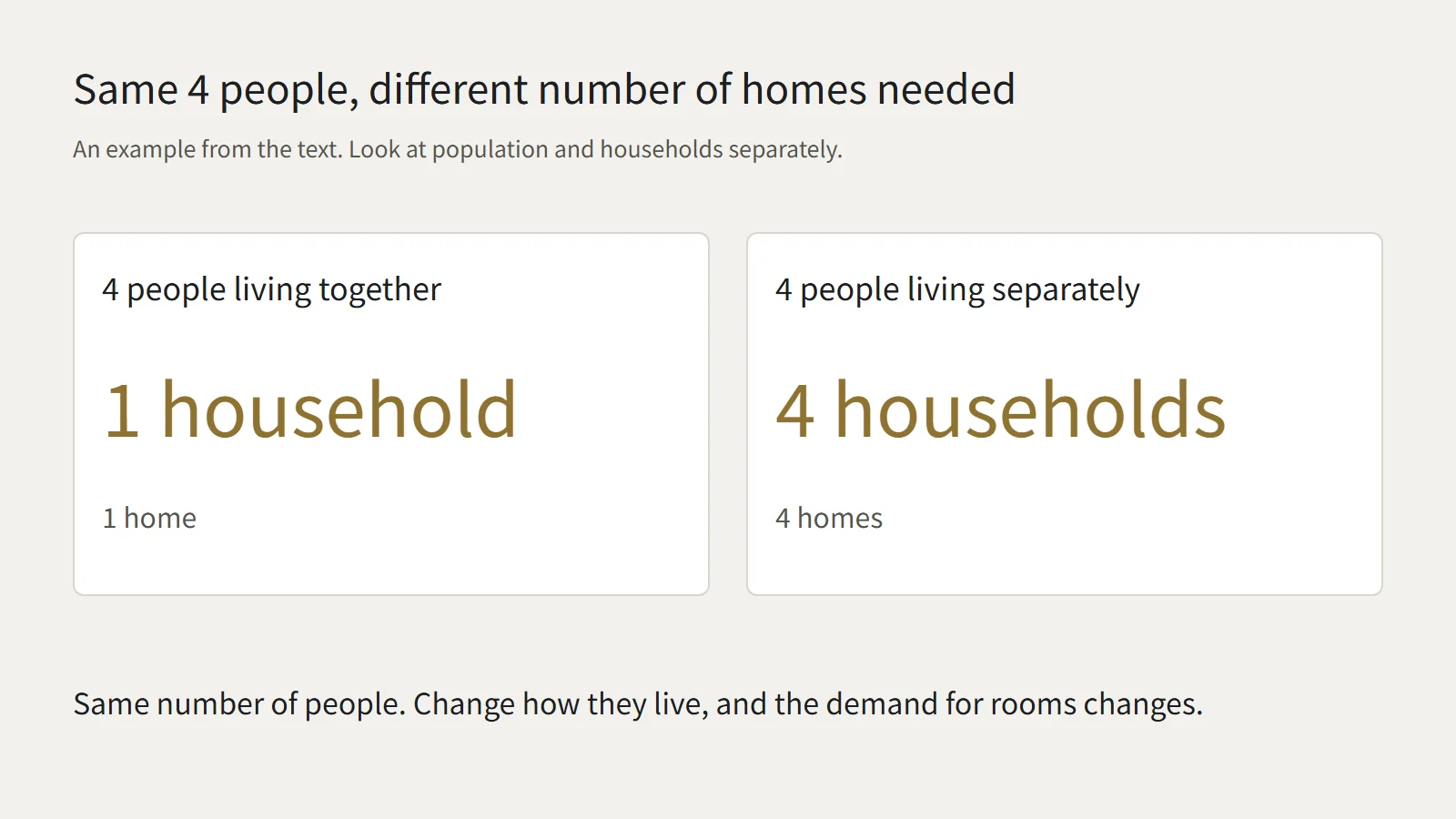
It is not people who rent rooms, but households. A family of four is one household and rents one place. If those four live separately, the number of people stays the same but it becomes four places.
In the National Institute of Population and Social Security Research's 2024 projection, the total number of private households nationwide moves like this.
| Year | Total households |
|---|---|
| 2020 | 55.70 million households |
| 2025 | 57.27 million households |
| 2030 | 57.73 million households (peak) |
| 2040 | 56.08 million households |
| 2050 | 52.61 million households |
The population peak passed long ago. Even so, the number of households is expected to grow by about 2.03 million between 2020 and 2030, and the peak is still ahead. Because single-person households are increasing.
In other words, fewer people and fewer renters are not happening at the same time.
After 2030, the number of households will also fall. In 2050, it is down about 8.9% compared with 2030. That will matter. Though it is further ahead.
There are 2 variables that set the price
The second is bigger.
The price of income-producing real estate is set roughly like this.
Price = annual net income ÷ the yield the market requires
Both the numerator and the denominator move. The population story only affects the numerator.
Let us look at a property with net income of ¥3 million.
| Yield the market requires | Price |
|---|---|
| 4% | ¥75 million |
| 5% | ¥60 million |
| 6% | ¥50 million |
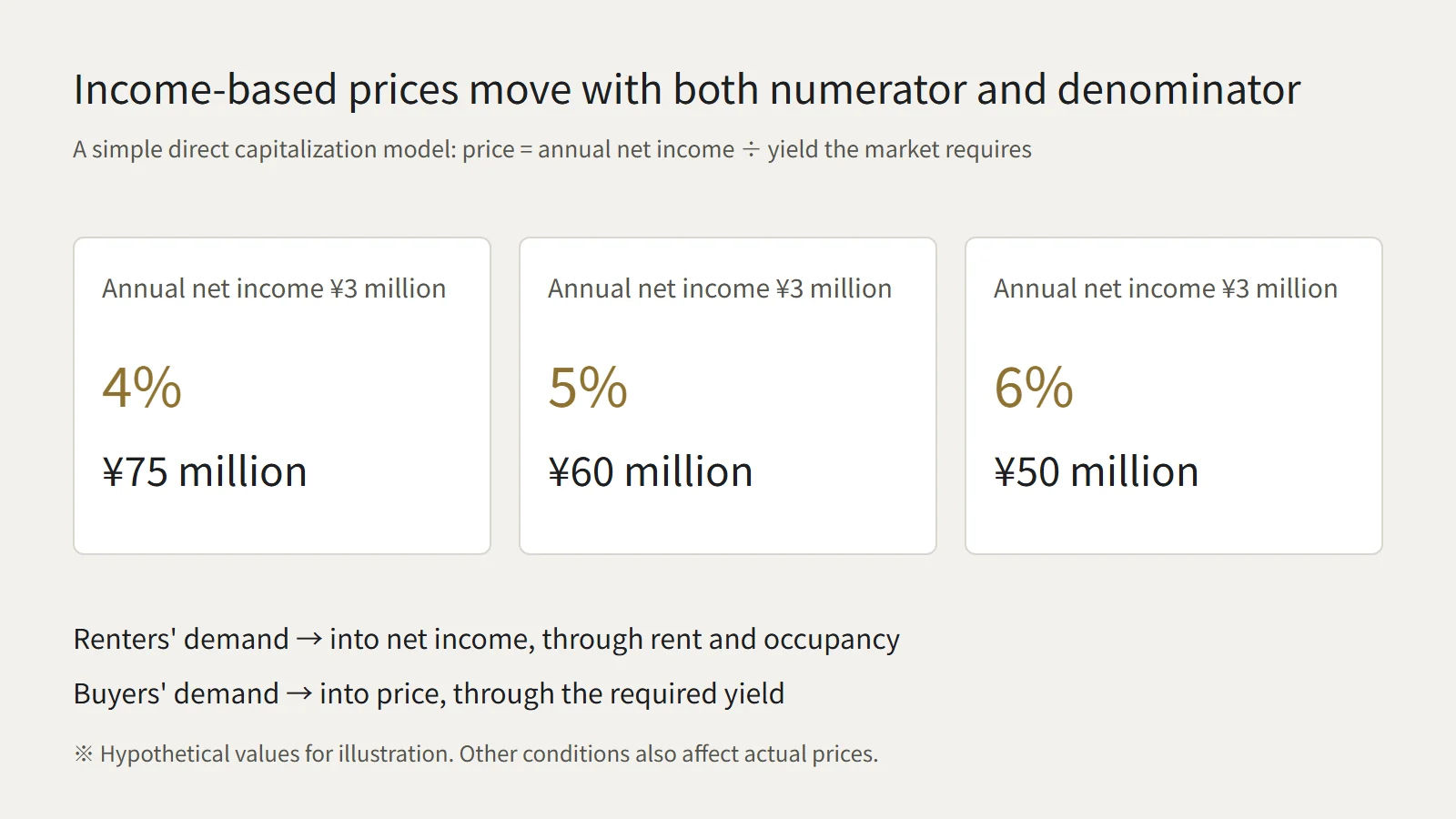
Same property, same rent. Just 1 percentage point of difference in the denominator moves the price by 17% to 25%.
Then what if rent falls and net income drops by 10%? Net income is ¥2.7 million.
- Denominator stays at 5% → ¥54 million (down 10%)
- Denominator falls to 4% → ¥67.5 million (up 12.5%)
Rent fell, yet the price rose.
That is what "prices don't fall even though the population shrinks" really is. Nothing strange is happening. It is just that only one of the variables was being looked at.
Let me split a word here.
The single word demand points to 2 separate things. Demand from people who rent, and demand from people who buy.
The former works on the numerator through rent. The latter works on the denominator through the required yield. And what moves the latter is not population, but mainly interest rates and the amount of money looking for somewhere to go.
You think you are talking about population, but the investors are left out. That is why it doesn't line up, I think.
The actual numbers can't be explained by one side
Let us look at the Ministry of Land, Infrastructure, Transport and Tourism's real estate price index. These figures set the 2010 average at 100 (seasonally adjusted), as of December 2025.
| Index | vs. 2010 | |
|---|---|---|
| Condominiums (sectional ownership) | 225.1 | +125.1% |
| Detached houses | 121.9 | +21.9% |
| Residential land | 119.8 | +19.8% |
The same country, under the same population decline.
If you explain it by population, all 3 should move the same way. They don't. Only condominiums are 2.25 times, and land is 1.2 times. The gap is 1.88 times.
What happened to condominiums and not to land in general was rising construction costs, concentration in the city center, and the buyers' money. All of these move for reasons separate from population.
Lumping everything together as "real estate prices" is the same type of error, I think.
Going up takes one side; going down takes both
Let me look at it from the opposite side once.
Then is it enough to look only at the denominator?
That doesn't work either. The denominator comes back if interest rates rise. The problem is that when it comes back, the numerator is not necessarily where it was.
Let us use the numbers from earlier. Suppose net income drops 10% to ¥2.7 million, and on top of that the denominator returns to 6%.
¥45 million. A 25% fall from the original ¥60 million.
The numerator alone is 10%, the denominator alone 17%. Together they make 25%.
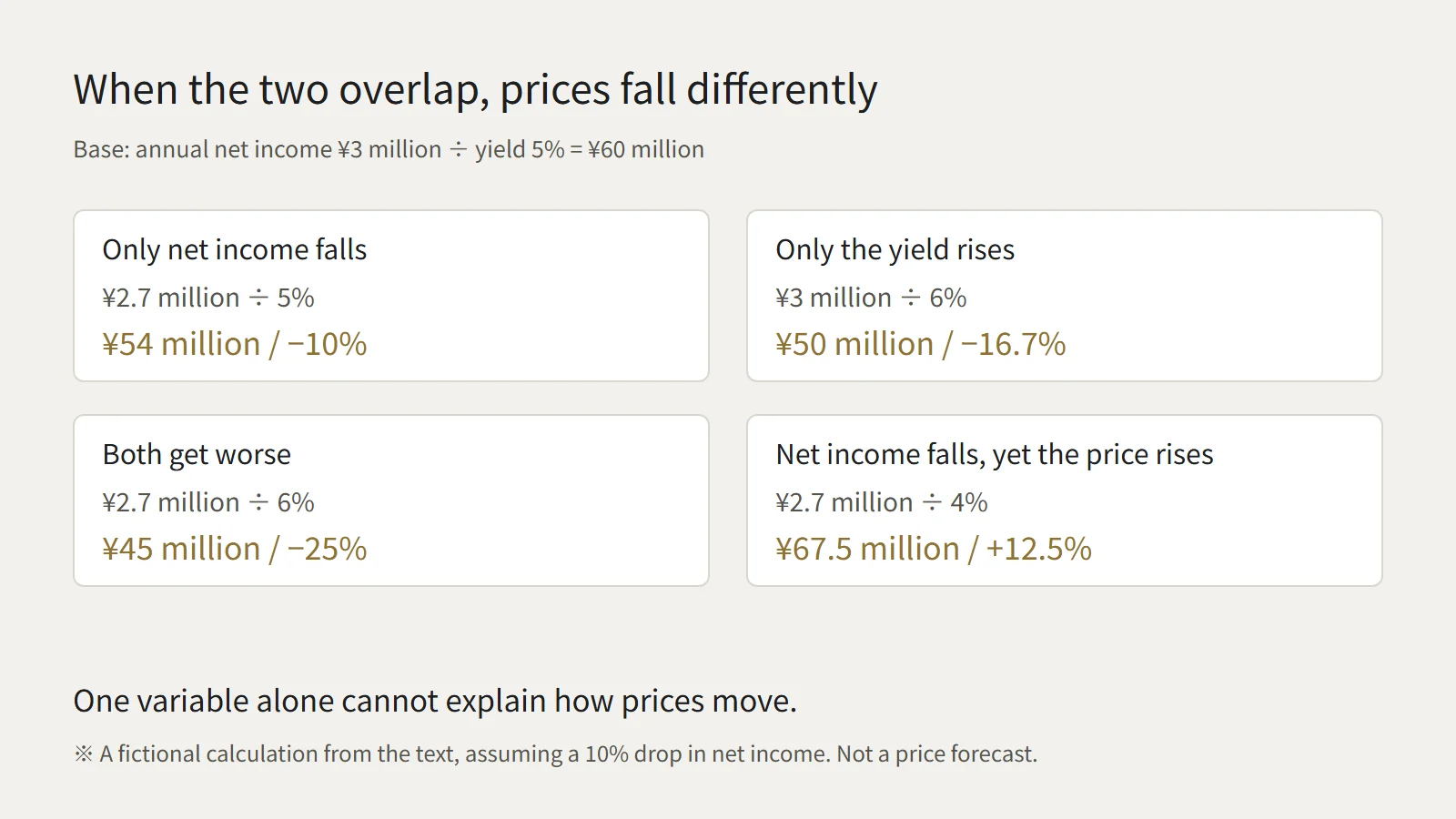
When prices go up, it is enough for one side to move. When they go down, both usually come at around the same time. Because a phase of rising vacancies, a phase of rising interest rates, and a phase of investors pulling back are not separate events.
What to check with your own property
If you own one, lay out 2 things.
The yield when you bought (net income against the purchase price) and the yield now (net income against today's market price).
Comparing these 2 shows whether the change in price came from the numerator or the denominator.
If the price has risen even though net income has not grown, the increase is something the market added. It is not the result of your own operation.
What is not your result goes back for the same reason. There is no assurance the same market will continue when you sell, so count it separately.
When 2 people go to a viewing, they look at different things.
The person who came to live there looks at the sunlight, the walk to the station, and the noise from the next room. The person who came to buy looks, in the same room, at the current rent, the asking rents nearby, and how many years of financing it can get.
Stepping on the same floor, knocking on the same wall, and counting different things.
The price of real estate is set by the tug-of-war between those 2. If you count only one side, you lose track of why it moved.