
The same ¥1 million brings back different things
Even with the same ¥1 million prepayment, the total and the timing of when cash comes back change depending on whether you shorten the term or lighten the monthly payments. We compare the 2 types with numbers.

BENERU writes for readers who live in Japan. Taxes, loans and the other rules described here are those of Japan, and they assume a resident of Japan.
This page is a translation of the Japanese original. If the two differ, the Japanese original prevails.
Good day.
Last time, I talked about how the yield of a loan prepayment is the same as the interest rate on the loan.
That time, I did the calculation assuming the method that brings forward full repayment.
But there is one more way to prepay. You keep the full-repayment date as it is and lower the monthly repayment amount.
It is the same ¥1 million, but what comes back is different.
The conditions are the same as last time; this is a fictional example for illustration. A remaining loan balance of ¥40 million, an interest rate of 3%, 20 years remaining. The monthly repayment is about ¥222,000.
Here we put in ¥1 million.
If you bring forward full repayment
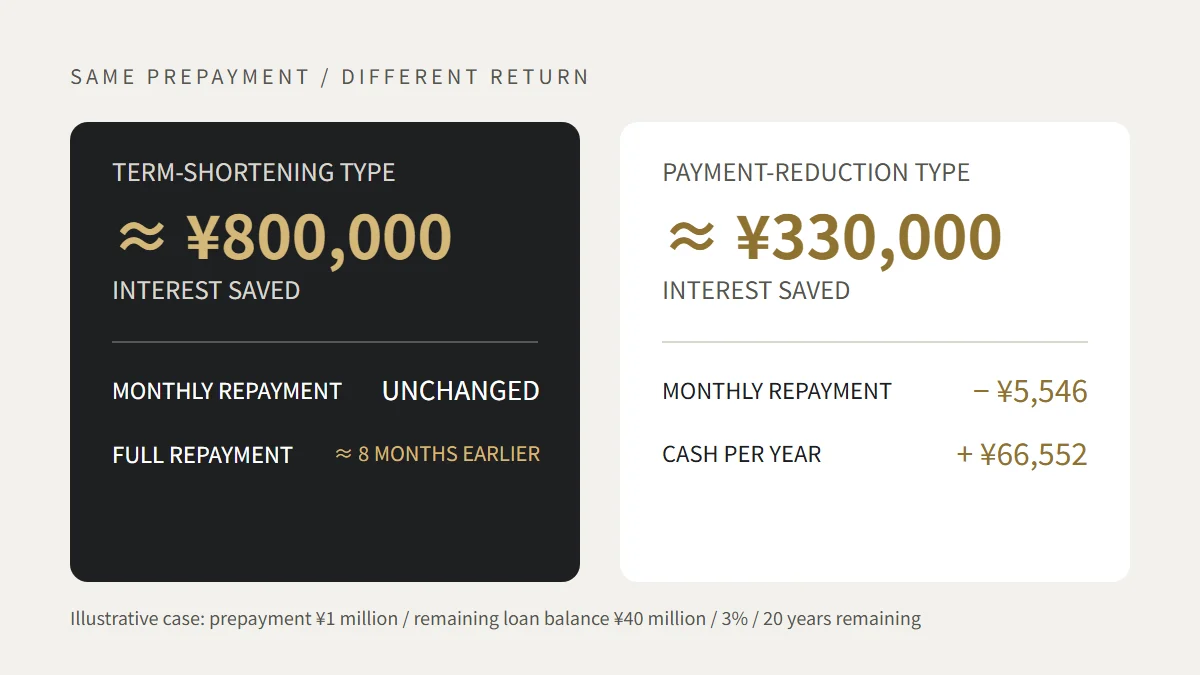
The repayment stays at ¥222,000. Full repayment comes about 8 months earlier, and in the end you save about ¥800,000 in interest.
If you lower the monthly payments
Full repayment stays 20 years away. The monthly repayment goes down by ¥5,546. Per year, that is ¥66,552. The interest you save in the end is about ¥330,000.
In total, it is not even a contest.
¥800,000 against ¥330,000. More than a 2-fold difference. If all you want is to reduce interest, there is nothing to hesitate over.
Then is there no point in lowering the monthly payments?
¥66,000 a year. A modest number.
But this comes in starting this year.
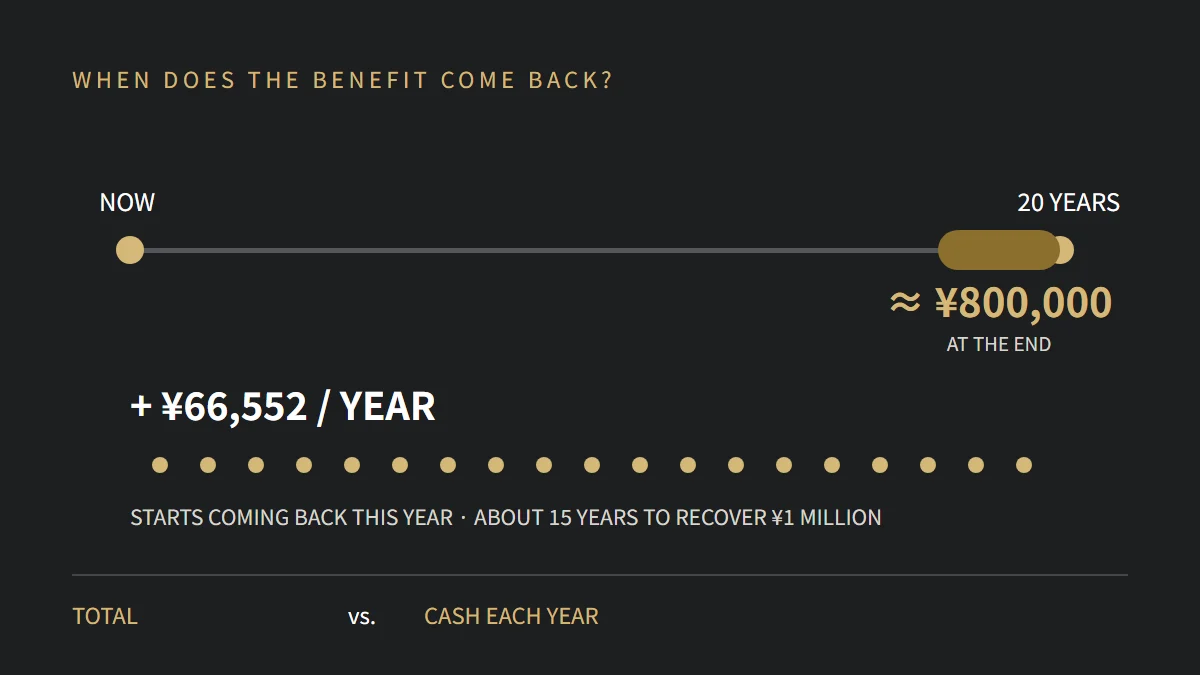
You put in ¥1 million, and ¥66,000 comes back every year. You recover the original amount after 15 years, which works out to recovering it at a pace of 6.7% a year.
This 6.7% is not a yield. It is a number that includes the return of principal. Even so, it is still true that your cash on hand grows thicker by that much every year.
With the method that brings forward full repayment, the benefit comes in the last 8 months. For the 19 years and 4 months before that, your monthly cash does not grow by a single yen.
In other words, with the same ¥1 million,
do you receive a large amount later, or receive a little at a time starting now?
That is the choice you are making.
Taxes are not a deciding factor here
Interest is an expense, so if you reduce it, your taxes go up. Then which method is kinder on taxes?
When I calculated it, the interest paid in the year after the prepayment was about ¥1.15 million when bringing forward full repayment, and also about ¥1.15 million when lowering the monthly payments.
Almost the same.
When you think about it, this is obvious. Whichever you choose, the remaining loan balance becomes ¥39 million. Interest is charged on the remaining loan balance, so it comes out the same. The only difference is the breakdown of the repayment amount.
Until I did the calculation myself, I too thought that bringing forward full repayment would be worse in terms of taxes. I was wrong.
So there is no need to bring taxes into it when choosing a type. What you should compare is the total and the yearly cash. Just these 2.
What will you use the ¥66,000 a year for?
Finally, I think this is where things divide.
If you lower the monthly payments and let the ¥66,000 you free up simply melt into living expenses, all that remains is the amount you lost on the total.
Put it toward a repair reserve, save it for the next down payment, or use it as a cushion in a year when a vacancy occurs. Only when there is a use for it does it become a story of closing the gap in the total.
And whether there is a use for it comes back to the same place as last time. Is your cash on hand thick or thin?
People with thick cash on hand have no particular need for ¥66,000 a year. In that case, it is more straightforward to go for the total and bring forward full repayment.
For people with thin cash on hand, ¥66,000 every year can mean more than ¥800,000 later.
That said, if your cash on hand is thin, there is also the option of keeping the ¥1 million rather than putting it toward prepayment. That part is up to you.
I like walking around supermarkets, and I go in even when I have nothing to buy.

I especially like looking at the commercial-size shelves, comparing the price per gram and being impressed. They are so cheap that buying the small packages seems foolish.
But I have rarely bought them.
Because they do not fit in my refrigerator.
That the unit price is cheap is a fact; I have no doubt about that. But whether something is cheap and whether I can buy it are probably separate questions.