
It can't be sold, so it doesn't fall
Comparing stocks and real estate by yield does not line up. Being hard to sell has a price, and it shows a different face 3 times: when you buy, while you hold, and when you sell. We take apart what is inside what gets called "defensive investment."

BENERU writes for readers who live in Japan. Taxes, loans and the other rules described here are those of Japan, and they assume a resident of Japan.
This page is a translation of the Japanese original. If the two differ, the Japanese original prevails.
Good day. I'm Nel Shikina.
With stock index investing available, why do people buy real estate?
It is a question that comes often. The answers that come back are usually a comparison of yields.
But that way of comparing does not line up. A stock's return is a future expected value that includes price gains; a real estate yield is today's rent divided by today's price. One is a forecast, the other an actual result. They are not on the same playing field.
So this time I will bring out one axis other than yield.
Ease of selling.
Being hard to sell has a price
"Being able to sell when you want to" looks like a good thing. It really is a good thing.
But good things carry a price.
Price is annual net income divided by the yield the market requires. If there are 2 things producing the same income and one is easier to sell, buyers will pay a higher price for that one. In other words, the yield they require becomes lower.
Let us line them up with net income of ¥3 million.
| Yield the market requires | Price |
|---|---|
| 4% (can be sold any time) | ¥75 million |
| 6% (takes several months to sell) | ¥50 million |
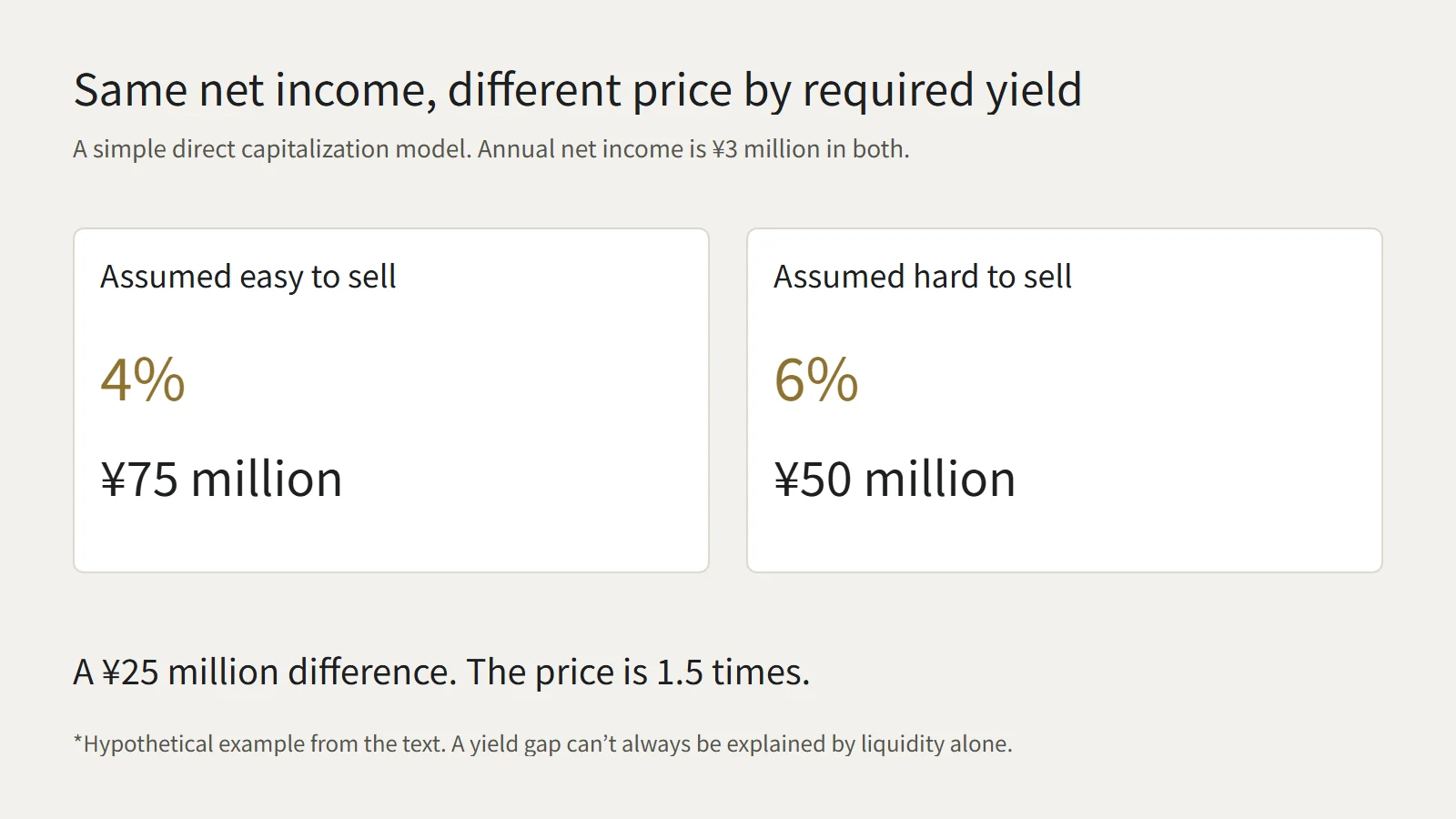
The same right to receive ¥3 million a year got a ¥25 million difference. That is 1.5 times.
What the difference consists of is not income. It is only whether it can be sold any time.
Let me split a word here.
Liquidity is not the kind of property where higher is simply better. It is a feature with a price tag. High liquidity is something you buy, and low liquidity is something you sell.
When real estate yields look higher than stock dividend yields, part of that difference is payment for taking on being hard to sell. That listed REITs trade at lower yields than physical property is the same logic, I think. They are bought higher by the amount that they can be sold every day.
Counting only "the yield is high" without noticing you are receiving a discount means seeing only half.
What being unsellable protects
This is the main point.
Listed stocks get a price about 245 times a year. As many as there are business days.
Getting a price also means being asked whether to sell. 245 times a year, the question comes. On days the price falls, the option of selling is right at hand.
Physical real estate does not get that question.
Its price moves every day, but you can't see it. Even if you decide to sell, it takes several months to get it valued, market it, negotiate, and reach settlement. Hold it 10 years, and you will face its price maybe 1 or 2 times.
This difference matters.
For the mistake of selling on a crash day and locking in a loss to happen, you need to be able to sell. It does not happen with something you can't sell.
I think this is one of the reasons it is called "defensive investment."
But look closely. What is protected is not the value of the asset. The value goes up and down just the same.
What is protected is the owner's hand.
The same trait shows a different face 3 times
Let me look at it from the opposite side once.
If being unsellable is good, is it better the harder it is to sell?
It is not. Because the very same trait changes direction depending on the situation.
When you buy: it becomes a discount. The ¥25 million from earlier is the reward for taking on being hard to sell.
While you hold: it becomes protection. Since you can't sell, you can't let it go in a panic.
When you sell: it becomes a liability. When you need cash, you can't necessarily sell at the time you need to.
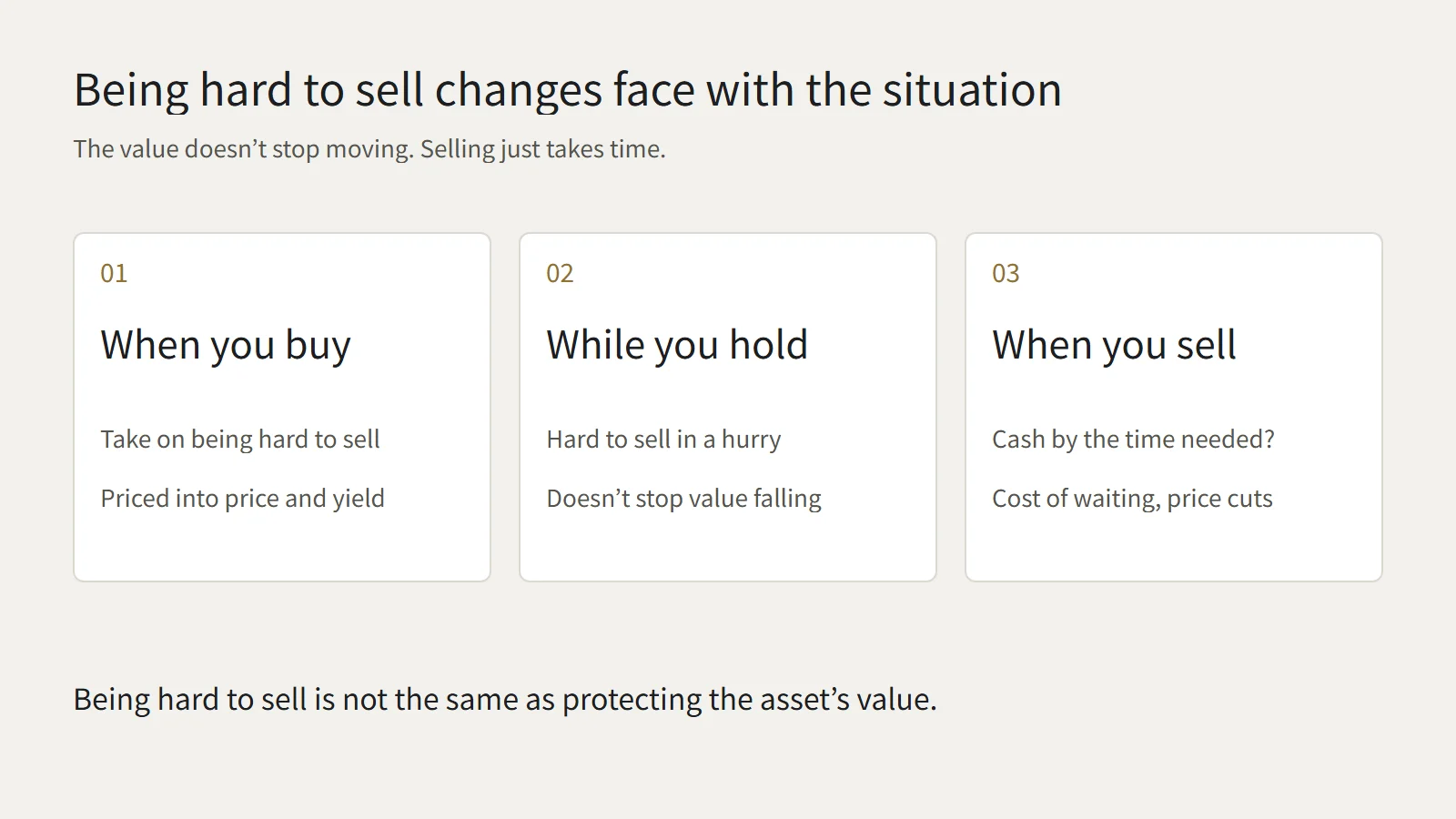
The third usually comes when your own circumstances change. An inheritance sets a deadline for paying tax. A business needs funds. Family circumstances shift.
In those situations, you pay back the discount you received when you bought, all at once. Lower the price and sell quickly, or wait until it sells. Both are costs.
In other words, the discount is closer to an advance you have taken than to something you were given.
What to check
Whether you already own or are about to buy, there are 2 things to lay out.
When, and how much, cash will you need? Write out the expenses whose timing you can see.
If you can't sell at that time, what will you do? Can you pay with other cash, sell at a lower price, or borrow?
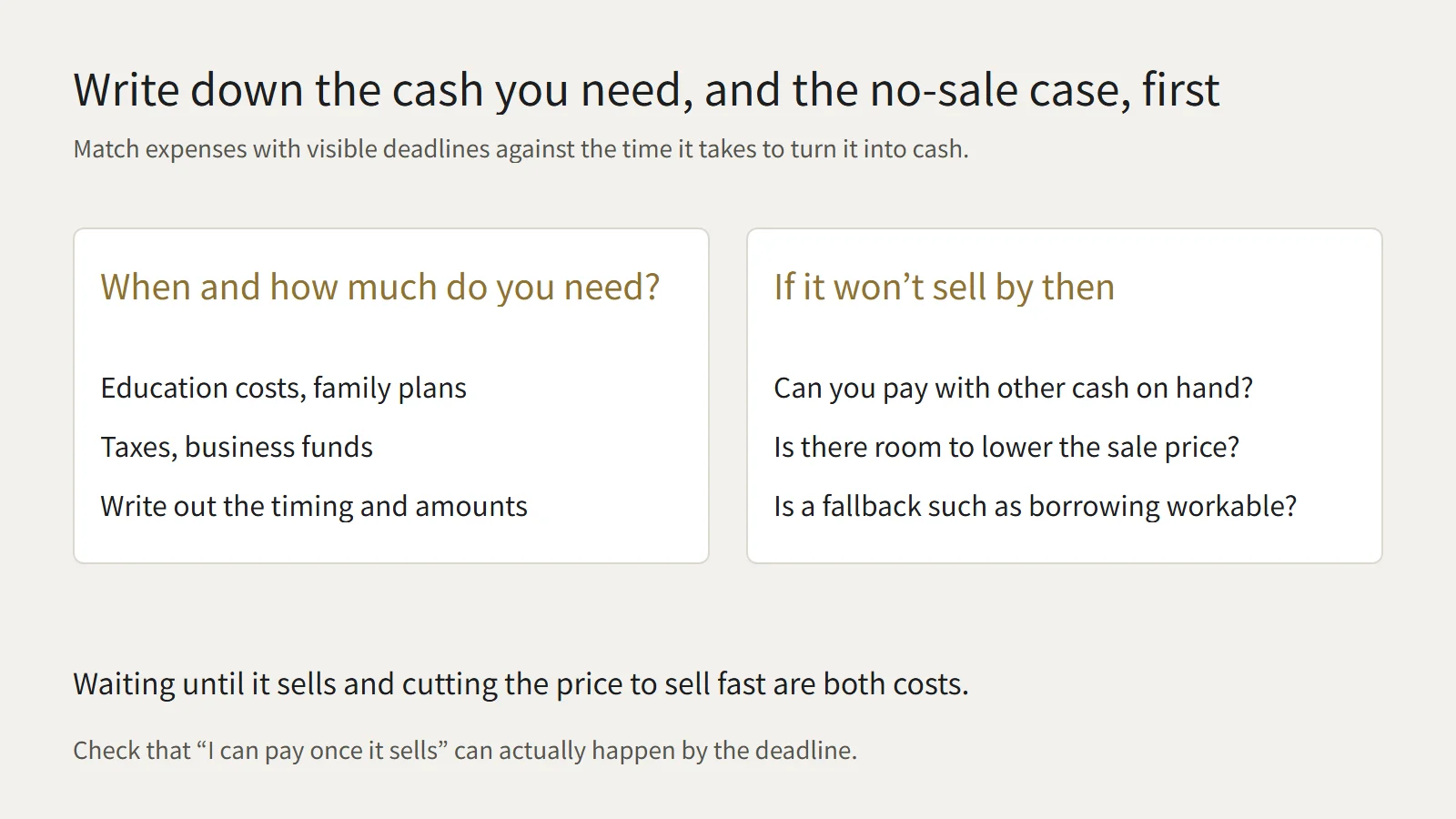
If these 2 are decided, being hard to sell becomes a trait you can take on. If they are not, it means you have not even noticed you received a discount.
What you received without noticing first appears as a bill at the moment you have to pay it back.
Hibernating animals cannot move during the winter.
Since they can't move, they don't go outside. If they don't go outside, they won't get lost on a snowy day or be found by something hungry. As a mechanism for protecting themselves, it is well made.
But what protects them is the burrow.
When the burrow itself collapses, being unable to move is no help at all.
Holding an asset that is hard to sell means standing in roughly the same place. You are protected from day-to-day misjudgments, but in exchange, you can't get out when you want to.
Which is better depends on what happens during the winter.
Since you can't decide after it happens, it comes down to deciding first.