
Credit does not accumulate
Cash accumulates, but the amount you can borrow does not. Even if your annual income does not fall, the limit shrinks just because you get older. Credit you did not use, and credit you used up. Both carry a loss you cannot see.

BENERU writes for readers who live in Japan. Taxes, loans and the other rules described here are those of Japan, and they assume a resident of Japan.
This page is a translation of the Japanese original. If the two differ, the Japanese original prevails.
Good day. I'm Nel Shikina.
I'll think about investing once I've saved up some money.
It is an order you hear often. It also makes sense. Moving after saving looks safer than moving with nothing in hand.
But while you are saving, there is something that is not growing.
To be precise, there is something that is shrinking.
Cash accumulates; credit does not
Let me put the word credit in its place once more.
It tends to be taken as the amount you can borrow. That is half right. But that amount does not pile up like savings.
What a lender looks at is your conditions today. Age, annual income, length of employment, employer, existing borrowing, funds on hand, room to repay. Next year, it is recalculated with next year's conditions.
The amount you could have borrowed last year is not stored anywhere.
Earlier, I talked about how an interest rate is decided not by the borrower's character but by an estimate of the probability of default. That was about unit price. This time it is something else: quantity and time limit.
Even with the same person's credit, how much the loan costs (interest rate), how much they will lend (limit), and over how many years you must repay (term) are each decided separately.
And the third one moves the first and second.
Even if your income does not drop by a single yen, the limit shrinks
This is what gets overlooked.
Many lenders set an upper limit on age at full repayment. This is a home loan example, but for the Japan Housing Finance Agency's Flat 35, the maximum loan term is published as the shorter of "80 minus your age at application" and "35 years." Financing for investment differs by product, but the structure itself, in which the maximum term is set by age at full repayment, is widely shared.
What happens when the term shrinks?
Even if the amount you can repay each month is the same, the total you can borrow goes down.
Let us calculate with an annual repayable amount of ¥2.4 million (¥200,000 a month), an interest rate of 3%, and equal principal-and-interest payments.
| Term available | Approximate borrowable amount |
|---|---|
| 35 years | ¥51.97 million |
| 30 years | ¥47.44 million |
| 25 years | ¥42.18 million |
| 20 years | ¥36.06 million |
| 15 years | ¥28.96 million |
Between 35 years and 25 years, the difference is ¥9.79 million. That is 19%. Between 35 years and 15 years, ¥23.01 million, 44%, disappears.
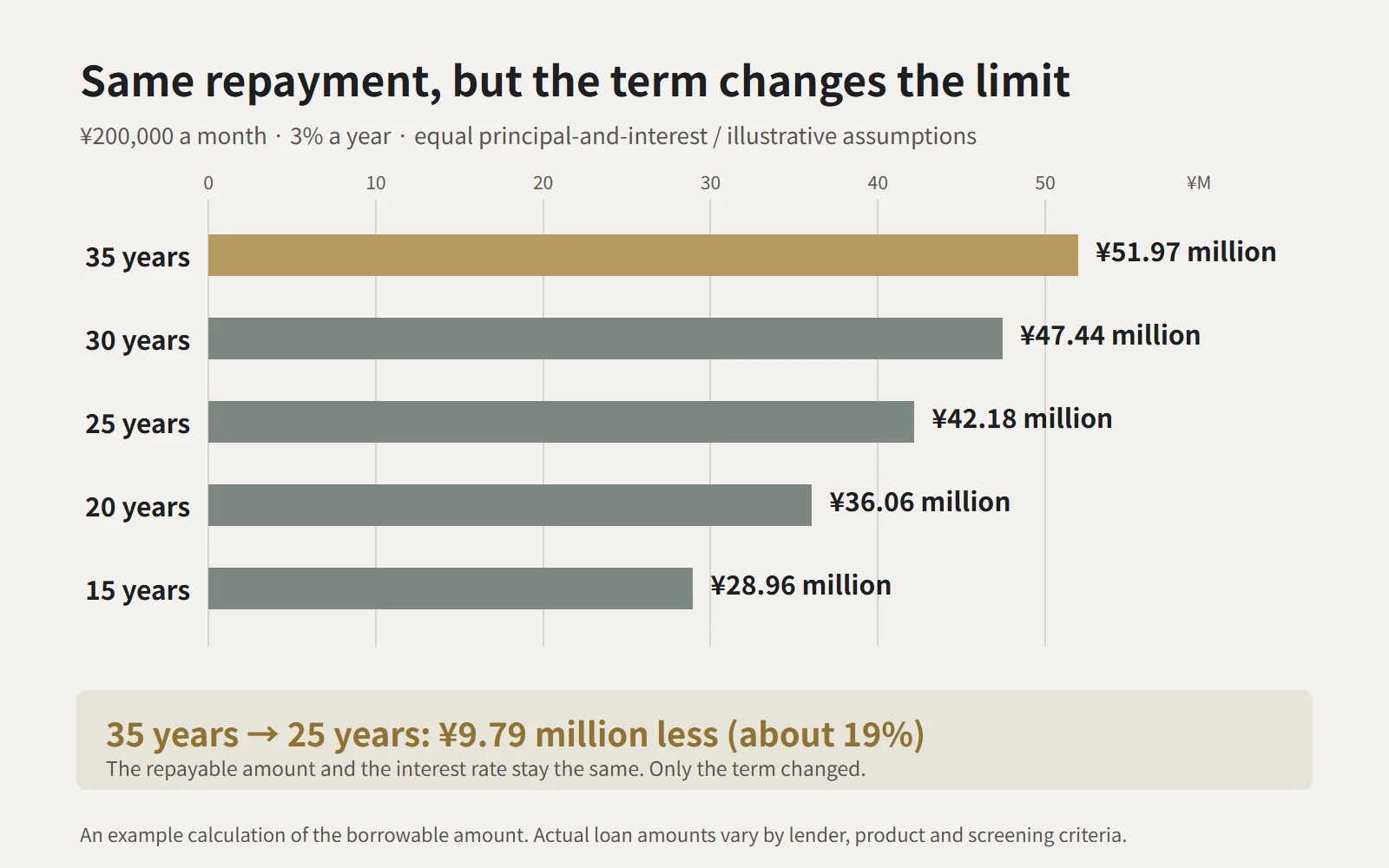
Annual income has not changed. Savings may even have grown. Even so, the limit has become smaller.
The only thing that changed was age.
While you are saying "once I've saved up," the side that accumulates and the side that shrinks are moving at the same time. If you only look at one side, you cannot notice this exchange.
Then should you use it early?
Let me look at it from the opposite side once.
If it disappears, is it better to use it before it does?
It is not. There are 2 reasons.
First. Using credit means taking on an obligation to repay. Using it only because it is about to expire is like buying something you don't need for a coupon close to its expiry date. What remains in your hands is not the discount but the item.
The second is harder to see.
The limit is exclusive.
If you use ¥40 million for investment, the limit for your own home shrinks by that much. The limit left when you start a business, when you need your child's school fees, or when you have to act for a parent's nursing care, has also become smaller by the same amount.
Credit is drawn from a single account. The moment you choose what to use it for, the other uses become the ones not chosen.
So the question stands like this.
Did the credit you did not use have no value?
This is a question often asked, but it is only one side. On the reverse side are the options blocked by the credit you used up.
Neither one sends a bill. Since none comes, neither is counted.
What remains are 3 questions
Borrow or don't borrow is too rough as a way to decide. Because it doesn't decide anything.
What you lay out are 3 things.
1. What will you use it for? If there is no purpose, the limit can stay a limit. There is no reason to move capital that has no use decided for it.
2. Until when can you use it? From the age at full repayment, subtract to find the term left to you as of today. It shows which row of the table above you are standing on.
3. If you use it, what can you no longer use? Housing, education, business, medical care. Write out the situations over the next ten years in which you are likely to need the limit.
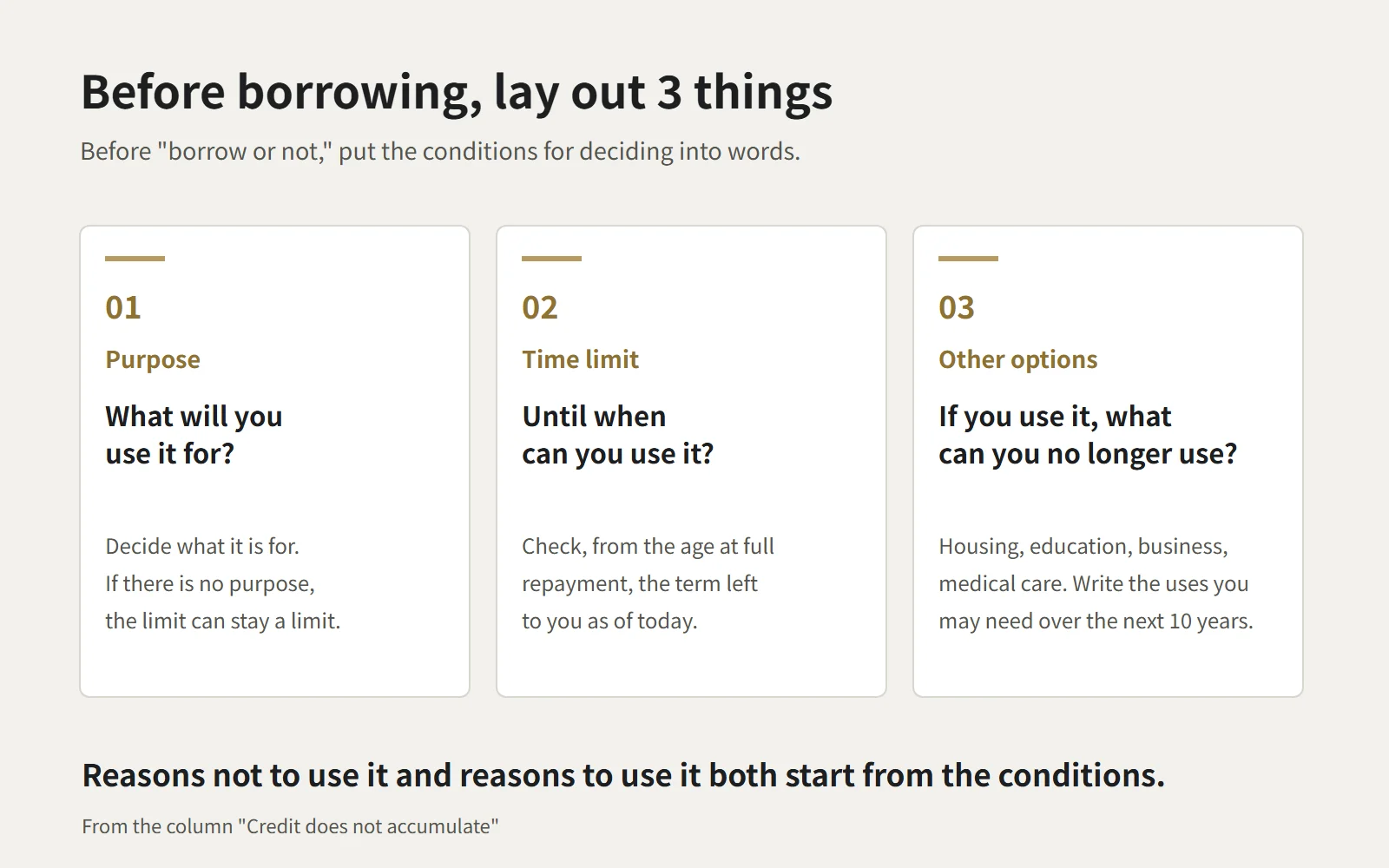
If these 3 are laid out, whether to borrow decides itself.
Stopping at "because it's debt" without laying them out, and moving because "it's a waste not to use it," are actually standing in the same place.
Neither has made a judgment yet.
With nelBS, which BENERU makes public, you can see side by side how net worth and cash flow move when you change the borrowing conditions. The data you enter is processed on your own device, and BENERU does not keep it. You can also do it on paper. What you lay out are the 3 above.
Suppose you plant a tree in a garden.
If you are going to plant, earlier is better. You get a longer time for it to grow, so that is right.
But there is only one garden.
The tree you plant first takes up space. The bigger it grows, the less room there is to plant another tree next to it. If you plant on "earlier is better" without deciding what you want to plant, there will be no place left for the tree you want later.
But if you wait until you decide, the season for planting ends first.
Speed, choice, and time limit. You are standing in a place where all 3 are moving at the same time, I think.
Is what you have only the cash you hold now?