
The interest rate is not attached to you
The same bank, on the same day, lends at 2.375% a year and at close to 15% a year. When you separate out what an interest rate is the sum of, you can see which parts the borrower can move and which parts they can't. What the gap between variable and fixed is the price of also comes out of that.

BENERU writes for readers who live in Japan. Taxes, loans and the other rules described here are those of Japan, and they assume a resident of Japan.
This page is a translation of the Japanese original. If the two differ, the Japanese original prevails.
Good day. I'm Nel Shikina.
When the talk turns to interest rates, it usually ends up at 2 things.
How to get it lower. Whether to choose variable or fixed.
Both are important questions, but before them there is something to look at.
What an interest rate is made of.
It is made of a sum of 4 parts
Seen from the lending side, an interest rate looks like this.
Funding cost + credit cost + expenses + profit
Funding cost is the price the bank pays to source that money. Whether it gathers it as deposits or borrows it from the market, it costs something.
Credit cost is the expectation of not being repaid. Lend to a hundred people and how many become unable to repay: everyone shares that estimate.
Expenses are screening, administration and branches. Profit is the bank's share.
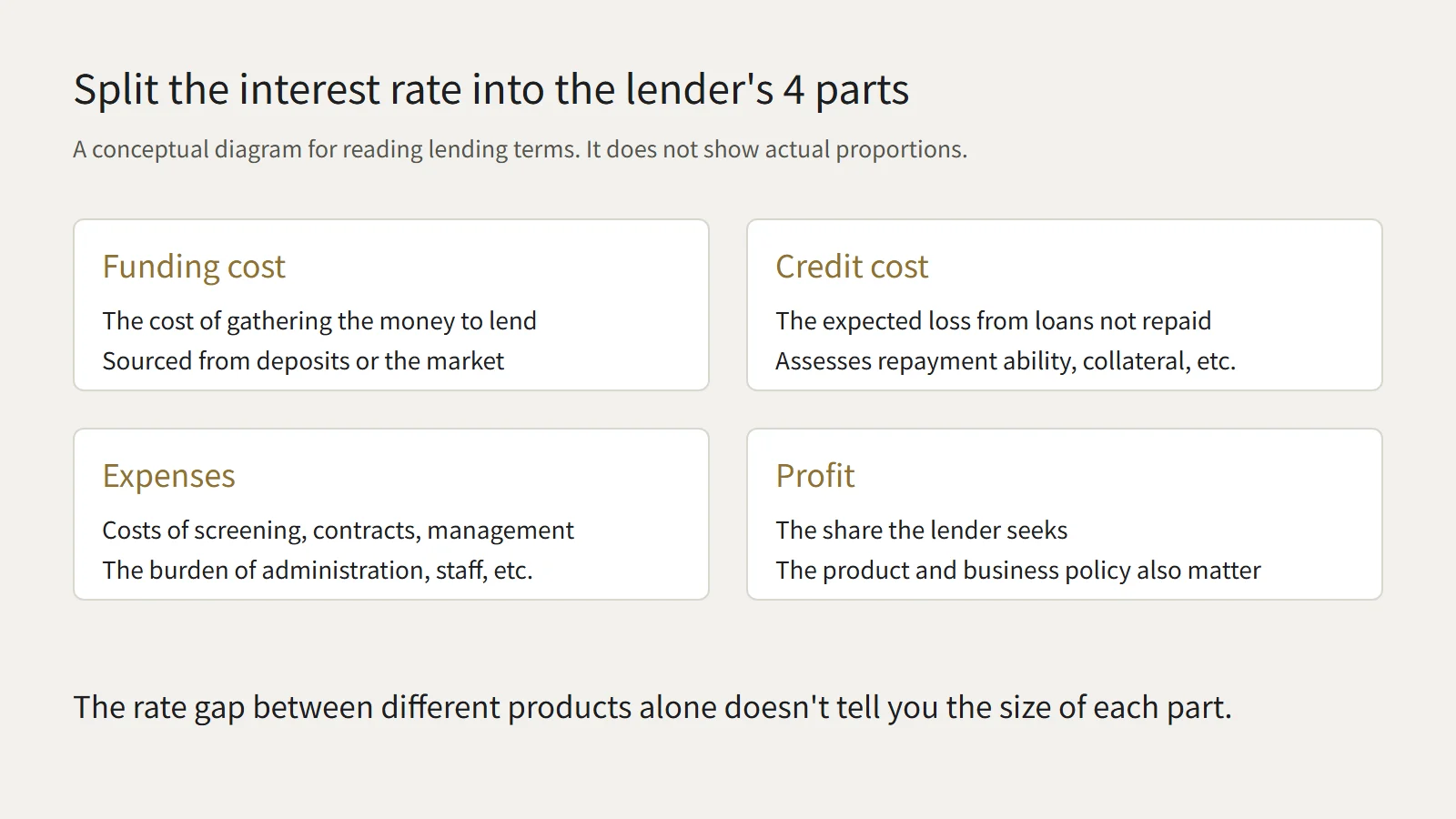
Of these, the only one the borrower can move is credit cost. The other 3 hardly change no matter who the borrower is.
The same bank, on the same day, lends at 6 times the rate
Let me put down the numbers.
The short-term prime rate is the benchmark for lending short-term to companies with the highest creditworthiness. From August 3, 2026, it is 2.375% a year (the mode among major banks).
Meanwhile, how high an unsecured card loan can go is set by law. Under the Interest Rate Restriction Act (Risoku Seigen Hō), for principal of ¥1 million or more, the cap is 15% a year.
The same bank, on the same day, lends to one side at 2.375% and to the other at close to 15%.
The difference is 12.625 percentage points. Of the 15% cap, 84% is this difference.
Funding cost does not change by counterparty. Expenses and profit differ by product, but they don't fill 12 points. So what does fill them?
Mostly credit cost.
Put another way, a considerable part of the interest paid on a card loan is for the people who become unable to repay. Those who repay bear the share of those who don't. As a system, that is how it works.
Let me split a word here.
Credit is not an assessment of character. It is an estimate of the probability of default.
So it can be lowered even without changing who you are. You put up collateral. Collateral is a device that replaces missing credit with a thing. The same person, with the same annual income and the same employer, borrows at rates more than 10 points apart depending only on whether there is collateral. That is because that is how the mechanism works.
Banks differ because their costs differ
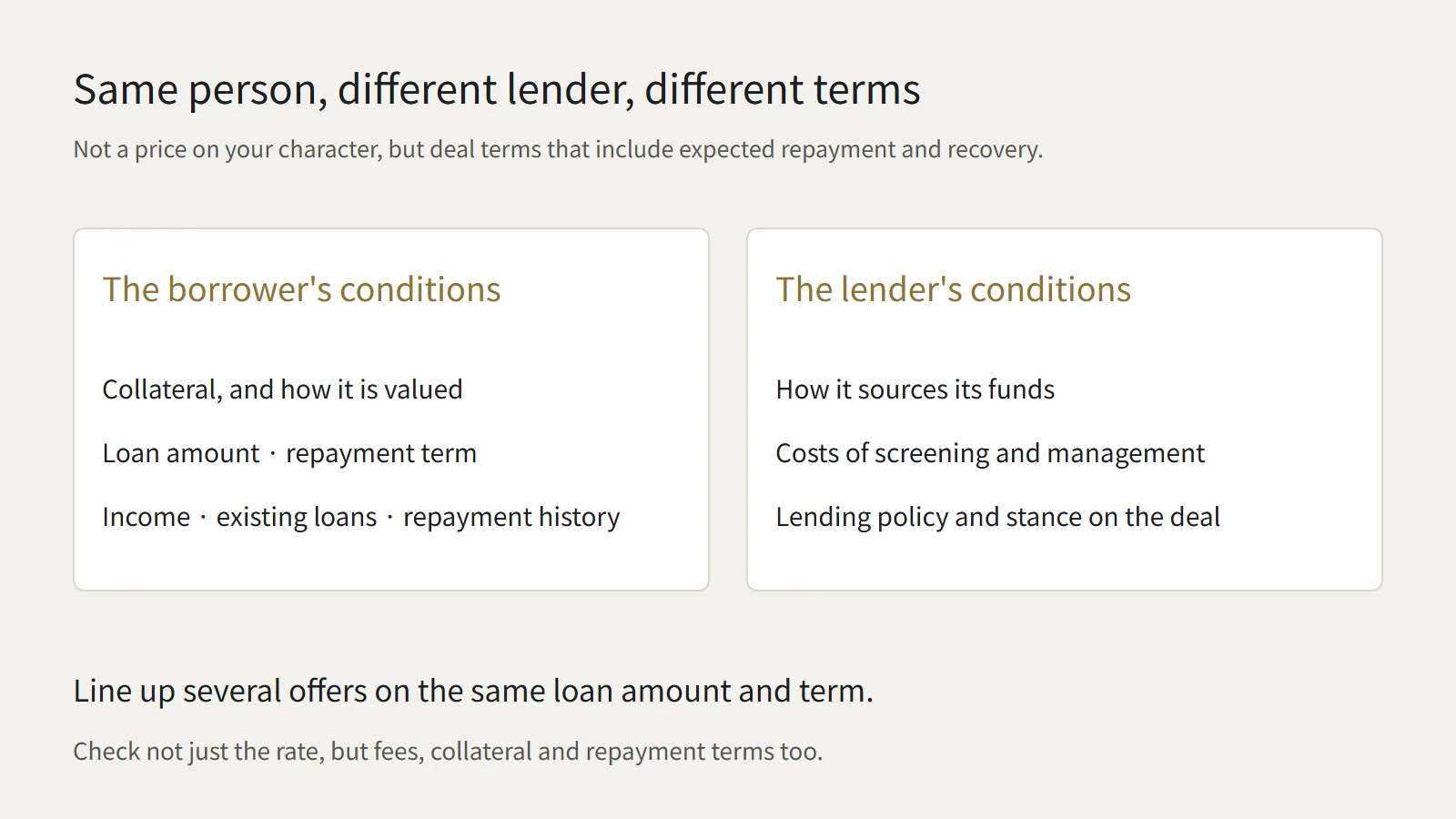
Even if the same person applies for the same property, the terms change depending on the lender.
What I hear most is "will it go down if I negotiate?", but that gets the order backward, I think.
Of the 4 parts from earlier, funding cost and expenses differ by bank. A bank with deep deposits can source money cheaply. With fewer branches and staff, expenses are lighter.
On top of that, how much that bank wants that deal matters. Does it want to grow lending in that area, or has it already lent too much in the same region? The borrower can't see this, but it shows up in the terms.
In other words, much of the interest rate gap comes not from the borrower's negotiating power, but from the lender's circumstances.
What to do is choose rather than negotiate. Put the same conditions to several lenders and line up what comes back. That difference is the difference in each bank's costs and circumstances.
The gap between variable and fixed is an insurance premium
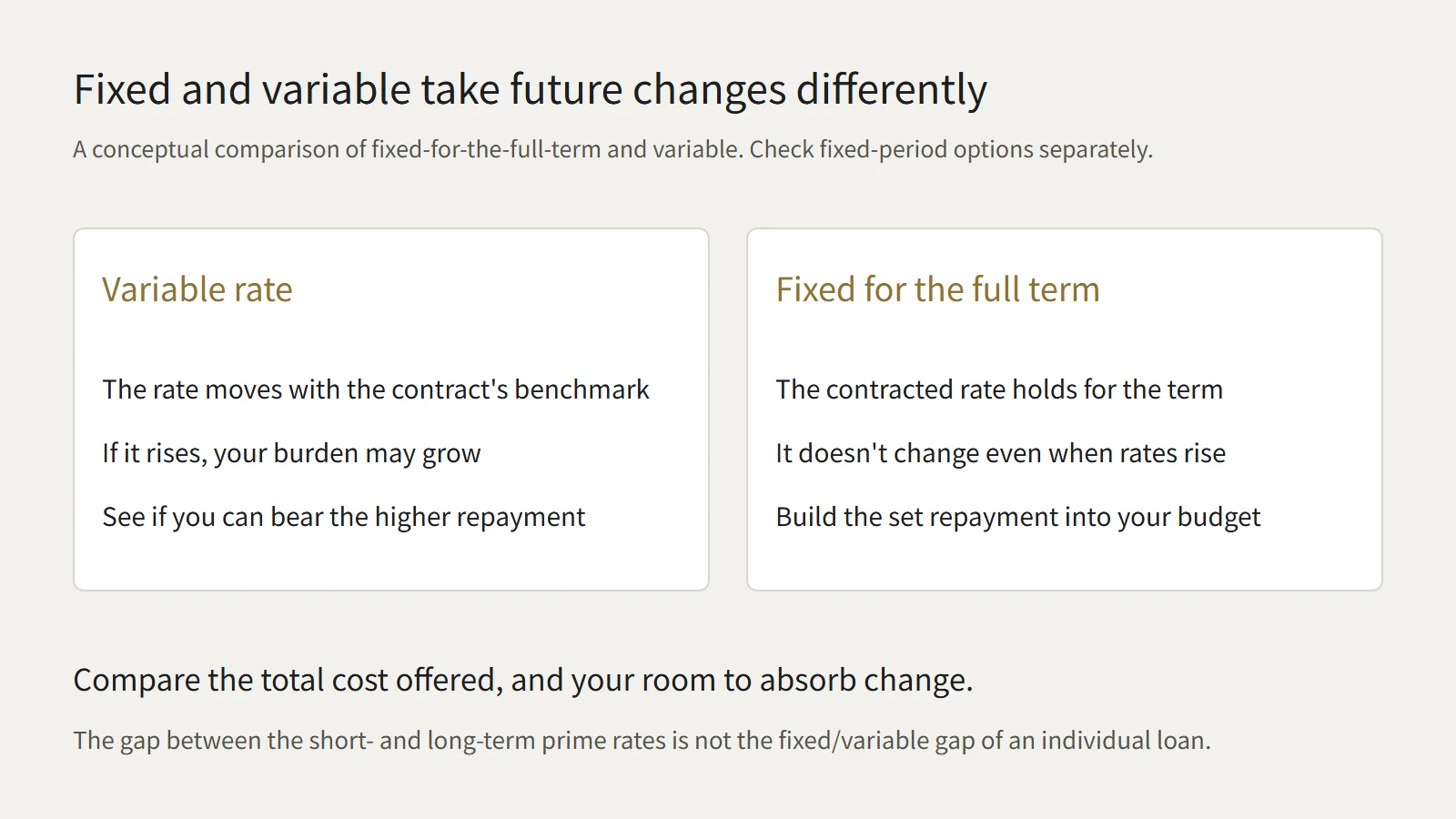
Variable rates are linked to the short-term prime rate. Fixed rates look at long-term market rates. Since they look at separate markets, their levels differ even on the same day.
- Short-term prime rate: 2.375% a year (from August 3, 2026)
- Long-term prime rate: 3.40% a year (from September 10, 2026)
The difference is 1.025 percentage points.
What is this 1 point the price of? It is the price of who takes the loss when rates rise.
With variable, the borrower pays the increase. With fixed, the bank takes it on. Fixed is higher because the bank holds that risk.
In other words, choosing fixed is the same as buying insurance. Looking at the gap in benchmark rates, the premium is about 1 point a year. Check the actual gap in each product's quoted terms.
If you borrow ¥40 million over 25 years, the annual repayment is about ¥2.12 million at 2.375% and about ¥2.38 million at 3.40%. The difference is ¥250,000 a year. That is the actual amount of the premium.
That many people choose variable means they are deciding not to pay this premium, I think.
The reverse side of deciding not to pay
Let me look at it from the opposite side once.
Is it better not to pay the premium?
Insurance looks like a waste if you don't use it. It only pays off when you use it. Which is better isn't decided until it happens.
But the premise is moving. The target for the uncollateralized call rate has been around 1.25% since September 24, 2026. Since 2024, it has been raised in stages. The short-term prime rate has been revised following it.
Choosing variable comes as a set with the judgment "I can withstand it if rates rise."
Whether you can withstand it is not decided by a forecast of interest rates. It is decided by how much a year you can pay out of your own pocket.
Choosing variable without working out that amount is not deciding not to buy insurance; it is just not having decided, I think.
At a shop you don't know, you can't run a tab.
As you keep going, you become able to. They remember your face and know you are someone who pays. But that is something built up at that shop. Go to the shop next door, and you start again as a first-time customer.
If someone vouches for you, you could probably run a tab even as a first-timer. What the shop looks at is not your character, but the likelihood it won't go uncollected.
Banks stand in the same place.
An interest rate is not your price but the price of that way of lending. What it is attached to is not the person, but the collateral, the term, and the relationship with the other side, I think.