
Does a 50-year home loan benefit the borrower or the lender?
A home loan with a 50-year loan term lightens the monthly repayment but increases the total interest. Assuming borrowing of ¥50 million at a 1% interest rate, this piece compares 35 years with 50 years and sorts out the borrower's options and the lender's aims.

BENERU writes for readers who live in Japan. Taxes, loans and the other rules described here are those of Japan, and they assume a resident of Japan.
This page is a translation of the Japanese original. If the two differ, the Japanese original prevails.
I answered a question like this on a Q&A site.
50-year home loans have appeared. If you start repaying at 30, you finish at 80. Will we still be healthy and working by then? What kind of repayment plan do people who borrow anyway have?
What should I answer? A repayment plan? That is already defined as a 50-year loan term, so that is the repayment plan.
Is it fair to say the core of the question is why anyone would be eccentric enough to take out a loan for as long as 50 years?
Is borrowing for a long time a disadvantage for the borrower?
With a loan as long as 50 years, what comes to mind by reflex is the interest burden of a long-term loan. From the consumer's point of view, you can suspect that lenders are cleverly getting people to take out long loans to earn interest.
However, when interest rates are low, long-term loans seem advantageous for consumers. Doesn't the benefit of time outweigh the interest burden?
Interest rates may rise from here, but if you borrow at a rate fixed for the full term, it stays at the rate when you borrowed. With a variable rate, it rises in step with the benchmark rate, so you should keep the 2 distinct. Even so, lenders cannot raise it as they please.
And rising interest rates probably also mean rising prices, so the real estate you bought would also rise in price.
Of course it depends on the property you buy, but with a conveniently located property in an urban area, it seems possible for the property's price to exceed the total borrowed.
If that happens, the negative net worth on the balance sheet is resolved, so it also seems that it is not miserable no matter how long the loan continues.
Lighter each month. Larger in total
The impression arises that still having a loan at 80 would be nothing but worrying, but the longer the loan term, the lighter the monthly payment, and the burden on the household budget would be small.
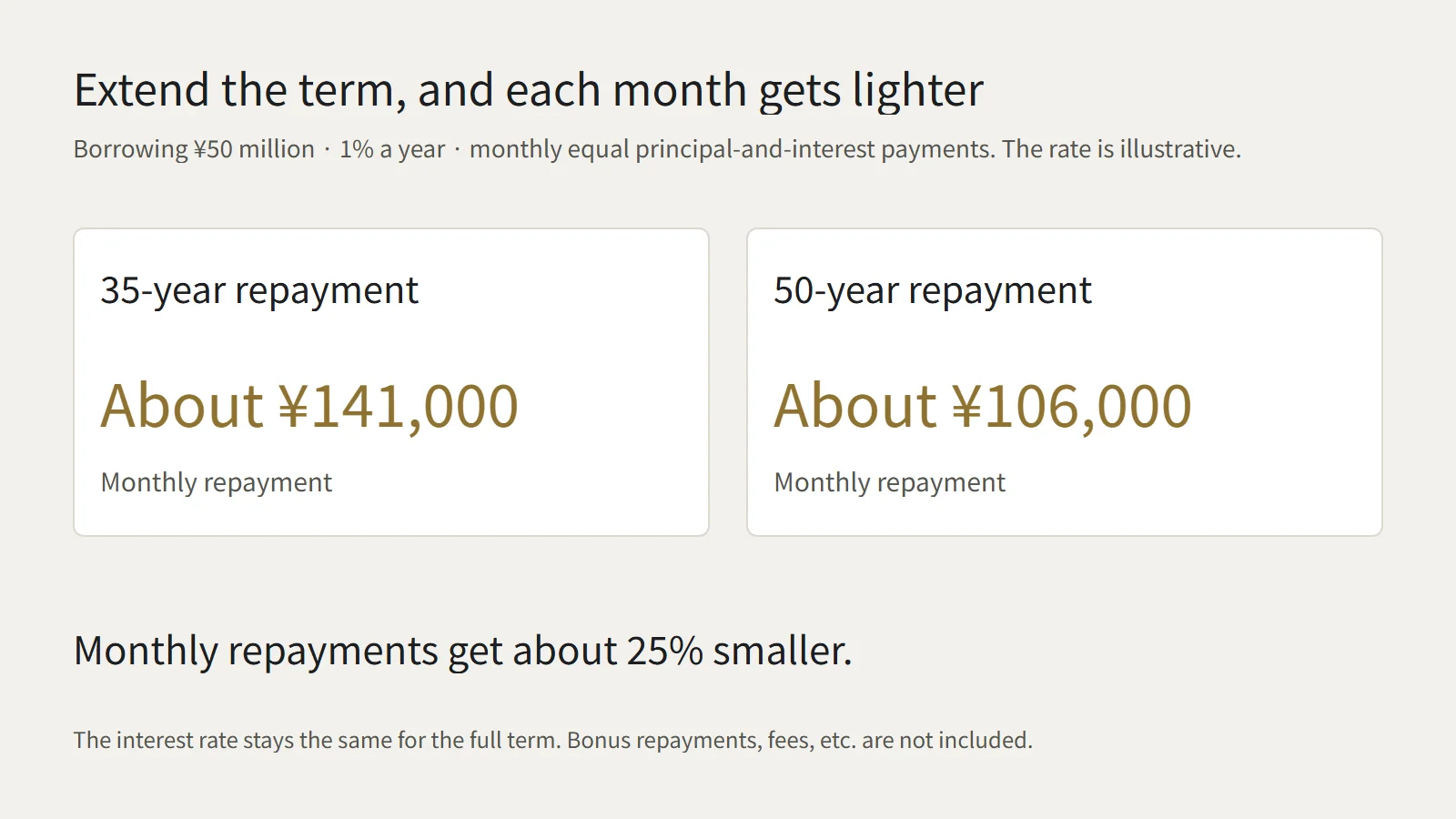
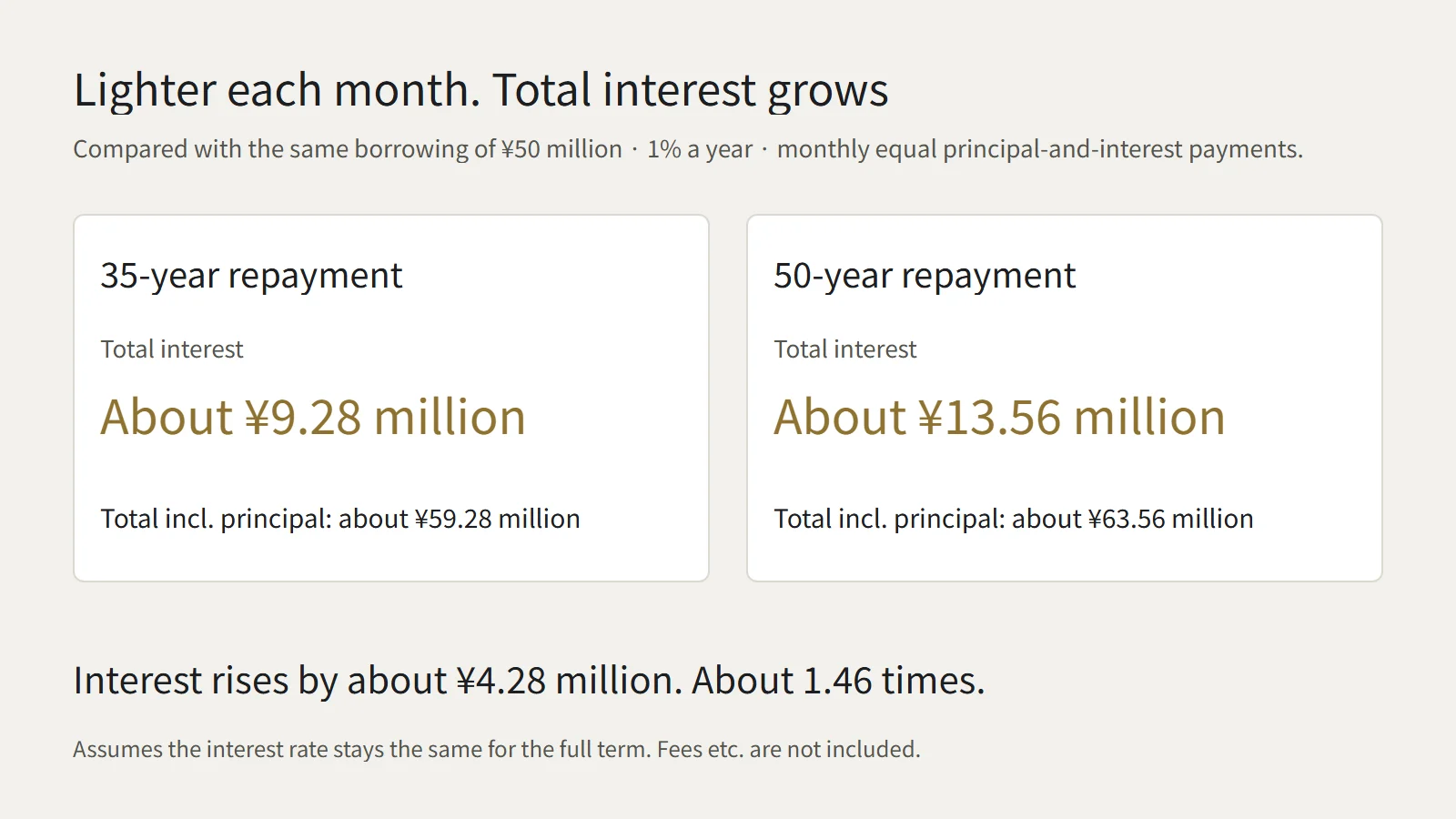
For example, borrowing ¥50 million at a 1% interest rate with equal principal-and-interest payments comes to about ¥141,000 a month over 35 years and about ¥106,000 a month over 50 years. Roughly 1/4 lighter. However, total interest increases from about ¥9.28 million to about ¥13.56 million. What gets lighter is the monthly amount, not the total.
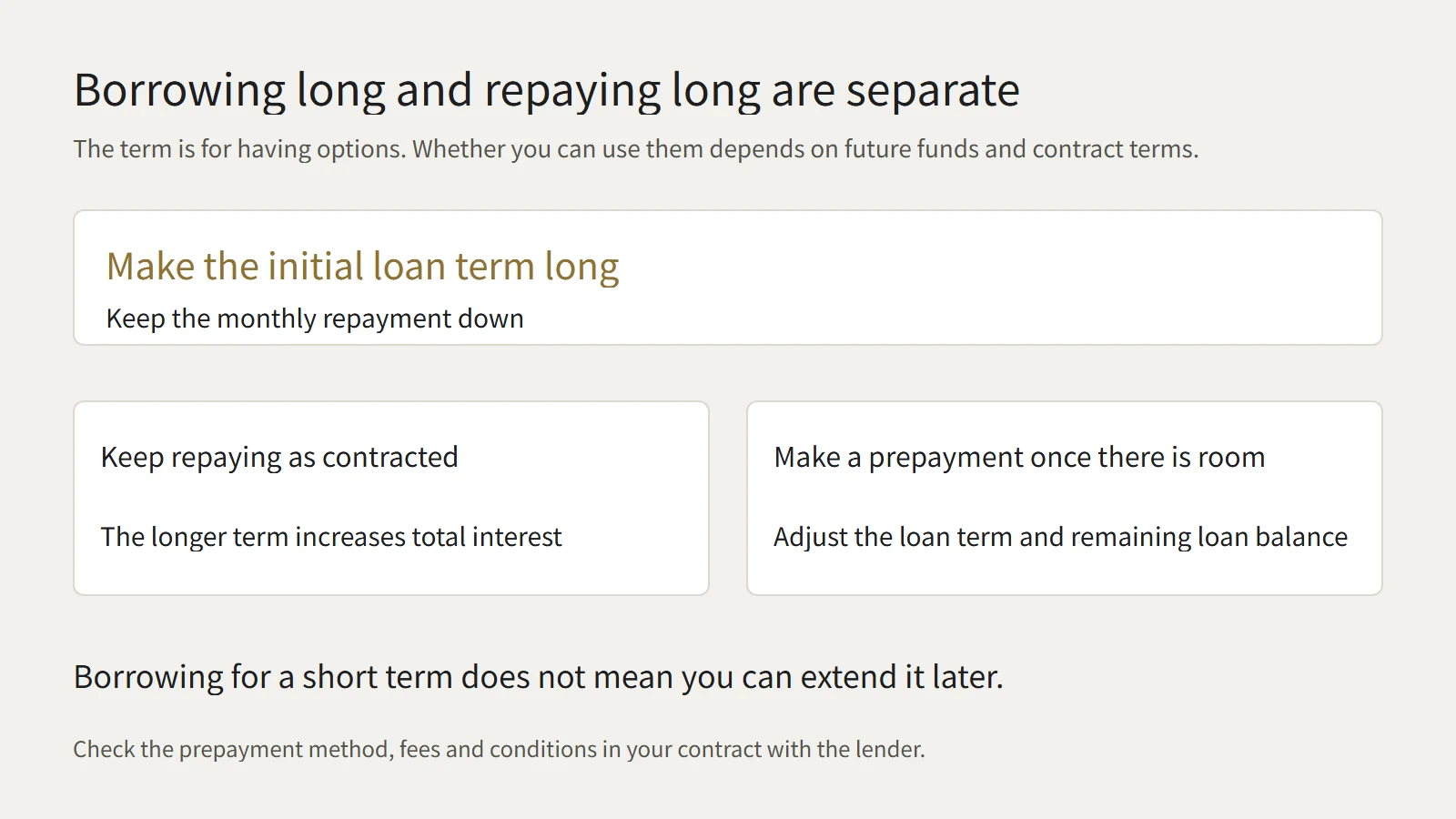
And as for long-term loans, you can adjust the remaining loan balance at any time by making a prepayment.
Asking later to turn a 30-year loan into a 50-year one is in principle not accepted, but the reverse is possible.
If you make a prepayment with your retirement allowance when you retire, no loan payments will be left in old age. It all comes down to the plan.
The lender's aim
You could say it is advantageous to consumers in that the options increase. Then I would like to consider what the merit is for lenders.
This is probably simply in the expectation that foolish consumers, if their monthly loan repayments get smaller, will borrow a lot = can buy even expensive properties.
With real estate prices rising, a large monthly burden is probably the consumer's bottleneck.
If you make it possible to buy without burden through a long-term loan, more people will take the plunge and buy, won't they?
A price you would hesitate at over 35 years becomes something you can reach for over 50 years. Of course, essentially it is somewhat in the mind, but it probably feels doable.
In conclusion, both sides have merits, so it comes down to how you think about it. I would like to recommend using it wisely.