
What does "if interest rates are low, a loan is better" actually mean?
When I tried to buy a car with cash in one payment, I was told "if interest rates are low, a loan is better." This piece explains what that means using a balance sheet and the "benefit of time." What creates the difference is how you use the cash after borrowing, and it also sorts out the point that investment gains are not certain.

BENERU writes for readers who live in Japan. Taxes, loans and the other rules described here are those of Japan, and they assume a resident of Japan.
This page is a translation of the Japanese original. If the two differ, the Japanese original prevails.
I came across a question like this on a Q&A site.
When I was going to buy a car with cash in one payment, a wealthy acquaintance told me, "Interest rates are low, so a loan is obviously better." What does that mean? I missed the chance to ask.
I'll write the answer first.
Because of the "benefit of time."
That acquaintance is assuming you invest.
Applied to your own balance sheet, while interest rates are low, increasing borrowing and putting your cash on hand into investments increases your net worth.
That is what they are saying.
Looking at the balance sheet
A balance sheet is a list of your assets and liabilities.
What people call "wealth" goes on the asset side.
Borrowing such as a home loan or a cash advance goes on the liability side.
And what remains after subtracting liabilities from assets is net worth.
Say you have ¥5 million in cash and buy a ¥5 million car.
Writing it as credits and debits is hard to follow, so here I will show them side by side.
If you buy with cash in one payment, the cash is replaced by the car.
If you take the car's value as ¥5 million, your wealth as a whole neither increases nor decreases.
What happens if you buy with a loan?
The ¥5 million in cash stays on hand, and the ¥5 million car is added to assets.
At the same time, a ¥5 million auto loan goes on the liabilities.
In every pattern, net worth stays unchanged at ¥5 million.
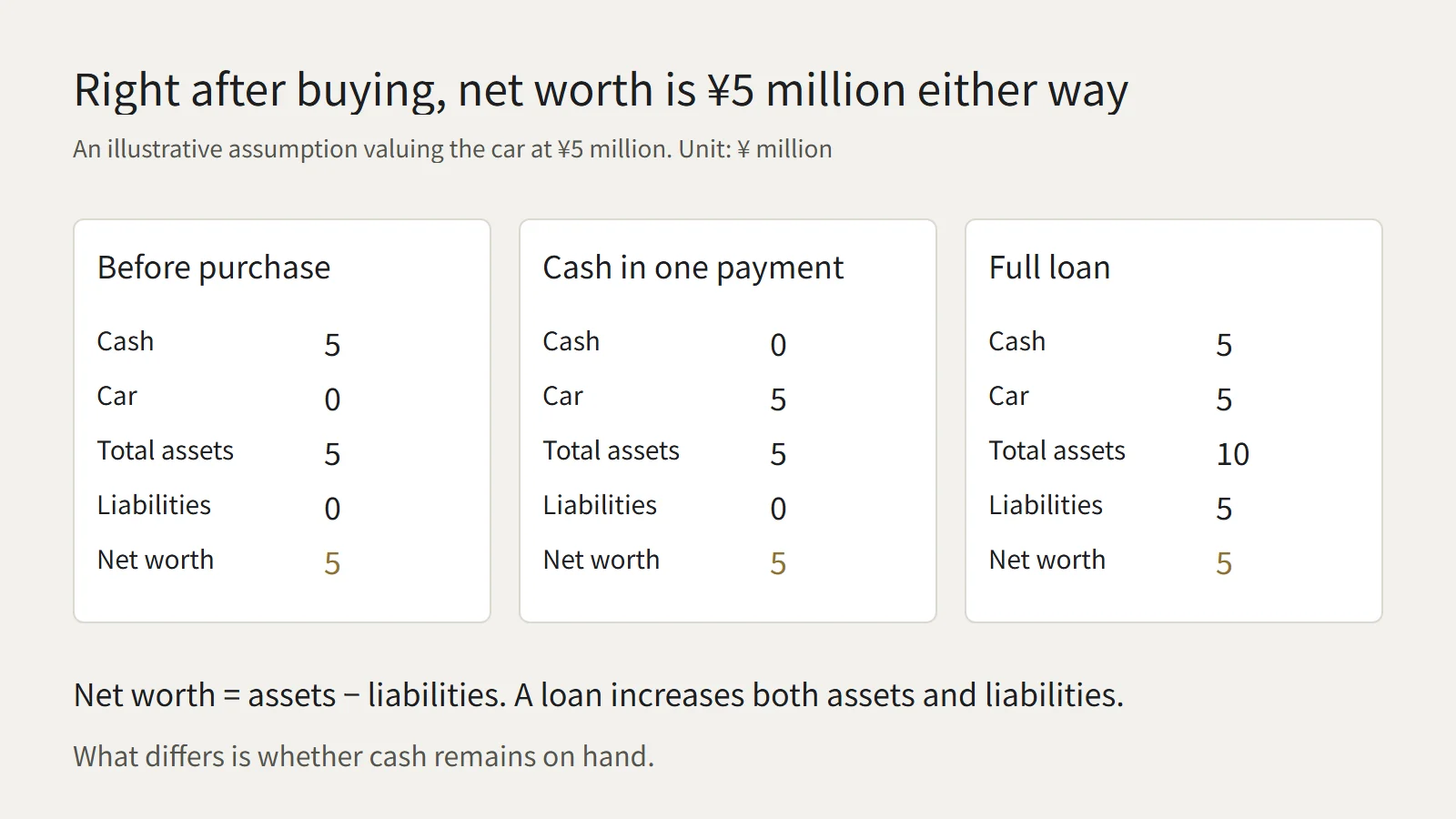
The reason it is "hard to understand" is that there seems to be no difference here.
A difference appears after 1 year
Now, let's think about 1 year later.
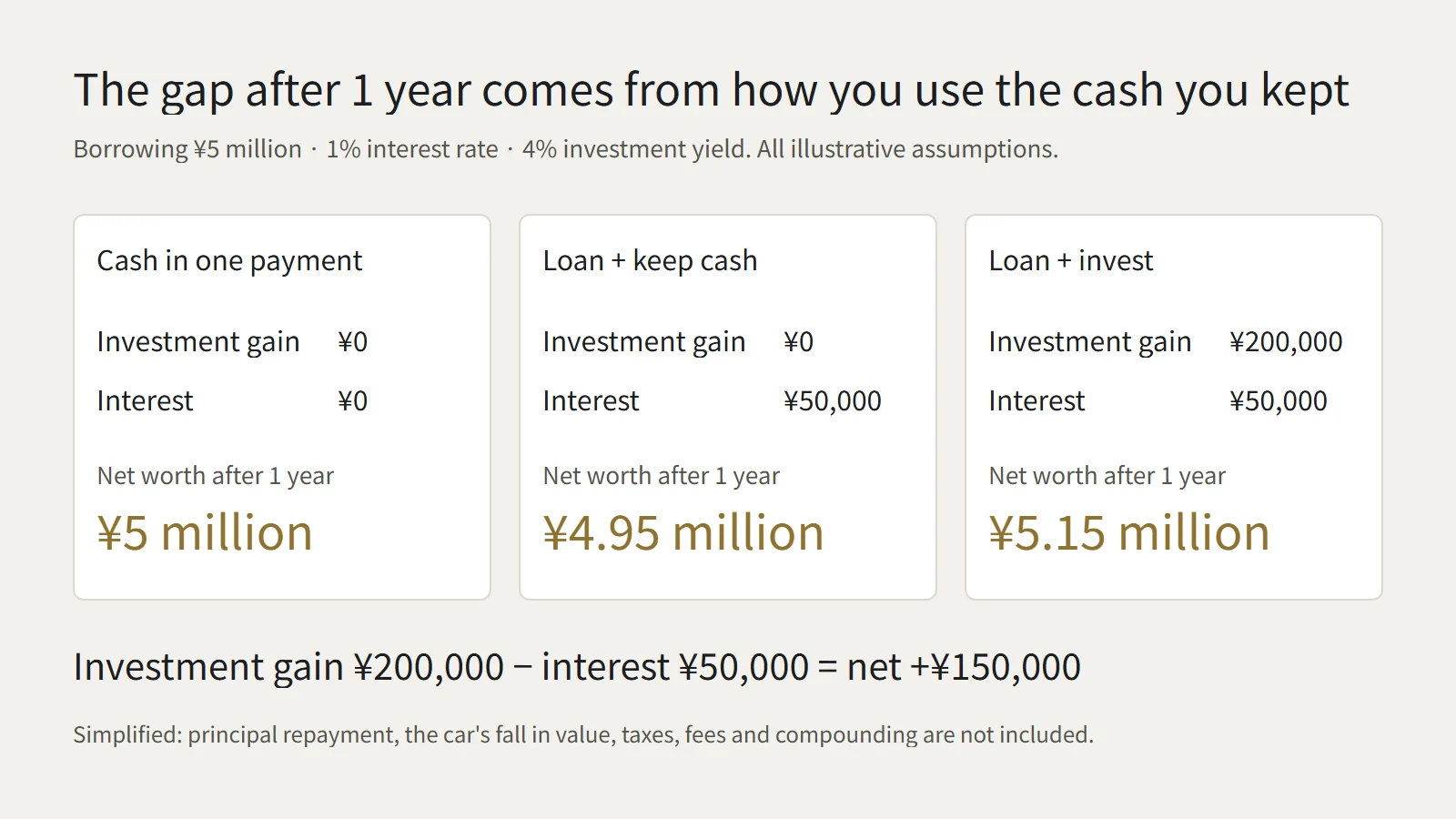
A loan carries interest. Suppose the auto loan's interest rate is 1%.
To keep things simple, treat it as making no repayment for 1 year.
Assume the car's value and the cash on hand stay the same.
Then net worth falls by the ¥50,000 of interest.
Then it would be better to buy with cash and not pay interest. Many people probably think so.
Next, consider putting the ¥5 million you kept on hand into investments.
With an average investment yield of 4%, the investment gain for 1 year is ¥200,000. Here too, I will not consider compounding.
How about that?
The ¥200,000 investment gain exceeds the ¥50,000 of interest, so buying with a loan increases net worth by ¥150,000 overall.
The reason it doesn't click when you compare at the time of purchase is that investment gains arise in the future.
Sending the payment into the future
You "send" the payment of ¥5 million for the car into the future.
By doing so, you can put the funds on hand into investments.
Through borrowing, the lender waits for repayment until the due date.
This is called the "benefit of time." The Civil Code presumes that a time limit is set for the benefit of the borrower (the obligor).
You should make use of this benefit of time to build assets.
That is what that acquaintance is saying.
I'll also write down the assumptions
This story has assumptions. I'll write down 2 of them.
First. Investment gains are taxed.
Profits on listed stocks and the like are taxed at 20.315%, combining income tax, resident tax, and the special income tax for reconstruction. For a profit of ¥200,000, the take-home amount is about ¥160,000.
Even so, it exceeds the ¥50,000 of interest. If you invest in a NISA account, investment gains are tax-free.
Second. Investment gains are not certain.
Interest is charged every year, but investments have years with losses too.
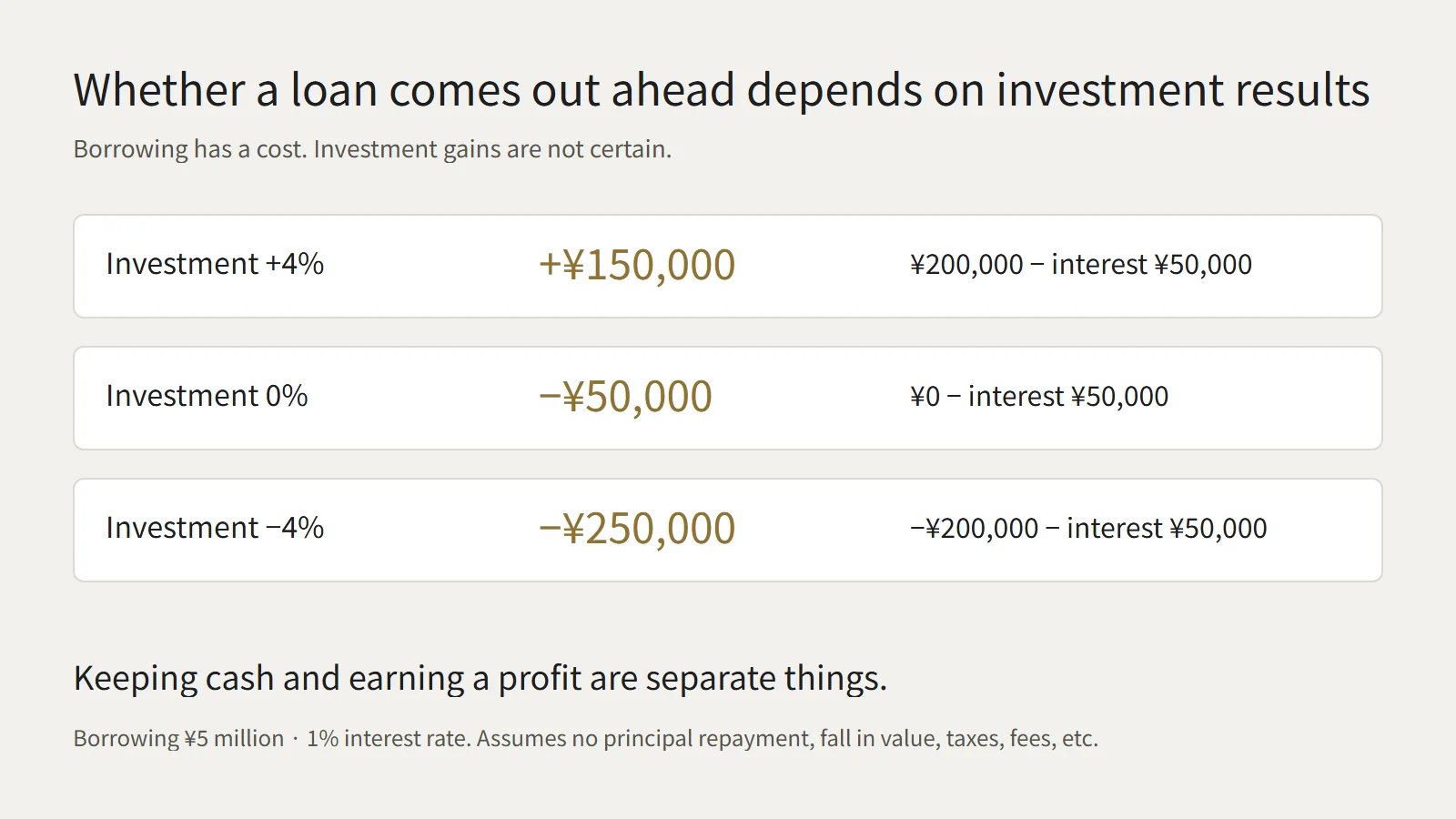
Keeping cash and earning a profit are separate things.
A loan comes out ahead only when you actually invest the cash on hand at a yield higher than the interest rate on the borrowed money.
The answer
Because, if you assume you invest, while interest rates are low, buying the car with borrowing and putting the cash on hand into investments at a yield above that interest rate increases your net worth.
The interest rate and investment yield here are assumptions for explanation. When you actually compare, please plug in your own loan's interest rate and the yield of an investment you can keep up.